The Monastery Mill stood on Wissahickon Creek at the foot of Kitchen’s Lane, by Monastery Avenue, in Roxborough — inside Wissahickon Valley Park today. The mill is gone; what stands is its farmstead: a three-story stone house built in 1747, a late-1700s barn, a millworker’s house built before 1848, a small barn, and a spring house — the five buildings the Friends of the Wissahickon call all that remains of Kitchens Mill, “a once thriving water-powered manufacturing center.”
The house is the building called the Monastery — the “Kloster” of legend, said to be a hermits’ house of the Kelpius circle. Scharf and Westcott debunked that in 1884: “There is no proof that Gorgas allowed his house to be used for monastic purposes.” It was a miller’s house.
The Gorgas ground
Before 1747 the ground passed from Johannes Gumre to his son, to Benjamin Shoemaker (1742), and to John Gorgas, who bought it in March 1747. The Stables history styles the buyer “John Gorgas Jr.”; Scharf and Westcott print plain John Gorgas; the reading here takes him for John Gorgas the eldest brother (c. 1710–1781). The two namings print as they stand.
In 1747 Joseph Gorgas (1715–1767), the miller brother, built the three-story stone house at his own cost — the recital stands in the 1752 deed, which conveyed half the ground to him. In 1761 he sold lot and house to Edward Milner, for £1,500 by the Stables account.
One claim about Joseph needs care: the Stables history says he “built… a paper mill” here. The claim is uncited, and FOW’s sequence puts a paper mill on this seat only by 1818 — over fifty years after Joseph sold. Joseph built the house; no record read credits him with a paper mill, and this story does not either.
Joseph’s will (December 14, 1766; proved January 10, 1767) styles him “Miller” of Germantown and names no real property.
Peter Care’s flour mill
By deed of March 17, 1775, Edward Milner — the deed styles him “Miller” — and his wife Susanna sold Peter Care, a miller of Bristol Township, land on the Wissahickon with a mill and messuage — a house with its ground — for £2,950. Even the acreage comes down in two readings, and they stand unreconciled.
Care then bought shares in a neighbouring mill: an undivided fourth of a grist and saw mill from Mary Wood on April 13, 1776 (£575), and another from Paul Engle on April 30 (£225) — a half share in all. The parcel card links that fractional mill to this seat; the deeds do not say so, and the link prints as the card’s, not as deed text.
In Jones’s 1779 list of Roxborough’s eleven mills, Care’s stood eighth; its 1781 tax valuation ranked at the top of the township, alongside Livezey’s — the exact figure was not read in the record, a gap printed as one.
Care’s paper trail holds one strange survivor: a sixty-day note for $1,594.67, signed January 10, 1795, payable to his son-in-law Henry Pratt. Pratt passed it to Joseph Rittenhouse; $1,200 (£450) was paid by March 26, 1795. Forty-four years later it turned up as evidence in Levering v. Rittenhouse — a miller’s debt preserved inside somebody else’s lawsuit.
In the Direct Tax of 1798, Care appears twice as an owner with other men in occupation — neither entry identified with the mill seat, and neither printed here as the mill.
The break, and the sale of 1804
In August and September 1803, Care assigned his estate to creditors — handed his property over to be sold for his debts. Poulson’s named the assignees, John Miller Jr. and Thomas W. Francis, and directed that the accounts of “Care and Wilson” be settled with them. Who Wilson was, no record read says; no cause is stated.
Care died in early 1821; his own story is told in this site’s Historical Figures collection.
The assignees’ advertisement (Poulson’s, March and April 1804) is the fullest picture of the seat that survives: an 84-acre estate with a three-story stone dwelling of eleven ceiled rooms and a full farmstead, and “a large stone merchant mill-house … with two water wheels, and between ten and eleven feet head and fall, four pair of mill stones, three of which are good burrs, six boulting cloths” — plus a new corn kiln and storage for upwards of six thousand bushels. A merchant mill buys grain and sells flour, where a country grist mill only grinds the neighbours’ grain; bolting cloths sift flour, and burrs are the prized French millstones — four pair of stones and six bolting cloths made this a flour business, not a neighbourhood grist mill. Buyers were directed to apply to Thomas Lloyd, or to John and Joseph Livezey — the Glen Fern millers, acting in the sale of the mill a mile below their own.
A Livezey, then the Kitchens
The Stables account says a Livezey bought the seat in 1805 and names “John Livezey.” The name is unverified and uncited, and the 1805 deed sits in the paper records — so this story prints “a Livezey bought in 1805” and builds nothing on it. The chain resumes: Brock and Hart (1841), Elizabeth Wiest (1843), her heirs. In 1852 William Gordon Kitchen bought the seat. McElroy’s directories carry the firm as “Kitchen Wm. & Son, woolen manuf., Monastery av” (1855–57); Freedley (1857) lists “Kitchen, Wm. & Son, Wissahicon, Jeans and cassimeres” — woolen cloths. His own story is told in this site’s Historical Figures collection.
Two Kitchens stand in the record just before the purchase, and they must not be merged. The census of 1850 shows “Gordon Kitchen,” 29, a manufacturer, in Roxborough household 174 — immediately after household 173: an older William Kitchen, 55, also a manufacturer, also England-born. When the older William died in 1865, his estate inventory appraised a $2,000 note of W. G. Kitchen’s and a $12,000 mortgage from him — $14,000 in all: mill-purchase money. But their kinship is unproven in every record read: the elder William Kitchen (died 1865) is not William Gordon Kitchen, and this story does not merge them.
In 1860 he stands as a manufacturer with $32,000 in real estate and $7,000 personal estate; by 1870 he was a “Retired Manufacturer” with $27,000 in real estate, nine months before his death. No count of his mill’s workers or output survives in any record read: the ward’s 1860 census of manufactures was not read, and the 1870 schedules hold no Kitchen entry and no woolen mill under any name — a permanent gap.
Five trades on one seat
FOW’s sequence counts at least five trades here: saw mill, grist and corn mill, paper mill by 1818, flax and twine mill, and — under the Kitchens from 1852 — a woolen mill. Two gaps print plainly: no record read names the paper-mill operator of 1818, and none names who ran the flax and twine mill.
The surveys
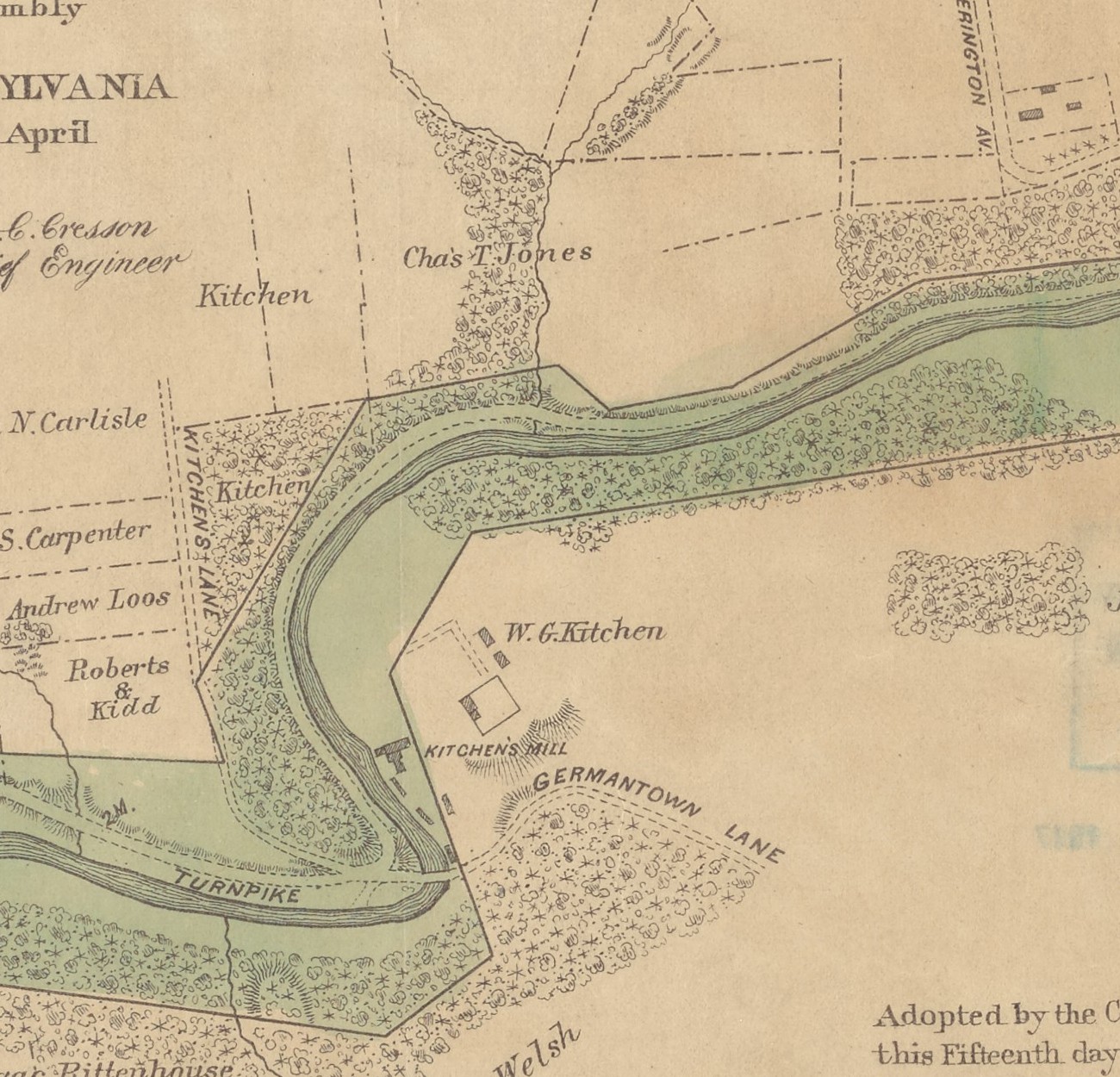
William Cresson’s survey of the valley (1868–69) draws “Kitchens Mill” standing, dam and race and all — under the owner label “W. G. KITCHEN” — the owner’s own initials, agreeing with the directories and every other record read.
A Hexamer index entry names a “Willow Glen Mill — Owner: Kitchen, William Gorden,” but the plate is lost and the index’s location field is blank. Whether Willow Glen was this mill under another name, or a second Kitchen mill, no record read settles; the question stays open, exactly as the record leaves it.
The end
The Kitchen family sold the mill property to the Fairmount Park Commission in 1873, and the house property in 1898. The year before the mill sale, the Commission’s Fourth Annual Report renewed the drive grades “from Kitchen’s Mill to near the toll house” — the seat was landmark enough to anchor the park’s own road contracts.
No demolition year was found in anything read; the mill was gone after the 1873 sale, under the park’s pattern of demolition and dereliction, and the farmstead survived because the family kept the house property until 1898. The millworker’s house outlived the mill and kept its people — FOW records that it “was later occupied by workers from the Gorgas/Kitchen’s Mill.” Their sentence stands as the seat’s epitaph: the five surviving farm buildings are “all that remains of Kitchens Mill.”
The one image that can be shown
No photograph or drawn portrait of the mill building was found in any source read. What can be shown is the survey drawing above — the seat as the city’s surveyors recorded it in 1869, dam and race and all. The Hexamer plate that might belong to this mill — “Willow Glen Mill” — is lost; only its index entry survives. And the well-known photograph of the Monastery shows the miller’s house, not the mill: it illustrates Joseph Gorgas’s story in the Historical Figures collection, and is not used here as the mill’s picture.
Timeline
| Year | Event | Source |
|---|---|---|
| 1742 | Benjamin Shoemaker holds the ground | Monastery Stables, “History of the Monastery” |
| March 1747 | John Gorgas buys the ground | Scharf & Westcott, History of Philadelphia (1884), from Jones’s 1859 notes |
| 1747 | Joseph Gorgas builds the three-story stone house | The 1752 deed recital, via the Stables history |
| 1761 | Joseph Gorgas sells lot and house to Edward Milner (£1,500) | Monastery Stables, “History of the Monastery” |
| January 10, 1767 | Joseph Gorgas’s will proved: “Miller” of Germantown, no real property named | Will Book O, p. 85 |
| March 17, 1775 | Milner sells Peter Care the mill and messuage for £2,950 | Deed Book I 14, p. 279 |
| April 1776 | Care buys two undivided fourths of a neighbouring grist and saw mill (£575 and £225) | Deed Book I 16, p. 209 |
| 1779 | Care’s mill stands eighth of Roxborough’s eleven | Jones, in The Levering Family (1858), p. 187 |
| January 10, 1795 | Care signs the sixty-day note for $1,594.67 to Henry Pratt | Levering v. Rittenhouse, 4 Whart. 130 (Pa. 1839) |
| 1798 | Care appears twice in the Direct Tax as owner, others in occupation | U.S. Direct Tax, Roxborough |
| August–September 1803 | Care assigns his estate to creditors | Poulson’s American Daily Advertiser |
| March–April 1804 | The assignees advertise the seat: 84 acres, the merchant mill-house specified in full | Poulson’s, March 28–April 2, 1804 |
| 1805 | A Livezey buys the seat (the Christian name unverified) | Monastery Stables, “History of the Monastery” |
| By 1818 | A paper mill works on the seat; its operator is named in no record read | Friends of the Wissahickon, “The Monastery” |
| 1841–1843 | Brock & Hart hold the seat, then Elizabeth Wiest | FOW and Stables accounts |
| 1852 | William Gordon Kitchen buys the seat | Friends of the Wissahickon, “The Monastery” |
| 1855–1857 | “Kitchen Wm. & Son, woolen manuf., Monastery av” | McElroy’s directories; Freedley (1857) |
| 1860 | W. G. Kitchen, manufacturer: $32,000 real estate, $7,000 personal estate | U.S. Census, Ward 21 |
| 1865 | The elder William Kitchen dies; his inventory holds W. G. Kitchen’s $2,000 note and $12,000 mortgage | Estate inventory of William Kitchen |
| 1868–69 | Cresson’s survey draws “Kitchens Mill,” owner label “W. G. KITCHEN” | Cresson survey of the Wissahickon |
| 1872 | The Park Commission renews the drive grades “from Kitchen’s Mill” | Fairmount Park Commission, Fourth Annual Report |
| 1873 | The Kitchen family sells the mill property to the Fairmount Park Commission (the house property follows in 1898) | Friends of the Wissahickon, “The Monastery” |