
In 1775, Peter Care bought the grist mill at the Monastery site on Wissahickon Creek in Roxborough Township. The mill stood at what is now Kitchen's Lane and Monastery Avenue, inside Wissahickon Valley Park. Care ran it for thirty years, until 1805. A grist mill grinds grain; a merchant mill makes flour for sale beyond the neighbourhood. Care's was both — and a substantial merchant flour mill at that.
His record is deeds, tax lists, a court report, and newspaper notices — no portrait, no memoir. Read together, they show a miller whose operation topped Roxborough's tax list during the Revolutionary War, whose credit moved through his merchant son-in-law into the Rittenhouse paper-mill family, and whose mill and 84-acre estate were advertised in detail when his affairs were wound down. They also correct a persistent temptation: Care was a grist and flour miller, never a paper-maker. A paper mill appears at his old seat by 1818, thirteen years after he sold it, its operator unnamed.
The deeds: a mill bought in 1775, shares added in 1776
The purchase deed has been read. On March 17, 1775, Edward Milner — the deed spells the surname "Miller" — and his wife Susanna conveyed to Peter Care, miller, for £2,950, land on the Wissahickon with a mill and dwelling house. Milner was the Roxborough grist miller immediately before Care; the property had earlier belonged to Joseph Gorgas, whose religious community gave the site its name.
Two more deeds followed in 1776. On April 13, Mary Wood conveyed Care an undivided fourth part of a grist and saw mill and its tract on Wissahickon Creek in Roxborough for £575; on April 30, Paul Engle conveyed him another undivided fourth of the same mill and tract for £225. Care's documented share reached one half within six weeks. The deeds style that mill a grist/saw mill — it ground grain and sawed timber — and Care simply "miller."
One of Roxborough's eleven mills
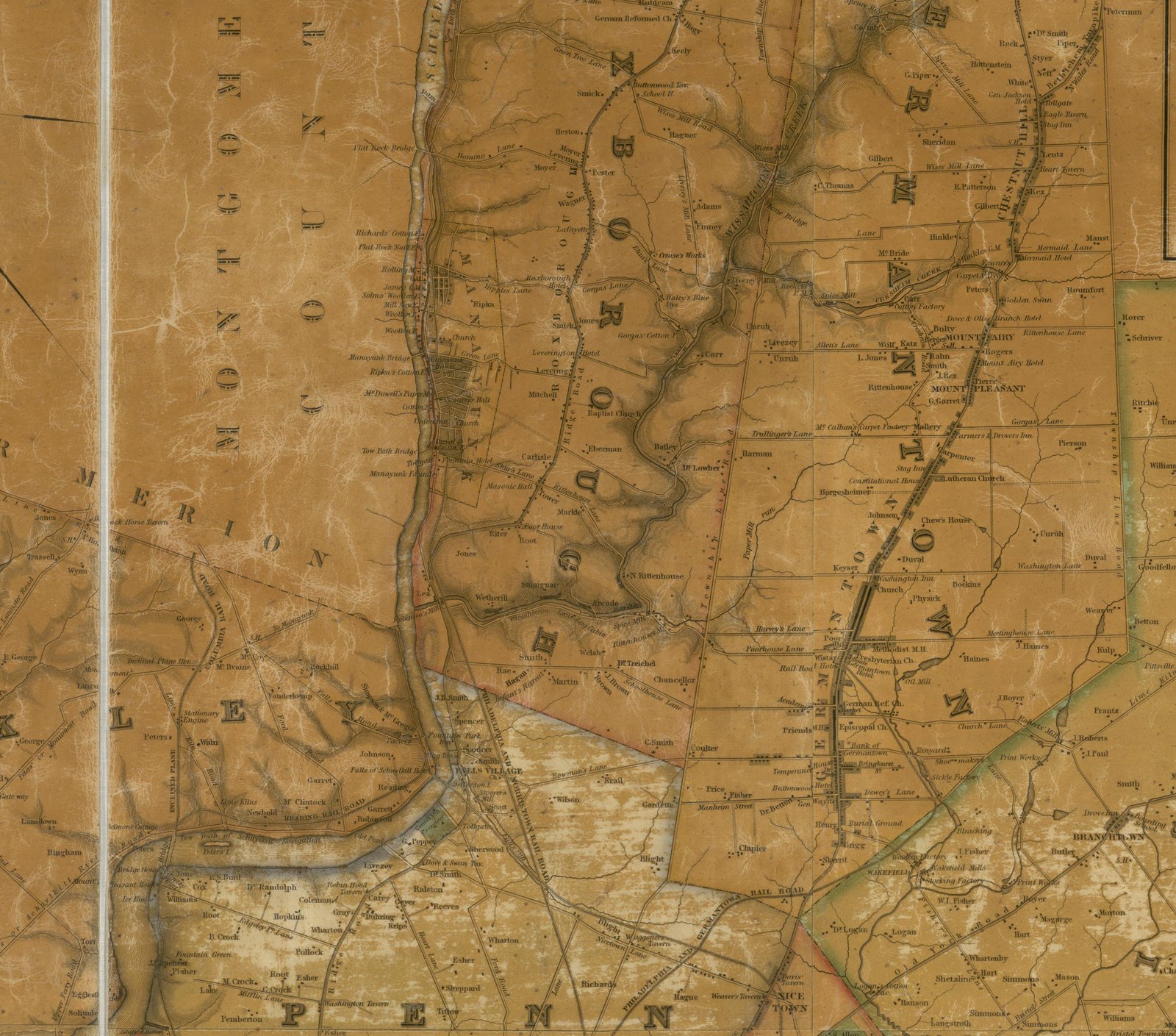
Roxborough in Care's years was a mill township. A list in Horatio Gates Jones's The Levering Family counts eleven Roxborough mills in 1779, nine on the Wissahickon. Care's grist mill was eighth — one water-powered workplace among grist mills, a paper mill, a fulling mill, and an oil mill along the same creek.
In the township's 1781 tax list, Care's mill valuation stood at the top of Roxborough, alongside Livezey's and ahead of Thomas Rees's £989. His own exact figure has not been extracted from the printed list, so this article prints the ranking, not a number: mid-Revolution, the assessors rated his operation among the township's two most valuable.
The first United States census, in 1790, records Peter Care as head of a Roxborough household of eight: two free white males of sixteen and upward, four under sixteen, and two free white females. The schedule gives no occupation. (A city merchant named Peter Care, and a Peter Care Jr., appear in Philadelphia records of the same years; they are not this man on the evidence found.)
A soldier in two militia placements
Care's military record is documented, but it does not reduce to one tidy company line. The federal VA Veterans Legacy Memorial describes his service as "Continental Line" — that wording is the memorial's.
The contemporary county records give two placements, printed here unharmonized. The Philadelphia County lieutenants' pay accounts (Third Series, Pennsylvania Archives) place Peter Care in Capt. Matthew Holget's militia company, on the company's Fourth Class roll and a company list, with money entered against his name. A muster roll (Sixth Series, vol. 1, p. 939) instead places Peter Care, Fourth Class, in Capt. John Levering's company, Sixth Battalion.
A third record, read on November 12, 2026, is his Military Abstract Card (Pennsylvania Archives, RG 13.50): CARE, PETER, inactive-duty militia, Lieutenancy of Philadelphia, 2nd Battalion, Capt. Matthew Holget's company, 4th Class, on the authority of the Return of the 1st–5th Classes, 1777 — the Holget placement again, under a different battalion number — with its own caution printed on it: the basic record does not prove active duty.
Clothes stolen from the miller's house
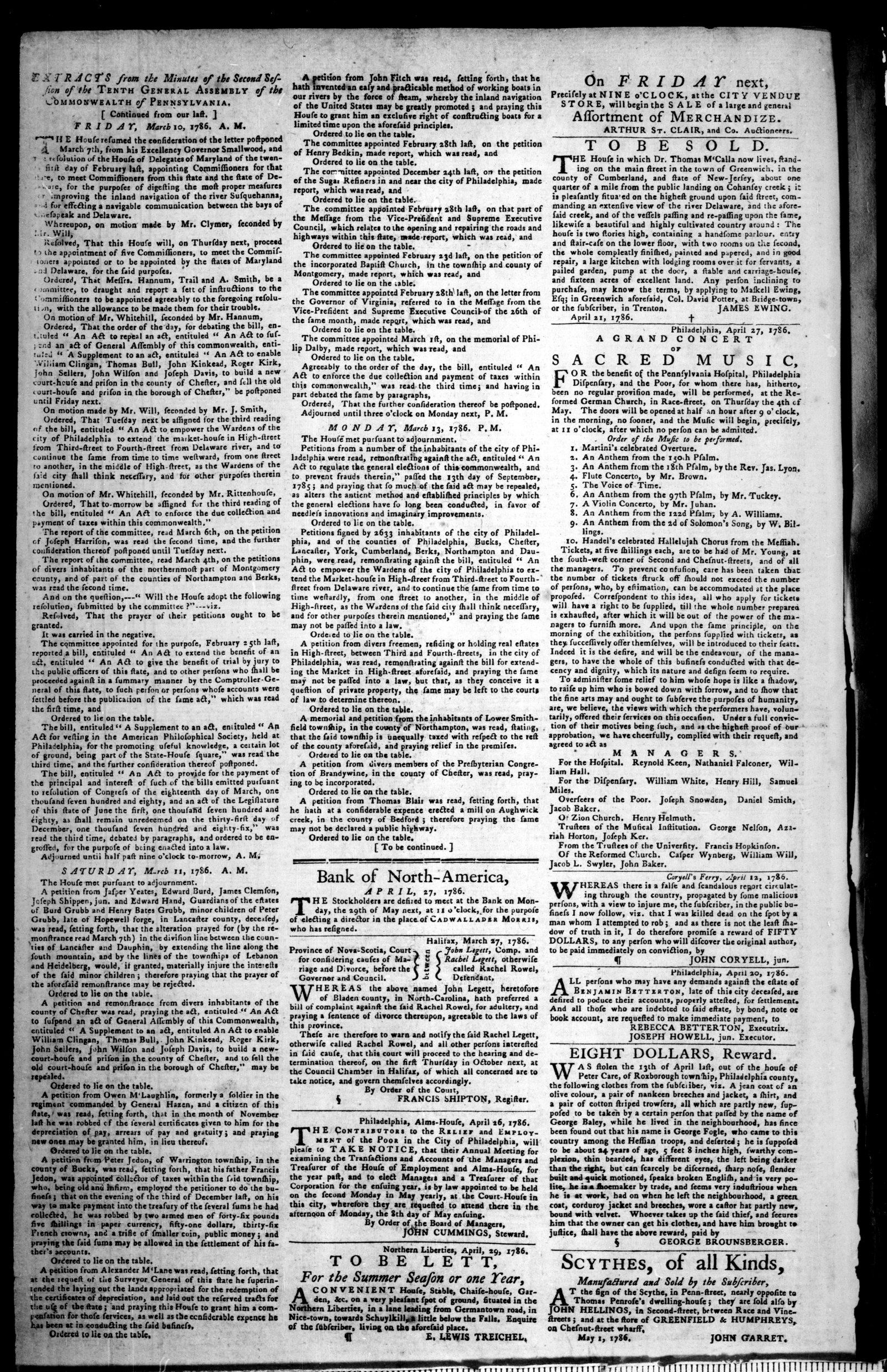
On April 13, 1786, a set of clothes belonging to George Brounsberger was stolen out of Care's house in Roxborough Township. The point is often misread: Care was not the victim — the clothes were Brounsberger's, kept in his house for reasons the notice does not give. The Pennsylvania Gazette notice of May 3 offered eight dollars reward, describing the clothes — an olive jean coat, nankeen breeches and jacket, a shirt, cotton striped trousers — and the suspect in unusual detail. He had passed as George Baley; he was in fact George Fogle, about twenty-four, a shoemaker who had come to America among the Hessian troops and deserted, with one distinguishing mark: his left eye was darker than the right, "scarcely discernible." Whether he was caught, no source found says. The notice ran three times in May 1786; the page is one of this story's collected images.
Family, credit, and the Rittenhouse paper trail
Care's daughter Susannah Care married the Philadelphia shipping merchant Henry Pratt on September 11, 1794; the Philadelphia Gazette notice (September 22) names the officiant, the Rev. Bishop White. Susannah was Pratt's third wife.
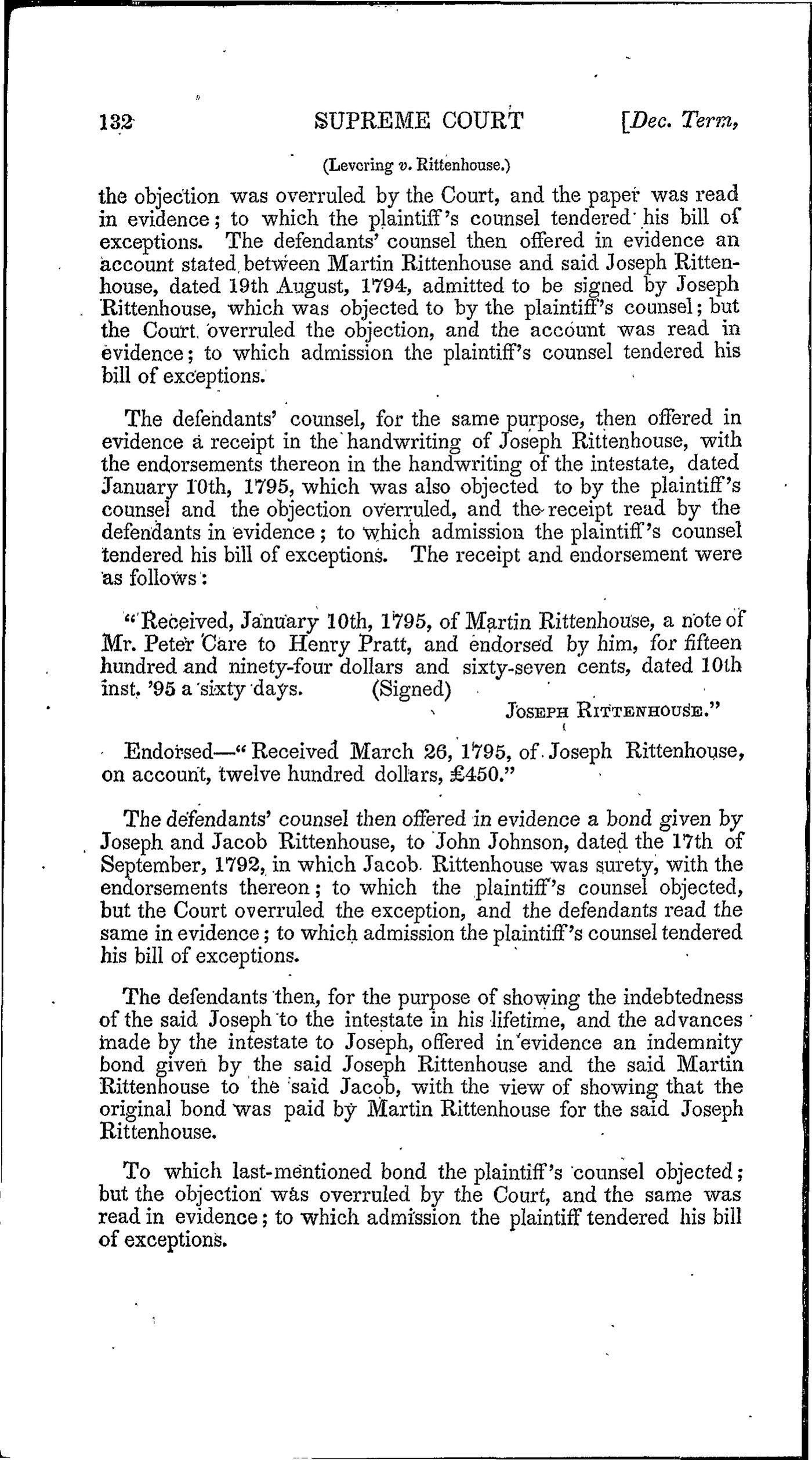
The marriage put Care inside a working credit network, one piece of which survives in a courtroom. On January 10, 1795, Care made a negotiable note for $1,594.67, payable at sixty days to Henry Pratt. Pratt endorsed it onward to Joseph Rittenhouse, of the creek's paper-mill family. By March 26, 1795 — just after the note came due — $1,200 (£450) had been received on account: honoured, almost in full, on time. Forty years later the receipt and endorsement were read into evidence in Levering v. Rittenhouse (1839), where the court noted the old claim on "Peter Care's note" only to observe that the limitation period had long run. The report page carrying the receipt is collected for this story.
Three years after the note, the 1798 United States Direct Tax shows another side of Care: landlord. The Roxborough lists enter him twice as owner of property occupied by other men — once with Andrew Long as tenant, once with Michael Rittenhouse as tenant. The second entry describes a stone barn, 36 by 40 feet, on a lot valued at $3,111. The entries prove he owned Roxborough land other men lived and worked on. They do not identify either property with the mill seat, his own dwelling, or any parcel in his deeds, and this article makes no such identification.
The end of the mill years: assignment, advertisement, sale
In August and September 1803, Poulson's American Daily Advertiser notified Care's creditors that he had made an assignment — the era's standard step by which a man who could not meet his obligations handed his estate to trustees for settlement among them. The assignees were John Miller Jr. and Thomas W. Francis; the accounts of "Care and Wilson" were to be settled with them. The notice states no cause, and none is given here.
The following spring (March 28, 30, 31 and April 2, 1804), Poulson's advertised Care's estate for sale or rent: 84 acres, a three-story stone dwelling of eleven rooms, stone kitchen, garden, carriage house, barn, hog-house, cider press, and orchard — and the fullest surviving description of his mill:
"a large stone merchant mill-house, situate on that noted never failing stream, called the Wissahickon, with two water wheels, and between ten and eleven feet head and fall, four pair of mill stones, three of which are good burrs, six boulting cloths… a new corn kiln… upwards of six thousand bushels"
That is a flour business of real capacity at the end of Care's tenure. Inquiries went to Thomas Lloyd or to John & Joseph Livezey. In 1805 Care sold the Monastery property and mill to a Livezey, ending his thirty years at the seat; the buyer's first name, "John," rests on one uncited page and is printed here as exactly that — likely, consistent with the advertisement's contacts, and unverified.
The seat's later history bounds his story: after grist and corn came a paper mill by 1818, then flax and twine, then Kitchen's woolen mill in 1852. Care left in 1805; the paper-mill period is not his, and no record found names its operator — a genuine gap, printed rather than filled.
Death and burial
Peter Care died in early 1821, in his eighty-fourth year by the contemporary notice, which puts his birth about 1737/38. The VA memorial gives his death date as February 2, 1821; a New York paper, the Evening Post, printed the Philadelphia death notice — "At Philadelphia, Mr. Peter Care, in the 84th year of his age" — on February 1, 1821, a day before the memorial's date. A newspaper cannot report a death before it happens, so one of the two is off by at least a day; the evidence cannot prefer either, and both are printed.
He was buried at Axe's Upper Burying Ground, Germantown, where a 1946 DAR plaque names him among the Revolutionary soldiers honoured there. One closing gap, stated plainly: no will or probate record for Peter Care has been found online. The published Philadelphia will abstracts volume covering 1820–1825 cannot be read online under this project's rules, and an Ancestry probate search for an estate around 1821 found none — so whether his estate was ever probated stands as a permanent gap.
What we still don't know
- His birthplace, parents, and origins; his birth year rests only on the death notice's age.
- His exact 1781 assessed figure — the top ranking is documented, the number unextracted.
- The 1805 buyer's first name — "John" comes from one uncited page.
- The cause of the 1803 assignment, and who "Wilson" was.
- Whether either 1798 tax property was the mill seat, Spring Bank, or other land.
- Whether a probate estate was ever opened for him.
- Who ran his old seat as a paper mill by 1818.
Timeline
- March 17, 1775 — Edward Milner and wife Susanna convey Wissahickon land with a mill and dwelling to Peter Care for £2,950. (Deed Book I 14, p. 279)
- April 13 & 30, 1776 — Care buys two undivided fourths of a grist/saw mill and tract on the creek — £575 from Mary Wood, £225 from Paul Engle — reaching a half share. (Deed Book I 16, p. 209)
- 1779 — Care's grist mill is one of Roxborough's eleven mills, nine on the Wissahickon. (Jones, The Levering Family, p. 187)
- 1781 — Care's mill valuation stands at the top of the Roxborough tax list, with Livezey's. (PA Archives, 3rd Ser., vol. XVI)
- May 3, 1786 (theft April 13) — The Gazette advertises eight dollars reward for George Fogle, alias Baley, the Hessian deserter suspected of stealing Brounsberger's clothes from Care's house. (No. 2918)
- 1790 — The first census records Care's Roxborough household at eight. (U.S. Census 1790)
- September 11, 1794 — Susannah Care marries Henry Pratt, by the Rev. Bishop White. (Philadelphia Gazette, Sept. 22, 1794)
- January 10, 1795 — Care's $1,594.67 note to Pratt passes to Joseph Rittenhouse; $1,200 (£450) received on account by March 26, 1795. (Levering v. Rittenhouse, 4 Whart. at 132)
- 1798 — The Direct Tax enters Care twice as owner of tenant-occupied property — tenants Andrew Long and Michael Rittenhouse; one entry describes a stone barn 36 × 40 feet. Neither entry is identified with the mill seat. (NARA M372)
- 1803 — Care makes an assignment for his creditors. (Poulson's, Aug. 18 & Sept. 1, 1803)
- March 28 – April 2, 1804 — The 84-acre estate and stone merchant mill-house are advertised for sale or rent. (Poulson's)
- 1805 — Care sells the Monastery mill to a Livezey — the buyer's first name ("John") from one uncited page — ending thirty years at the seat. (Monastery Stables page)
- By 1818 — The seat is a paper mill; its operator is not named in any record found. (Project SWEEP-40)
- Early 1821 — Care dies, aged about 83; the memorial says February 2, a New York paper printed the notice February 1. Buried at Axe's Upper Burying Ground, Germantown. (VLM; Evening Post)
A note on pictures
No portrait of Peter Care exists in any source found, and none may be invented. Three collected images are cleared, all public domain: the Pennsylvania Gazette page of May 3, 1786 (No. 2918), carrying the theft notice from the original newspaper; the 1839 court report page (Levering v. Rittenhouse, 4 Whart. 130, at p. 132) carrying the 1795 receipt for Care's note; and Charles Ellet Jr.'s 1843 map of Philadelphia County (Library of Congress), full sheet and a Roxborough/lower-Wissahickon detail — the mill ground a generation after Care, captioned as an 1843 map, never as his mill.