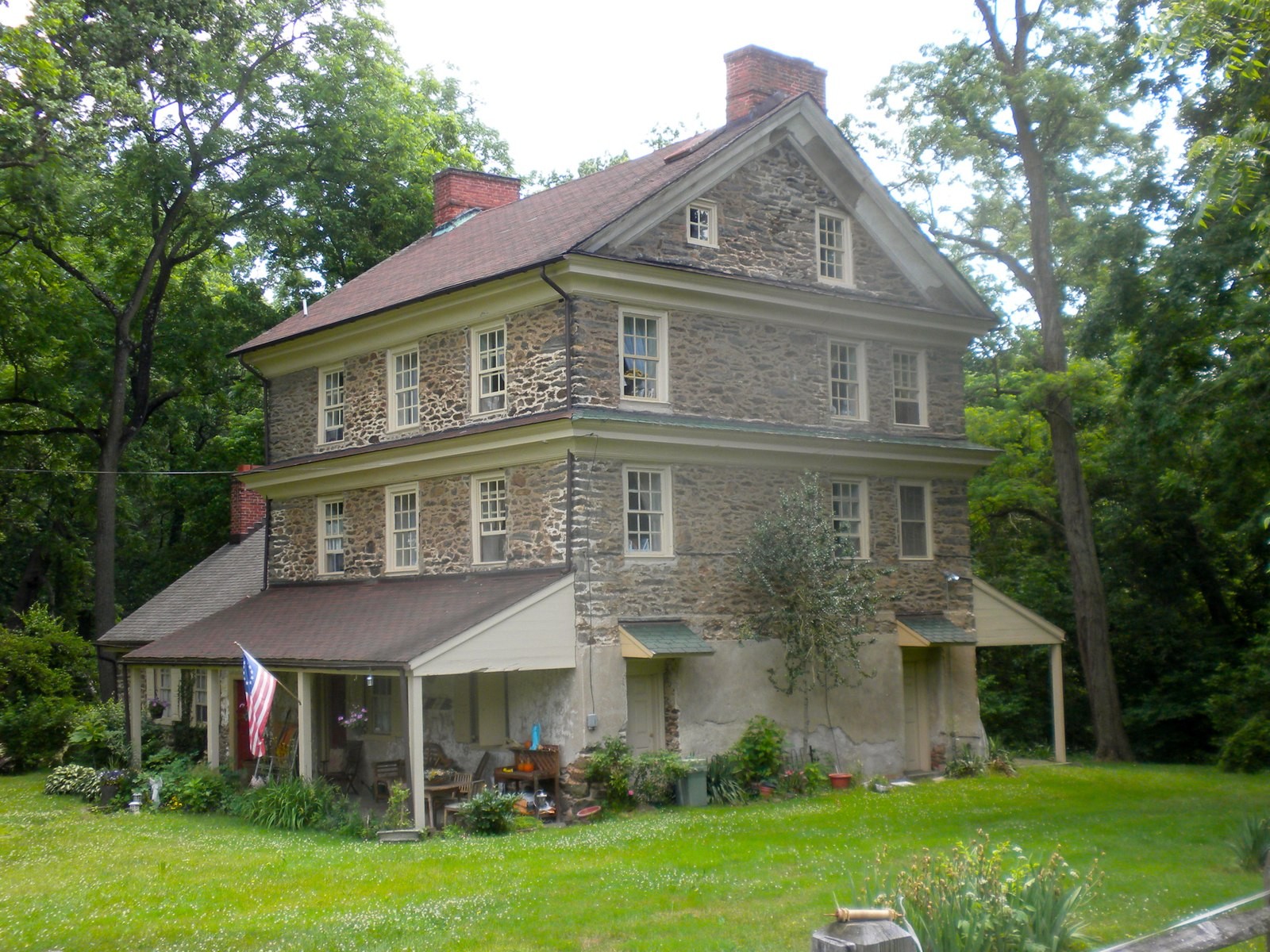
Joseph Gorgas's story is anchored to Wissahickon Creek by a house. In 1747, at the end of what is now Kitchen's Lane in Roxborough, he built at his own cost a three-story stone mansion — the house the valley has called the Monastery for more than two centuries, and the grandest surviving house of the colonial Wissahickon. We know it was his work because a deed of 1752 says so, in so many words, and because in 1761 he sold the lot with the house to Edward Milner, beginning a chain of owners — Milner, Peter Care, the Livezeys, the Wiests, the Kitchens, the Fairmount Park Commission — that runs unbroken to the park visitors who walk past it today. Joseph himself was a Germantown miller, heir to a share of his family's fulling mill, and his own paper trail is a will of ten lines and an estate sale that offered two eight-day clocks and a spinnet. The house is the monument; the documents, read closely, are the story.
The deed that names the builder
For years, this project's own list carried a flag over the Monastery: the Penn Museum, whose archaeologists dug the mill complex at Kitchen's Lane in the 1970s, calls John Gorgas the earliest known owner there — while the builder tradition names Joseph. The answer turns out to be that both are right, at different steps.
Scharf and Westcott's History of Philadelphia (1884), working from Horatio Gates Jones's "Historic Notes of Olden Time in Roxborough and Manayunk" (1859), prints the sequence. The ground "was sold in March, 1747, to John Gorgas, of Germantown." Then: "In 1752 the latter conveyed half of it to his brother, Joseph Gorgas, and there is a recital in the deed that Joseph had since (1747) erected at his own cost and charges 'a three-story stone house or messuage on a certain piece or spot of land.'" John owned the land first; Joseph built the house on it. Between them they resolve the flag entirely.
A recital is the part of a deed that states the facts behind the transaction, and it is as close to the deal's own voice as survives — the deed books themselves are physical records, beyond this project's online reach. The Friends of the Wissahickon, whose history of the house rests on a deed-based study of the property, say the same thing in their own words: "In 1747, Joseph Gorgas, a member of the sect, and a miller, built the house still standing on the site, using local Wissahickon schist."
A miller's inheritance
Joseph was a son of John Gorgas of Germantown, whose will of June 1, 1741 settled the family with care. Joseph received a piece of land with a smaller house on the North Wales Road, the Germantown main road; an equal third, with his brothers Benjamin and Jacob, of their father's other Germantown lands; and — after their mother Sophia's death — a share of the other half of the family fulling mill, the cloth-finishing mill whose first half went to the eldest brother, John.
The same will holds the family's most striking sentence. Joseph's sister Mary was to have £20, and £30 more if she left "the Monastery at Lancaster" — the Ephrata Cloister, the great Seventh-Day Baptist community — and married or lived for herself. The Gorgases were of the German Baptist Brethren world in fact, not in legend: affirming instead of swearing, keeping sisters at Ephrata. When the valley later hung the name "Monastery" on Joseph's house, it was hanging it on a family that knew the word from the inside.
The house they called the Monastery
The house itself justified its fame: three and a half stories, seventeen rooms, built of the valley's own stone — "as grand as any mansion in Germantown," in the Friends of the Wissahickon's phrase. Scharf and Westcott report that Joseph "was a member of the society of Seventh-Day Baptists," and add, carefully, that "it is conjectured that he erected this house for purposes of seclusion and meditation." The Friends of the Wissahickon give its German name, the "Kloster," and hedge the same way: the house was "probably not used for that purpose." The stables that lease it today say he let the Baptists stay with him, and that this is "probably" why it is called a monastery.
No record found documents monks or a cloister community in the house. What the record does document is the confusion to avoid. An Ephrata chronicle tells of hermit brethren who built a house in a valley near Germantown in 1737 — and Scharf and Westcott, examining whether that house was Joseph's, answer flatly: "It is altogether unlikely… There is no proof that Gorgas allowed his house to be used for monastic purposes, but novelists have made much of the legends." The error persists in modern dress: the National Register database credits this house to "Kelpius, Joseph" — the 1690s hermit leader Johannes Kelpius (died 1708) fused by a data error with Joseph Gorgas. The Philadelphia Architects & Buildings record has it right: "Client: Gorgas, Joseph."
Sold to Milner, 1761 — and the chain that followed
"Joseph Gorgas sold the lot with the house, now called the 'Monastery,' to Edward Milner in 1761, and it has since gone through various hands." The stables' history gives the price: £1,500. Why he sold, no record says.
From Milner the chain is deed-solid. In 1775 Milner and his wife Susanna sold to Peter Care for £2,950 — the deed survives in the record and has been read in full for this project — and Care ran the seat's grist mill for thirty years. John Livezey followed in 1805, then Brock and Hart (1841), Elizabeth Wiest (1843), and her heirs' sale to William Gordon Kitchen in 1852; the Kitchens sold the mill property to the Fairmount Park Commission in 1873 and the house property in 1898. The seat's mills ran in sequence — saw mill, grist and corn mill, a paper mill by 1818, a flax and twine mill, Kitchen's woolen mill — though the early steps are undated in every source, and one popular claim must be refused: the stables' page credits Joseph with building a paper mill as well as the house. Nothing else supports it, the agreed sequence puts the paper mill half a century after he sold, and his own estate sale names no mill at all. It is the page's claim, and it stops there.
His own last years in Germantown
Joseph's public life after 1761 is Germantown's, and it is quiet. In June 1765 a neighbour's land sale in the papers directed buyers to "enquire of Joseph Gorgas, living near the Premises" — the standing of a settled local landholder. On December 14, 1766, "weak and sick in Body," he made his will: "I Joseph Gorgas [of] Germanton, and County of Philadelphia, Miller." Everything after debts and funeral charges went to "my dearly beloved Wife Jouliana" — "all the remainder part of the whole Estate which is to be sold after my decease." Executors: his wife and John Gorgas Junr. No child is named; no acre, no house, no mill is named. It was proved on January 10, 1767.
One thing the will never does is place his milling. He inherited a fulling-mill share in 1741; he styled himself Miller in 1766; the seat he built later ran mills for a century and a half. Whether he worked the family fulling mill, a Germantown mill now unrecorded, or the saw mill at his own seat, no document found says — and a careful reading leaves the question open rather than filling it with the nearest mill.
The estate sale: two clocks and a spinnet
In March 1767 the executors advertised his vendue in the Pennsylvania Gazette: at "the house of Joseph Gorgas deceased, at the upper end of Germantown," a lot of about sixteen acres with "a good new two story stone house, and a good stone barn," and another lot in Cresham of about five acres — offered again in April and May at slightly different acreages, as such advertisements did. Among the household goods: "two eight day clocks, a very good spinnet."
His own Germantown house — two stories, new, stone — is worth separating from the Monastery in print, because later accounts blur them. The Monastery was three stories, and it had been Milner's for six years. What the vendue shows of Joseph himself is the inside of a prosperous miller's home: two tall clocks and a keyboard instrument were not ordinary furniture in 1767 Germantown.
Timeline
| Year | Event |
|---|---|
| 1741 | His father John Gorgas's will (June 1) leaves Joseph Germantown land and a house, and a share of the family fulling mill after his mother Sophia's death |
| March 1747 | His brother John buys the Kitchen's Lane ground |
| 1747 | Joseph builds the three-story stone house — the Monastery — at his own cost |
| 1752 | John conveys half the ground to Joseph; the deed recites Joseph's building of the house |
| 1761 | Joseph sells the lot with the house to Edward Milner (£1,500, per the stables' history) |
| 1765 | The Pennsylvania Gazette directs land buyers to "enquire of Joseph Gorgas, living near the Premises" in Cresham |
| Dec 14, 1766 | His will, made at Germantown; he styles himself Miller; all to his wife Jouliana, the estate to be sold |
| Jan 10, 1767 | Will proved; letters to John Gorgas and Juliana Gorgas |
| Mar–May 1767 | Estate vendue: his Germantown house and lands, two eight-day clocks, a spinnet — no mill offered |
| 1775 | Milner sells the Monastery seat to Peter Care (deed read) |
| 1798 | "Gorgas's Mill" on the Wissahickon advertised in Roxborough — the next generation's seat, not Joseph's |
| 1852 | The Monastery seat sold to William Gordon Kitchen |
| 1873 / 1898 | The Kitchen family sells the mill property, then the house property, to the Fairmount Park Commission |
What to see today
The Monastery still stands at the end of Kitchen's Lane in the Wissahickon Valley Park — the mansion Joseph Gorgas built in 1747, with its bank barn, spring house, and the millworker's cottage below, leased today as the Monastery Stables. It is one of the very few valley houses the Park Commission chose not to demolish, and it is the oldest thing on its lane that carries a builder's name in a deed. Joseph's own Germantown house, sold at his vendue in 1767, has no such certain survival — nothing found identifies it today. The Gorgas name also survives on Gorgas Lane in Mount Airy, for the family's later generations; the mill the next generation ran as "Gorgas's Mill" is gone, and its seat is a separate place from the Monastery grounds.