John Gorgas's tie to the Wissahickon comes first, because it is the whole story. In March 1747, John Gorgas (c. 1710–1781), a skin dresser of Germantown, bought about 129 acres on Wissahickon Creek at what is now Kitchen's Lane, inside today's Wissahickon Valley Park — the seat the valley knows for the Monastery, the great stone house his brother Joseph built on the ground that same year. John held the seat in shares for thirteen years; its mill was called "Gorgas's Mill" by 1752. Six months before that purchase he had bought a second seat, about 85 acres below Glen Fern, and that one stayed in his hands until his death: a 1777 deed calls its mill "John Gorgas Senr's Mill," and his estate's partition of 1782 divided its grist mill and oil mill among his sons. He is the man who brought the Gorgas family onto the creek. He is not his father, the John Gorgas who bought into the Crefeld paper mill in 1713, and he is not his son, the John Gorgas who worked the Roxborough mills after him — the records separate all three, and so does this account.
A tradesman's inheritance
He enters the record as an heir. His father's will (June 1, 1741) names him eldest son, gives him the first half of the family fulling mill in Germantown and half the small piece of ground it stood on, makes him an executor beside his mother Sophia, and leaves £5 to his own son John — so he was a father by 1741. No record read names the stream the fulling mill stood on, and this account does not place it on the Wissahickon; Germantown had the Wingohocking too. His birth year is a compiled estimate, about 1710, printed as compiled. What the records do prove is his trade and his timing: by 1746 he had money of his own, and he spent it on the creek.
Two purchases in six months
On August 22, 1746, John Ballay and his wife Mary Sophia sold him two Roxborough tracts — 43¼ acres and 42 acres 70 perches, about 85 acres below Glen Fern. That deed survives through its recital in a deed of 1777, read in full; the original's index citation does not resolve, and its price and bounds are a printed gap.
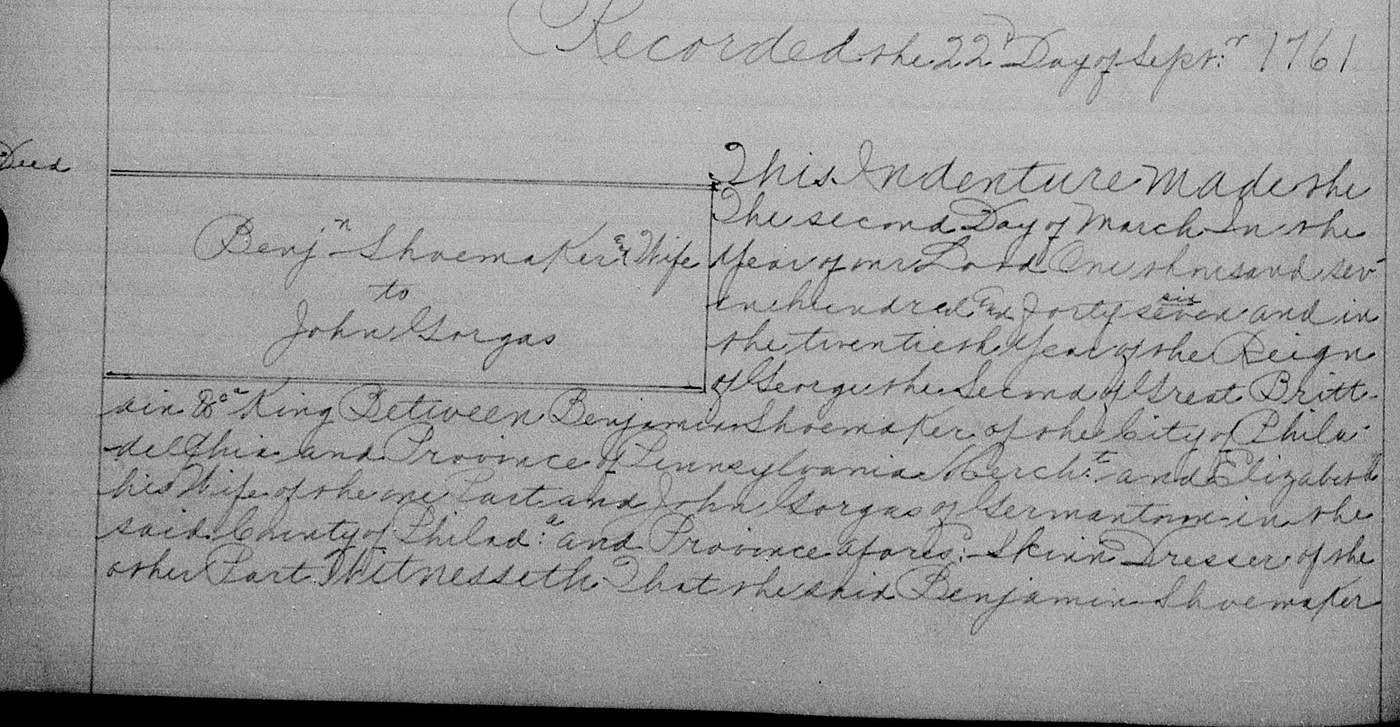
On March 2, 1746/47, Benjamin Shoemaker and his wife Elizabeth sold him the Kitchen's Lane seat: about 129 acres on the creek in four pieces, one of them with a dwelling already on it, for £354. The deed — read in the original for this biography — styles him "John Gorges of Germantown, skin dresser," a dresser of hides; the Germantown historian Hotchkin, who called him a tanner, had the trade right. The deed then hid in plain sight: it was not recorded until September 1761, fourteen years late, in a book far from its date, and print accounts carried the seat's story for generations without it. It surfaced through the deed grantor index.
A seat held in shares
He never held the Monastery seat whole. In November 1747 he and his wife Mary conveyed an undivided half of the smaller pieces and 27 acres to Michael Pelsner and Jacob Simon. In 1747 his brother Joseph built the Monastery house on the two-acre house lot. In April 1752 an Adam Gorgas — unidentified, not among the children of the 1741 will, and left unidentified here — conveyed a fourth part of that lot to Joseph. And on July 6, 1752, John and Mary conveyed Joseph a half of the house lot for £8, in the deed that names the seat's mill: "Gorgas's Mill," on Wissahickon Creek, its lot bounded from the north corner of the grist mill. A grist mill stood there by 1752 and bore the family name. Who built it, no record read says — John owned the seat, Joseph lived on it as miller — and this account prints the fact and the dates, not a builder.
In December 1760, with a second wife, Regina, signing beside him, John sold Joseph his remaining share of the seat's "Mill Lands" for a full £600. In April 1761, styled in the deed "miller" and "eldest son of John Gorgas," he settled the last of the brothers' mill shares with Joseph, adding a right of road over his own Germantown land and the right to dam the creek to the mill's height. Joseph sold the house lot out of the family that year. The seat passed to Milner, then to Peter Care in 1775, and in time to the Fairmount Park Commission.
The seat below Glen Fern
The Ballay land was his for life. In July 1770 he and his third wife, Rachel, conveyed part of it to his eldest son John. In May 1777 that son, "John Gorgas Junior, miller of Roxborough," sold a lot on the great road to Reading, and the deed locates it "by the road to John Gorgas Senr's Mill" — the father's name still on the mill in the neighbourhood's speech.
The Roxborough tax lists tell father and son apart. In 1779 the list rates a "John Gorgas Junr" — for himself, and again "for Jn.o Gorgas &c." In 1780 three lines stand together: "John Gorgas, Miller" at 20,100; "Benjn Gorgas, Oylmiller" at 22,100; and "John Gorgas Senr" at 33,000, the family's largest valuation, no trade styled. In 1781 the senior line is gone, in the year his will was proved. The senior is the father, rated on the seat he bought in 1746; the junior — the "Miller" of 1780–81, the "Oylmiller" of the years after — is the son who worked it. Compiled accounts had given the 1779 miller to the father; the list names a junior, and the correction is printed here. His home township's lists add his Germantown footing: 17 acres and a dwelling in 1774, rated again in 1779 and in 1780, the last year on "Cash £500." Hotchkin's "tanner who ran the old mill" is the same two men in one sentence: the tanner is the father, the mill-running of those years the son's.
His will, and the great partition
His will (May 28, 1780) leaves "all my Lands, Mills, Tenements & Hereditaments whatsoever or wheresoever" in equal shares to his five sons and four youngest daughters — ten children in all, the eldest daughter not among the devisees, for reasons no record gives — with his widow Rachel to take a third of the annual rents for life, and his sons John and Benjamin as executors. It was proved December 12, 1781. His estate inventory, due the following January, does not survive in the online files; the search was made jacket by jacket and is printed in the sources.
On September 1, 1782, five referees partitioned the estate into nine equal shares, Rachel to take £5 a year from each in place of dower. The eldest son John took the stone messuage and the oil mill on Oyst Mill Run — Oil Mill Run, at Glen Fern — 14 acres 120 perches: the oil mill the tax lists style him by from 1785. Benjamin took the messuage and grist mill, its lot running from the run by the mill road down to Wissahickon Creek — 25 acres 60 perches by the partition, 24 acres 60 perches by the deed that followed. For Jacob had conveyed his ninth to Benjamin the day before the partition, and the day after it Benjamin sold Jacob back an undivided half of the grist mill for £380 11s 1d — which is why, in 1786, the tax list rates Benjamin and Jacob at half the grist mill each, and John at the oil mill whole. The grist mill Benjamin held is the mill of the later dam dispute with the Livezeys of Glen Fern, told in Benjamin's own entry in this collection. Its first name, though, was its founder's: John Gorgas Senr's mill.
What the record does not say
His birth year is compiled. His inventory is lost. The Ballay deed's price is unread. The Monastery seat's grist mill has no named builder. Adam Gorgas, who held a fourth of the house lot in 1752, is nobody the records explain. In 1767 a John Gorgas acted as his brother Joseph's executor beside the widow Juliana — Joseph's will calls that executor "Junr," which points to the nephew; the newspaper notices pair a plain John with the widow, which reads as the brother; the question stands open. His Germantown tax lines are read for 1774, 1779, and 1780; the years between are bounded negatives. Rachel is found once more in 1820, heading her own Germantown household of two women, both past forty-five by the census index. What stands is the spine: a Germantown skin dresser who bought two seats on Wissahickon Creek in six months, put his family's name on a mill, and left the second seat to nine children.
Timeline
| Date | Event |
|---|---|
| c. 1710 | Born, eldest son of John Gorgas of Germantown (compiled date) |
| June 1, 1741 | Father's will: half the family fulling mill, co-executor; already a father himself |
| August 22, 1746 | Buys the Roxborough seat below Glen Fern from John Ballay — two tracts, about 85 acres |
| March 2, 1746/47 | Buys the Monastery mill seat at Kitchen's Lane from Benjamin Shoemaker — about 129 acres, £354; styled "skin dresser" |
| November 25, 1747 | With wife Mary, conveys a moiety of parts of the seat to Michael Pelsner and Jacob Simon |
| April 10, 1752 | Adam Gorgas (unidentified) conveys a fourth part of the house lot to Joseph Gorgas |
| July 6, 1752 | With Mary, conveys a moiety of the house lot to Joseph; the deed names "Gorgas's Mill" on the creek |
| December 21, 1760 | With wife Regina, sells Joseph his moiety of the "Mill Lands" for £600 |
| April 28, 1761 | Settles the seat's grist and saw mill shares with Joseph; dam right and mill road granted |
| July 9, 1770 | With wife Rachel, conveys Roxborough-seat land to his eldest son John |
| 1774 | Rated in his home township, Germantown: 17 acres, a dwelling, 2 cows — with £70 of his son John junior's money rated under his name |
| May 2, 1777 | His son's deed names the seat's mill "John Gorgas Senr's Mill" |
| 1779–1780 | Rated in Roxborough beside his sons; in 1780 as "John Gorgas Senr," 33,000 |
| May 28, 1780 | His will: nine equal shares to five sons and four youngest daughters; Rachel to take a third of the rents for life |
| December 12, 1781 | Will proved — he died in 1781, the day unrecorded |
| September 1, 1782 | Partition of his estate: the oil mill to his eldest son John, the grist mill to Benjamin |
| September 2, 1782 | Benjamin sells Jacob an undivided half of the grist mill for £380 11s 1d |
| 1786 | Tax list: Benjamin and Jacob at half the grist mill each; John at the oil mill |