
William Gordon Kitchen ran a woolen mill on Wissahickon Creek. The mill stood at the foot of the lane in Roxborough, in Philadelphia, where the old Monastery house still stands inside Wissahickon Valley Park. Kitchen bought the mill complex in 1852 and worked it until his death in 1871. His family sold the mill ground to the Fairmount Park Commission in 1873 and kept the house until 1898. The creek is why he belongs in this collection: he was the last mill man of one of the valley's oldest mill seats, and the lane down to his mill carries his family's name to this day. That is the tie, stated first, because everything else in his story hangs on it.
Almost everything else about him had to be dug out of the record piece by piece. No article about him existed. His death date was unknown — the project's own list carried only "died before 1873," guessed from the mill sale — until his death certificate was read. His mill had a second name that no history of the site mentions. The man who apparently financed his purchase lived next door to him and died holding his mortgage, and no source says what they were to each other. This article puts together everything the surviving records actually say, and says plainly where they stop.
The name on the lane
Start with what a walker in the park can still see. The lane from Ridge Avenue down to the creek at the old Monastery is Kitchen's Lane, and the bridge where it crosses the creek is the Kitchen's Lane Bridge. The Friends of the Wissahickon, in their history of the Monastery, give the reason in one sentence: the property "was bought by the Kitchen family in 1852, hence the name Kitchen's Lane." The Fairmount Park Commissioners were already calling the mill a landmark in their Fourth Annual Report, for 1872, listing the places on the Wissahickon drive whose grades they had renewed: "Greenwood Hill, Rittenhouse Culvert, Kitchen's Mill, Gorgas' Hill, Township Line Bridge." Kitchen's Mill — a place name in the park's own records before the park had even finished buying the valley.
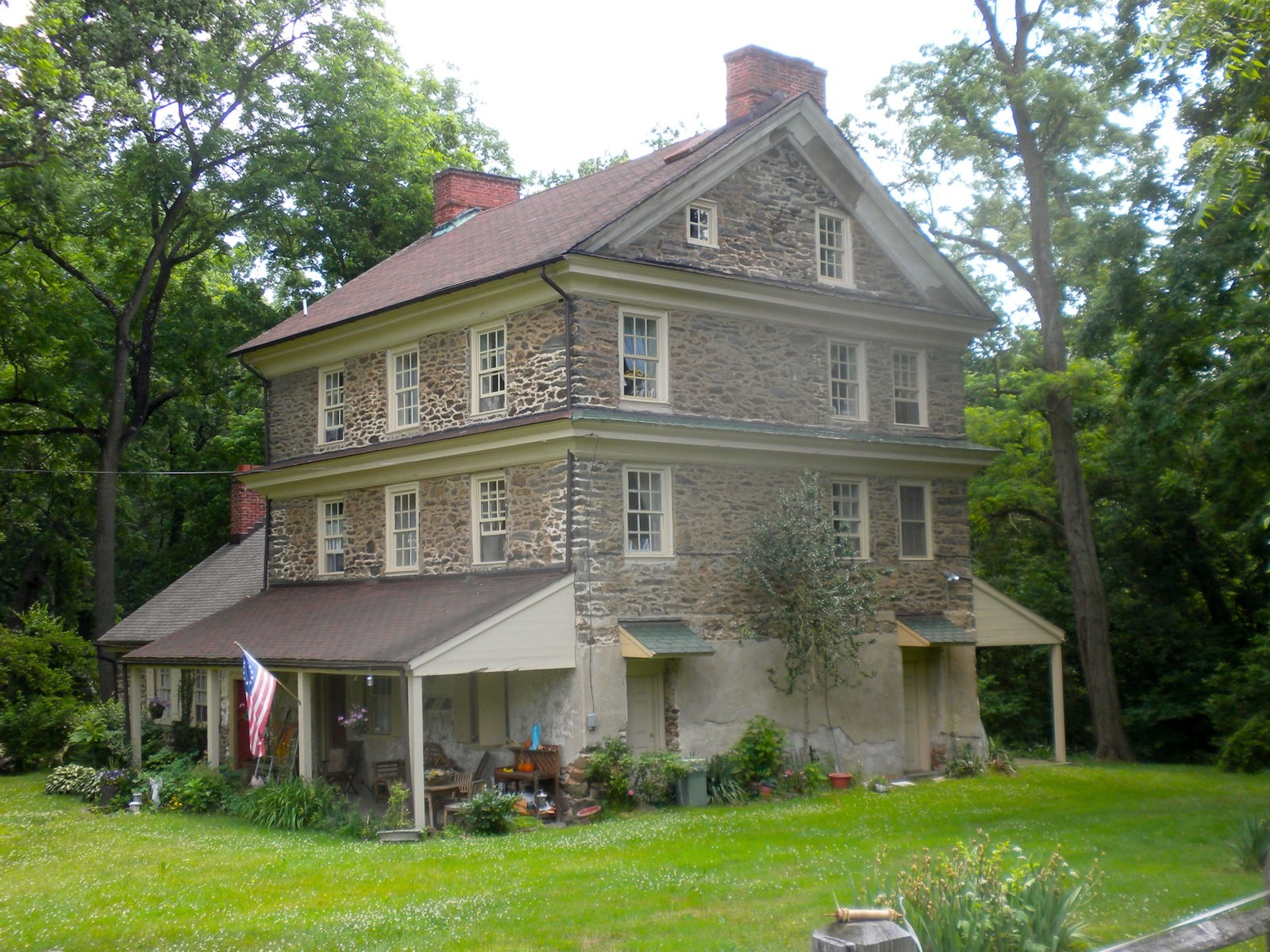
The house survives, too. The Monastery mansion, built in 1747, was Kitchen's home through his mill years and his family's until 1898. It stands today, leased as stables — one of the handful of creek-side buildings the Park Commission preserved instead of demolishing. The mill buildings are gone. The name, the lane, the bridge, and the house are what remain of him in the landscape, and they are not little things: no other figure in this collection named a piece of the park's map the way he did.
Two Williams, side by side
The first problem in Kitchen's record is that there are two of him — almost. In the 1850 census for Roxborough, two households stand one after the other. Household 173 is headed by William Kitchen, 55, a manufacturer born in England, living with Elizabeth, 28, and Anna, 20. Household 174, next door, is "Gordon Kitchen," 29, also a manufacturer, also born in England — our man, enumerated under his middle name, with his wife Susan, 27, and their children William J., 6, James G., 5, Elizabeth, 2, and Alfred H., 11 months.
The older William's life runs in parallel for fifteen years: a retired manufacturer — "late manuf." in the directories — on Broad Street and then Lyceum Avenue, a gentleman of the same small township and the same trade. When he died, his will was proved on May 2, 1865, and his inventory, sworn nine days later, lists what he owned. Among the assets: a note of William G. Kitchen for $2,000, and a mortgage of William G. Kitchen for $12,000 — $14,000 of the younger man's debt, held by the older man at his death.
A $12,000 mortgage is mill-purchase money. Kitchen bought the Monastery mill in 1852; three years later his firm appears in the city directory as "Wm. Kitchen & Son." Whose son? If the firm was the older William's, the son is plausibly our man. If it was our man's firm, his eldest son James was nine years old, and cannot sensibly be the partner. The record does not say. It also never says what the two Williams were to each other — father and son, uncle and nephew, or no kin at all. The circumstantial case is strong: same name, same trade, same township, next-door households in 1850, and a purchase-sized mortgage running between them. But no record read for this article states the relationship, so this article does not state it either. The debt is a document. The kinship is a guess, and it is printed here as one.
A third Kitchen complicates the block further. Robert Kitchen, a clerk on Ridge Avenue through the 1850s, appears in the 1860 directory as a manufacturer on the Wissahickon in his own right. He is in none of William Gordon Kitchen's census households, and no record found connects him to either William. He stands in this story unmerged and unexplained, because that is where the record leaves him.
The fifth industry on an old seat
The mill Kitchen bought in 1852 was old before he touched it. The Monastery seat, at the foot of the lane on the creek, had already been a saw mill, a grist and corn mill, a paper mill (by 1818), and a flax and twine mill before his woolen mill made five. His predecessors at the seat include Joseph Gorgas, who built the mansion in 1747, and Peter Care, whose grist mill stood here from 1775 to 1805 — both of them figures in this collection in their own right. The chain of owners as the Monastery Stables' history gives it: Brock and Hart bought the property in 1841 and sold it to Elizabeth Wiest in 1843; at her death it passed to her children, who sold it to William Gordon Kitchen in 1852. That history page cites no sources, and this article flags it every time it leans on it — but the endpoint is corroborated: by 1855, Kitchen's woolen firm is in the city directory at Monastery Avenue, and everything after agrees.
What he brought to the seat was the last industry it would ever have. The Wissahickon was still a working industrial valley when he bought in — more than thirty water-powered mills on the creek — but the Fairmount Park Commission, empowered in 1867, was about to buy the valley mill by mill to protect the city's water. Kitchen's was taken in the first wave. He did not live to see the sale; the arc of his own life bent away from the mill before the park arrived, as a later section tells.
Jeans and cassimeres
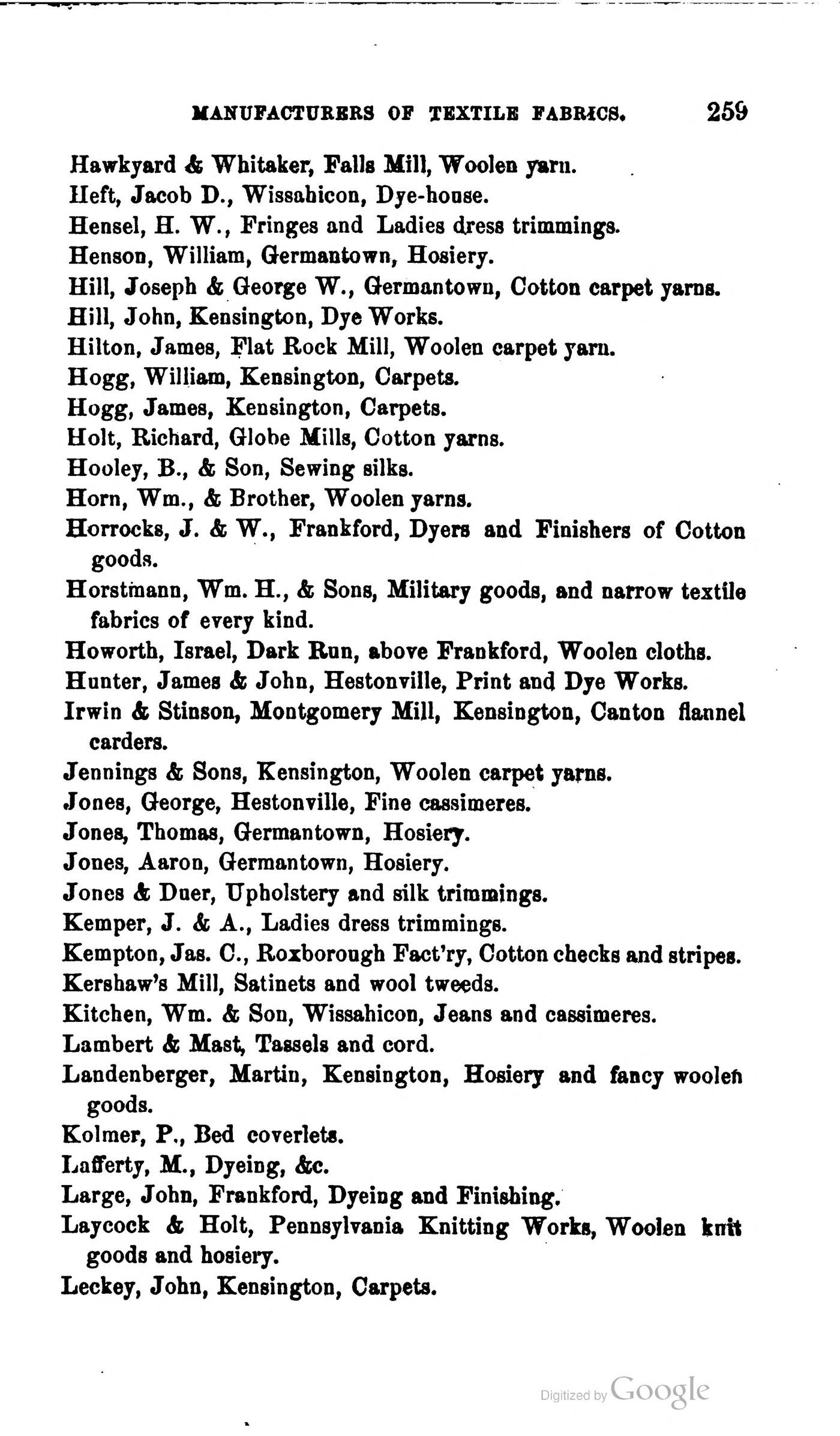
For what his mill actually made, there is exactly one contemporary statement, and it is a good one. Edwin T. Freedley's 1857 handbook of Philadelphia manufactures lists his firm among the city's textile makers: "Kitchen, Wm. & Son, Wissahicon, Jeans and cassimeres." (Freedley's spelling of the creek is his own.) Jeans and cassimeres are woolen and wool-cotton cloths — jeans for working clothes, cassimeres for men's suiting. Kitchen made cloth for the broad market, not fine goods, and he sold it the way serious Philadelphia manufacturers did: by 1862 the directory shows "Kitchen William G., manuf. cotton & woollen goods, 115 Chestnut, h Rox" — a selling office on Chestnut Street, the city's dry-goods row, with his home in Roxborough.
The directories walk his firm through the years: "Kitchen Wm. & Son, woolen manuf., Monastery av" in 1855, 1856, and 1857; then, in 1860, the line that opens the next section's puzzle — "Kitchen Wm. G., domestic goods, Willow Glen (Rox)."
The census gives the weight of the enterprise. In 1860 his real estate stood at $32,000 — the mill property — with $7,000 personal estate: a substantial mill man by the standards of the creek. In 1870 the real estate was $27,000 and the personal estate a few thousand (the index says $3,000; the census image reads $5,000; both figures are printed here because the record gives both). What the mill produced in yardage, how many hands it employed, what its water power was worth — those figures would sit in the Census of Manufactures schedules, and that class of record could not be read online for his ward and years, on either of the two routes that hold it. The gap is permanent under this project's online-only rule, and it is printed here as one.
The mill with two names
Twice, the record calls his mill something else. The 1860 directory places him at "Willow Glen." And the Hexamer insurance surveys — the great fire-insurance survey of Philadelphia industry — carry an index entry for a "Willow Glen Mill," owner "Kitchen, William Gorden" (Vol. 3, plate 169, about 1866). A Hexamer plate normally shows a mill building by building: exactly the drawing that could settle where Willow Glen was and what it looked like. This plate does not survive. The Free Library of Philadelphia and the Library of Congress both lack it; only the index line remains, and its location field is blank — "Missing."
So the question stands open, and this article leaves it open: was Willow Glen the Monastery mill under a trade name, the way a mill might carry a brand? Or was it a second mill of his, somewhere in Roxborough that no surviving record fixes? No document read equates the two names, and none separates them. The 1870 manufactures schedules, read page by page for his ward, contain no Willow Glen entry and no woolen mill under any name — but by 1870 he had retired, so the silence proves nothing about 1860. Willow Glen is the loosest thread in his story, and it stays loose.
Retired at forty-nine
The 1870 census is the saddest page in his file. It does not show a mill owner at the height of his business. It shows Wm Kitchen, 49, "Retired Manufac[turer]," nine months from his death, in a household that has already changed shape: his wife Susanna, his son James at 24, daughters Elizabeth, Sallie, Susie, and Annie, Gordon at 8, May at 5 — and two boys missing. Alfred, who would have been 20, and Millard F., who would have been 13, are simply not there. One of those absences now has an explanation; the other does not, and the family's section below keeps them separate.
He died on April 9, 1871. His death certificate — read from the image for this project — gives the cause as valvular disease of the heart, his occupation as manufacturer, his birthplace as England, and his address in the certificate's own hand as "Wissahickon Pike & Conrads Lane." His parents' names are blank; he was a grown man, and the form's keeper did not know them, which is one reason his English beginnings stay dark. The family's notice in the Philadelphia Inquirer (April 10–12, 1871) reads: "On the 9th instant, WILLIAM GORDON KITCHEN, in the 51st year of his age… funeral, from his late residence, Wissahickon, near Conrad's lane… To proceed to Leverington Cemetery." He was buried there on April 12, 1871. His estate went to administration — the index entry survives (1871, No. 338, Administration Book T, page 514) — but the administration book itself is not digitized anywhere this project can reach, so who administered, and on what bond, prints as a gap.
Why had he retired at 49? The record gives no reason — no illness named before the death certificate, no failure, no lawsuit found in the published court reports (the Kitchen-named Pennsylvania cases of his era are all other men). The retirement and the death stand nine months apart, and a reader will connect them; this article only notes that no document does.
The family finishes the story
The mill property stayed in the family's hands for two years after his death; who ran the mill in 1870–73 — a son, a tenant, Robert Kitchen, or no one — no record read says. In 1873 the family sold the mill property to the Fairmount Park Commission. The house they kept for twenty-seven more years, until 1898, when the house property followed the mill into the park. Who signed for the family on either sale is a deed question, and the deeds cannot be read online; Susan's own probate petition in 1900 lists her real estate as "none," which fits a woman who had already parted with the house, and proves nothing about the signature.
His widow Susan outlived him by twenty-nine years. Her maiden name was very likely Hoogland — an inference, printed as one: in the 1880 census her widowed mother, Elizabeth Hoogland, 88, is living in her household, and a user-contributed cemetery index gives the same maiden name and the same mother. Her own age wanders across the censuses (27 in 1860, 46 in 1870, 57 in 1880 — they cannot all be right); her death record settles it best: she died July 25, 1900, at 5326 Green Street in Philadelphia, aged 77, which agrees with 1880 and puts her birth about 1823. Her will, written in 1889, left her household goods to her daughters Susie and Annie F. and the residue in trust under her son Gordon; her personal property came to about $4,500, and she was buried beside the family's dead at Leverington.
The sons' endings are the last finds in his file, and they are uneven. Alfred — the missing boy of the 1870 census — died on August 30 or 31, 1869 (the death index carries him twice, once for each date, and the conflict is printed here unresolved), aged 19, single, a manufacturer, living at "Wissahickon Creek at Conrads Lane" — the mill address itself. He was working in the family trade at the family mill when he died, and he is buried at Leverington. Gordon W., the 8-year-old of 1870, became the family's anchor: his mother's executor in 1900, and by his own death the holder of an estate sworn at $75,000 in personal property and $40,000 in real estate — including Roxborough lots at 568–572 East W[?] Lane, the street name uncertain in the probate hand. He died on *June 6, 1906, aboard the Steamship Germania***, at 6:15 in the evening, on his way to Europe as his petition appears to say. His will, written in 1899, left its income to his mother and his sister Annie F. for their lives — his mother had been dead six years when he died; the will was simply older than her death — and the principal after them to the five children of his brother James G.
And the two who stay missing: William J., the eldest, gone from the household by 1860 at about 16, and Millard F., gone by 1870 at about 13. Both were searched in the Philadelphia death indexes by name, initial, and wildcard across fifty years, and neither was found. One unsourced family tree online gives Millard a death date in 1862 — but its birth date for him conflicts with his age in the 1860 census, and an unsourced claim that contradicts a census is not printable as fact. Church records, burial collections, and Leverington Cemetery's own records were not searched; the cemetery's original registers burned in 1966, and its transcriptions are physical records this online project does not pull. The boys' fates print as gaps.
What we still don't know
His English origin — the town, the parents, the ship — was not found; no passenger or naturalization record for him surfaced, and the record of his life begins with a formed family in Roxborough. His marriage date and place are unrecorded in anything read; his wife's maiden name rests on the Hoogland inference. The kinship of the older William — the neighbour, the creditor, the possible father — is unproven. The "& Son" of his 1850s firm cannot be assigned. Willow Glen cannot be placed. The mill's workforce and output are locked in schedules that cannot be read online. The mill's last three years are undocumented. Who signed the 1873 and 1898 sales is unknown. Two of his sons vanish. Every one of those gaps is printed in this article where it belongs, in the open — they are the honest edges of a life the record kept only in pieces. What the pieces do show is a man who bought an old mill seat on a Philadelphia creek, worked it for nineteen years, made cloth working people wore, and left his name on the map of the park that replaced his world.
Timeline
| Year | Event |
|---|---|
| c. 1821 | Born in England |
| 1850 | Enumerated in Roxborough as "Gordon Kitchen," manufacturer, next door to the older William Kitchen |
| 1852 | Bought the Monastery mill complex on Wissahickon Creek |
| 1855–57 | Firm in the city directories: "Wm. Kitchen & Son, woolen manuf., Monastery av" |
| 1857 | Freedley's handbook lists the firm's products: "Jeans and cassimeres" |
| 1860 | Census: real estate $32,000; directory places him at "Willow Glen" |
| c. 1866 | Hexamer index enters his "Willow Glen Mill" (the plate is lost) |
| 1865 | The older William Kitchen dies holding his $2,000 note and $12,000 mortgage |
| 1869 | His son Alfred dies at 19, a manufacturer, at the mill address |
| 1870 | Census: "Retired Manufacturer" at 49 |
| 1871 | Died April 9, of valvular disease of the heart; buried April 12 at Leverington Cemetery |
| 1873 | His family sold the mill property to the Fairmount Park Commission |
| 1880 | His widow Susan heads a household that includes her mother, Elizabeth Hoogland |
| 1898 | His family sold the Monastery house property to the Commission |
| 1900 | Susan died July 25, in Philadelphia |
| 1906 | His son Gordon W. died aboard the Steamship Germania, leaving a $115,000 estate |
A note on pictures
No portrait of William Gordon Kitchen was found in any source read, and no made-up image will ever be substituted. A modern photograph of the Monastery — the house he lived in and his family held until 1898 — exists on Wikimedia Commons as a public-domain file by Smallbones, its Commons record and embedded coordinates placing it at the end of Kitchen's Lane on Wissahickon Creek; it appears in this story, below the opening section. Photographs of his mill's bridge in his own tenure exist — Bartlett & French stereographs of the Kitchen's Lane Bridge, about 1868, at the Library Company of Philadelphia — but they are not cleared for use and are described here, not shown. The one drawing that could have shown his mill building by building, the Hexamer survey plate for Willow Glen Mill, does not survive in the Free Library or Library of Congress collections; its loss is part of his story, told above.