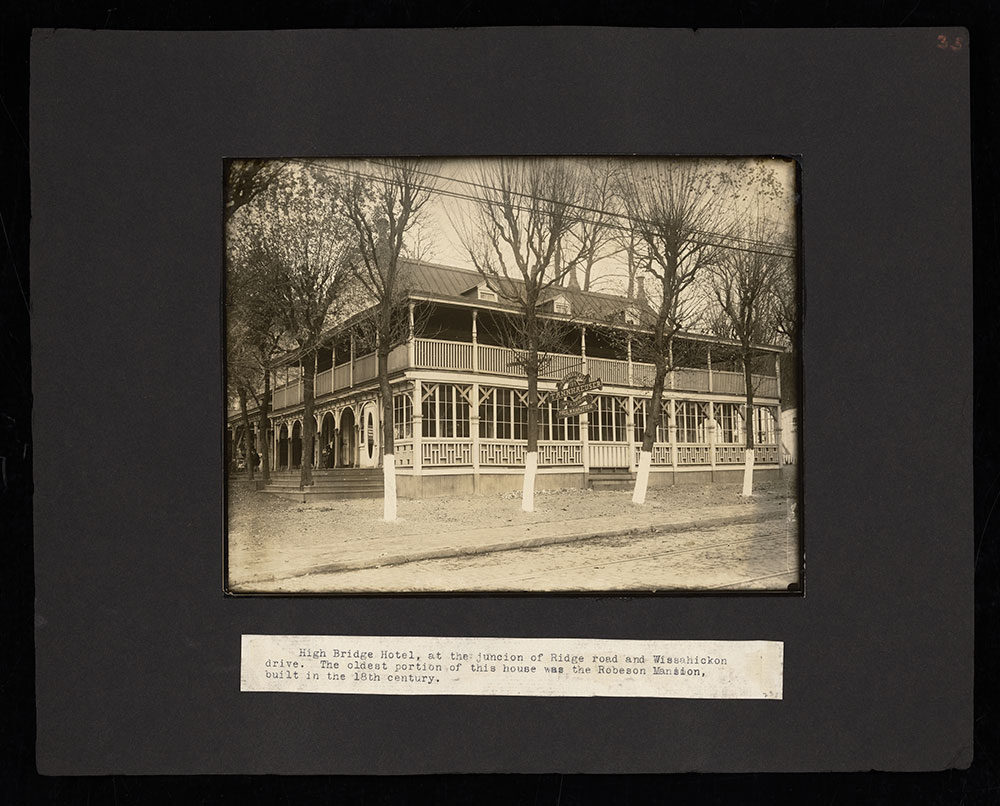
The High Bridge Hotel was a tavern and hotel in the old Robeson stone house at the mouth of the Wissahickon, under the railroad viaduct people called the High Bridge. Period newspapers name the business plainly. On September 30, 1888, The Philadelphia Times reported that Magistrate Lennon placed Peter Valer, of the High Bridge Hotel, Wissahickon, under $600 bail for selling liquor without a license — the same day, in the same item, as William Long of the Maple Spring Hotel, a different house farther up the drive. Help-wanted notices sought a bartender at “High Bridge Hotel, Ridge ave. and Wissahickon Drive.” A Free Library scrapbook photograph is captioned “High Bridge Hotel, at the junction of Ridge road and Wissahickon drive,” and says the oldest portion of the house was the Robeson Mansion, built in the 18th century. It is not one of the seven inns. It is older than all of them, and it stood where the creek meets the Schuylkill, in the shadow of the bridge.
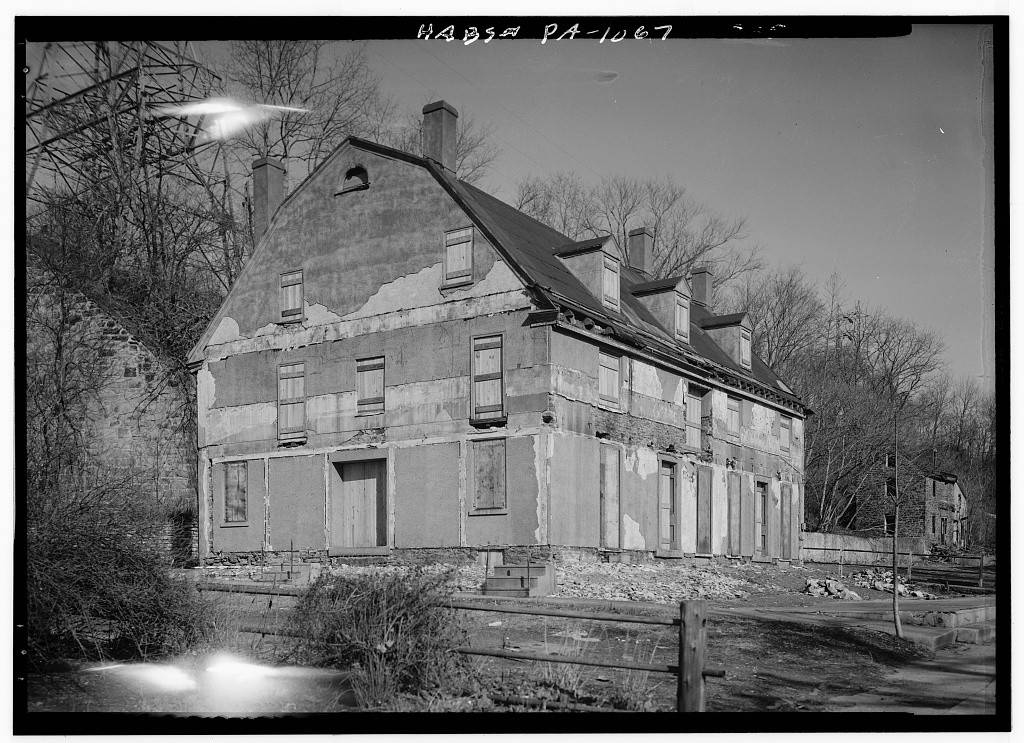
The ground came first, and it came cheap on paper. In 1684 William Penn patented some five hundred acres above Schuylkill Falls, called Shoomac Park, to Robert Turner, at a rent of “one English silver sixpence” a year. The Robesons followed — Andrew senior at the mill, Andrew junior taking Shoomac Park about 1702, and buying a thousand acres from three men in London who held title from Penn for the annual payment, in the genealogy's words, of “one bear's skin forever.” The present house rose in 1759 for Rudiman Robeson; the Logan Papers measure 143 perches of its stone that November. The surveyors of 1961 read it as widened around 1840, from about twenty-three feet across to thirty-eight.
The Revolution passed through the mill, not the hotel — there was no hotel yet, and this page will not invent one. The mill land belonged then to John Vandeerin, who toward the close of his life, the genealogy says, “became deranged”; his estate was sold by the sheriff, and in December 1789 Peter and Jonathan Robeson bought Shoomac Park, the mill, and 263 acres back for $15,400. But before that sale, Washington's Germantown orders of October 3, 1777 sent General Armstrong across the Wissahickon at the head of John Vandeering's mill-dam, and on February 1, 1778 Washington ordered the Wissahickon mills disabled — Vanderen's among them: “take off the spindles and saw off the spikes of the water wheels.” Washington never slept in this house. The record puts his orders at its mill, and that is where this page leaves them. A later tradition, carried in a scrapbook at the Historical Society, holds that Hessians built a redoubt on the bluff behind the homestead during the occupation; it is printed here as tradition, because that is what it is.
Overhead, the bridge kept burning. The railroad's wooden viaduct across the creek mouth was razed by fire in 1862 — the same fire season that took the Dobson mill below it — rebuilt as a temporary trestle, and destroyed again when the old mill burned in 1866. The stone High Bridge that replaced it was begun in 1874, stalled for money, and finished in 1881–82; trains cross its descendant today. The hotel almost certainly took its name from that viaduct overhead. No period sentence says so. It is an inference, and it is labeled one here.
The house became a tavern late and by a side door. John and James Dobson bought the estate in 1864, and James fitted the house as his residence until Bella Vista was built. Fairmount Park bought most of the tract, mill site included, in 1872; the Dobsons kept the house. Thomas Shoemaker, quoted in the federal survey, put it in one sentence: “it was John Dobson who turned Shoomac Park into a tavern.” By 1885 the house had a public name and a public problem. Dana C. Barber, surveying the creek-side houses for the State Board of Health, listed “High Bridge Mansion,” on Ridge Avenue near the mouth of the Wissahickon, separately from Indian Rock, Valley Green, Maple Spring, and Wissahickon Hall — and wrote that it “was said to drain all liquid waste, including that from urinals, into the creek through a 15-inch pipe sewer,” discharging above low-water level and causing “noisome odors in hot weather.” The health officer's own hedge — was said to — is kept, because he kept it.
After Valer came William Lowa. His name survives twice: on the painted beer sign in the Free Library photograph — “The Bergner & Engel Br'g Co's Tannhaeuser — Wm. Lowa — Fred W. Krautter, Successor” — and in E. R. Mustin's reminiscence, written some forty years on from the Prohibition side of the bar. “Across the way from Riverside was William Lowa's High Bridge Mansion,” Mustin wrote — Riverside Mansion being a different house entirely, across the way. Lowa's faced the park drive and Ridge Avenue and was “a popular rendezvous in those days for horsemen all the year around, especially during the sleighing season along the Wissahickon.” By the time Mustin wrote, “it is still there, but only as a restaurant.” The Philadelphia Press of August 11, 1890 had already recorded the name settling: the homestead was “now known as the High Bridge Mansion,” its porch newly added, its great trees felled, its summer house remembered “upon the top of the rocky crag,” and a neighbor, Ezekial Williams, still crying after his ox-cart, “Gee up, there, Jonty Robeson's oxen.” Mustin also remembered the corner's keeper of the peace: the Rev. Charles Albany, a park guard “stationed at this point for over thirty years,” a licensed Methodist exhorter who conducted the little mission at Blue Bell and was known to every Germantown horseman on the drive.
One more family crosses the house, and its story refuses to sit still. Peter Valaer — a chemist, writing about 1969 what his father had told him — set down his theory of how his Aunt Anna met the Alexandria brewer Robert Portner: “according to my father Aunt Anna came to the U. S. to help him in his tavern business in High Bridge Mansion, Philadelphia… It was here she met Mr. Portner, and they were married in Philadelphia.” The marriage itself is solid print: the Encyclopedia of Virginia Biography records Robert Portner's marriage on April 4, 1872 to “Anna von Valer, daughter of Johann von Valer, a native of Switzerland,” and the 1888 newspaper's Peter Valer matches that von Valer spelling closely enough that the keeper of the High Bridge and the brother of the memoir are probably one man. Probably — not proven. And the meeting has rival tellings. Later Portner biographies place the 1869 meeting at the Vine Street brewery and winter garden of Anna's brother Jacob — McElroy's 1867 directory does put Jacob Valer's Winter Garden & Concert Hall at 722–726 Vine, with Peter at 724 Vine — and one later account has Portner meeting Anna while dining at Christian Mathis's home in Manassas. There is a tension underneath all of it: if Shoemaker is right that the tavern at Shoomac Park dates from after the Park purchase of 1872, an 1869 meeting in its bar sits a little early. This page keeps all three tellings and the tension with them. It does not choose.
The end came in two acts, twenty years of vacancy and argument apart. An undated scrapbook notice — its year is not on the clipping, and this page will not guess one — tells of a Sunday-morning fire at “the High Bridge Hotel, at Ridge avenue and Wissahickon Drive”: the old structure, “which antedates the Revolutionary War, has been vacant for two years, and is supposed to have been set on fire by sparks from a locomotive in the Reading Railway.” Engine Company No. 35 answered. Yet the house was still standing for the genealogist in 1913, “only slightly altered… now a wayside Inn,” its original doors, windows, and mantels in place, its brass fireplace scrolls already gone south — “still in use, tho' now doing duty in Florida, at the home of one of the Robeson descendants.” In December 1956 the Park Commission voted its destruction; the Inquirer, as the vote was cited, found the Shoomac Mansion of “no particular architectural design nor historical significance,” and within the week Senator Stiefel had sued to preserve it. The suit's outcome is not in the sources this page rests on, so it is not printed here. What is printed is the federal survey of April and May 1961: present use, “To be demolished May 1961”; condition, “Very poor”; fourteen fireplaces, all closed off; seven original built-in cupboards with their trim “lost through vandalism”; and of all the house's hardware, only its H-L hinges surviving. It was razed that May. The corner keeps the name the trains still use. The house keeps nothing but its papers.