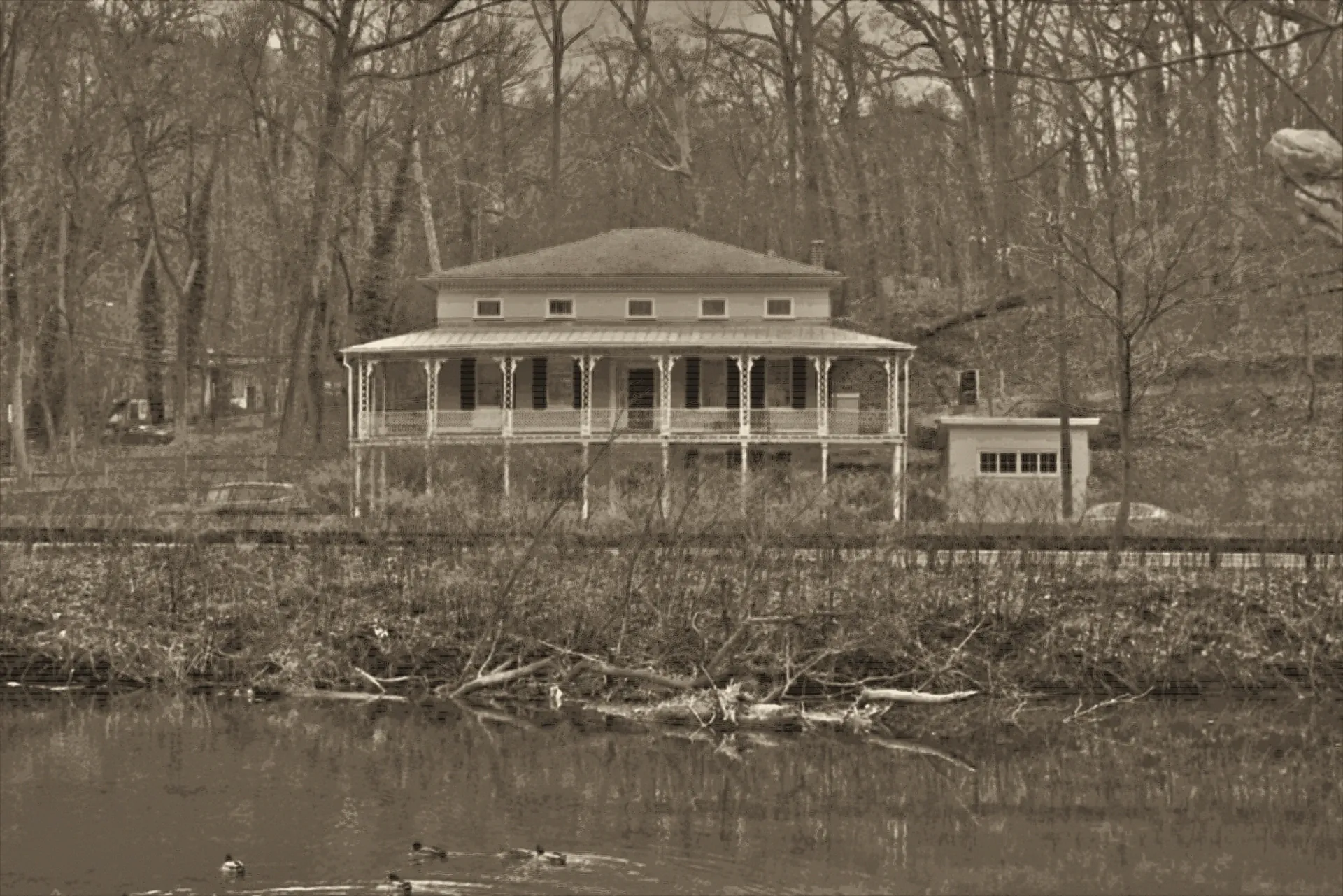
Henry Lippen built the Hall about 1849, on the drive below Gypsy Lane, and built it grand: the wealthy came down the gorge in sleighs all winter and in carriages all summer, the stables faced the creek, and a cable ferry carried his patrons across the water for five cents. The photographers of 1868 found a white house behind the trees, a low white wall, and a hand-made sign advertising German bitters.
The records cannot even hold the builder's name steady. The Library Company's catalogs call him Harry Lippen and modern accounts say Henry. Harry is short for Henry, so they are taken to be the same man. An Evans watercolor caption of 1870 is even less sure: “Lippen or Lippman.” The city's 1884 survey lists the house as “Nippin's Wissahickon Hall,” a name in no directory and probably a misprint for Lippen.
What the house looked like in its prime, the photographers of 1868 to 1870 recorded: stereograph views of the drive and the stables, a hand-made sign advertising Hoofland's German Bitters, a canoe lying upside down by a stable in James Cremer's view, and the Evans watercolor of 1870 — the white building behind the trees, a low white wall, a horse-and-carriage shelter at its end. The ice houses, the empire underneath the elegance, no camera ever caught.
The elegance floated on ice. Lippen cut the creek's winter skin by the thousand tons and stored it in two ice houses — an empire of cold that paid for the music. No photograph of the ice houses is known. The house can be seen today; the ice business is known only from paperwork.
The paperwork is not kind. In 1884 the city's survey wrote of this house: all wash water direct to creek; the kitchen garbage — lemon skins, oyster shells — heaped on the brook bank above it. The grandest house on the drive, fouling the water like the rest.
In 1885 the Park took the ground, and Henry's son Charles fought the taking the way a man fights for a house that is also a business. The Commission offered a lease at two thousand a year, the ice to be gathered "for family purposes only." Charles countered at one thousand. He was evicted. The Hall's run as an inn ended in a sheriff's sale.
Its second life was a promise. The Park leased the shut house to Nicholas Hayes — boatman and liquor dealer, by the directories — on a no-liquor agreement. In 1890 a newspaper accused him of selling liquor in the Hall without a license. No copy of that clipping is known, so the accusation can't be proven or disproven.
When the Hall stopped being an inn, the accounts refuse to merge. MacDowell's Story of Philadelphia, in 1900, already calls it “a shelter and a guardhouse.” Gopsill's business directory for 1901 still lists it among the hotels, with John Dorn as keeper. An early guidebook of the new century split the difference without knowing it: “an early roadhouse but now serving as a barracks for the Park Guard,” standing across the creek from a boat landing. By 1910 the guard post is proven, and in January 1920 the papers carried a proposal to move the guardhouse out of the Hall — the guard, plainly, still in residence.
Fire took its share on a day the record keeps badly — the city's accounts settle a loss for this house in April 1927, and a settlement date is not a fire date. Then the law moved in, and stayed: a barracks for the Park Guard, a guardhouse into the 1970s, a police station after that. The grandest house on the Wissahickon spent the twentieth century with a log book on its desk.
The twentieth century kept repairing what it would not reopen. The WPA era brought extensive repairs. The guardhouse years ran into the 1970s; then the house became a police station — headquarters of the 92nd District in the 1990s — until the officers moved out in 2008 and the park's tree crew took the keys. In the 2020s the city voted it real money again: $776,000 for facade and mechanical repairs, a two-phase project for columns, framing, porch decking, gutters, windows and marble plinth, a new boiler in 2023 — this after a car crashed into the building in the mid-2010s and Hurricane Ida flooded its first floor in 2021. It stands on the Philadelphia Register of Historic Places. It is also, still, shut.
It stands yet — repaired at the edges now, seven hundred thousand dollars of mending voted to it — and it admits no one. It has been closed to the public for about fifty years.