Riverside Mansion was a hotel in an old Robeson family house on the river side of Ridge Avenue, just above the mouth of the Wissahickon. It began as Milverton, a house Peter Robeson built on the opposite side of Ridge Road from Shoomac Park, for his son Andrew. It became a day resort with a steamer landing on its own bank. It is not one of the seven inns of this site, and it is not the High Bridge Hotel — that house stood across the way, and the two are kept apart on this page, as the records keep them.
After Andrew and his family left for New Bedford, Massachusetts, in 1817, Milverton was a summer home, then a permanent home until 1845, for Peter's daughter Sarah Ann Robeson Lea and Joseph Lea. Their daughter Mary C. Lea Minster then made it her home for about thirty-five years. The family genealogist, Kate Hamilton Osborne, wrote while the house still stood. She called it “a double house with large central hall, and large rooms,” “surrounded by many varieties of unusually fine trees,” and “still in a good state of preservation” — and she recorded what it had become: “now used as a hotel, and called ‘Riverside Mansion.’”
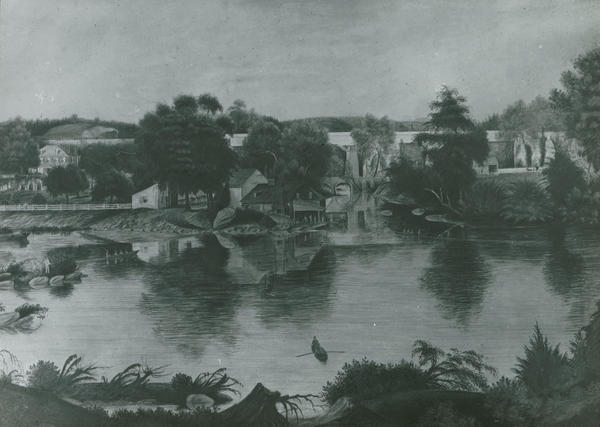
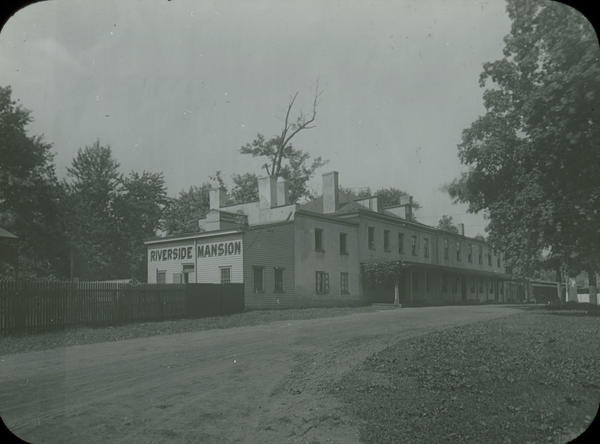
John G. Bullock photographed it about 1913: an unusually broad, two-story mansion seen from a dirt drive, with the words “Riverside Mansion” painted on the side addition. Bullock had married Rebecca Malin Downing, a Robeson descendant, and for Osborne's book he also copied a painting of the house as Milverton — the view from the west bank of the Schuylkill looking northeast, the Norristown Railroad Bridge and the Ridge Avenue Bridge behind it, another house on a hill to the north. The Library Company's catalog note on his photograph adds one line: the house was occupied by a beer garden operated by John F. Betz some time after 1880.
The period atlases keep the ground plan plain. Bromley's 1895 atlas, on the river side of Ridge — the plate labels the road Main Ave — just above the Wissahickon mouth, prints “John F. Betz” and “RIVERSIDE MANSION” over a substantial building compound between the road and the Schuylkill. On the shore of that same parcel it prints “BOAT LANDING.” At the point where the creek meets the river, still on this parcel, it prints “FISH HOUSE” on a separate small building — not this house, and not the mill downstream of it. Across the creek, separately labeled, stands “HIGH BRIDGE HOTEL,” next to land labeled for Jas. Dobson. The 1910 atlas still prints “RIVERSIDE MANSION” and “John F. Betz Est.” on the parcel, the building cluster still standing — which fits Osborne, in 1916, calling it a hotel still.
What kind of hotel, the state's own engineer recorded. Dana C. Barber, surveying for the State Board of Health in 1886, described Riverside Mansion as “a day resort and stopping place for teams passing from the East Park to Wissahickon drive, having grounds bordering the river just above the mouth of Wissahickon creek; and containing the upper landing of the Fairmount and Wissahickon steamers.” On hot summer days it was sometimes patronized by more than six hundred people in one day. The steamers ran from Fairmount — from just above the Fairmount Dam, in a modern local history's words — up the river to the landing on this bank. A later historical society account, citing an 1881 Manayunk Chronicle piece this page has not opened, gives the service in detail: five boats of the Fairmount Steamboat Company running hourly from Fairmount to Riverside Mansion, twenty cents round trip, the last return at 9 p.m., or 10 p.m. on moonlight nights. Those details are printed here as that citation gives them, not as a page this site has read. In winter the resort kept its crowd: a 2014 local paper, quoting the Philadelphia Times of January 2, 1881, names Riverside Mansion among the sleighing-season hostelries crowded that day — again a quotation at one remove, and labeled as such in the cellar.
Barber was not writing a travel guide. He was tracing what the creek-side and river-side houses poured into the water, and at Riverside Mansion the wash and waste water, and the waste from the men's urinals and water-closets, went directly to the river by pipe — about two and a half miles above the Belmont pumping station and three and a half above Spring Garden. He called it one of the most dangerous sources of pollution in that investigation. The law followed. In Commonwealth v. Soulas, November 26, 1884, Judge Thayer told the jury the premises were “situated upon the bank of the Schuylkill river just above the confluence of the Wissahickon with that stream,” and the defendants stood charged with maintaining a common nuisance for draining excrement and foul water into the river. The jury found the proprietors, Messrs. G. & C. Soulas, guilty without leaving the box. Sentence was suspended so they could abate the nuisance, and afterward a well or cess-pool for the water-closet drainage was made.
A generation later, E. R. Mustin set down what he remembered of the place, and his memory is vivid: a beer garden with a statue of Bismarck, a carousel running seven days a week, fireworks and balloon ascensions, steamers by name, John F. Betz as owner, and keepers named Allan R. Warren, Pat Dempsey, and Richard Patterson — and a “Divine Healer” named Schroeder who spent three winter months there. This page prints those as Mustin's reminiscence, because that is what they are. Some of it checks against the paper record: Betz's name is on both atlases, the beer garden is in the Library Company's catalog, the statue is in a 1917 newspaper, and the steamers and landing are in Barber and Bromley. The keepers' names, the healer, and the balloons rest on Mustin's word alone.
The house also drew fighters. In December 1900, newspapers as far off as Topeka and Lewiston placed Gus Ruhlin's training quarters at Riverside Mansion. In February 1915 the Evening Public Ledger reported that Kid Williams “will” finish training at “the Riverside Mansion Fairmount Park, where Battling Nelson and Terry McGovern worked out for their bout here in 1906.” Williams's stay is a plan printed in a newspaper, not proof he arrived, and this page prints it as a plan. Nelson and McGovern are printed as the paper reported them; no 1906 source for that bout has been opened here.
The statue's end is dated, even if the house's is not. On July 30, 1917, the Evening Public Ledger reported that a 1,200-pound statue of Bismarck had been torn down from in front of “the old Riverside Mansion” near Ridge Avenue and East Park Drive. Joseph Scherf of 4420 Cresson Street, a Pencoyd employee, took the iron cross; the statue was to be melted at Pencoyd for war work. The item confirms the statue stood at this house, and it calls the mansion “old” by 1917. It does not date the demolition. No source this page rests on does. The house is labeled standing in 1910; Osborne calls it a standing hotel in 1916; it is “old” in 1917; Mustin later said it came down with Prohibition. By 1942 a city land-use map labels the river-side tract “Carnegie-Illinois Steel Corp.” and “Pencoyd Iron Works” — an industrial label that proves what the tract was called in 1942, not when Pencoyd acquired it or whose crew took the house down. A 1962 map labels the tract “Empire Ordinance Corp.,” in the map's own spelling, with a strip along the creek marked “P.T.C.” — the Philadelphia Transportation Company, SEPTA's predecessor. That strip may be the earlier, smaller bus loop. It is printed here as a possibility, nothing more.
What stands in that vicinity now is a bus station, and the record of how it got there is exact. By the time SEPTA built, Restaurant Depot stood on that spot. The Times Herald reported on February 14, 2022: “SEPTA has purchased the 4-acre Restaurant Depot next door, has demolished it, and will build the new transit center there.” SEPTA demolished Restaurant Depot, not the mansion. SEPTA's own release puts the new Wissahickon Transit Center at 5000 Ridge Avenue: service began Sunday, December 14, 2025, with a ribbon-cutting Monday, December 15; the project cost about $50 million, construction began in spring 2023, and the center is more than six times the size of the former facility. So the safe sentence is the plain one: SEPTA opened a new transit center at 5000 Ridge Avenue in December 2025, on the river side of Ridge at the mouth of the Wissahickon — the same vicinity as the old Riverside Mansion. It has not been shown that the new building covers the mansion's foundation or all of the historic grounds. And next door, the mill that became the Philadelphia Canoe Club, at 4900 Ridge, still stands — a different building from this house, as a 1915 newspaper already kept them: Colony Castle the mill, Riverside Mansion the house.