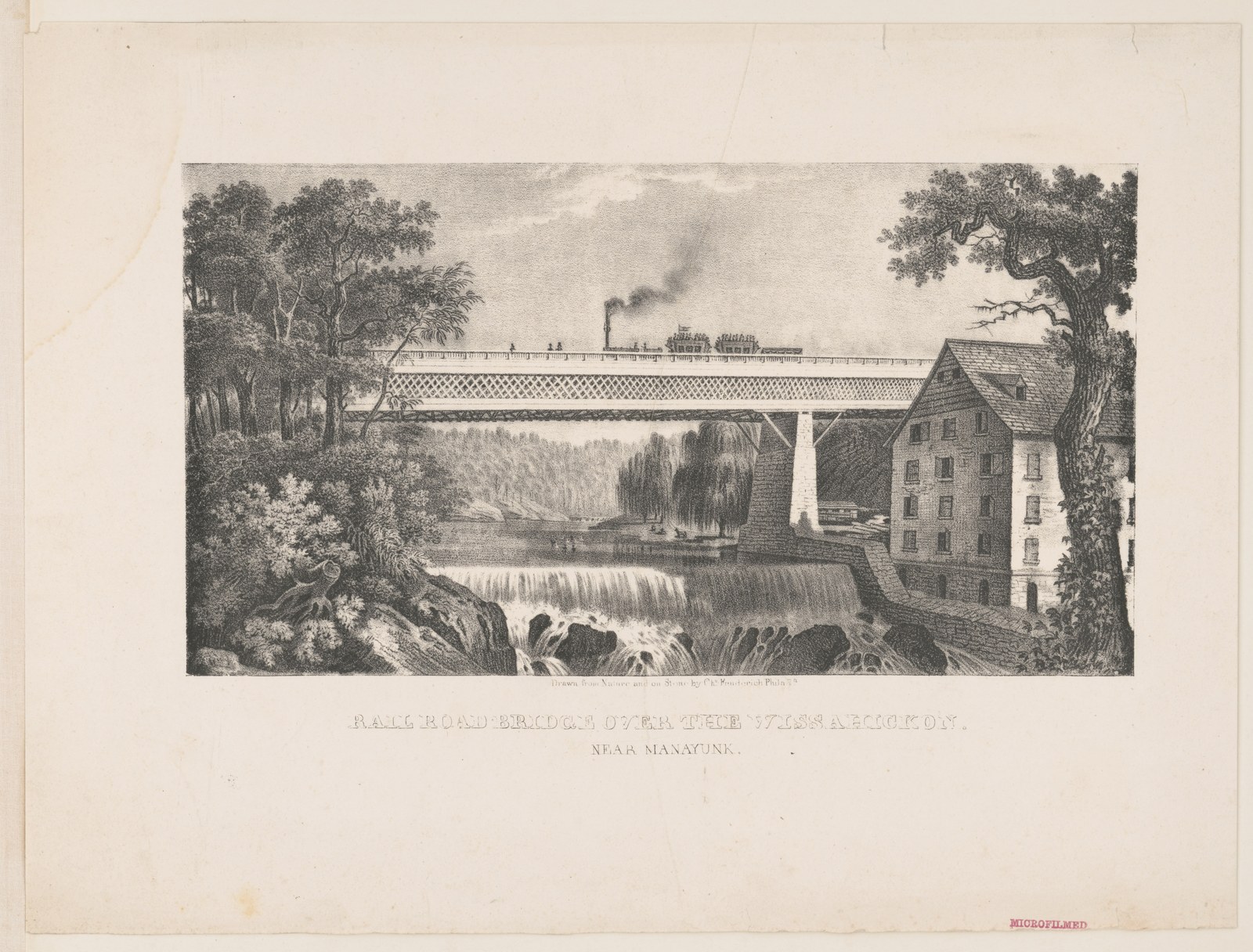
The Robeson grist mill stood on the north side of Ridge Avenue, where the avenue crosses Wissahickon Creek at the creek’s mouth — the northwest corner of Wissahickon Road and Ridge Avenue, in old Roxborough Township. Today the ground is parkland inside Fairmount Park; the Ridge Avenue bridge, a three-span stone arch built in 1888, stands near the site. The grist mill was the largest building of the Robeson mill complex. Its sister works — a sawmill, a nail factory, and a rolling mill — stood across the water on the west bank.
Two traps wait at this seat, and both are named here at the start. Ellet’s map of the county, printed in 1843, labels this mill “Robinson’s Mill.” That is a misspelling of Robeson, not a different mill. And across the creek stands the old rolling mill building — the one building of the complex still standing, home today to the Philadelphia Canoe Club. It is a separate seat. The fire that ends this story burned the grist mill north of Ridge Avenue, and it is never attached to the rolling mill.
Nothing of the grist mill stands today.
Three mills under one roof
The first mills at the creek’s mouth were built by Richard Townsend, with Joshua Tittery and, from 1689, John Tysache, on leased ground. On July 11, 1691, Andrew Robeson and Charles Saunders bought the mills and the 500-acre tract called Shoomac Park from the partnership and Robert Turner.
About 1697 the great grist mill went up, north of the earlier corn mill. A 1930 article, “Redmens Trail,” quoted in Griffin Affel’s study of the Robeson mills, says it had three waterwheels “under the same roof,” and that at one time those wheels drove five millstones.
When the partners’ land was divided — the Writ of Partition, confirmed by the court on March 4, 1703 — the writ called the holding “One Water Corn Mill & Millns (Being three Grist Mills under one Roof) Commonly called or known by the name Wessahickon Mills.” The 200 acres were split between John Van Laer and the Saunders heir, with the 8-acre mill lot held jointly. Andrew Robeson Jr. took 96 acres and half the mill lot in 1703.
The mill shrank on paper. A deed of September 22, 1748, describes the mills as “two grist mills with two pairs of Stones under one Roof,” and gives a name change in the same breath: “sometimes called or known by the name Wissahickon Mills and now called Roxborough Mills.” The standard accounts print the 1702 description only.
Two dams served the complex. Wm. M. Runkel, remembering the creek as it was about 1821, wrote: “The lower dam was built to supply the saw and grist mill on the left bank, and the upper one the grist mill on the right.” A new dam was built in 1821 in place of the original dams. The Robeson estate plan of 1835–38 shows the mill race flowing under Ridge Road, the sawmill’s tail race feeding the rolling mill’s pond.
A landmark in Washington’s orders
In the Revolutionary years the complex was also called Vandaren’s Mills, after John Vandaren, the tenant who ran it. When Washington ordered the attack on Germantown, his General Orders of October 3, 1777, used “the head of John Van Deering’s mill dam” as a landmark for the march.
Two classic accounts disagree on where the name belongs. Daly (1922) ties “Vanduring’s” to a different mill — the Vandaren and Enoch Rittenhouse grist mill near Hermit’s Lane. Brandt (1927) puts “Vandaren’s Mills” here, at the creek mouth. Both readings stand; the Hermit’s Lane mill is a different seat.
The flour mill
The Robesons recovered full ownership of the complex by a sheriff’s deed of December 6, 1789, and a deed poll of March 6, 1790. Peter Robeson (1748–1833) then held the works for over forty years.
By then the grist mill was a merchant flour mill — a mill that bought grain and sold flour. The 1820 Census of Manufactures carries a separate return for Peter Robeson’s flour mill, 200 yards upstream of the rolling works. The water measurements taken in 1822, for the Robeson lawsuits against the Schuylkill Navigation Company, list the complex’s second power as the “Merchant and Grist Mills,” on three wheels.
When Peter died, the land passed to his sons Andrew (died 1862) and Jonathan (died 1859), a third each, with their brother-in-law John Moore and his wife Katherine, born a Robeson, holding the third share.
In 1848 Jonathan Robeson sued the Schuylkill Navigation Company over the second raising of its dam, charging that it had cut the flow to the mill race, “making it inoperative.” The great flour mill’s power was giving out fourteen years before the fire.
The fire
The grist mill burned in August 1862. This project’s records fix the day: August 12, 1862 — though no source read for this story gives the day itself. Affel’s study states the month and year twice, in the same words: “the main Mill North of Ridge Avenue burned down in August of 1862.” The day is the project’s locked ruling, and it controls.
One account disagrees, and it is printed here. The Ridge Avenue Roxborough nomination says the Dobsons bought the property in 1864 and “the old mill burned in 1866.” The purchase year is right; the fire year is treated here as an error. The mill that burned in 1866 was a different one — the Lees/Towers mill near Wissahickon station, which burned on February 25, 1866. And the insurance surveyors drew the Dobson carpet mill already standing on this seat in 1866, which fits a rebuild after an 1862 fire, not a mill that burned that year.
And the fire belongs to this seat alone. The rolling mill across the creek — the building that still stands — did not burn. When the Dobsons bought this seat two years later, their purchase expressly left out the 8-acre rolling-mill lot. The old building was never theirs.
Perseverance Mills
In 1864 the seat was sold. The Robeson brief of title, quoted in Affel’s study, names the buyers as John and Joseph Dobson, who took the large mill by the railroad and some 235 acres with it. Every other source read — the insurance surveys, the East Falls Historical Society, the city’s 2018 Dobson houses nomination — knows the brothers as John and James Dobson. Whether “Joseph” was a third brother, a copying error, or another relative, nothing read resolves. The working firm on the seat from 1866 is John & James Dobson.
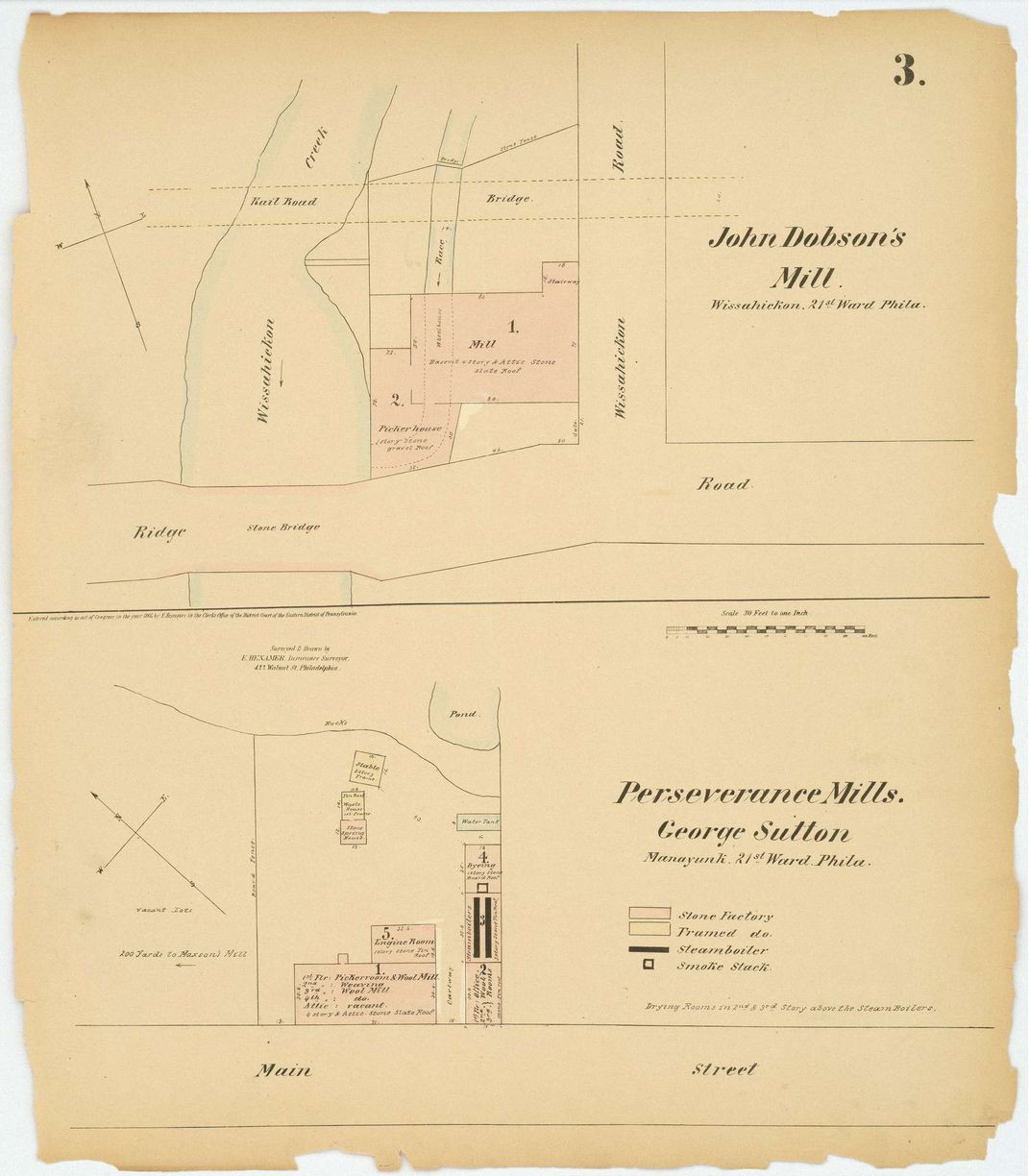
The Dobsons rebuilt the seat as a carpet mill. In 1866 the Hexamer insurance surveyors drew “John Dobson’s Mill” at the northwest corner of Ridge Road and Wissahickon Road, making textiles and carpets. The GeoHistory Network’s record of that survey gives the plant a name of its own: “Perseverance Mills” — a name the usual Dobson accounts never carry. A second survey, in 1869–70, lists “Wissahickon Mill — Dobson, John & James,” in Ward 21, still making carpets.
John Dobson (1827–1911) was an English immigrant who had worked in the mills of Oldham as a child. With James he won, at the outbreak of the Civil War, one of the largest contracts to make woolen blankets for the Union Army — an Army of the Potomac contract, by the East Falls Historical Society’s account. Twice during the war John left the mills to lead a company of Pennsylvania Volunteers, the “Blue Reserves,” into the field.
Keep the two Dobson plants apart. The famous Dobson Mills — the National Register district at 4001–4041 Ridge Avenue and Scott’s Lane, in the Falls of Schuylkill — is a different plant, built from 1855 on the Schuylkill side and first powered by Dobson’s Run, a small stream now culverted under the lane. It stands on no Wissahickon water. The big numbers attached to the Dobson name — 6,000 workers, or 11,000; the sources disagree — belong to that later complex. No count of workers or output for the creek plant was found in anything read.
The seat had a strange neighbour in those years. In 1866 a broadside proclaimed that oil wells were being drilled at the junction of the Schuylkill and the Wissahickon, one well pumping fifty barrels a day.
The end
The Fairmount Park Commission began acquiring the valley’s mill sites in 1868, and Gibson’s Workshop of the World lists “Dobsons’ Mill (formerly Townsend’s 2nd mill)” among them. The Commission’s own property files hold a “Dobson Tract” acquisition file — but those files are paper records, not online: a permanent gap under this project’s online-only rule.
The East Falls Historical Society’s history states that the creek-side Dobson mills were demolished by the Fairmount Park Commission in 1872, and that the firm rebuilt at Scott’s Lane. That is carried here as the Society’s statement, not as a proven fact about this parcel: the solid record proves the taking, and no deed, award, or Commission report for this ground was read online. The sentence also mixes the two plants — the Scott’s Lane complex was built in 1855, before the creek purchase, and was never demolished in 1872.
A photograph dated 1923, reproduced in Affel’s study, notes that by then “all but one of the mills on the Wissahickon had been demolished” — the one survivor being the rolling mill building across the creek.
Today there is nothing of the grist mill to see. Stand at the Ridge Avenue bridge, at the creek’s mouth, and you are standing by the seat of the Wissahickon Mills — three mills under one roof, a flour mill, and Perseverance — under park grass.
Timeline
| Year | Event | Source |
|---|---|---|
| 1691 | Andrew Robeson and Charles Saunders buy the mills and the Shoomac Park tract, July 11 | Affel study, chain table |
| c. 1697 | The great grist mill is built: three waterwheels under one roof, driving five millstones | “Redmens Trail” (1930), via Affel |
| 1702 | The Writ of Partition calls the holding “three Grist Mills under one Roof,” named Wessahickon Mills | Affel study, quoting the writ |
| 1748 | A deed describes two grist mills with two pairs of stones, “now called Roxborough Mills” (September 22) | 1748 Whitpaine deed, via Affel |
| 1777 | Washington’s General Orders name “the head of John Van Deering’s mill dam” (October 3) | The Papers of Alexander Hamilton, vol. 1 |
| 1789–90 | The Robesons recover full ownership: sheriff’s deed (December 6, 1789) and deed poll (March 6, 1790) | Affel study, chain table |
| 1820 | Peter Robeson’s flour mill stands in the Census of Manufactures | 1820 schedules, via Affel |
| 1821 | A new dam is built in place of the original dams | Affel study |
| 1848 | Jonathan Robeson sues the Schuylkill Navigation Company over the race’s failing flow | Affel study |
| 1862 | The grist mill burns — August 12 by this project’s locked ruling; the sources give August 1862 | Affel study; project ruling |
| 1864 | John and Joseph Dobson (brief of title) buy the mill seat and some 235 acres | Robeson Brief of Title, via Affel |
| 1866 | Hexamer surveys the rebuilt carpet mill: “Perseverance Mills” | Hexamer Vol. 1, Plate 3 |
| 1869–70 | Hexamer again: “Wissahickon Mill — Dobson, John & James,” carpets, Ward 21 | Hexamer Vol. 5, Plate 377 |
| 1868 | The Fairmount Park Commission begins acquiring the seat (“Dobsons’ Mill”) | Gibson, Workshop of the World |
| 1872 | The creek-side Dobson mills are demolished, per the East Falls Historical Society’s history | A History of East Falls, via the University of Pennsylvania finding aid |