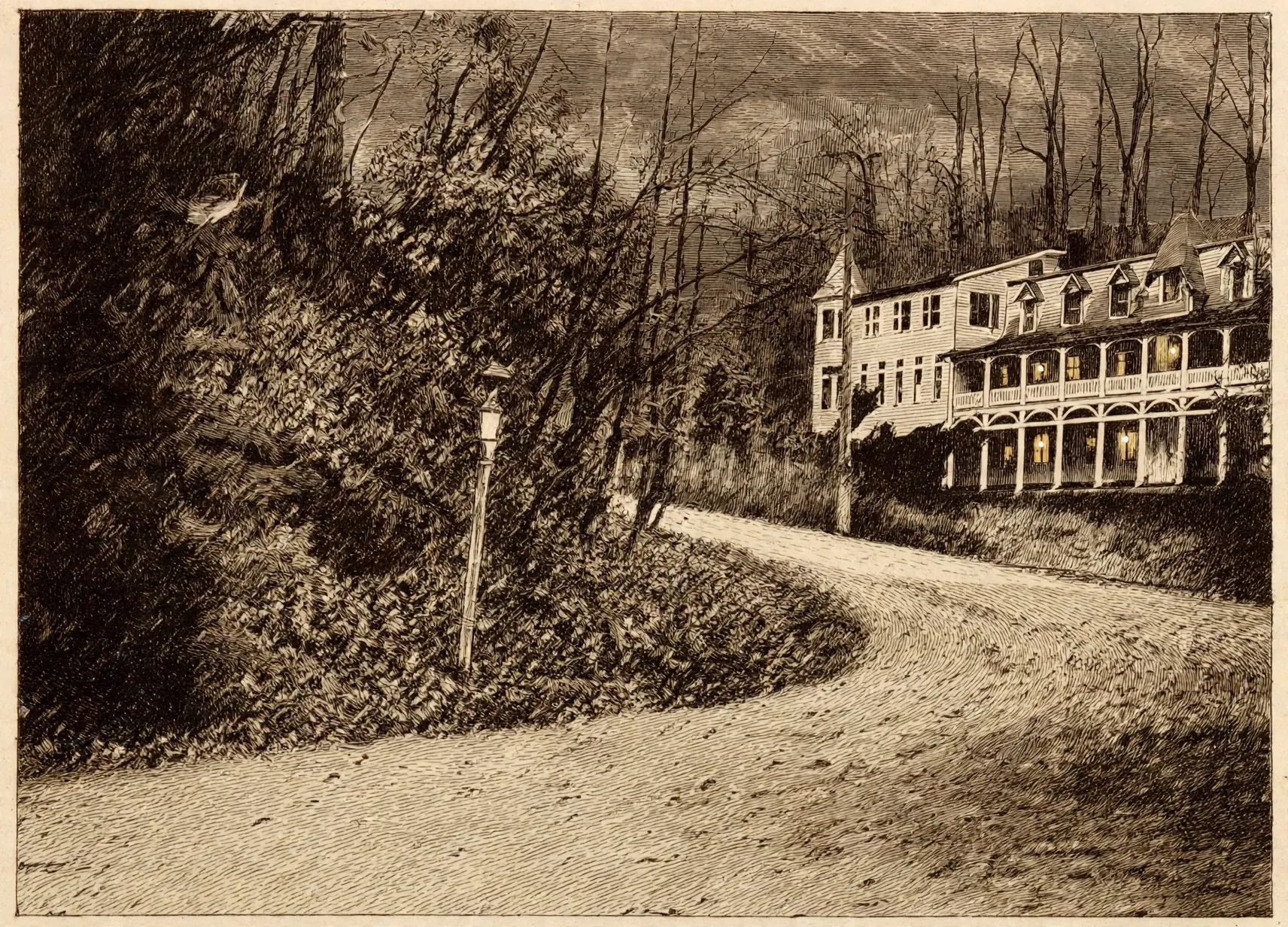
There were two Indian Rocks. The first was Rube Sands's famous house up at Rex Avenue. The second stood here, at the foot of Monastery Avenue, deliberately outside the park's boundary line. According to the one printed account, that let it keep what the park's houses could not. It was, that account adds, a famous resort for tally-ho parties: the big wagons, the horns, the long pale house at the end of the curving drive with its two storeys of arched porches.
Who built it? Three answers exist, and none is proven. One library history gives it to Reuben himself, opened in the early 1870s after the park bought his first house. The valley's own history gives it to his widow Catharine, built after the first house closed in 1887. A third caption dates it 1870, before either story can start. Reuben died in August 1884, which clears him out of any building done after that year. Catharine's own trail is thinner still: one directory year, 1887, a hotel at Chestnut Hill — and by 1893 she is gone from the books. Her own will papers have since changed that: in a codicil added to her will in October 1887, Catharine Sands named her "present Stand" at the corner of Monastery Avenue and Magdalena Street, near the drive, "also known as the Indian Rock Hotel," and her executors' petition records that she died at the hotel, at Monastery Avenue and the drive, on November 21, 1887. The keepers after her were Barbara Tresch, Charles Weingartner and William Lowa, and in 1915 the park bought the property out of Dr. William J. O'Brien's ownership.
The widow herself is nearly as hard to find as her house. Her one solid listing comes in 1887, the year the first house is said to have closed: the hotel lists name “Indian Rock, Catharine Sands, C Hill,” and the directory gives “Catharine, hotel, C Hill” — Chestnut Hill, not Monastery Avenue — with a Harry J. Sands clerking at the Indian Rock. He was her son — Harry Jefferson Sands, entered as her son in the 1880 census and named "my Son" in her will, which left him a third of the hotel's profits for life so long as he kept the peace. By 1893 she is gone from the directory — she had died in November 1887. The widow's second house is no longer only a local story: her probate papers place her hotel, and her death, on Monastery Avenue itself. What the papers do not say is who built the house, or when she first stood at it.
The keepers the paper does name are other people. In October 1892 the proprietress here was Mrs. Barbara Tresch, and she was expanding: a twelve-room annex with a banquet hall. The builders' paper calls it two storeys; the permit it printed a fortnight later says three, thirty-seven by fifty-three feet. Both are in the file. Charles Weingartner kept the house in 1894. On 26 June 1901 the property changed hands — Tresch to Katharine Lowa, twenty-six thousand five hundred dollars — and the Lowas were still keeping it past 1911.
The keepers after Tresch are named, too. Charles Weingartner holds the house in 1894 and again in 1899. On June 26, 1901, Barbara Tresch sold the property — Monastery Avenue with Magdalena Street frontage — to Katharine Lowa for $26,500, and the Lowas kept the house past 1911, when the directory still lists “Lowa Wm (Indian Rock Hotel)” at the drive and Monastery Avenue. George B. Tresch, who died in July 1890, was named in his death notice as “proprietor of the hostelry at Valley Green, near Indian Rock” — a building the notice leaves ambiguous — and Barbara was in all likelihood his widow. In all likelihood, it is not proven.
For the end, the paper is thin, but it is not the blank it once seemed. The park's own guidebook of 1915 directs travellers to the spring on Monastery Avenue, "opposite Indian Rock Hotel." The same guidebook in 1917 directs them to the spring, and the hotel is not in the sentence. Between those two printings the house steps out of the record. A newspaper fills part of the gap: the Forecast of 25 February 1915 reported that the Fairmount Park Commission had bought the Indian Rock Hotel, at Monastery Avenue and the drive — offered to the park for $25,000 by William Macdonald, a real estate broker. Dr. William J. O'Brien had bought the hotel and the land around it some years before, and two and a half acres of the property had been condemned back in 1896. It is a newspaper report of the purchase, not the deed itself.
No deed of the taking has been found, and the final award — who was paid for the ground, and how much — is still missing. A Chadwick column of 1933, a later account, says a Board of Viewers met in 1916 on damage claims that included this hotel. Local historians say the house operated until the park's boundaries were expanded in 1916; a library record says it was razed before 1916. Neither is proven.
There may even be a picture. Brandt's history of the valley, in 1927, prints a photograph captioned “THE SECOND INDIAN ROCK HOTEL — Built at the foot of Monastery Avenue.” It is the only image that claims to be this house. Photo captions on this creek have been wrong before (a library slide record puts the first hotel's name on the Wissahickon Hall building), so this identification is unconfirmed.
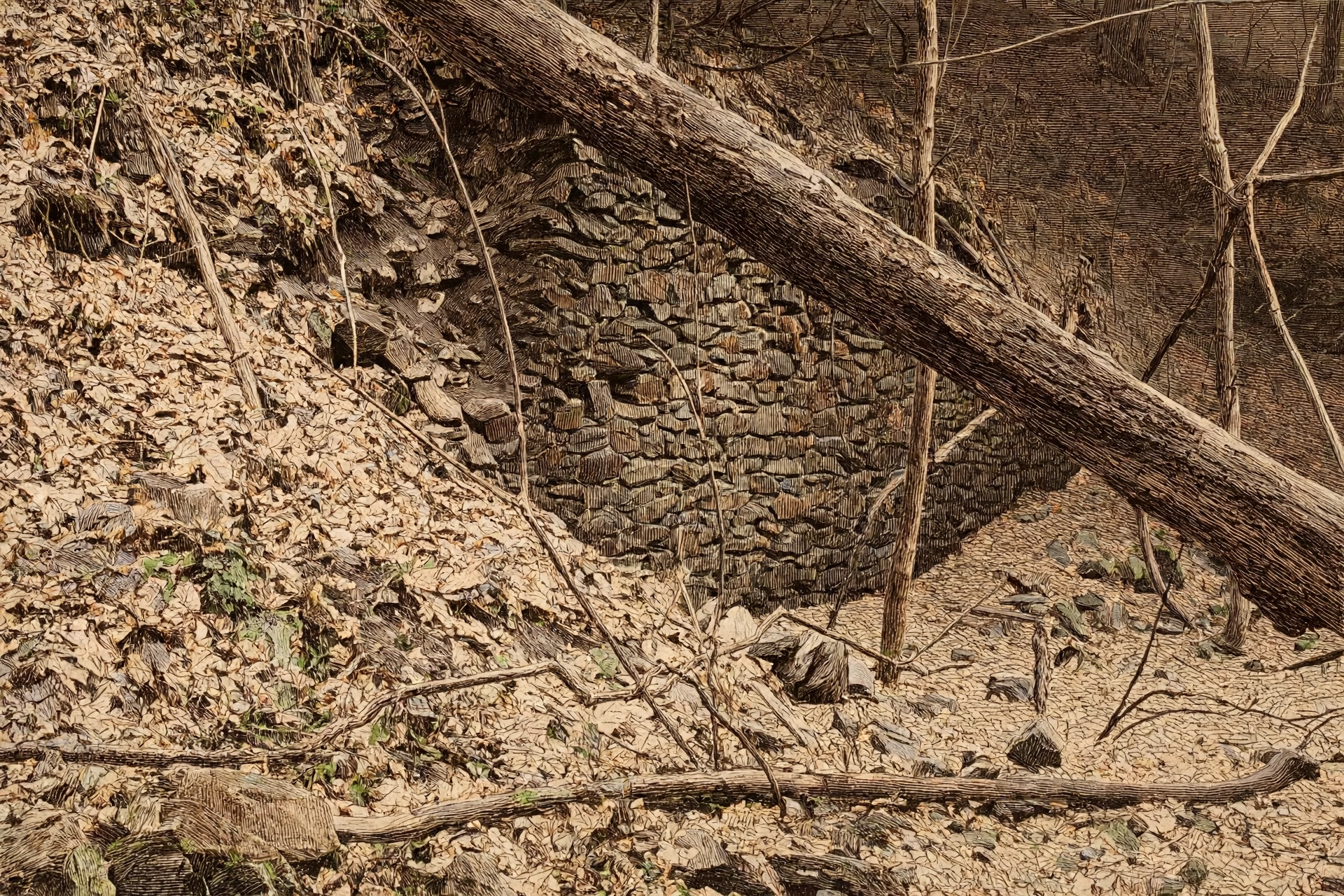
What is left is a stone wall in the hillside, a spring across the drive, and a file of papers that do not agree. It lays the evidence on the table, and lets the house stay argued.