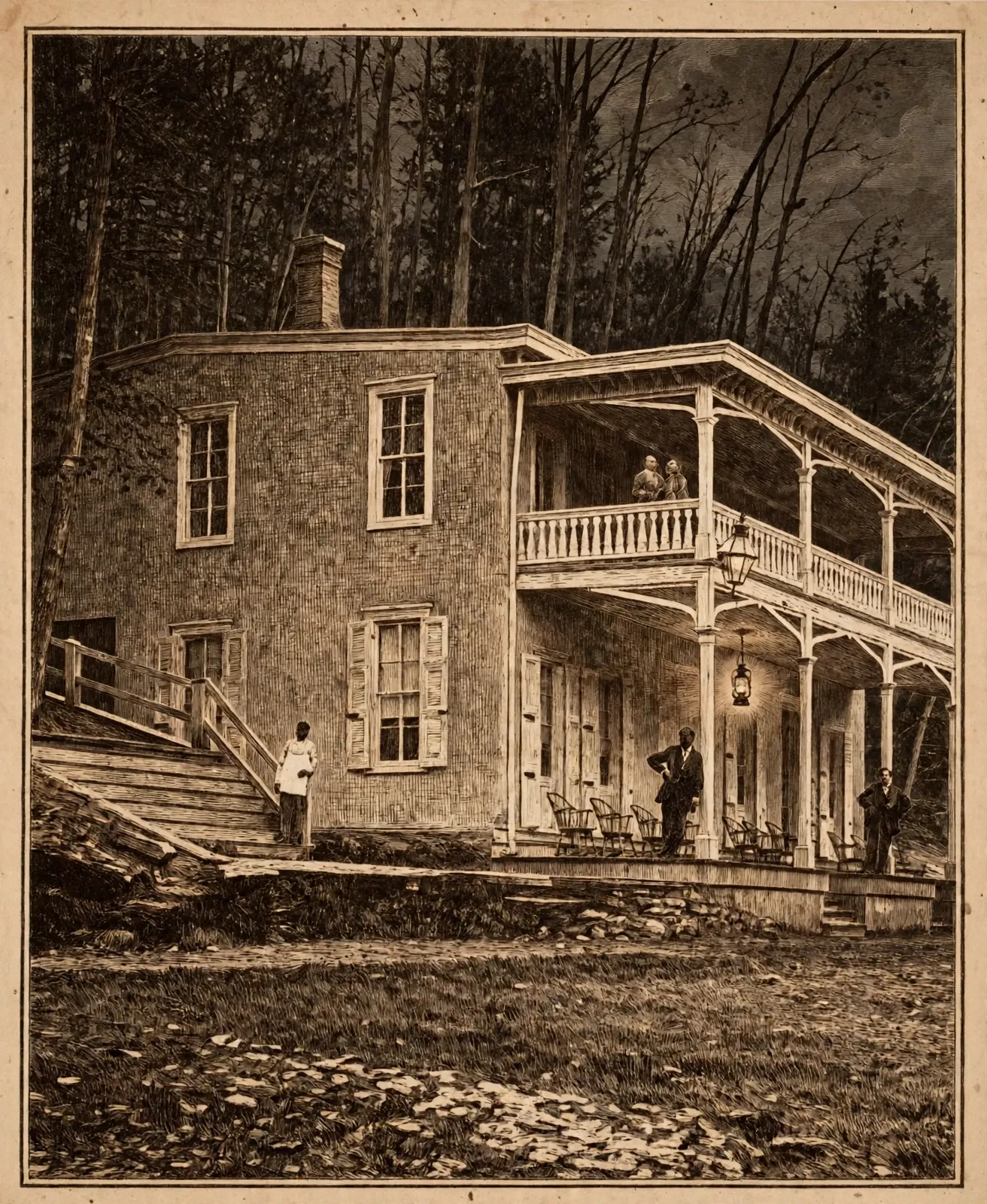
The house stood on the drive north of the Rex Avenue bridge, in the shadow of the great ledge the valley calls Council Rock, and its keeper was Reuben Sands — Rube. For many years, the city's own historians wrote, it was the most famous road house around Philadelphia. Up the drive at Valley Green the keeper was not well liked, and the trade came here instead: to the long veranda, the rocking chairs, and the sheds across the road where the teams were left standing.
Sources disagree on when it opened. Two library catalog records say 1848. The valley's historians say after the Civil War. The directories — which kept every keeper on this creek a line a year — side with the later date: no Reuben Sands hotel stands on the creek before 1865. In 1863 the newspapers name “the public house of Reuben Sands, at Chestnut Hill” in a theft case; in 1866 his hotel stands on Germantown Avenue, not on the drive at all. The first creek listing comes in 1871: liquors, on the Wissahickon road near Wise's Mill Road. The 1848 date is a claim, not an established fact.
One photograph of the house survives, taken about 1872, and it is full of people. Two men lean at the veranda columns. A woman and a young girl stand at the second-storey railing. On the side staircase stands a man in an apron, caught mid-duty, his face turned half away. The camera kept every one of them. None of their names is known.
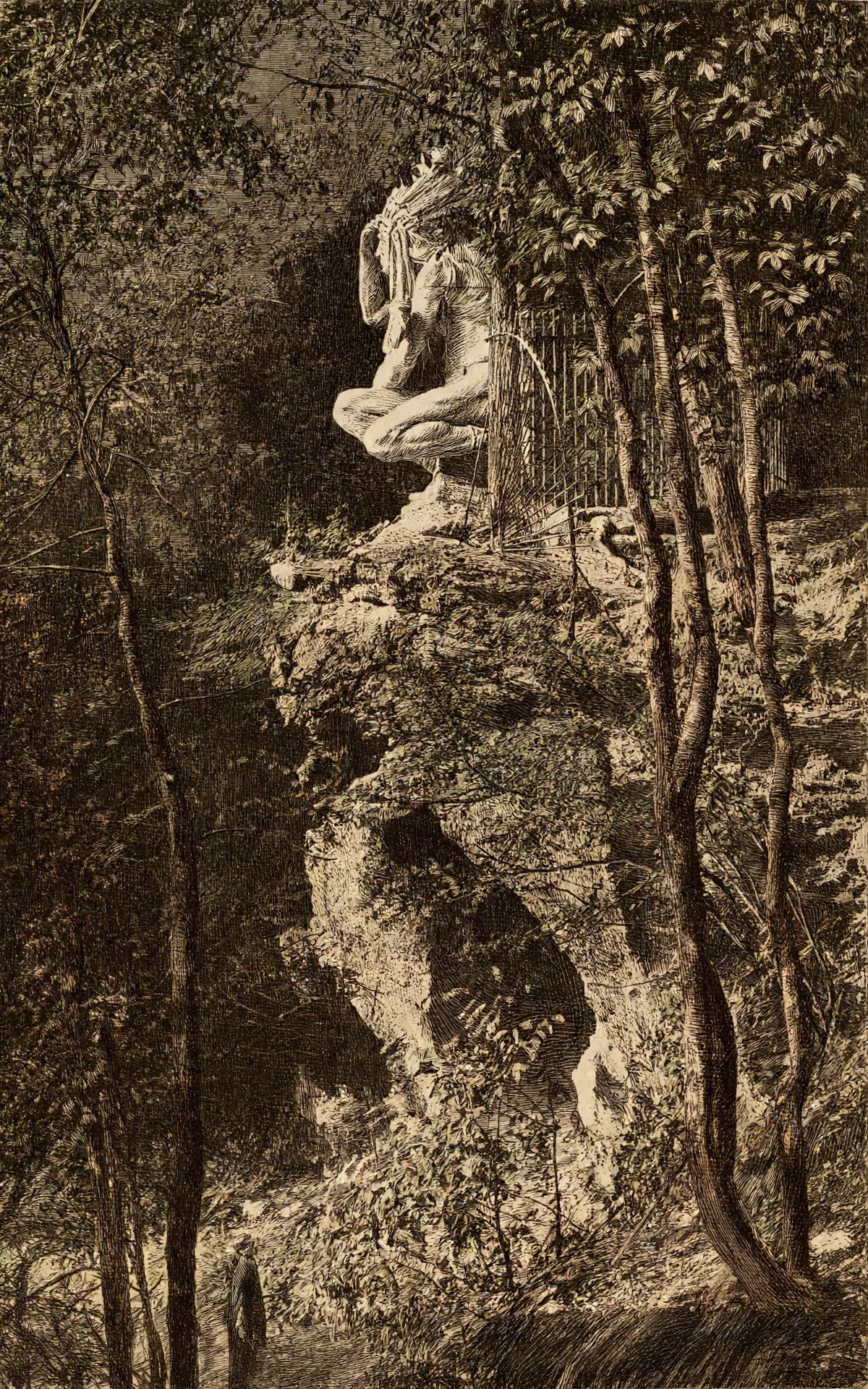
Above the house, on the road, stood a stone fountain built in 1854 — the first public drinking fountain in Philadelphia, the gift of John Cook, who cut the stone, and Charles Megargee, who gave the spring. It was carved with two Latin promises: pro bono publico — for the public good — and esto perpetua — let it be forever. Drivers watered their horses there and climbed the path to the rock, where a wooden statue had watched since 1856.
The rock the house was named for drew its own crowds. Patrons climbed from the hotel to Council Rock, the ledge the valley tradition calls the Lenape council place. In 1856 Joseph Middleton, of the Wissahickon Turnpike Company, set a wooden statue on the ledge to mark it; the figure that stands there now — the limestone Tedyuscung, by J. Massey Rhind, the gift of Mr. and Mrs. Charles W. Henry — replaced the wooden one in 1902.
The books cannot agree on how the house ended. One says the park bought it in 1872 and closed it; another says it stood until a taking in 1887. Both are wrong as written: the park's own report for 1878 lists the Indian Rock Hotel open for business inside the park, one of seven refreshment places on the drive. Sands himself died in August 1884. After that the record thins to a line in a survey, and then to nothing at all. The name outlived the house: a second Indian Rock Hotel stood at the foot of Monastery Avenue, and its thinner, argued story has its own page.
One more mix-up: a library lantern-slide record gives this hotel's name and its 1848 opening to a building at Gypsy Lane and Lincoln Drive, “also identified as Wissahickon Hall and the Fairmount Park Guard House.” That is Wissahickon Hall's corner and later use, not this house. Four separate chains put Sands's hotel here at Rex Avenue. The slide is a catalog's mistake, kept on the table because the table is where mistakes belong.
By the early years of the new century, travellers found only foundations on the left of the drive. Today there is not even that — a bench, a stone bridge, the wide gravel going on without it. Of the seven houses on this creek, this is the one that left nothing to knock on. The stone figure on the rock above keeps the watch alone.