
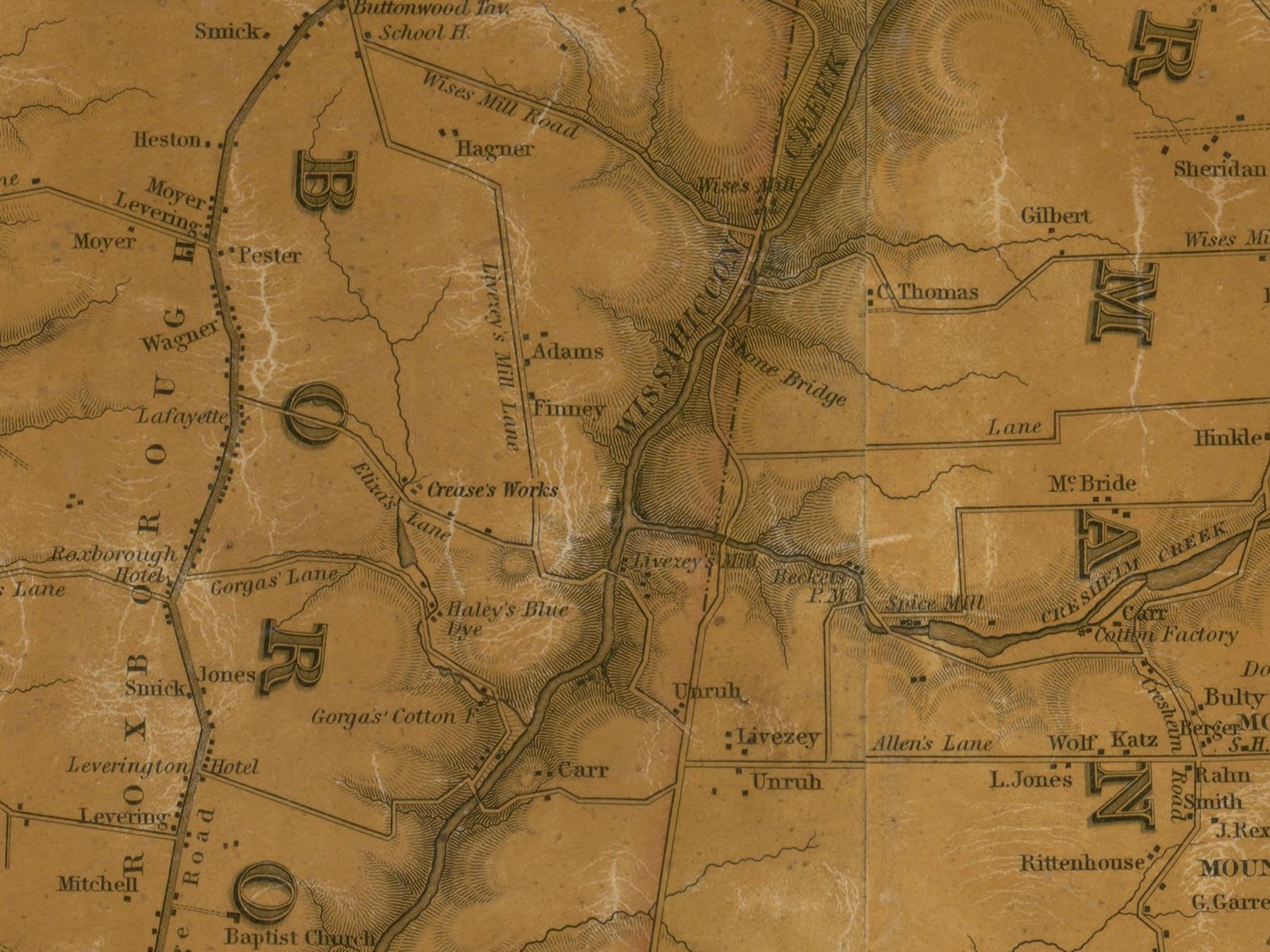
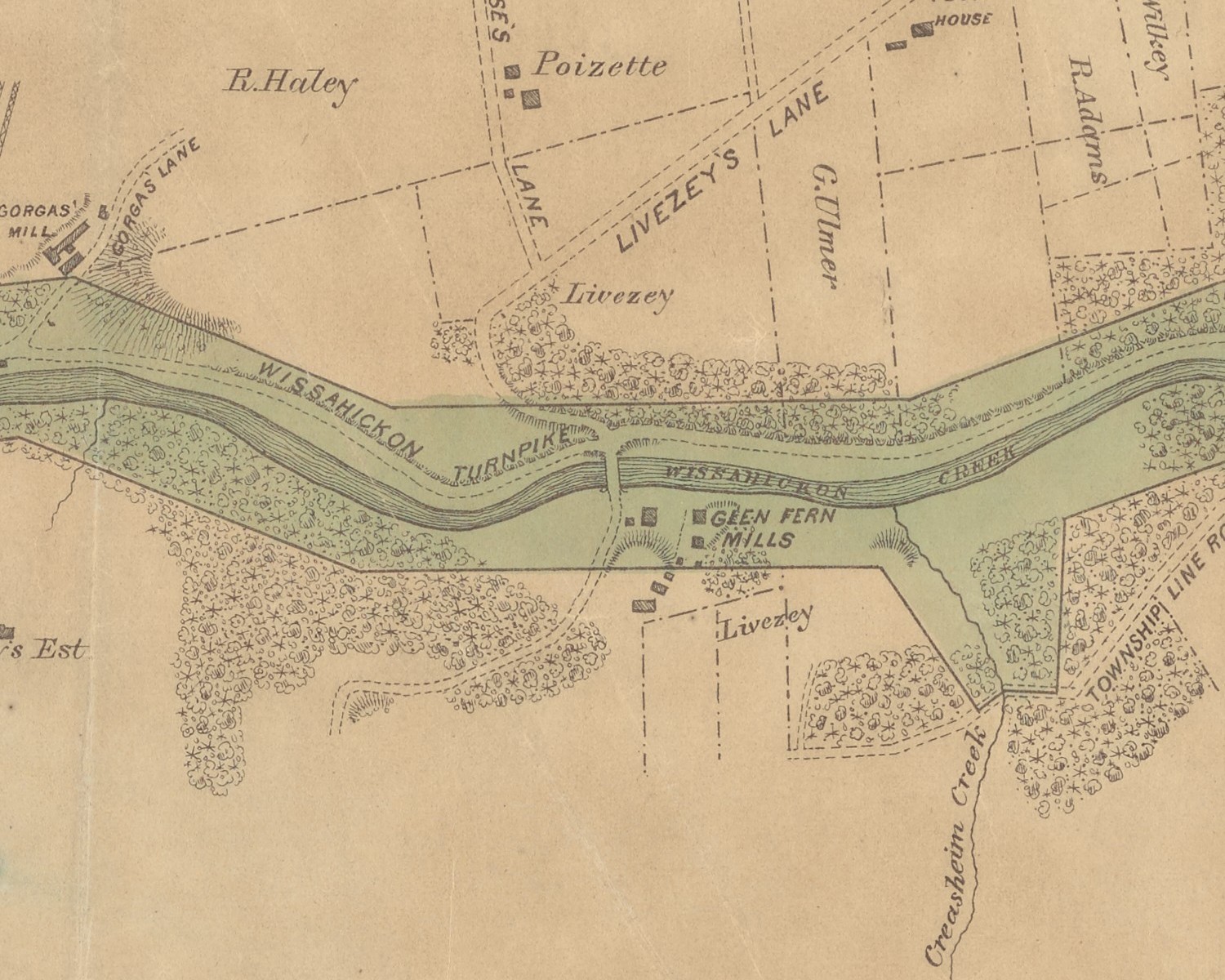
Livezey’s Mill stood on the east bank of Wissahickon Creek at the foot of Livezey Lane, just below where Cresheim Creek comes in — inside today’s Wissahickon Valley Park. It was a merchant grist mill: it bought grain and ground flour in quantity for the market. One thing needs saying at the start, because this valley reuses its names: this seat stands on the main Wissahickon Creek — not Glen Echo Mills, the carpet works on Paper Mill Run in Mount Airy. Different water, different works.
The miller’s house — Glen Fern, at 1100 Livezey Lane — still stands, placed on the Philadelphia Register of Historic Places on June 26, 1956. The mill itself is gone, but it did not vanish whole: the Historical Commission’s nomination text records that “the foundation of the mill and the associated dam survive.” The dam — most likely built in the mid-1700s, by the Water Department’s study — still crosses the water.
A bricklayer builds the mill
Thomas Shoemaker, a bricklayer of the City of Philadelphia, put the mill up on ground he had gathered in the 1740s — a release from John Hammer in September 1742, and 44½ acres from John Hammerer and his wife Jane in February 1745-6. The deed describes what he built: a water grist mill with two pair of stones under one roof.
When he built it, the accounts disagree. Brandt prints 1717. The Library Company’s house record dates the house campaign to 1733–39. Daly gives the mill as 1745. The deed controls: the mill was standing by October 1747, because on October 10, 1747, Shoemaker and his wife Sarah sold it to Thomas Livezey — the mill, two tracts of 20 acres and 3 acres 18 perches running to the middle of Wissahickon Creek, with the ways, woods, waters, water courses, dams, and mill races — for £416.
Herb Lapp’s Glen Fern page adds one more claim, printed as a conflict: that the house’s oldest section was built by Thomas Livezey beginning in 1750. The deed record says Shoemaker erected the mill, and the house campaign is dated 1733–39. The deed controls.
Thomas Livezey’s mill
Livezey came from Cheltenham, already a miller at about 24, and ran the mill for 43 years. The Roxborough tax lists rate “1 Grist Mill” in his name year after year. In 1783 the list gives the whole estate at a glance: 75 acres and the dwelling at 434; the grist mill at 1067; two horses at 35; two cows at 10; five ounces of plate at 2; his occupation at 352 — £1900 in all. The mill alone was rated at more than twice the land and the house together. No saw mill appears in any year read, though later accounts sometimes give the seat one — a bounded negative.
He was a public man as well: the Pennsylvania Gazette of October 4, 1770 reports him chosen a Representative for Philadelphia County, re-elected in 1771.
His will — dated June 15, 1790, and proved September 22, 1790 — left “all my Mills Lands and Tenements” in Roxborough and Germantown to his sons John and Joseph, with his horses, cows, and swine, his implements of husbandry, and his coopers’ tools, “with Every Utensil in the said Mills.” The will folds in a bargain with the Gorgas mill down the creek: the heirs of John Gorgas owed a £10 yearly payment “for the priviledge of Keeping up a Mill dam within five Inches of a hole bored in a Rock near the East end of the said dam.” His widow Martha’s garden, the will says, lay “between my dwelling house & Mill pond.” Livezey died on September 11, 1790.
The working mill
This was a merchant mill of the first rank. The Historical Commission’s text says Livezey “operated one of the largest mills in the colonies,” and the Water Department’s study calls this “the largest mill along the Wissahickon Creek.” The plant was fitted for corn as well as wheat. Beside the mill stood a corn kiln — a building with a hoist hood and a fireplace at each of its four corners, for drying corn before milling — of which only the lower foundation exists today. The coopers’ tools in the will tell the other end of the trade: the flour barrels were made on the place, in a cooper shop of its own.
Fire in the night
On the night of October 23, 1793, the first mill burned. Elizabeth Drinker’s journal gives October 24; the two dates print side by side, as the records give them. What burned with the mill was a merchant miller’s stock: 600 barrels of flour and 500 bushels of wheat. The mill was rebuilt, larger.
The sons, in halves
The father’s will has it in one word: “in severalty” — separately, as written. Their own wills show undivided halves, held in partnership. The two print side by side, not reconciled. John Sr.’s will, dated March 14, 1825 and proved September 9, 1826, left his Roxborough and Germantown half, the mill utensils, and $10,000 to his son Thomas (1800–1884), and the city property to his son John. Joseph’s will, dated May 1, 1835 and proved September 2, 1841, left his Roxborough half to Thomas too. From September 1841, Thomas Livezey held the whole seat.
The last miller
Thomas held Glen Fern for three decades. In 1850 he leased 3 acres upstream from the mill to Edward Rinker, for a small temperance hotel and boats on the creek — the beginning of the Valley Green Inn, which still serves meals today. The miller was the inn’s landlord.
His fight with the city came first, before the taking: on September 13, 1867, he sued Philadelphia over a city bridge a freshet had torn loose and left lying in the creek through his land, wrecking the great ornamental trees at Valley Green. The court record in Livezey v. Philadelphia, 64 Pa. 106, calls the freshet “a most unusual and extraordinary one — greater and more destructive than was ever known to happen before or since”: the water rose ten feet above its ordinary level, in the night, unseen. Witnesses thought the bridge would have stood, had it not been butted by a wooden bridge carried down from higher up the creek. Livezey gave the city notice; the city tried to remove the wreck and failed, then sold it to another man, who also failed. On January 24, 1870, the Supreme Court affirmed the judgment against Livezey: no negligence — an act of Providence — and his remedy was to remove the wreck himself. The opinion’s last line gives both sides their loss: “The defendants have lost their bridge, and the plaintiff his ornamental trees.” The opinion names neither the bridge nor the freshet’s date, and neither is supplied here.
Bought out, not burned out
The end came by purchase, not by fire or flood. The city’s taking moved in stages: an ordinance of intention on March 4, 1868; a state supplement that April; the Cresson survey adopted on May 15, 1869. On June 12, 1871, while Thomas Livezey still held the seat, the city renamed Livezey’s Mill road as Green Tree avenue. The sale closed the sequence: 66 acres for $75,000, confirmed by the Court of Quarter Sessions on May 28, 1872, and the deed recorded on August 22, 1873. The Water Department study compresses all this into one line — the Commission “purchased the house and mill in 1868.” The deed record controls, and both are printed.
The rebuilt mill stood empty under park ownership until it was torn down, before 1910 by Lapp’s dating. The cooper shop outlived it, standing until about 1915, when it was taken down for its decay. Brandt, writing in 1927, found “only picturesque ruins now remain of ‘The Great Mill.’”
The photograph — and one that is not
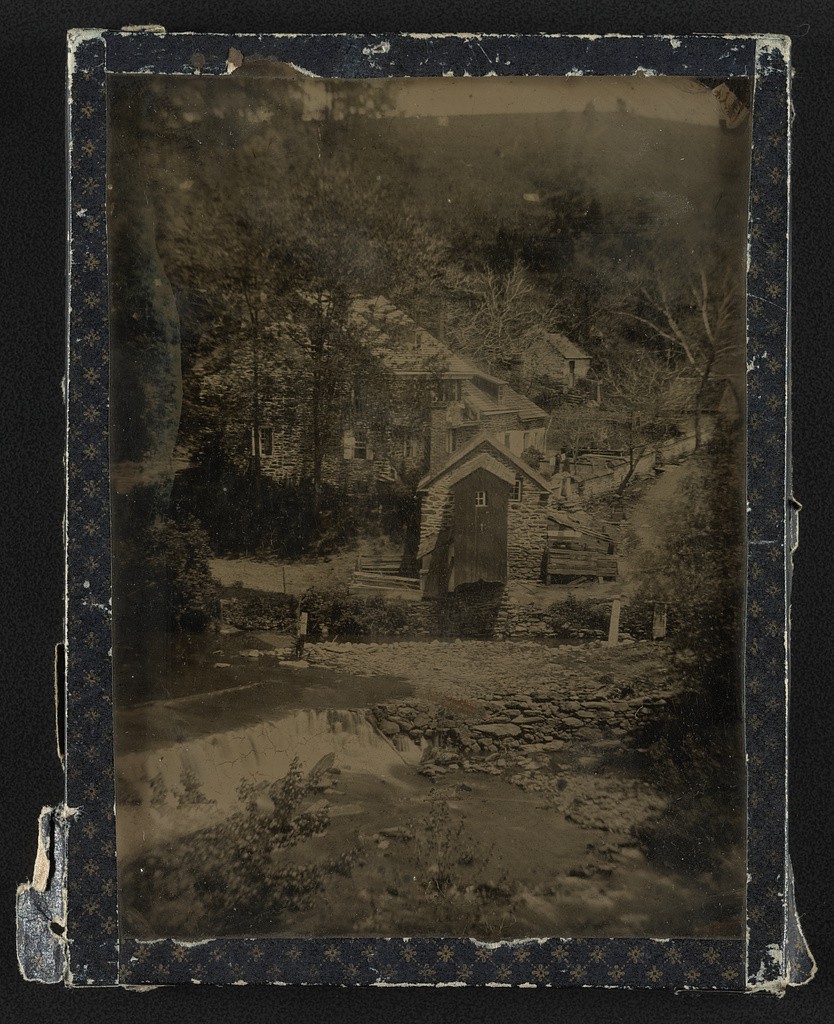
One genuine photograph of the mill survives: the ambrotype of 1858 at the head of this page. It shows the dam in the foreground, the small stone mill building at the center, and the Glen Fern house behind it. Brandt’s book of 1927 prints a photograph captioned “THE OLD LIVEZEY MILL,” showing a large four-story stone factory with a tall chimney, standing intact. That is not this mill: the Glen Fern mill was a modest stone building, and it was demolished decades before Brandt’s photographs were taken. The identification is rejected, and the picture is not used here. The last images of the old site are William Fennimore’s paintings, made just after the city acquired it; their rights are not cleared, and they are not used either.
What remains
The house stands — built in the campaign of 1733–39 and enlarged, raised one story, in 1765. The mill’s foundation and the corn kiln’s lower foundation remain. Tropical Storm Floyd damaged the dam in 1999, and about two feet were taken off its top, lowering the water in front of the Valley Green Inn. The men of this story stand in this site’s Historical Figures collection: Thomas Shoemaker, who built the mill; Thomas Livezey, who bought it in 1747; and his grandson Thomas, the last miller of Glen Fern.
Timeline
| Year | Event | Source |
|---|---|---|
| By 1747 | Shoemaker’s mill standing; on October 10 he sells it to Thomas Livezey for £416 | Deed Book G 8, pp. 489–491 |
| 1770 | Thomas Livezey chosen a Representative for Philadelphia County | Pennsylvania Gazette, October 4, 1770 |
| 1783 | Tax list: the grist mill rated 1067; the whole estate £1900 | Roxborough tax lists |
| 1790 | Thomas Livezey dies September 11; his will leaves the mills to John and Joseph | Will Book W, pp. 8–11; Yearly Meeting minutes |
| 1793 | The first mill burns in the night, October 23 (Drinker’s journal: October 24); 600 barrels of flour and 500 bushels of wheat lost | Elizabeth Drinker’s journal |
| 1826 | John Livezey Sr.’s will proved; his half goes to his son Thomas | Will Book 8, p. 633 |
| 1841 | Joseph’s will proved; Thomas holds the whole seat from September | Will Book 15, pp. 139–146 |
| 1850 | Thomas leases 3 acres upstream to Edward Rinker — the Valley Green Inn begins | Friends of the Wissahickon, Roadhouses |
| 1867 | Livezey sues the city over the wrecked bridge, September 13 | Livezey v. Philadelphia, 64 Pa. 106 |
| 1870 | The Supreme Court affirms the judgment against Livezey, January 24 | 64 Pa. 106 |
| 1871 | Livezey’s Mill road renamed Green Tree avenue, June 12 | Mill account |
| 1872 | The sale is confirmed May 28: 66 acres for $75,000 | Deed Book FTW 70, pp. 225–228 |
| 1873 | The deed is recorded, August 22 | Deed Book FTW 70 |
| Before 1910 | The mill is torn down | Lapp, Thomas Livezey: Pennsylvania Merchant Miller (2010) |
| c. 1915 | The cooper shop is taken down | Lapp, Glen Fern page |
| 1956 | Glen Fern house designated on the Philadelphia Register, June 26 | Philadelphia Historical Commission |
| 1999 | Tropical Storm Floyd damages the dam; about two feet removed from its top | Water Department fish-passage study |