Thomas Livezey's tie to the Wissahickon is the whole story, so it comes first. From September 1841 to the park settlement of 1872–73, Thomas Livezey (1800–1884) held Glen Fern — the water grist mill on Wissahickon Creek at the foot of today's Livezey Lane in Roxborough, with its stone dwelling, dams, and races — entire, in his own hands. He came to it by inheritance, half from his father's will in 1826 and half from his uncle's will in 1841. He ran the mill for three decades, sued the City of Philadelphia when a freshet threw a city bridge onto his land, and sold the seat to the City for Fairmount Park: 66 acres for $75,000, in a deed executed in 1872 and recorded in 1873. The mill was demolished soon after; the house, Glen Fern, still stands in Wissahickon Valley Park. He was the grandson of Thomas Livezey (1723–1790), who bought the seat in 1747 — a different man, with his own page in this collection — and the brother of John Livezey (1798–1878), who took the family's city property instead.
The inheritance
The second Livezey generation held Glen Fern in undivided halves, two brothers in partnership: John (1753–1826) and Joseph (1764–1841). Both of their wills survive and were read in full for this biography, and they dovetail. John's will (1825, proved 1826) gave his Roxborough and Germantown half — the mill seat's half, with half the mill utensils and stock and $10,000 — to his son Thomas, and the city real estate to his son John. Joseph's will (1835, proved 1841) gave his city half to nephew John and his Roxborough and Germantown half to nephew Thomas. From September 1841 the whole seat was Thomas's. He was 41, and he kept it for 31 years.
The man and his family
Thomas was born 27 May 1800 at Germantown, son of John Livezey and Abigail Ridgway; Abington Monthly Meeting registered the birth. (A duplicate index entry names his father "Thomas" — an index slip of a kind found elsewhere in this family, printed here so it is not hidden.) In 1820 his father's Roxborough household counts nine persons, two of them enslaved, but the column for young men of 16–25 is empty: Thomas, at twenty, is not in his father's house that year, and no record read says where he was.
In 1836 he married Ann Louise Phillips "out of unity" — outside the Society of Friends — made his acknowledgement, and stayed a member of Green Street Monthly Meeting. That account comes from compiled sources (the Friends Historical Library's family-papers note; Eberlein's Colonial Homes of Philadelphia, 1912) and is printed as compiled: the meeting's records were searched online and hold his birth and death, but no marriage record. His wife is Ann Louisa in his own will and probate papers, Ann Louise Phillips in the compiled sources, Anna Louisa Phillips on her memorial — three forms, all printed. Their five children: John (1837–1921), Thomas Jr. (1844–1916), Joseph, Anna Louisa (who married Dr. George Laughlin), and Sarah Marshall (1855–1930), who married into the Firth family. By 1840 Thomas heads a Germantown household of ten, three of them working in agriculture — the census spells him "Thomas Linzey," and the household's members are counted, never named, in this account.
The mill years — and what the record skips
Eberlein states that Thomas was the last of the family to run the mill. The project master list records, at citation level, that about 1850 he leased the Valley Green site to a tenant named Rinker. Beyond that, the working detail of his mill is largely a printed gap, and the gaps are named rather than papered over: the Roxborough tax lists that rated the mill year by year do not exist online (they are physical records at the City Archives); the federal manufactures schedules were searched twice and not found, on a route that could not be fully browsed; and an 1850 insurance certificate "For mill on Cresheim Creek" among his papers survives only as a finding-aid line — whether he also held an interest in a mill on that Wissahickon tributary cannot be followed online.
The freshet and the lawsuit
In July 1865 a freshet the court called the greatest ever known on the creek — water ten feet above its ordinary level — tore a city iron bridge loose and dropped it on Thomas's land, diverting the water and destroying his ornamental trees. He sued. In Livezey v. Philadelphia, 64 Pa. 106 (1870), read in full for this project, the Pennsylvania Supreme Court affirmed a nonsuit: no fault in the bridge's construction, an act of God, and the landowner's remedy in his own hands. "The defendants have lost their bridge, and the plaintiff his ornamental trees." One press item does not fit the report — The Press shows a Livezey v. City action "on trial" in November 1870, months after the January 1870 decision — and it prints unreconciled, as found.
The sale to the park
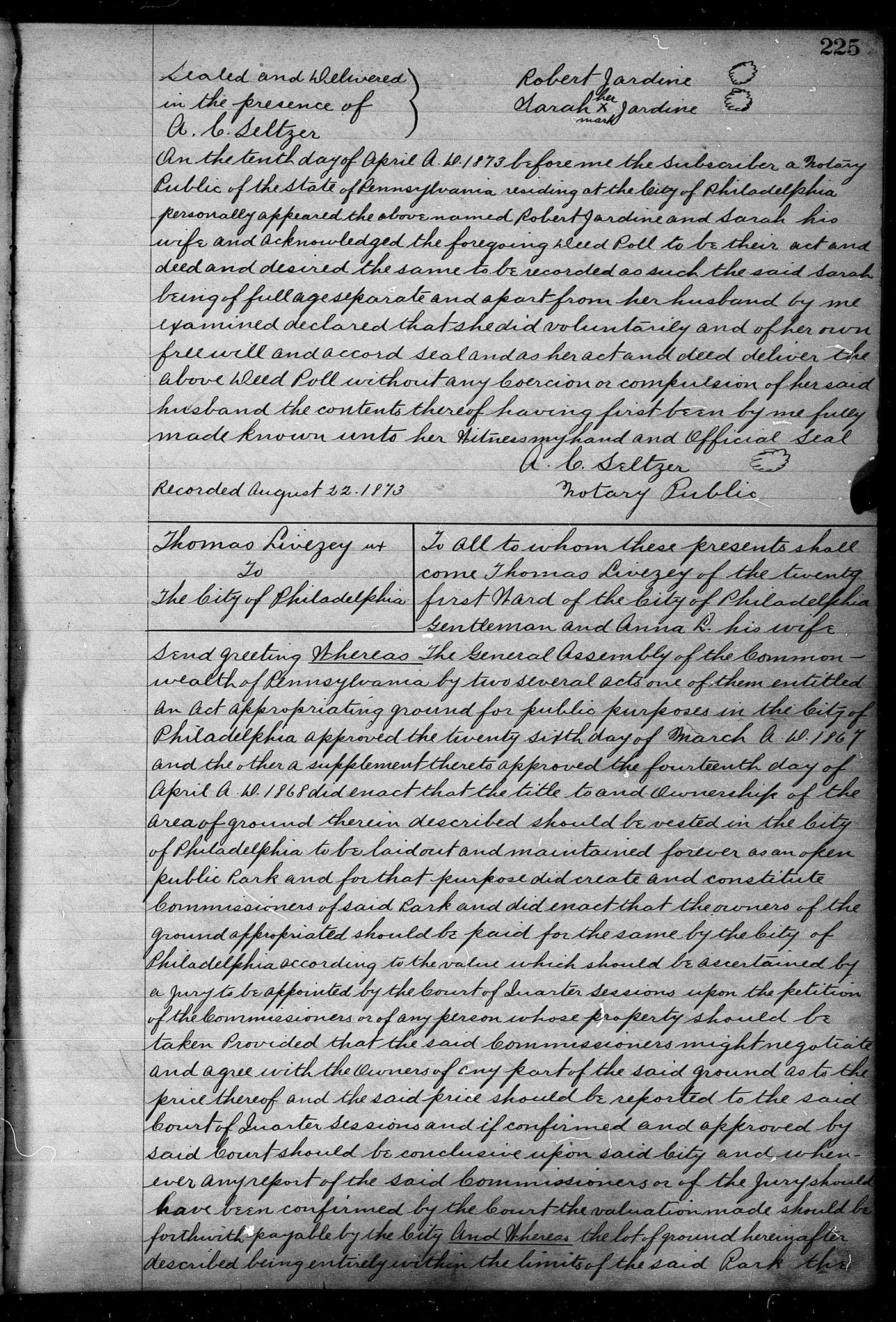
The park came in stages: the ordinance of intention in March 1868, the supplement act that April, the Cresson survey adopted in May 1869, the renaming of Livezey's Mill road to Green Tree avenue in June 1871 — and then the deed. Thomas and Anna L. Livezey conveyed the 66-acre seat to the City for a negotiated $75,000, confirmed by the Court of Quarter Sessions on 28 May 1872, executed in 1872, acknowledged 10 April 1873, recorded 22 August 1873 (Deed Book FTW 70, pp. 225–228, read in full). Printed sources date the purchase 1868, 1869, 1873, and even 1893; the deed controls, and the spread prints in the rigorous version of this biography. After the sale the mill ran "a couple of years as a grist mill by J. Wagner Jermon and then torn down" (Eberlein) — and then the ravine belonged to the park, as it does today.
Allen's Lane: the farmer years
The family kept the house at the top of the lane. The 1878 city directory lists "Thomas Livezey … Allen's La … Farmer," and the censuses show a working farm: in 1870 a household of eight at Germantown post office — his age reads 60 as written, against his birth in 1800, and prints unresolved — with $23,000 of real estate; in 1880, at 5760 Allen's Lane, a household of ten with three servants and two laborers, John, 40, and Thomas, 35, still at home. His son John and daughter Sarah Livezey Firth were still in that hill house in 1912, among the old furniture, a Peale painting of Glen Fern, and a Sully portrait (Eberlein).
The will and the fortune
His will (2 August 1881, codicil 10 October 1882; Will Book 115, pp. 234–241, and the original packet, both read) styles him "Gentleman" of the Twenty Second Ward — the recorded copy was reported as "Contractor," a variant printed in the rigorous version. Everything went into trust: his wife Ann Louisa to have the income for life and the homestead kept open; then five equal parts — John and Thomas Jr. outright, Joseph, Anna Louisa, and Sarah M. in trust for life — under a clause that no real estate should ever pass out of his blood in lineal descent. His son Joseph's middle initial is a true conflict of the records: R. in the original will, the codicil, the printed appeal report, and the inventory's mortgage line; H. in his uncle's will as transcribed; C. in the recorded copy of his father's will. This biography uses R. and prints the rest.
The probate petition (16 June 1884) values his real estate at $250,000 or thereabouts and his personal property at $80,000 or thereabouts — the real-estate figure standing unexplained against the 1870 census's $23,000, the two printed side by side. The appraisement is exact: $161,768.50 of personal property, its lines summing to the written total — railroad and canal stock, a $40,000 city loan worth $50,000, bank shares, his son Joseph's mortgage, twenty unvalued shares in the Wissahickon Turnpike Road Company, and at the end the farming utensils, horses, cows, and carriages ($1,023.05) and the household furniture and silver ($408.55). No mill. No Glen Fern. The seat had been the City's for eleven years.
Death and burial
He died at No. 601 Allen's Lane, Mount Airy, on Wednesday 21 May 1884 at 8 P.M. The Inquirer's notice (24 May 1884) set the funeral for Monday 26 May at 3 o'clock from his late residence, carriages meeting the 2.30 train at Mount Airy station; the Friends' Intelligencer remembered him as "a member of Green Street Monthly Meeting." He was buried 26 May 1884 at Ivy Hill Cemetery. His age prints three ways — 83 by the dates, 84 in the death index and the Quaker record, "in his 85th year" in Hotchkin — and all three print. Anna Louisa lived on at Allen's Lane until 21 December 1900 and was buried at Ivy Hill on 24 December; no probate for her was found in any collection searched.
Timeline
| Year | Event | Source |
|---|---|---|
| 1800 | Born 27 May, Germantown, to John and Abigail (Ridgway) Livezey | Abington Monthly Meeting birth record (Ancestry coll. 2189, rec. 1623011) |
| 1820 | Not counted in his father's Roxborough household (males 16–25: 0) | U.S. Census, Roxborough (M33 Roll 110, p. 61) |
| 1826 | Father's will gives him the Roxborough & Germantown half of Glen Fern | Will Book 8, p. 633 |
| 1836 | Marries Ann Louise Phillips, "out of unity"; remains of Green Street Meeting | FHL RG5/271 note; Eberlein (1912), p. 274 (compiled) |
| 1840 | Heads a Germantown household of ten, 3 in agriculture | U.S. Census (Roll 489, p. 238) |
| 1841 | Uncle Joseph's will gives him the second half — the seat entire from September | Will Book 15, pp. 139–146 |
| c. 1850 | Leases the Valley Green site to Rinker | Project master list (citation level) |
| 1865 | July freshet throws a city bridge onto his land | Livezey v. Philadelphia, 64 Pa. 106; The Daily Age, Jul 1865 |
| 1870 | Nonsuit against him affirmed, 24 Jan — and "Farmer" of Ward 22 by June | 64 Pa. 106; U.S. Census (M593_1408, p. 282B) |
| 1872–73 | Sells Glen Fern to the City: 66 acres, $75,000 | Deed Book FTW 70, pp. 225–228 |
| c. 1873–75 | Mill run briefly by J. Wagner Jermon, then torn down | Eberlein (1912), pp. 274–275 |
| 1878 | Directory lists him at Allen's Lane, "Farmer" | Philadelphia directory (Ancestry rec. 1197909070) |
| 1880 | Heads a household of ten at 5760 Allen's Lane | U.S. Census (ED 457, p. 522C) |
| 1881–82 | Will (2 Aug 1881) and codicil (10 Oct 1882) | Will Book 115, pp. 234–241; probate packet |
| 1884 | Dies 21 May at 601 Allen's Lane; buried 26 May, Ivy Hill | Petition; Inquirer, 24 May 1884; death index rec. 2228522 |
| 1884 | Inventory appraises his personal property at $161,768.50 | Probate packet (Ancestry coll. 8802, case 597) |
| 1900 | Anna Louisa dies 21 Dec; buried 24 Dec, Ivy Hill | Death index rec. 900923 |
| 2021–22 | The Livezey & Firth dispersal sells the family's Franklin and the J.L. & Co. ledgers | Antiques and The Arts Weekly, 25 Oct 2022 |
Coda: the dispersal
The Firth line — descendants of his daughter Sarah Marshall (Livezey) Firth — kept the family's things until Russum's Furniture Auctioneers dispersed the Livezey & Firth estate in 2021–22, grossing over $550,000. As the sale review in Antiques and The Arts Weekly (25 October 2022) reports it: Franklin's Experiments and Observations on Electricity (1769), inscribed "Thoˢ Livezey's Book," brought $153,400 — which of the three Thomas Livezeys signed it, no one can say — and ten ledgers stamped "J.L. & CO.," his sons' firm, brought $560. The coda runs as text; no sale photograph is rights-cleared for this page.