
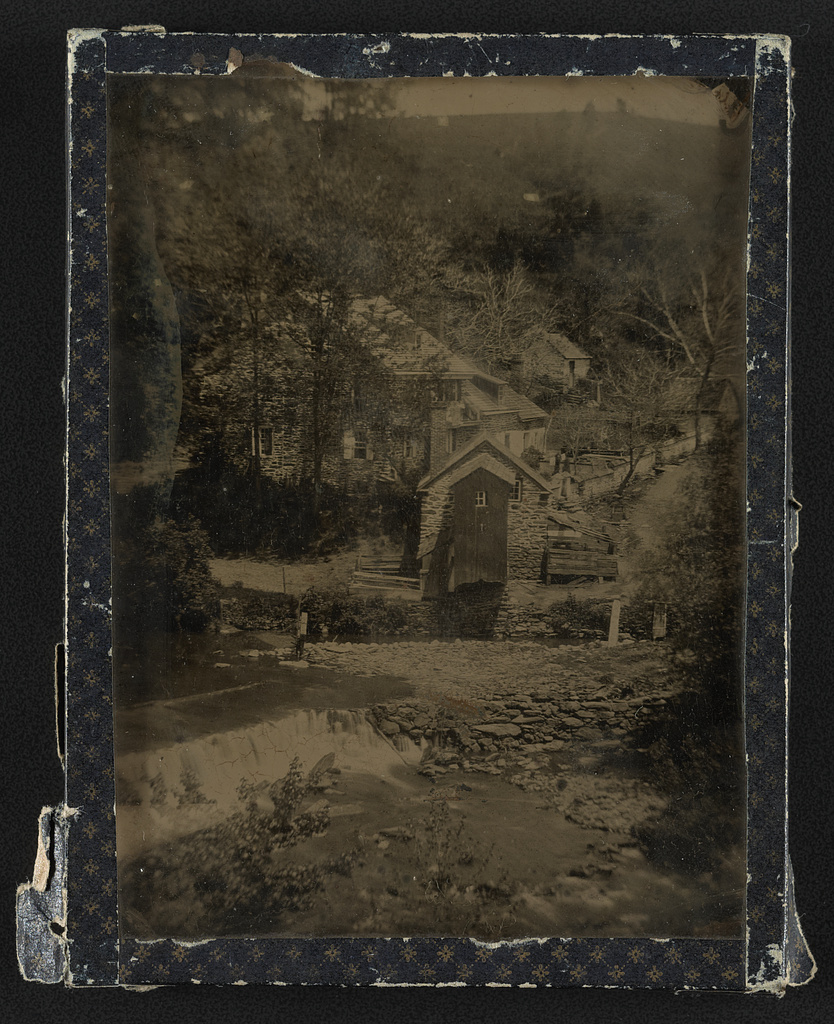
Thomas Shoemaker's Wissahickon tie is a building that still stands. On the east bank of Wissahickon Creek, just below the mouth of Cresheim Creek, he built the stone dwelling and outbuildings of a mill seat between 1733 and 1739, and the grist mill that Thomas A. Daly, the creek's historian, called the old Livezey or "Great Mill" — "built by Thomas Shoemaker in 1745," and "the most important and for a long time the largest in the Colony." In 1747 he sold the whole seat to Thomas Livezey Jr., who ran the mill for the rest of his life and named it Glen Fern. The house stands today in Fairmount Park (1100 Livezey Lane, designated a Philadelphia historic landmark in 1956); the mill's foundation and dam survive beside it. Of the builder himself — his birth, his family, his death — no record this project could read says anything at all. This is the biography of a founder recoverable only through what he built, with the searches that prove the silence set out in full.
The building
Two histories and two institutional catalogues agree on the campaign, though their dates layer rather than match — printed here as found. The Library Company of Philadelphia's cataloguing of its lantern slides states that "Thomas Shoemaker constructed a dwelling and outbuildings, including a grist mill, from 1733 to 1739," and that the house "was enlarged and raised one story in 1765" under Livezey. The Philadelphia Historical Commission's nomination gives the same span, 1733–39. Daly dates the mill to 1745. Cousins & Riley's Colonial Architecture of Philadelphia (1920) dates the place "about 1747" and states the conveyance: the mill "was built by Thomas Shoemaker, and in 1747 conveyed by him to Thomas Livezey, Junior, who operated it the rest of his life and lived at Glen Fern near by." A published summary of the house's record gives the sale's exact day, October 10, 1747 — designation-file precision, printed at that grade. And the land under it: a deed summary in the designation tradition says the mill stood on twenty acres bought from John Harmer on February 5, 1746, the deed already mentioning buildings and improvements — which fits a house built in the 1730s on a seat formalized by purchase a decade later, though no record read says which parcel the house stands on. The deeds themselves are physical-only records, a permanent gap under this project's online-only rule; the tie rests on the printed and designation record, graded as such.
The father he may have had
Cousins adds the only parentage in print: the builder's father was Jacob Shoemaker, "who gave the land upon which the Germantown Friends' Meeting House stands… came to this country with Pastorius in the ship America in 1682 and became sheriff of the town in 1690." The Germantown Quaker Account Book — read closely for this project for 1739–1757 — supports the frame's neighbourhood: its 1739 land recital runs the meeting-house ground from Telner's 1682 purchase through Op den Graeff's deed to Jacob Shoemaker, 125 acres, in 1690. A Jacob Shoemaker did hold that land. But the same project's searches complicate the son. A Philadelphia marriage certificate of 1715 names a Thomas Shoemaker who really was a Jacob's son — "son of Jacob Shoemaker of the City of Philadelphia, turner" — marrying Mary Powell in the city, a generation before the conveyance; whether that groom grew into the Glen Fern builder is unproven either way. And the Pennsylvania Gazette of August 25, 1737 notices the estate of a Thomas Shoemaker already dead, with a Jacob Shoemaker as one of his executors — an earlier Thomas in the same family and town, whom the builder (alive to convey in 1747) cannot be. Son, grandson, nephew: the records read do not decide, and this account prints Cousins's sentence as a 1920 history's claim, flanked by the three documents that keep it from settling.
The searches
Everything else about the man was looked for, class by class, and the looking is the finding. Probate: both handwritten Philadelphia will indexes were read entry by entry for the surname — twenty-four Shoemaker entries between them, no Thomas in his window; the typed index's one early Thomas citation (1738, Book H, p. 371) does not resolve — that page holds another man's will — and its later Thomases are a 1799 city carpenter and an 1872 namesake. Newspapers: the exact name in the Readex papers, 1730–1765, returns eleven items, all read — an earlier man's estate notice, a city administrator, city assessor lists, a Chester County abutter — none touching Germantown, the creek, a mill, or a Livezey. Meeting records: the Germantown Monthly Meeting's FamilySearch films are restricted to research centers; on the Ancestry side, the name search re-run found 40 results, none Germantown, and the Germantown Account Book, read closely for 1739–1757, names Peter, Abraham, Jacob, Benjamin, and Sarah Shoemaker — never Thomas; the Germantown Women's Minutes and the post-1756 minutes could not be opened online at all, a bound printed with the negative. His death, his marriage, his children: in no record read. He may have died outside the county, died without probate, or rest in the meeting records no online reader can open. The gap is the finding, printed unfilled.
Timeline
| Year | Event |
|---|---|
| 1690 | Jacob Shoemaker takes 125 acres from Op den Graeff in the meeting-house land chain (Account Book recital, 1739) — the father of Cousins's account, at record level |
| 1715 | A Thomas Shoemaker, son of Jacob Shoemaker of Philadelphia, turner, marries Mary Powell in Philadelphia — identity with the builder unproven |
| 1733–1739 | Shoemaker builds the dwelling and outbuildings at the creek seat (Library Company; Historical Commission) |
| 1737 | The Gazette notices a Thomas Shoemaker deceased, Jacob Shoemaker an executor — an earlier namesake |
| 1745 | The grist mill built (Daly) — the "Great Mill" |
| 1746 | Twenty acres bought from John Harmer (Feb 5), the deed mentioning buildings (deed summary, citation level) |
| 1747 | Shoemaker conveys the seat to Thomas Livezey Jr. (Oct 10, per the house record's summary); Livezey names it Glen Fern |
| 1956 | Glen Fern designated on the Philadelphia Register of Historic Places (June 26) |
Why he is here
The Livezeys held Glen Fern for over a century; their mill was the upstream party of the creek's famous dam case; the city took the property for the park (1869 in the project's sources, 1873 in the house summary — printed both). The house passed to the Valley Green Canoe Club in 1909 and stands in the park today. All of that begins with a builder the standard accounts name once and abandon. This project's contribution is the other half of his file: the namesakes screened so no later worker merges them, the broken index citation flagged so no one chases it, the father's story tested against the three nearest documents, and the meeting book read page by page for a name that is not in it. Thomas Shoemaker built the seat the creek remembers. The record kept the building and lost the man, and this biography prints both halves of that sentence.