Thomas Livezey's tie to the Wissahickon is Glen Fern, the mill seat on Wissahickon Creek in Roxborough that stands today inside Wissahickon Valley Park, at 1100 Livezey Lane. On October 10, 1747, Livezey — a 24-year-old miller from Cheltenham Township — bought the seat's water grist mill from Thomas Shoemaker for £416, by a deed that survives and has been read in full. He ran the mill for the remaining forty-three years of his life, raised ten children in the house beside it, served two terms in Pennsylvania's colonial Assembly, and devised the seat to the sons who held it after him. His grandson inherited the whole property in 1841 and sold it to the City of Philadelphia in the park settlement of 1872–73. No portrait of Thomas Livezey exists, and his parents are named in no record yet found — but the paper trail he left, from a Quaker family register to the tax lists that rated his mill year by year, is one of the fullest this project has assembled for an unknown of the creek.
A birth in the meeting register
The Abington Monthly Meeting's family register opens his record in a single line: "Thomas Livezey miller in Roxborrow Township was Born the 25th of the first month 1723." The date is the first day of the year 1723 as the year was then counted — before 1752, the year began on March 25, and the same register page double-dates his daughter Rachel's birth "1748/9" because hers fell two days before the year turned. The Philadelphia Yearly Meeting's record of his death, in September 1790 "in the 68th year of his age," fits the 1723 birth exactly. The register styles him by his adult trade and township — it was written up over time, its children's entries running to 1764 — and it names no parents. Neither does any other record read. He is styled "junior" in his 1748 marriage intention, in a 1755 newspaper list, and in the standard printed account of his purchase, so an elder Thomas Livezey stood somewhere behind him in the Cheltenham–Germantown orbit; who that man was, the records read so far do not say, and this account does not guess.
The deed of 1747
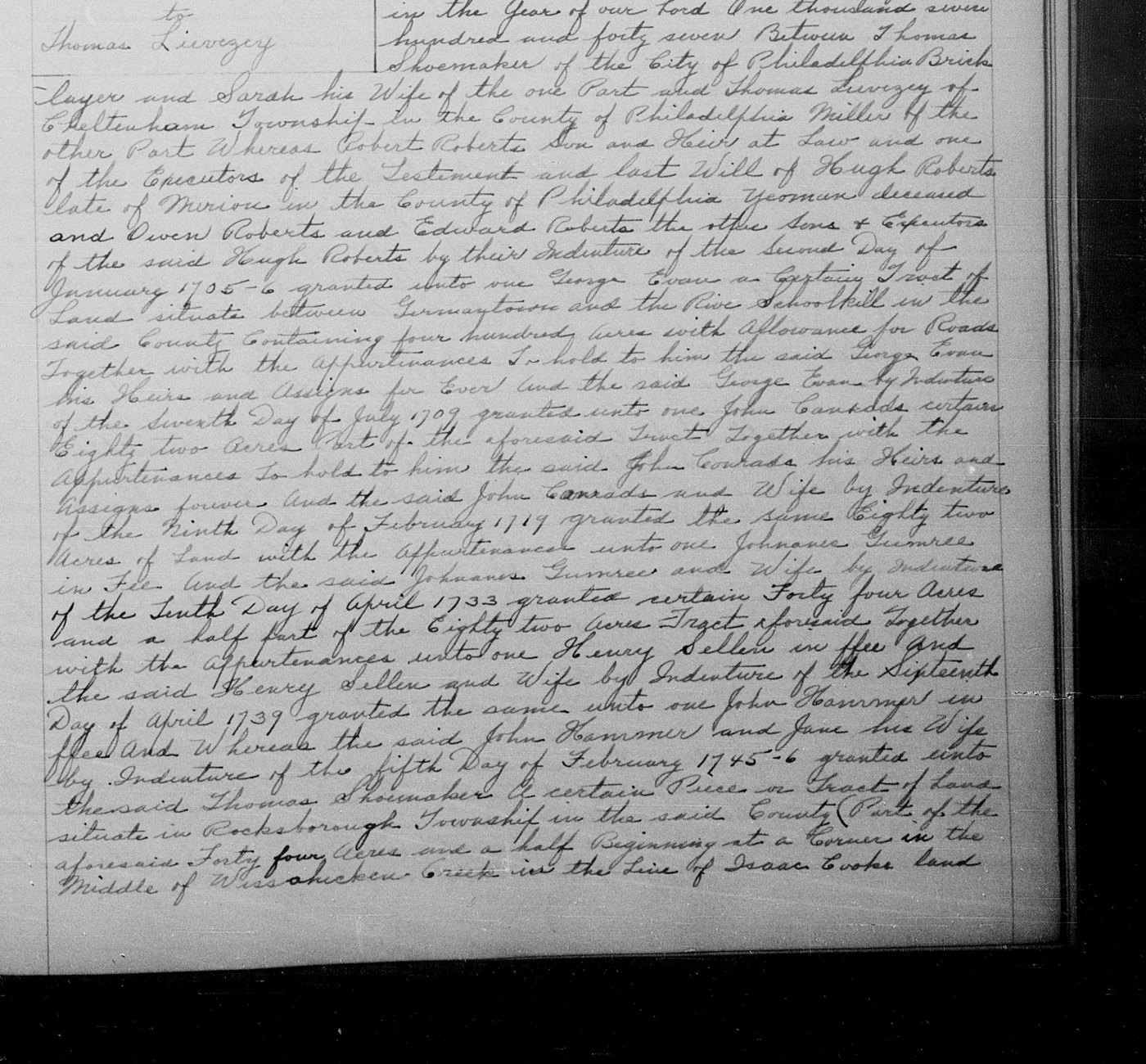
The deed (Philadelphia Deed Book G 8, pp. 489–491) is dated October 10, 1747, acknowledged the same day, and recorded on October 26. The sellers are Thomas Shoemaker, a bricklayer of the City of Philadelphia, and his wife Sarah; the buyer is "Thomas Livezey of Cheltenham Township in the County of Philadelphia Miller"; the price is £416, and Shoemaker's signed receipt for the money stands on the deed's closing page. What Livezey bought was two Roxborough tracts — twenty acres, and three acres eighteen perches — and on the twenty-acre tract, "all that the said Water Grist Mill with the two pair of Stones," with bounds beginning in the middle of Wissahickon Creek and appurtenances granted in the period's full formula: "Ways, Woods, Waters, Water Courses, Dams, Mill Races, Rights, Liberties, Privileges."
The deed's own recitals answer the question the printed histories left open — who built the mill. Working backward, the tracts came to Shoemaker from John Hammer (release of September 3, 1742, from Daniel Barndollar and his wife Rebecca), and Shoemaker's own purchase, recited on the deed's opening page, was John Hammerer and Jane his wife's indenture of February 5, 1745/6: forty-four and a half acres beginning in the middle of Wissahickon Creek. The deed then states that "the said Thomas Shoemaker hath erected a certain Water Grist Mill with two Pair of Stones under One Roof on the twenty Acre Tract aforesaid." Daly's 1922 history calls this "the old Livezey, or 'Great Mill' built by Thomas Shoemaker in 1745" — the deed itself now stands behind the tradition. One loose end prints as an open point: Shoemaker bought forty-four and a half acres and sold Livezey twenty-three; where the rest went, no record read says (a bound in the deed runs by "Benjamin Shoemaker's land").
The name Glen Fern is not in the deed. The Library Company of Philadelphia's cataloguing of its photographs of the place credits Livezey with the purchase in 1747 and with naming it Glen Fern, and dates the stone dwelling's construction for Shoemaker to 1733–1739, with an enlargement under Livezey in 1765 that raised it one story. In May 1749 Livezey added twenty-one and a quarter acres in Germantown (Deed Book H 10, p. 431) — no mill mentioned — the Germantown side of the estate his will would one day describe as his property "in the Township of Roxbury & Germantown."
Marriage, and ten children
His marriage is in the meeting's own books. On April 25, 1748, the Abington men's minutes record that "Thomas Livezey Jnʳ. & Martha Knowles appeared & Declared their Intentions of Marriage with each other." On June 2, 1748, the certificate was signed at a public meeting at Abington: Thomas took Martha by the hand and promised to be "a Loving faithful Husband until Death shall Seperate Them," Martha promised the same, and both signed — she as Martha Livezey, having taken his name. Her maiden name, Knowles, is thus proven by the meeting record itself, which matters because her own will, written forty-six years later, never uses it. The certificate's opening lines — the part that would name the couple's residences and parents — lay above the viewable portion of the page and are unread, and the witnesses' names are too faint to read; both are printed here as unread, not absent.
The register then lists ten children: Rachel (1748/9), Thomas (1750), Mary (1752), John (1753), Martha (1755), Ann (1757), George (1759), Samuel (1760), Elizabeth (1762), and Joseph (1764). A faint line under George's entry appears to say he died the day he was born and was buried the next; it is partly legible and printed at that grade. Mary and Elizabeth appear in neither parent's will, and no death record for them has been read. The other seven carry the story forward — above all John (1753–1826) and Joseph (1764–1841), the sons who would inherit the mill.
The tax lists: a mill in his own name
Pennsylvania's tax lists let us watch the seat work. In 1783 the Roxborough list gives his assessment in full: seventy-five acres and a dwelling (£434), "1 Grist Mill – 1067," two horses, two cows, five ounces of plate, his occupation (£352) — £1,900 in all. The mill alone was rated at more than twice the land and house that carried it. In 1785 the mill stands at £900 of a £1,509 total; in 1786, with Livezey styled "Miller" in the list, at £1,000 of £1,682. No saw mill appears in any year — the seat's taxed work is the grist mill alone. In 1780 one list styles both Thomas and his son John "Miller" (the page carries no year; the date is the tax index's, and it is printed as such), and in 1781 both men are marked "Non juror" — they had not sworn the allegiance oath the revolutionary state required, the expected mark for Friends, whose testimony barred oaths. He stands on the carriage lists of 1783, 1784, 1786, and 1787 with one chair, and the county commissioners' minutes of June 10, 1776, record a small abatement in his favour: "Thomas Lievezey .. abated .. 1.17.6."
Two cautions ride with the tax story, and this account prints both. The coverage is browsed-and-found, not exhaustive: no line was found for 1769–1775, 1777–1779, or 1788–1790, but the index search missed the genuine 1781 and 1782 lines, which browsing found — so the silent years prove nothing either way. And Joseph, the younger co-heir, has no Roxborough tax line at all: every one of his entries in the collection (1774, 1780–1785) is for Lower Dublin. His half-interest was in the property; his tax footprint was elsewhere, and the record does not explain why.
Assemblyman, auditor, neighbour
The newspapers of 1765–1791 (twenty-eight Livezey items, all read; the set is the NewsBank Selected edition of America's Historical Newspapers, and its silences are bounded to that set) show the miller in public life. The Pennsylvania Gazette of October 4, 1770, reports Thomas Livezey chosen a Representative for Philadelphia County — a seat in the colonial Assembly — and he was re-elected in 1771 (Pennsylvania Journal, October 3, 1771; Pennsylvania Chronicle, October 7, 1771). The election reports name no township, so the identification of the Assemblyman with the Roxborough miller rests on the name, the county, and the era converging, with no rival Thomas Livezey in any record read; it is printed as that convergence, not as a document. In 1773 the Court of Common Pleas named him, with Rowland Evans and Michael Hillegas, an auditor of Joseph Richardson's accounts. The Gazette of November 14, 1781, calls him in so many words "Thomas Livezey, miller, in Roxbury township," as an executor for a neighbour's estate. A 248-acre Roxborough tract advertised in 1788 was "bounded on the south by lands of Thomas Livezey," its creek frontage praised as "an excellent mill-seat." No advertisement of his own mill and no sheriff's sale of his property appears in the set.
His will preserves the seat's one long quarrel in a single clause: the heirs of John Gorgas owed a £10 yearly payment "for the priviledge of Keeping up a Mill dam within five Inches of a hole bored in a Rock near the East end of the said dam," under an agreement with Benjamin and Jacob Gorgas — two mills on one creek, their dam heights fixed against a hole bored in a rock. The quarrel outlived him: his sons' round of it, Levezey v. Gorgas, ended with the referees' award reversed on January 17, 1800, and the family papers at Swarthmore hold a draft proof in an earlier round of about 1760, from Thomas's own time — a physical record this project describes but has not read.
The will of 1790
Thomas Livezey wrote his will on June 15, 1790, styling himself "Thomas Livezey of Roxbury Township… Miller," and it was proved on September 22, 1790 (Will Book W, pp. 8–11). To John and Joseph he left "all my Mills Lands and Tenements & Real Estate Situate in the Township of Roxbury & Germantown," with the mill stock — "Horses Cows & Swine Implements of Husbandry and Coopers tools Hay and Straw with Every Utensil in the said Mills" — charged with £20 a year to their mother, her firewood, pasture for her horse, and £10 a year to their sister Ann while single. The will gives the land to the brothers "in severalty," a word this account prints exactly as written: the sons' own wills, read in full, show the property held instead as undivided halves in partnership, and the two generations' texts stand side by side, unreconciled.
Martha's provisions map the house: the lodging room at the west end of the dwelling, cellar and kitchen use, half the garden "between my dwelling house & Mill pond," her riding chair and chair horse, and £400 at interest for her life. The other children are remembered in kind: Thomas £500 and the silver pint can; Samuel the watch, buckles, and "Blackstones Commentaries"; Ann the blue room's bed and furniture; Rachel a share of the residue; and £600 for the children of Martha Robison, the daughter already dead. Joseph also took his father's share of the stock held "in Copartnership with my son John" — the brothers were already working together, in their father's lifetime and with his capital in the firm.
The 1790 census, taken that August, counts his Roxborough household at eight persons — three men of sixteen and up, five women and girls — weeks before the end. The Yearly Meeting minutes record the end itself: "our Esteemed friend Thomas Livezy an Elder of Germantown particular and Abington monthly meeting… Departed this Life in good Esteem the 11th of the 9th mo 1790 in the 68th year of his age." His estate notice ran in the Gazette of February 9, 1791: "Thomas Livezey, sen. late of Roxbury township… miller, deceased." A separate burial entry was not searched, and his grave is not stated here.
The widow, and the seat after him
Martha lived seven more years in the house, and her will (Will Book X, pp. 671–673, written 1794, codicil 1797) divides a household, not an estate of land: her silver server to Rachel, her horse and £50 to Joseph, the desk, looking glass, large Bible, and corner-cupboard furniture to Ann, a full set of bedding held for her granddaughter Martha Robeson, and £200 among her six Robison grandchildren — Catharine, Jonathan, Martha, Thomas, Andrew, and Sarah (the surname prints as written; his will reads Robison). The codicil, written weeks before her death, moves her riding chair from John to Ann — since John already has one.
The seat's later history is documented in the sons' wills. John Sr. (1825 will, proved 1826) left his undivided half of the Roxborough and Germantown property to his son Thomas (1800–1884) and his city property to John Jr.; Joseph (1835 will, proved 1841) left his half to the same nephew. From 1841 the grandson held Glen Fern entire, until he quitclaimed sixty-six acres to the City of Philadelphia in 1872–73 at the $75,000 price the Quarter Sessions had confirmed — the "1869" and "1873" dates in the printed sources are stages of that one settlement, the park act of 1868 and the Cresson survey of 1869 before the deed. The Historical Commission's nomination, which designated Glen Fern in 1956, calls the mill Thomas Livezey ran "one of the largest mills in the colonies." He would have called it, as the tax list did, one grist mill — his.
Timeline
| Year | Event | Source |
|---|---|---|
| 1723 | Born 25th of the first month (March 25, Old Style) | Abington MM register, p. 92 (coll. 2189) |
| 1745/6 | Thomas Shoemaker buys 44½ acres on Wissahickon Creek from John Hammerer | Recital in the 1747 deed, G 8 pp. 489–491 |
| 1747 | Livezey buys the Glen Fern seat and its water grist mill from Shoemaker, £416, October 10 | Deed Book G 8, pp. 489–491 |
| 1748 | Marriage intention (April 25) and certificate (June 2) with Martha Knowles, Abington | Abington MM minutes and marriages (coll. 2189) |
| 1749 | Buys 21¼ acres in Germantown from George Shorr, May 2 | Deed Book H 10, p. 431 |
| 1748/9–1764 | Ten children born, Rachel first, Joseph last | Abington MM register, p. 92 |
| 1755 | "Thomas Livezey, junior, near Germantown" gives £4 to the hospital | Pennsylvania Gazette, May 29, 1755 |
| 1765 | Glen Fern house enlarged and raised one story under Livezey | Library Company of Philadelphia cataloguing |
| 1770 | Chosen a Representative for Philadelphia County (identification by name/county/era convergence) | Pennsylvania Gazette, October 4, 1770 |
| 1771 | Re-elected to the Assembly | Pennsylvania Journal, October 3, 1771; Pennsylvania Chronicle, October 7, 1771 |
| 1773 | Appointed an auditor of Joseph Richardson's accounts | Pennsylvania Journal, September 22, 1773 |
| 1776 | Tax abated £1 17s 6d, Roxborough | County Commissioners' minutes, June 10, 1776 (coll. 2497) |
| 1780 | Styled "Miller" in the Roxborough list; his son John also "Miller" (list undated on its page; date is the index's) | Tax list (coll. 2497) |
| 1781 | Marked "Non juror"; styled "miller, in Roxbury township" as an executor | Tax list (coll. 2497); Pennsylvania Gazette, November 14, 1781 |
| 1783 | Full assessment: 75 acres, "1 Grist Mill – 1067," total £1,900 | Tax list (coll. 2497, image -00313) |
| 1785 | Grist mill rated £900; total £1,509 | Tax list (coll. 2497) |
| 1786 | Styled "Miller"; grist mill £1,000; total £1,682 | Tax list (coll. 2497) |
| 1790 | Household of eight in the census (August); will written June 15; dies September 11, an Elder of his meeting; will proved September 22 | 1790 census, Roxborough p. 332; Will Book W, pp. 8–11; PYM Minutes 1775–1795 |
| 1791 | Estate notice published | Pennsylvania Gazette, February 9, 1791 |
| 1794–1797 | Martha's will and codicil; she devises no land; the Robison grandchildren named | Will Book X, pp. 671–673 |
| 1826 / 1841 | The sons' wills pass their undivided halves to Thomas Livezey (1800–1884) | Will Book 8, p. 633; Will Book 15, pp. 139–146 |
| 1872–73 | The grandson quitclaims 66 acres at Glen Fern to the City of Philadelphia, $75,000 | Deed Book FTW no. 70, pp. 225–228 |
| 1956 | Glen Fern designated on the Philadelphia Register, June 26 | PHC, Ridge Avenue Roxborough nomination |