
Roxborough · on Wissahickon Creek · 1769–1821

Benjamin GorgasBenjamin Gorgas

Twenty years in the tax lists, one famous lawsuit, and a grave that settled which Benjamin he was

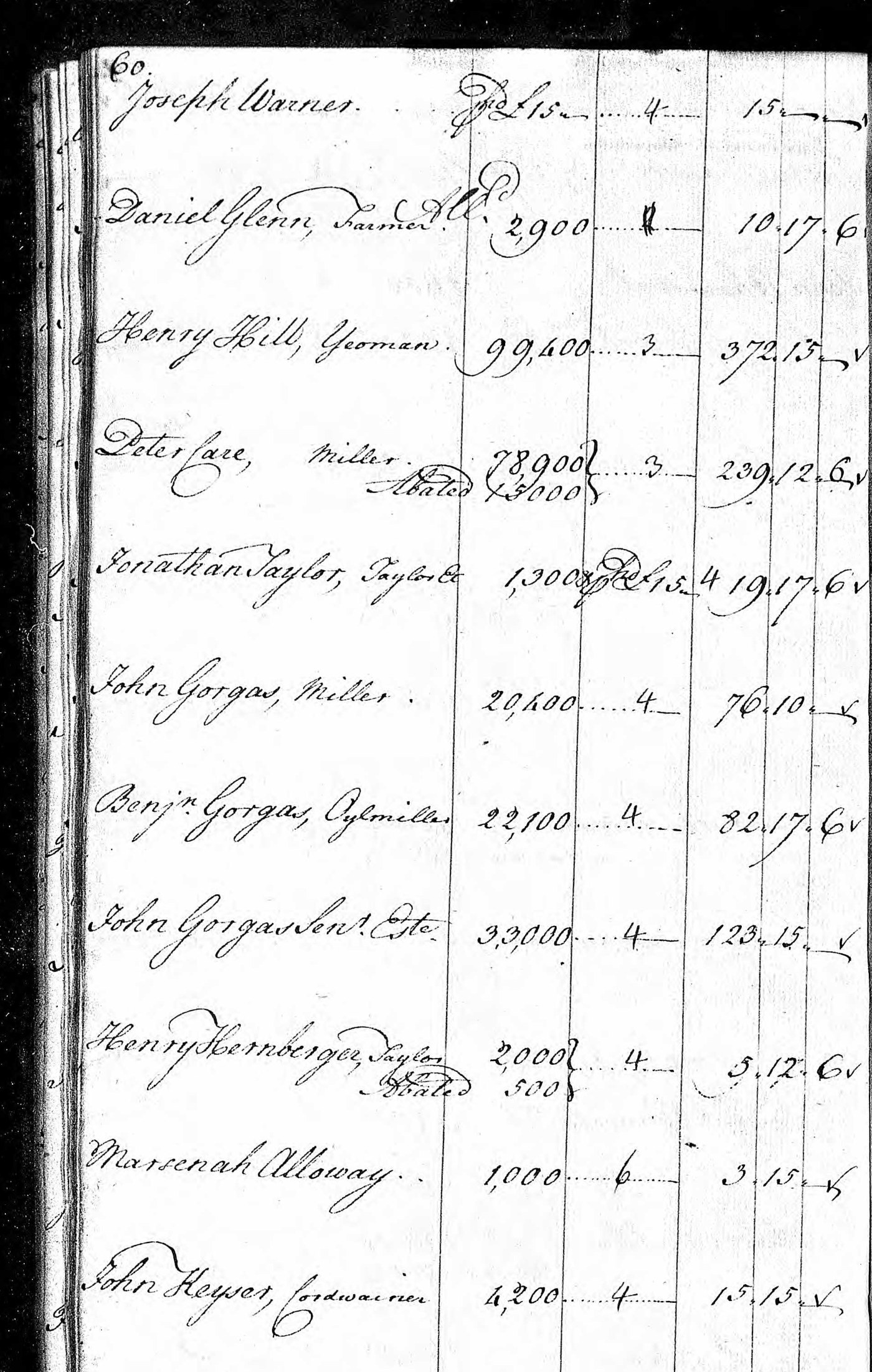
The Roxborough Township tax list of 1780, with the line “Benjn Gorgas, Oylmiller”
The Roxborough tax list of 1780: “Benjn Gorgas, Oylmiller” — with his brother John, “Miller,” on the line above. The record, in the tax collector’s hand, that makes Benjamin the valley’s only named oil miller. Pennsylvania Tax & Exoneration Lists, Records of the Comptroller General (RG-4).

Benjamin Gorgas's tie to the Wissahickon is the Gorgas family mill seat in Roxborough Township, on Wissahickon Creek below the Livezeys' mill at Glen Fern. The tax lists style him its oil miller in 1780 and 1781 — "Oylmiller," "Oil Miller" — the valley's only named oil miller on the record, and its grist-mill holder from 1782; and the family's dam on the creek produced one of early Pennsylvania's most quoted water cases, Levezey v. Gorgas, with its legal gauge of a hole bored in a rock. He was taxed in Roxborough from 1769, moved to Germantown by 1800, and died there in 1821, buried aged 74. One question his file carries openly: his grandfather's 1741 will also names a Benjamin, and for years the miller was taken for that son — but a man born by 1741 cannot be 74 in 1821. The burial age, the young freeman's first tax lines, and an unbroken twenty-year progression say the miller was the grandson, the son John's son. The identification is strongly supported; the entry stands, as the project ruled, "Benjamin Gorgas of Roxborough (generation left open)."

A working life in thirteen levies

The Roxborough tax lines, transcribed in full from the record images, are the spine of his life. In 1769 and 1774 he is taxed on his person alone, holding nothing — a young freeman. In 1780 he appears as "Benjn Gorgas, Oylmiller," and in 1781 as "Oil Miller," while his brother John is the seat's plain "Miller": John ran the grist mill, Benjamin the oil mill that stood with it on the same water. In 1782 Benjamin is "Miller" himself, on 60 acres with a dwelling, a horse, and two cows. In 1783 an assessor struck his name from the oil mill's line and wrote his brother Jacob over it — a reassignment whose reason no record gives. By 1785 the brothers have exchanged mills: Benjamin holds "1 Grist Mill" on 60 acres with two dwellings, and John holds the "Oyl Mill" (1785–86). In 1786 Benjamin and Jacob hold the grist mill in halves; in 1789 Benjamin stands on 72 acres with the mill. The 1790 census finds him heading a Roxborough household of six, his brothers John and Jacob on the same page. It is one man's arc — freeman, oil miller, mill holder — with no seam where a different Benjamin would have to be spliced in.

The 1779 Roxborough mill list (Horatio Gates Jones's) counts the Gorgas grist mill among the township's eleven creek mills and names Benjamin its oil miller. The list stands at the grade of a later compilation; the trade itself is proven by the tax lines in his own name.

The hole in the rock

The Livezeys, upstream at Glen Fern, declared that the Gorgas dam below them had been raised higher than before, penning the water back and breaking their works. Benjamin's own place among the defendants — the report names only "Gorgas et al." — is probable on the tax lists' evidence, not proven, and this account keeps it at that grade. Rather than try the case, the parties sent everything to four referees, whose award became the famous part: the Gorgases might keep their dam forever at a height "corresponding with the bottom of the hole bored in a certain rock" on the creek's north-east side; if they raised it wilfully, the Livezeys, after notices and a viewing by three freeholders, might enter the dam and tear it down themselves; and for the privilege the mill's holders would pay £50 down and £10 yearly. The Supreme Court confirmed the award in 1796 — and the High Court of Errors and Appeals reversed it on January 17, 1800, holding the referees had gone beyond what was submitted to them: they had sold a new privilege and built a standing tribunal for future fights. The settlement everyone quotes was undone; how the mills shared the water afterwards, no record read says.

The seat changes hands

In October 1798 the seat was advertised as "a valuable Merchant, Country and Oil Mill, known by the name of Gorgas's Mill," 25 acres on the creek. By January 1800 the neighbouring Rever plantation was being bounded by "Wisse's or late Gorgas's mill." That September, Benjamin Gorgas and his wife conveyed 41 acres on the township line to Jacob Gominger — the Gazette was soon calling it "Benjamin Gorgas's former plantation," about 20 acres with a stone house and a new stone barn (the acreages do not match; printed as found). Roxborough's only Gorgas household in the 1800 census is his brother John's.

Germantown: land, sales, and a paper mill

Benjamin's second act is Germantown real estate and mill-world dealing, traced through the newspapers. In 1802 he offers an elegant Mount Airy seat on Main Street, and serves as the contact for the sale of Cresheim Mill — "conditions of sale made known by Benj. Gorgas, or Son." Through 1802–1805 his name bounds other men's sales — Peter Care's tract, lots on Livezey's Mill Road, the Yorkes' Cresheim Creek lots — and he sells Germantown Turnpike lots of his own. His last newspaper trace, January 1814, is characteristic: a stone paper mill on Cresheim Creek, built about 1809, 33 by 45 feet with 30 feet of fall — "apply to Benjamin Gorgas, near the 8-mile stone." Contact, as so often, rather than stated owner. The censuses track him to Mount Airy in 1810, his son Benjamin Jr. in the next household.

The will, and the stepmother in the lot

His will (Will Book 7, pp. 397–398), dated August 25, 1819 and proved November 7, 1821, styles him "Benjamin Gorgas Senr of the Township of Germantown… Farmer." His wife Juliana takes the furniture, a fourth of the money and notes, and the life use of the mansion house and lot on Allens Lane; his son Benjamin Jr. and son-in-law Samuel French execute — affirming, not swearing, in the family's Brethren practice; daughter Susanna shares; and a fourth goes to the children of a son who died before him, including "Ann the wife of — Houston," her husband's first name a blank dash in the will. The lots to be sold include one adjoining Peter Bechtel and a last three acres in Roxborough on a mill road. No mill is named — the mill life was thirty years past.

He was buried October 23, 1821, aged 74, in the Germantown Church of the Brethren Cemetery — in a lot headed "Owner Rachel Gorgas, Estate." Rachel's will (Book 8, p. 462, read in the original) names her six children — exactly the younger six of his uncle John's ten — and so identifies her: the later wife of John Gorgas the son, mother of his younger children, and Benjamin's stepmother. It is her lot he lies in, beside his widow Julianna (d. 1833). His inventory was never found on either online collection and stands as a permanent gap; no newspaper noticed his death.

Timeline

YearEvent
1769First Roxborough tax line — taxed on his person alone, a young freeman
1780–81Styled "Oylmiller" / "Oil Miller" in the Roxborough tax lines; his brother John holds the grist mill
1782"Miller" — 60 acres, dwelling, occupation assessed £319
1783The assessor strikes his name from the oil mill's line and writes Jacob over it
1785–86The brothers reversed: Benjamin holds the grist mill, John the oil mill
1790Heads a Roxborough household of six in the first census
1796–1800Levezey v. Gorgas: the referees' award (the hole in the rock) confirmed 1796, reversed January 17, 1800
1798The seat advertised as "Gorgas's Mill" — merchant, country, and oil mill, 25 acres
1800Conveys 41 acres to Jacob Gominger (Sept 1); Germantown in the census; Roxborough's only Gorgas household is John's
1802Offers a Mount Airy seat; contact for the Cresheim Mill sale ("Benj. Gorgas, or Son")
1814Last newspaper trace — the Cresheim Creek paper mill, "apply to Benjamin Gorgas"
1819Will dated August 25 (Book 7, pp. 397–398, no. 164)
1821Buried October 23, aged 74, Germantown Church of the Brethren Cemetery, Lot 15; will proved November 7

What remains open

The generation, formally — held open by the project's ruling though the evidence runs one way. His birth record and marriage, nowhere found. His inventory, a permanent gap in the physical probate file. The brother John's death and burial — a John Gorgas buried two days before Benjamin proved, on examination, to be a boy of ten on another lot, not the brother. And the transaction behind an assessor's pen-stroke in 1783, when the oil mill passed on paper from Benjamin to Jacob. What is not open: the oil miller's trade, the tax arc, the lawsuit's course, the will, and the grave.
The Cellar

Primary (read)

  1. Will of Benjamin Gorgas, Philadelphia Will Book 7, pp. 397–398 (dated August 25, 1819; proved November 7, 1821). Read in the original, FamilySearch, Wills v. 7–8, 1819–1826, DGS 7726384, images 205–206 (ARK 3Q9M-C9B2-LVDZ; 3Q9M-C9B2-LVXC).
  2. Will of John Gorgas, Philadelphia Will Book F, p. 221 (1741), and Will of John Gorgas the son, Will Book S, pp. 44–45 (1781) — read in the originals in the passes for entries 19 and 18; the two Benjamin-namings on which §8.1 turns.
  3. Levezey et al. v. Gorgas et al., 4 Dall. 61 (Pa. High Court of Errors and Appeals; opinions at the adjourned session, January 17, 1800; judgment reversed). Read in Dallas, Reports of Cases Ruled and Adjudged…, vol. 4 (open scan, archive.org item sim_united-states-supreme-court-cases-adjudged_1807_4); the scan's OCR is damaged in places, graded where it matters.
  4. Pennsylvania tax lists, Roxborough Township, 1769, 1774, 1779 — Pennsylvania Archives, 3rd series, vol. XIV, read in the project's working text (the lists name Benjamin Gorgas; the 1779 levy read taxes him at 14 shillings).
  5. The Benjamin Gorgas tax lines, Roxborough Township, 1769–1789 — Pennsylvania Tax & Exoneration Lists (RG-4): indexed in the project's Ancestry harvest, Item 24 (sixteen entries), and transcribed in full from the record images in Item 53 (thirteen distinct levies; the 1780 line "Benjn Gorgas, Oylmiller," image 33020_254657-00760; the 1781 line "Oil Miller"; the 1782 line "Miller," 60 acres, image 33020_254658-00430 — Item 53's transcription supersedes Item 24's first reading of that line).
  6. U.S. Census 1790, Roxborough Township ("Benjn Gorges"), NARA M637 roll 9, DGS 5157141, image 581 (sheet pp. 329–330) — read from the image; household 2/2/2.
  7. U.S. Census 1800, Germantown ("Benjm Gorgas"), NARA M32 roll 42, DGS 4956043, image 194, p. 125 — tallies measured column-by-column; head 45 and over, five persons. Roxborough's only 1800 Gorgas household is John Gorgas (same roll, image 210).
  8. U.S. Census 1810, Mount Airy, Germantown Township — "Benjn Gorgas" and "Benjn Gorgas Junr" adjacent, M252, DGS 5157105, image 19 (names verified; tallies not read).
  9. Newspapers, Readex / America's Historical Newspapers via the Free Library of Philadelphia — "Gorgas," all titles, 1800–1825: 184 hits, all screened. Benjamin items: Rever plantation advertisements, Claypoole's American Daily Advertiser, January 29, 1800, and the Philadelphia Gazette, 1800–1801; former plantation, Philadelphia Gazette, December 18, 1800; Mount Airy seat, Poulson's, March 24, 1802; Cresheim Mill sale, Poulson's, June 3, 5, 12, 1802; Care tracts, Gazette of the United States, November 19–23, 1802; Care assignees' lots, Poulson's, August 24, 26, 1802; Yorkes' lots, Poulson's, May 12, 1803; Turnpike lots, Poulson's, September 16, 18, 1805; Gominger sheriff's sale, Poulson's, July 9, 1810; Cresheim Creek paper mill, Poulson's, January 3, 4, 5, 1814. No Benjamin item after January 1814; no estate notice anywhere in the set (OCR-bounded).
  10. Philadelphia will indexes (handwritten, DGS 7726617 and 7726616; typed, DGS 7725195) — read for the surname, 1741–1825: John 1741 (F 221), Joseph 1767 (O 85), John 1781 (S 44), Benjamin 1821 (Book 7, p. 397), Rachel 1825 (Book 8, p. 462). Administration Index, both volumes (DGS 7726470; DGS 7726505) — no Benjamin Gorgas; administration/estate files (olib:1876726) sampled 1779–1800, no Gorgas (bounded).
  11. Philadelphia directories, 1794, 1796, 1802, 1810, 1820 (archive.org full texts, read) — no Benjamin Gorgas; all Gorgas entries are the city lumber family.
  12. Will of Rachel Gorgas, Philadelphia Will Book 8, p. 462 (will no. 99; dated April 29, 1818; proved August 13, 1825). Read in the original, FamilySearch, Wills v. 7–8, DGS 7726384, image 567 (ARK 3Q9M-C9B2-LJZN) — "relict of John Gorgas deceased," of Germantown Township; her six children named; §7.
  13. Benjamin Gorgas's estate file — SEARCHED, NOT FOUND: Philadelphia administration files (catalog 1876726), all fourteen volumes covering 1821–1822 full-text searched surname by surname (DGS 5874470–5874483; the no. 115–168 volume, which should hold file no. 164, also searched under Gorges and Gourgas, with a working control); the three surname hits in those volumes were opened and eliminated (a James Houston administration account naming Keyser & Gorgas as rent payers; a Samuel Gorgas as appraiser; a Cridland creditor list). Bounded by the files' OCR index.

Harvest and index layer

  1. The project's Ancestry harvest, Item 24 (Benjamin Gorgas): sixteen candidate Roxborough tax entries indexed, 1769–1789 (one line transcribed — item 5 above); Septennial Census exact-name search — three results, none Roxborough (Lancaster County and Philadelphia city men); probate collection exact search 0.
  2. Find a Grave index entry for Benjamin Gorgas (b. February 19, 1747; d. October 23, 1821; Germantown Church of the Brethren Cemetery) — seen in search results only, the record not opened; carried as a lead, §7 and §8.8.
  3. The project's Ancestry harvest, Item 54 (Benjamin probate, in its actual years): the will's record in collection 8802 (Book 7, pp. 397–398, entry no. 164 — the will book's margin and the Old Index read 164; the 1777–1825 index's 184 is that index's slip) and its abstract, whose readings differ from the original's at the points flagged in §7; the inventory negative with its bounds (no 1821 will-file packet volume exists in the collection; the 1821 Orphans' Court estate papers and administration files were not browsed there); the collection 4695 abstracts naming Benjamin under both Johns (1741 and 1781) and a Benjamin Gorgas "Sr." as witness to the Caspar Fallar will, proved August 18, 1819; the Administration Index (1777–1825) negative for the surname.
  4. The project's Ancestry harvest, Item 55 (Gorgas church records, collection 2451, Historical Society of Pennsylvania): the Germantown Church of the Brethren Cemetery lot card (reel 631, image 40162_264348-00439, record 2510723) — Benjamin buried October 23, 1821, aged 74; Julianna, 75, January 9, 1833; Rachel, 13, 1819; Rachel, 85, March 8, 1825; Sarah, 67, 1856; Henry, 87, 1857; Mary H. White, 32, 1852 — a typed card compiled later, graded as such; the baptism and marriage negatives with their stated bounds; Germantown index hits (Jacob Gorgas & Catharina marriage, 1803; baptisms of their children Johannes, 1805, and Maria, 1808); and the index hit for a John Gorgas burial, Philadelphia, October 21, 1821 (opened for Item 56 and settled at §8.12).

Secondary and project sources

  1. Sweeps 1 and 4 (project files) — the 1779 mill list attribution (Gorgas grist mill among Roxborough's eleven; Benjamin named its oil miller) and the case's identification, both graded in §8.2–8.3.
  2. Dossiers for entries 18, 19, and 26/29 (project files) — the 1798 "Gorgas's Mill" advertisement (read in entry 18's newspaper pass); Jones (1858) on Roxborough's mills of 1779; the Livezey family frame.

Not read

  1. The 1779 Roxborough mill list in its original publication (Jones/Watson tradition) — carried at sweep grade (§8.2).
  2. Deed books — the September 1, 1800 Gominger indenture and the Cresheim conveyances are known from the sheriff's recital and the advertisements only (Pull List (c)).

---


A note on sources. This biography was researched online from the public record — deeds, censuses, tax lists, newspapers, court reports, and probate files — and every fact in it is tied to a source in the bibliography. Records from the eighteenth and nineteenth centuries are imperfect: names were spelled several ways, ages drift from census to census, and officials made mistakes. Where two records disagree, this account prints both rather than choosing silently; where an identification rests on converging evidence instead of a single document, it says so in the text. If you hold a record that corrects or extends this account, the project welcomes it — corrections make the record better.

Back to Historical Figures

Back Home