William DeWees built a paper mill on Wissahickon Creek in 1710. The mill stood on his hundred-acre tract in Crefeld, the western district of Germantown Township in Philadelphia, where the tract ran down to the Manor of Springfield line — the creek at today's City Line and Northwestern Avenue, at the northern end of Wissahickon Valley Park. The sources call his mill the second paper mill erected in the American colonies, after his in-laws' Rittenhouse mill of 1690. He sold it in 1713, deed, tools, and iron pots together; nineteen years later he was making paper again at a second Crefeld seat, in partnership with Henry Antes; and he died on the land in 1745. The creek is why he belongs in this collection: he built on its bank and worked on its water, twice, across thirty-five years. That is the tie, stated first, because everything else in his story hangs on it.
Almost everything else about him had to be recovered from a handful of documents, some of them damaged. His will survives in the Philadelphia will books as torn loose leaves. His name appears in the newspapers of his last seventeen years only attached to a younger man. The inventory that would have priced his mill tools was ordered by the court and never found. This article puts together everything the surviving records actually say, and says plainly where they stop.
The second mill in America
In 1710, twenty years after William Rittenhouse built the first paper mill in America on the run in Roxborough that still bears the name Paper Mill Run, his brother-in-law's brother built the second. William DeWees had come to Germantown from New York in 1689 or 1690, with Nicholas Rittenhouse, whose wife Wilhelmina was DeWees's sister. Horatio Gates Jones, the Germantown historian, believed DeWees learned the trade at the Rittenhouse mill itself; the record does not document an apprenticeship, and the belief is printed here as Jones's opinion, no more.
The proof that the 1710 mill worked comes from a minister's pocketbook. The Rev. Paulus Van Vlecq, a Dutch Reformed minister, kept his private accounts inside his church records, and under December 18, 1710, he lent "Willem DeWees" five pounds, repayable the first of May. The account goes on to show the loan repaid — partly in paper. Quires of DeWees's paper move through the entries at six pence, seven pence, seven pence-halfpenny, and nine pence for fine paper, and one payment goes to Francis Daniel Pastorius himself. Van Vlecq's book calls him, in passing, "William Dewees, paper maker, on the Wissahickon." It is the smallest, firmest evidence a mill could leave: paper, sold by the quire, in the mill's first winter.
The deed of 1713
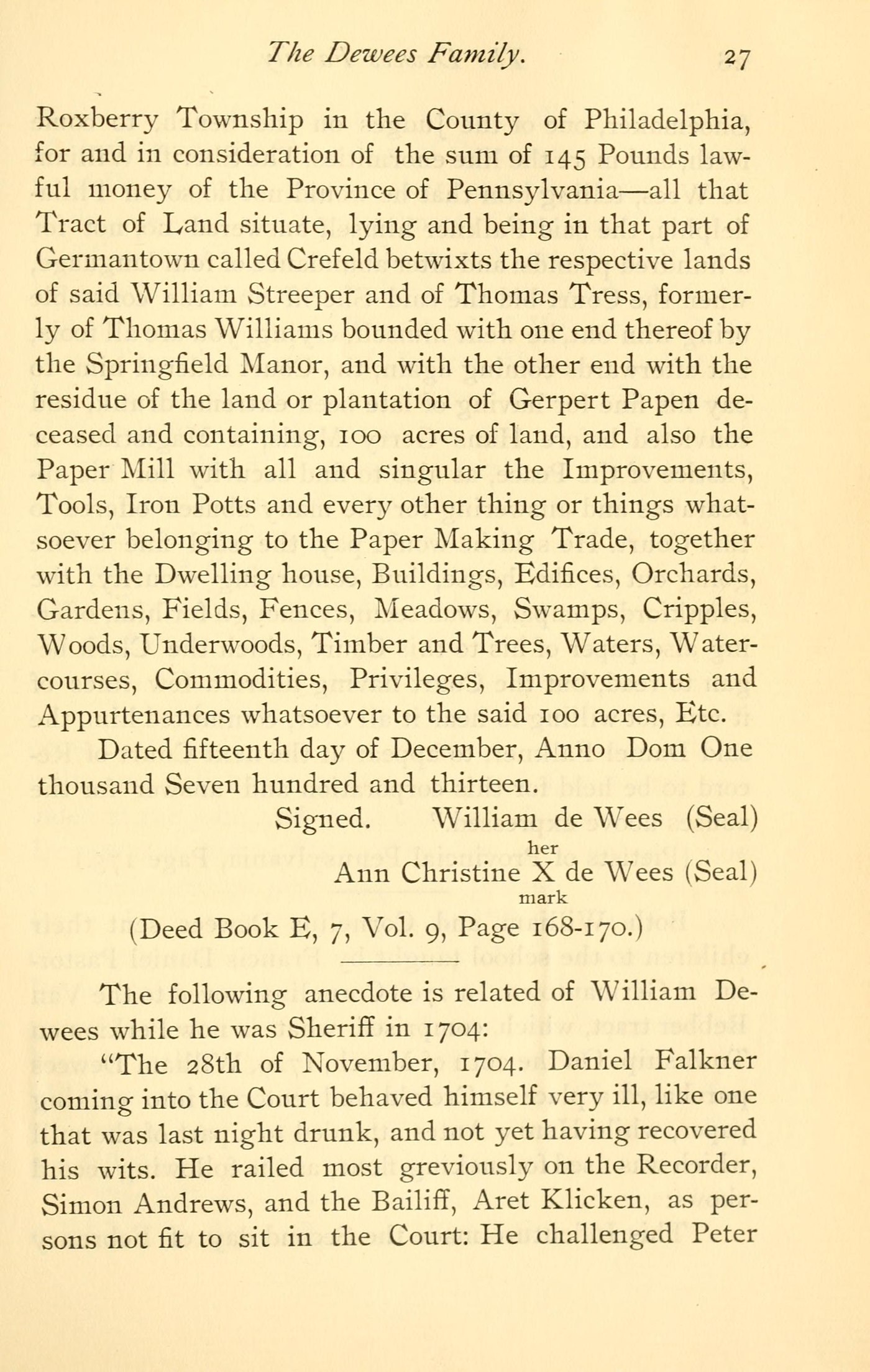
Three years later DeWees sold the mill, and the deed — recorded in Philadelphia Deed Book E7, volume 9, pages 168 to 170, and printed in full in the family genealogy of 1905 — is unusually explicit. On December 15, 1713, William de Wees and his wife Anna Christina conveyed to Abraham Tunis, William Streeper, Claus Rittenhouse, and John Gorgas, for £145, a hundred acres "in that part of Germantown called Crefeld," bounded at one end by the Springfield Manor, "and also the Paper Mill with all and singular the Improvements, Tools, Iron Potts and every other thing or things whatsoever belonging to the Paper Making Trade, together with the Dwelling house." The genealogy notes that the deed's recitals show the mill then in full operation. Claus Rittenhouse is Nicholas — the founder's son. The second mill in America passed from its builder to a partnership headed by the family of the first.
One conflict in the sources deserves print rather than a quiet fix. Jones and the genealogy both describe the mill as standing on the "west side" or "west bank" of the Wissahickon, while the deed puts the tract in Germantown, which lay east of the creek, its far end on the Springfield Manor line. The deed governs the legal statement — Germantown Township, County of Philadelphia — and the "west side" wording most plausibly describes the mill's position at that boundary; but the two phrasings are printed here side by side, as the dossier prints them, and neither is silently corrected. What no source disputes is the water: the mill stood on the Wissahickon itself, at Germantown's northwestern corner — not on Cresheim Creek, a confusion this biography is careful to avoid.
The sheriff of Germantown
Before the mill, there was the town. In 1704 DeWees was Sheriff of Germantown, and the court record of November 28 that year — preserved in Sachse's Pietists of Provincial Pennsylvania — shows him at work. Daniel Falckner, a leader of the Frankfort Company Pietists, came into court, in the record's phrase, "like one that was last night drunk, and not yet having recovered his wits," insulted the Recorder and the judges, and challenged a judge to come down and fight. The Sheriff warned him he would not do such things in Philadelphia; Falckner answered that he would not — "not for a hundred pounds." The court fined him, demanded security, and committed him, with the Sheriff and the constable ordered to bring him out. It is the only scene in the whole record where DeWees acts rather than owns, and it fixes him in Germantown's public life within fifteen years of landing.
First the flour, then the paper
DeWees's second paper-making career began on March 26, 1729, when he bought 93 acres in Crefeld from the heirs of Gerpert Papen — a tract with a grist mill on it. The following February he and Henry Antes, the carpenter who would become a leading figure of the Moravian movement — and who was DeWees's son-in-law — signed an indenture (Deed Book F5, page 197) dividing the work of a double mill. The grist mill, with two pairs of stones and two bolting mills, was to be built at their joint and equal cost; the dams and the mill-race dug between them; the paper mill's gears were DeWees's charge alone. Antes took a half interest in the grist mill and ground. And the paper mill's water was rationed in writing: it was "to be only served by the overplus of water, when the Grist Mills are supplied." First the flour, then the paper.
Antes lived on the tract three to five years before removing to a mill near the Perkiomen. DeWees lived on it until his death in 1745. The genealogy identifies the tract as the later site of the Convent and Academy of St. Joseph — a 1905 locator for the Crefeld edge of Chestnut Hill, printed here as the genealogy's statement rather than a verified modern fact. Scull and Heap's map of 1752 marks an unnamed "Paper Mill" on the tributary west of upper Germantown, in the reach this seat occupied; the map names no owner, and the identification is consistency, not proof.
The other William Dewees
There is a paper mill in the Pennsylvania Gazette of October 4, 1739: "THERE is at the Paper-Mill of William Dewees, jun. in Cresham Township, Philadelphia County, a large brown Horse, his near hind Foot white, and some white in the Face." A Dewees paper mill, standing in Cresheim Township, in the elder man's lifetime — and the name on it carries a "jun."
The junior is a real presence in the record: a tenant on Edward Farmer's 200-acre plantation in the sale advertisements of 1738, and the "William Dewees, at Whitemarsh" who answers for stray animals in July 1745, after the elder's death. The elder's will names a son William, left five shillings — the token of a child already provided for. The junior may be that son, set up at a mill; the 1739 mill may be the father's first seat, his second seat, or a third. No record read settles it, and this article does not settle it either: the notice is printed with its "jun." intact, claimed for nobody. What the newspaper run does establish, searched entire for 1728 to 1745, is a negative: in his own person, the elder William Dewees never appears in the province's newspapers at all — no notice, no advertisement, no death announcement in 1745.
The will that names no paper mill
William Dewees signed his will on November 22, 1744 — "of the Township of Germantown, in the County of Philadelphia and Province of Pennsylvania, Miller" — and it was proved on July 13, 1745. It is a careful settlement. His wife Anna Christina receives £12 a year for life, a feather bed of her choosing, and a room in his new dwelling house for as long as she lives, wherever the house's owner must provide it. His son Garrett receives the dwelling house, the grist mill, the land, and the plantation, and all the personal estate, charged with paying the legacies: £100 each to Cornelius and to Philip (Philip's at twenty-one), £70 each to Christina and Mary, £30 to Margaret, who had already had land worth £40, and five shillings each to William and Henry. The executors are the widow, Garrett, and "my Son in Law Henry Antes."
For a biography of a paper maker, the will's loudest feature is its silence. It names a grist mill. It never names a paper mill — no mill, no gears, no tools, no stock of paper. Whether the paper works of the 1730 indenture had been dismantled, sold apart, or lay inside the general words, nothing read says, and the silence is printed here as the record's silence, not explained away.
The document's own survival is a story of damage. The registered copy does not stand in the bound will book; it lies among torn loose leaves photographed after the book's title page, two leaves to a frame, out of order. Checked against the genealogy's transcription in November 2026, the substance holds — but Margaret's item is torn at its head, so her £30 rests on the transcription alone; Henry's amount is torn off entirely ("the Sum of [torn] shillings"); Christina's name sits in a torn edge; and the witness Richard Bull, printed in the genealogy, does not appear on the attestation leaf at all. The inventory, ordered by the court for August 13, 1745, was searched for in Philadelphia's administration files and not found.
Timeline
| Date | Event |
|---|---|
| c. 1677 | Born in Leeuwarden, Friesland, Holland (the genealogy's date and place) |
| 1689 or 1690 | Arrives in Germantown from New York with his brother-in-law Nicholas Rittenhouse |
| 1704 | Sheriff of Germantown; the Falckner court scene, November 28 |
| January 1706 | Sells Germantown land to Conrad Rutters |
| 1710 | Builds his paper mill on the Wissahickon in Crefeld; Van Vlecq's loan and paper account, December 18 |
| December 15, 1713 | Sells the mill, its tools and iron pots, and the 100-acre tract to Tunis, Streeper, Rittenhouse, and Gorgas for £145 |
| March 26, 1729 | Buys 93 acres with a grist mill from the Papen heirs |
| February 2, 1730 | Indenture with Henry Antes: the shared grist mill and DeWees's paper mill, the paper mill to run on the overplus water |
| By 1734 | Holds 150 acres in the Crefeld (Cresheim) district on the quit-rent list |
| October 4, 1739 | A Gazette stray notice names "the Paper-Mill of William Dewees, jun. in Cresham Township" — attribution open (see text) |
| November 22, 1744 | Signs his will |
| March 3, 1745 | Dies (the genealogy's date; the probate bounds it before July 13) |
| July 13, 1745 | Will proved at Philadelphia; inventory ordered by August 13 — searched for, not found |
What to see today
Nothing of DeWees's mills stands. The ground of the first seat lies at the creek's northern reach inside and beside Wissahickon Valley Park, where Northwestern Avenue follows the water under the city line; the second seat's tract is the Crefeld ground at the Chestnut Hill edge of Germantown. The documents outlasted the buildings: the deeds in their Philadelphia books, quoted in the 1905 genealogy any library can open; the map of 1752 at the Library of Congress; and the will itself, torn leaves and all, in the Philadelphia will books — the settlement of a miller who provided for everyone, in order, and left his paper mill out.