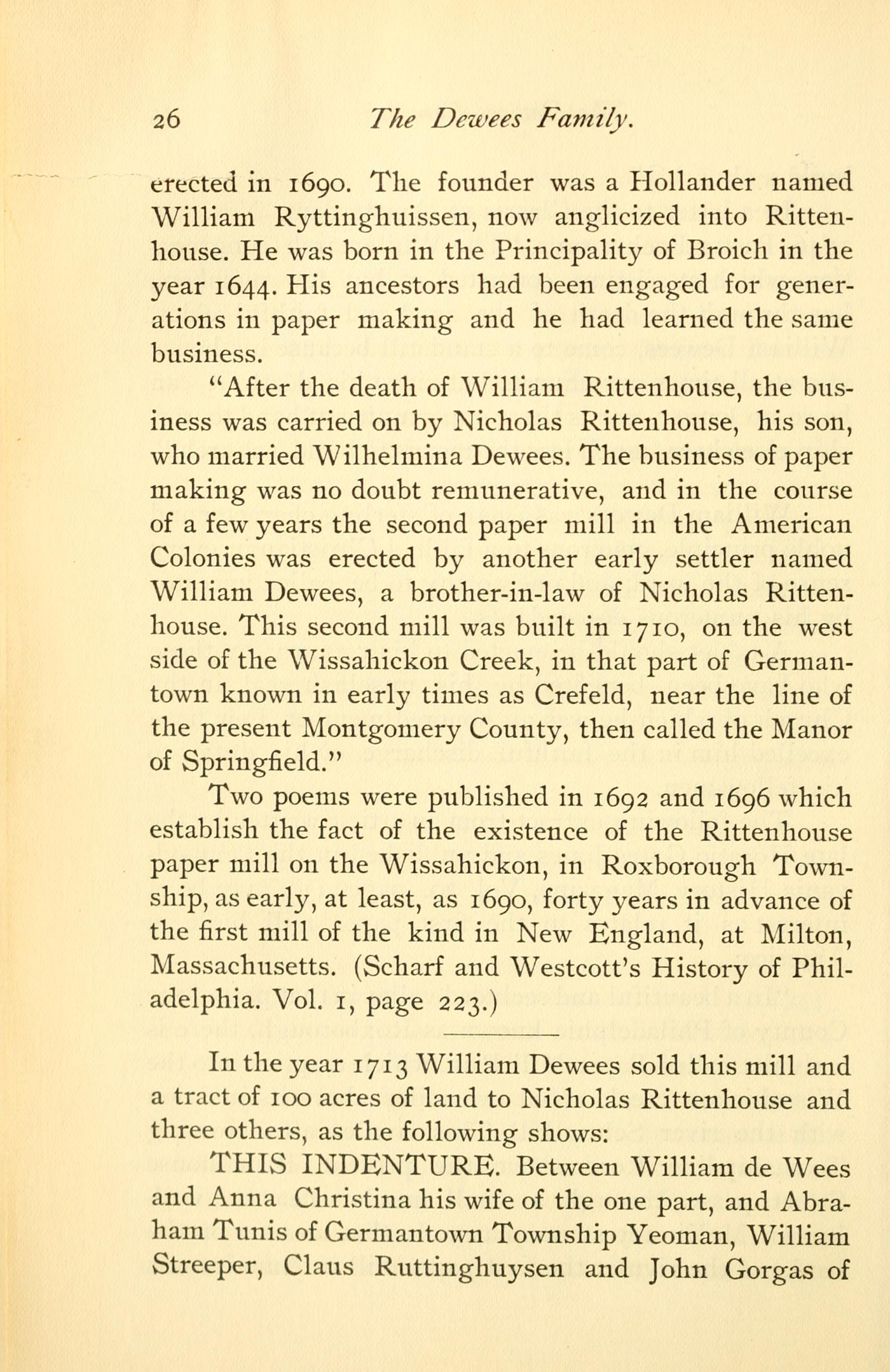
John Gorgas's Wissahickon tie is a purchase, made on December 15, 1713: he was one of four Germantown men who bought William DeWees's paper mill on Wissahickon Creek — 100 acres at Crefeld, in Germantown Township, Philadelphia County, with the mill, its tools, and its iron pots — for £145. Isaiah Thomas, the first historian of American printing, adds a second act: De Wees and John Gorgas, he wrote in 1810, built a mill on the Wissahickon in 1728 that made an imitation asses-skin paper. The deed is a document; Thomas's account is a tradition at one remove, and this account keeps them at those grades. Everything else known of the man fits around those two facts: a burying-ground wall in 1724, a will in 1741 that divides a fulling mill among four sons and names no paper mill at all, and a family whose next two generations run through the creek's mill record.
The man in the records
No record read gives his birth, his origin, or his arrival; he was buying Germantown land by 1713. The project's master list styles him "John Jacob Gorgas" and dates him from 1686 — both forms descend from a project sweep whose basis is unstated, and no record read supports either; this account calls him John Gorgas. His wife was Sophia; his will names six children — John, Benjamin, Joseph, Jacob, Susanna, and Mary. A published will index of 1900 styles him a "skin dresser," but his will itself gives no occupation, and the same index misstates his executor's name; the styling stands at index level only. His identification as the 1713 buyer is well-supported rather than document-proven: his son was a child in 1713, no rival John Gorgas appears anywhere, and the estate his will divides is the estate the buyer's generation would leave.
The purchase
The deed (Philadelphia Deed Book E7, vol. 9, pp. 168–170, read in its printed text in La Munyan's The Dewees Family, 1905) runs from William de Wees and Anna Christina to Abraham Tunis, William Streeper, Claus Ruttinghuysen — Nicholas Rittenhouse of the 1690 mill family — and John Gorgas, for £145: 100 acres "in that part of Germantown called Crefeld," and "also the Paper Mill with all and singular the Improvements, Tools, Iron Potts and every other thing or things whatsoever belonging to the Paper Making Trade, together with the Dwelling house, Buildings, Edifices, Orchards…" The mill was the second paper mill on the creek, built by DeWees in 1710 and then in full operation. What the four owners did with it — worked it, tenanted it, leased it — no record read says; the seat's working years from 1713 to 1729 are silent in everything searched.
The mill of 1728, on an old man's word
Thomas's History of Printing in America (1810) counts "the third paper mill establishment in Pennsylvania" as the work of "William De Wees and John Gorgas, who had been the apprentices of Kittenhouse [Rittenhouse]… on the Wissahickon creek, eleven miles from Philadelphia, and built in 1728. They manufactured an imitation of asses skin paper for memorandum books, which was well executed." His source, named in a footnote, was John Brighter, "an aged paper-maker, who conducted a mill for more than half a century in Pennsylvania," who added that the paper "was made out of rotten stone… and that the method of cleansing this paper was to throw it in the fire" — a mineral paper, as Weeks (1916) glossed it, apparently an asbestos paper. A specialty no other colonial mill is recorded making — carried here as what it is: a tradition printed in 1810, irreconcilable in detail with the 1713 deed, and the only source that pairs the two men as builders. (Thomas's index, incidentally, garbles him as "Gorgas, George, paper maker.")
The wall of 1724
Between the purchase and the will stands one dated community record. Hotchkin's history of Germantown (1889) records that the front wall of the Upper Germantown Burying Ground "was begun in May, 1724," and lists John Gorgas among those who aided the work — with Paul Engel, Garret Rittenhausen, Peter Keyser, Peter Shoemaker, Christopher Witt, and others; the wall cost £40 8s. 6d in all. It places him, eleven years after the purchase, in the Reformed congregation's orbit — though his own faith is stated in no record read, and his children's later affiliations (a daughter at the Ephrata Cloister, a son in the Brethren world) are theirs, not his.
The will that names no paper mill
John Gorgas's will, dated June 1, 1741 and proved June 22, 1741 (Will Book F, p. 221, read in the original), settles a Germantown estate: his widow Sophia takes the profits for life, with power to sell his Bristol Township lands; the eldest son John takes the first half of the family's fulling mill and half its fifteen-perch lot, for £50 paid; Joseph takes a house and lot on the North Wales Road; the three younger sons share the other Germantown lands toward Cresan Road, and after their mother's death share the fulling mill's other half; daughter Mary gets £20, and £30 more if she leaves "the Monastery at Lancaster" — the Ephrata Cloister, where she was then living — to marry or live for herself; a grandson John gets £5. The executors are Sophia, John, and "my trusty friend William Kettenhousen" — the 1900 index's "William Rittenhouse" is its own error. And the will names no paper mill: the Crefeld mill of 1713 is not his to devise in any words it uses, and what became of his quarter share is in no record read. His inventory was searched in the estate files and not found; his burial place is unknown.
Timeline
| Year | Event |
|---|---|
| 1713 | With Abraham Tunis, William Streeper, and Claus Ruttinghuysen, buys DeWees's Crefeld paper mill and 100 acres for £145 (Deed Book E7, pp. 168–170) |
| 1724 | Named among the helpers of the Upper Germantown Burying Ground's front wall (Hotchkin, p. 171) |
| 1728 | The year Thomas (1810), on Brighter's recollection, gives for the De Wees–Gorgas mill and its asses-skin paper — tradition, not document |
| 1741 | Will dated June 1; proved June 22 (Will Book F, p. 221) — a fulling mill divided among his sons; no paper mill named |
| 1781 | His son John's will (Book S, pp. 44–45) devises "all my Lands, Mills, Tenements" — the document that keeps father and son apart |
Why he matters, and what is not known
Three of his sons anchor creek entries of their own — Joseph, who built the Monastery house (1747); Benjamin, the Roxborough oil miller; and John, whose line holds mills into the next century — which makes the father the family's creek patriarch on paper as well as in fact. His own file is the thinnest of the four, and its gaps print as gaps: his birth and arrival, his trade, his burial, the working years of the mill he bought, and the fate of his quarter share. A later claim that DeWees's son Henry owned the 1710 mill rests on a map of 1746 that no one in this project has identified; it stands unproven, from this side as from Henry's. The silence around him is at least a searched silence: the probate indexes and estate files were read and searched for his papers, the Pennsylvania newspapers of 1719–1741 were searched for his name against a control search that proved the corpus live (the name returns nothing), and the Germantown church registers that might hold his marriage and burial are restricted to research centers — closed to an online project, and printed here as a permanent gap rather than a pending errand.