The grain mills beside the paper mills
RittenhouseTown is remembered for paper. The village stands on the Monoshone — the run also called Paper Mill Run — just above where it flows into Wissahickon Creek, and the Rittenhouse paper mills that made its name stood on the family’s original twenty acres along that run. But the family did not stop at paper. Around that first small tract, the Rittenhouses gathered land, and on the added land they built grist mills — mills to grind the neighborhood’s grain into flour and meal. The paper family became the valley’s millers of grain as well.
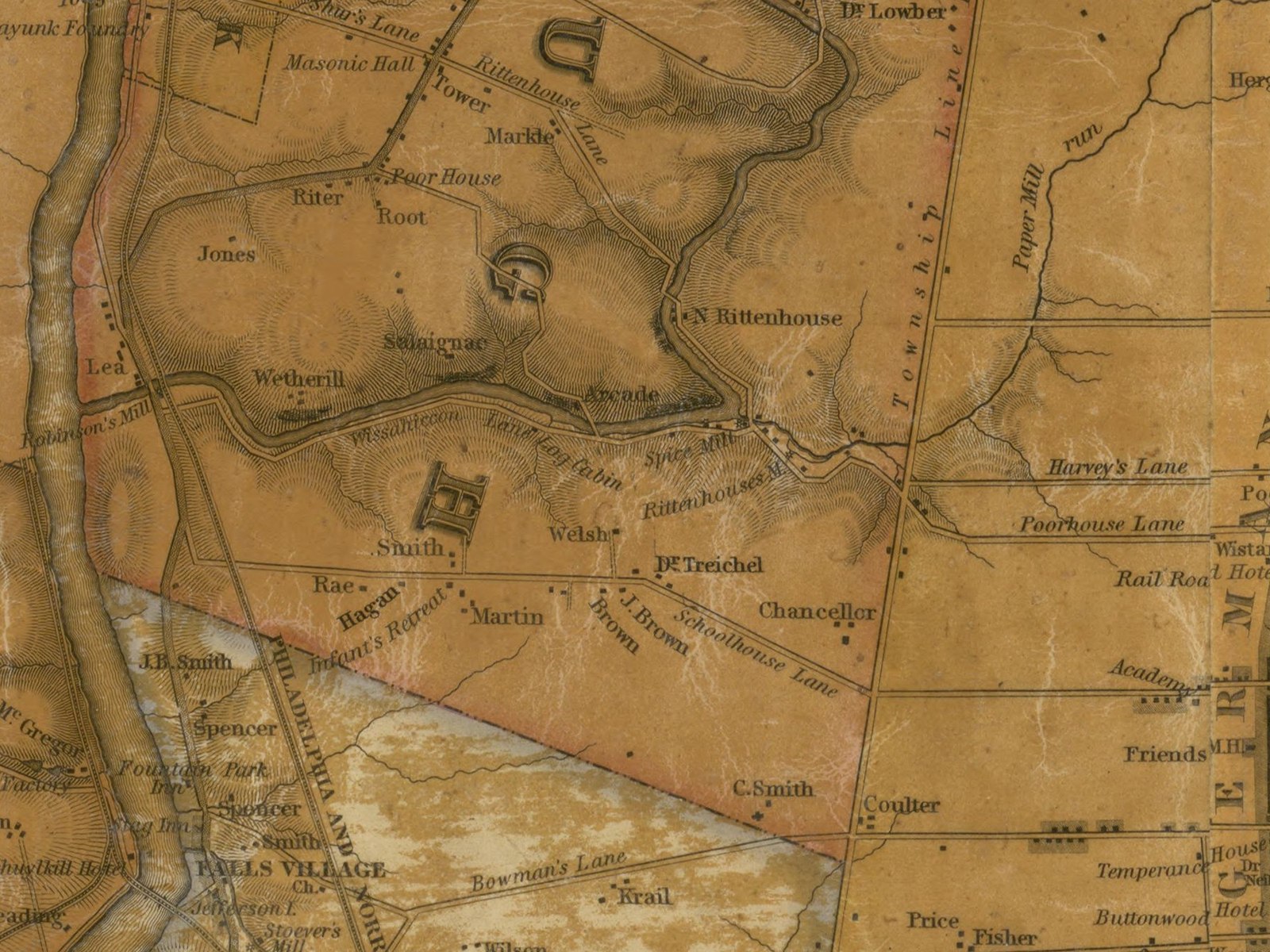
The gathering was two generations’ work. Claus Rittenhouse had acquired a fifty-acre parcel before his death in 1734. His son William, who inherited the place in 1734, added ninety acres to the southeast and thirty-five acres to the northwest in 1741 — over two hundred acres in all, held together around the original twenty. When Lehman’s survey of the family’s land was drawn in 1772, before William’s death in 1774, it showed the two paper mills and the houses on the original twenty-acre tract, and two grist mills on the newly acquired land along the Wissahickon. The grist mills belong to that expansion.
Five mills, five dates — and one thread
The National Park Service’s nomination for the RittenhouseTown Historic District lists five dated grist mills for the family’s holdings: a William Rittenhouse Mill of 1746; a Henry Rittenhouse Grist Mill of 1751; a William Rittenhouse Grist Mill dated before 1760; a second William Rittenhouse Grist Mill dated before 1772; and a Nicholas Rittenhouse–Vanderen Mill of 1772.
Those five dates deserve an honest label. The nomination’s own footnote gives its source for them: Douglas MacFarlan’s “The Wissahickon Mills,” Part One, written in 1947 — a typescript held by the Historical Society of Pennsylvania, on paper only. It stands as a permanent gap. Every standard account repeats the five dates; the thread they hang on is that one unread typescript, and they are printed here at exactly that grade.
Nor can the five be matched to the ground with any confidence. Which two of them are the two grist mills on Lehman’s 1772 survey is not itemized in anything read. The other three may have stood elsewhere on the two hundred acres, or the survey may predate them, or omit them. That is printed as a gap, not resolved.
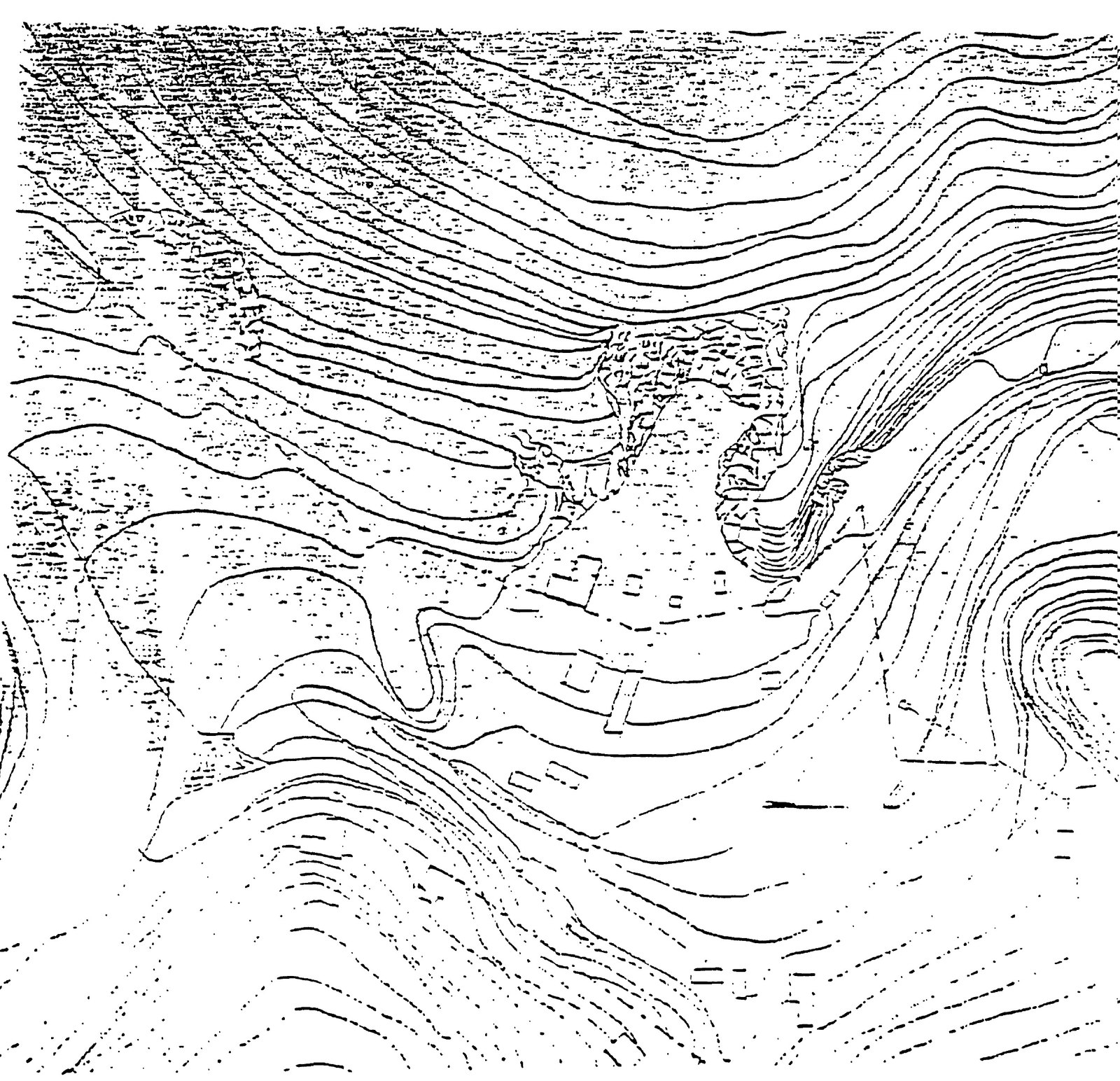
Of the mills themselves, the record is thin. The William mills belong to the generation of the son who inherited in 1734 and died in 1774, but the nomination does not distinguish the mill of 1746 from the grist mills dated before 1760 and before 1772, and no source read gives any of them an operator, a tenant, a count of its stones, or a fate of its own. Henry Rittenhouse is a name and a date only: the nomination dates his grist mill to 1751 but gives him no parentage and no residence, and which Henry of the family he was is not fixed by anything read. The mill of 1772 joins a Nicholas Rittenhouse to a Vandaren — John Vandaren, co-builder of the Hermit’s Lane grist mill up the creek, the same Vandaren whose mill dam was a landmark in Washington’s order of march in 1777. Whether the Nicholas of this mill is the Nicholaus Rittenhouse III of the family line is not asserted here.
A working cluster
That the cluster was real and working is corroborated from outside the family’s own papers. The Roxborough mill list of 1779, printed in Horatio Gates Jones’s history of the Levering family, names the township’s grist millers: the Robesons; John Vanderen and Martin Rittenhouse; Nicholas Rittenhouse; William Rittenhouse; Abraham Rittenhouse; Peter Care; John Gorgas; and Thomas Livezey — three Rittenhouse names and Vanderen among eight grist-mill holdings, with the Rittenhouse paper mill also in operation. The list covers all of Roxborough township and fixes no seat; it is printed here as the cluster’s corroboration, no more.
The work itself was the ordinary, necessary work of a farming neighborhood: grain in, flour and meal out, for the village and the farms around it, carried on beside the paper works. By the end of the eighteenth century, one modern account counts that the family “owned and operated at least seven paper, grist, and cotton mills” — the five dated grist mills and their paper companions are that widening in the record. Of scale, nothing mill-by-mill survives: no stones, no hands, no output figures for any grist mill of this group were found in anything read. The village they served was, at its height, a community of over forty structures, and the nomination counts “many hundreds of mill workers and their families” passing through its history — the village’s scale, printed as the village’s, not as any one grist mill’s.
The bicentennial, then the sale
The village marked its age almost at the moment it ended. The Paper Trade Journal of September 20, 1890 reported the Rittenhouse bicentennial celebration set for September 29, 1890, at Paper Mill Run — two hundred years of papermaking celebrated on the ground, months before the family sold the village.
In 1891 the property was sold to the Fairmount Park Commission. The nomination’s account says the Commission “began the gradual dismantling of the complex, which included over forty structures including six mills, a church, a school, and a fire company,” and that, save for the earliest buildings preserved as relics, the complex came down; it credits the Rittenhouse family’s efforts to save the birthplace of David Rittenhouse for the seven buildings that survive. The Friends of the Wissahickon tell it more plainly: the Commission “demolished the Rittenhouse mills and most of the buildings that had fallen into disrepair,” and the family saved the remaining seven houses. A third account gives the same shape: forty structures, six mills, “All but the seven oldest buildings were then demolished in order to expand the park.”
One conflict stands in the open. Wikipedia gives not a single sale but a process: between 1890 and 1917 the site “was acquired through donations and purchases by the City of Philadelphia’s Fairmount Park Commission.” Both versions are printed. The nomination is the primary document, and its 1891 sale is the dated fact for the mills’ end, but the longer tail of buying is not smoothed away.
And the six mills of the sale are nowhere named. No source read itemizes them, and no source gives any one of these five grist mills an end of its own — no demolition date, no fire, no separate sale. Their fate is a group fate, printed as one: all demolished in or after the 1891 sale.
What is left
No mill building of any kind survives at RittenhouseTown. The seven buildings standing are six houses and a barn, at 206–210A Lincoln Drive. The mill seats survive, if at all, as the “head and tail races, mill pond sites and other archaeological features” the nomination counts among the district’s remains — and no source read ties any one of those races or pond sites to any one of these five grist mills. The paper mills that shared this ground have their own stories in this collection.
Timeline
| 1734 | Claus Rittenhouse dies, having added a fifty-acre parcel to the family’s original twenty acres on the Monoshone; his son William inherits. |
| 1741 | William Rittenhouse adds ninety acres to the southeast and thirty-five acres to the northwest — over two hundred acres in all. |
| 1746 | William Rittenhouse Mill, the first of the five dated grist mills. |
| 1751 | Henry Rittenhouse Grist Mill. |
| BEFORE 1760 | William Rittenhouse Grist Mill. |
| BEFORE 1772 | Second William Rittenhouse Grist Mill. |
| 1772 | Lehman’s survey of the family land shows two grist mills on the newly acquired land along the Wissahickon. |
| 1772 | Nicholas Rittenhouse–Vanderen Mill. |
| 1774 | William Rittenhouse, the son who inherited in 1734, dies. |
| 1779 | The Roxborough mill list names Nicholas, William, and Abraham Rittenhouse, and John Vanderen, among the township’s grist millers. |
| 1890 | The Paper Trade Journal of September 20 reports the Rittenhouse bicentennial celebration set for September 29, at Paper Mill Run. |
| 1891 | The RittenhouseTown property is sold to the Fairmount Park Commission; the mills are demolished in or after the sale. |