A village that began with a mill
This mill stood at what is now Historic RittenhouseTown, 206–210 Lincoln Drive in Fairmount Park, on the Monoshone Creek — the run that period and park sources also call Paper Mill Run — just above where the Monoshone meets Wissahickon Creek, about a mile and a half above the point where the Wissahickon flows into the Schuylkill. One caution about that name: this Paper Mill Run is the Germantown-side Monoshone at RittenhouseTown, not the Mt Airy run of the same name farther up the valley. The whole settlement began with this mill, on twenty acres leased from Samuel Carpenter. The village that grew around it later spread over hundreds of acres, but the first twenty were the mill’s.
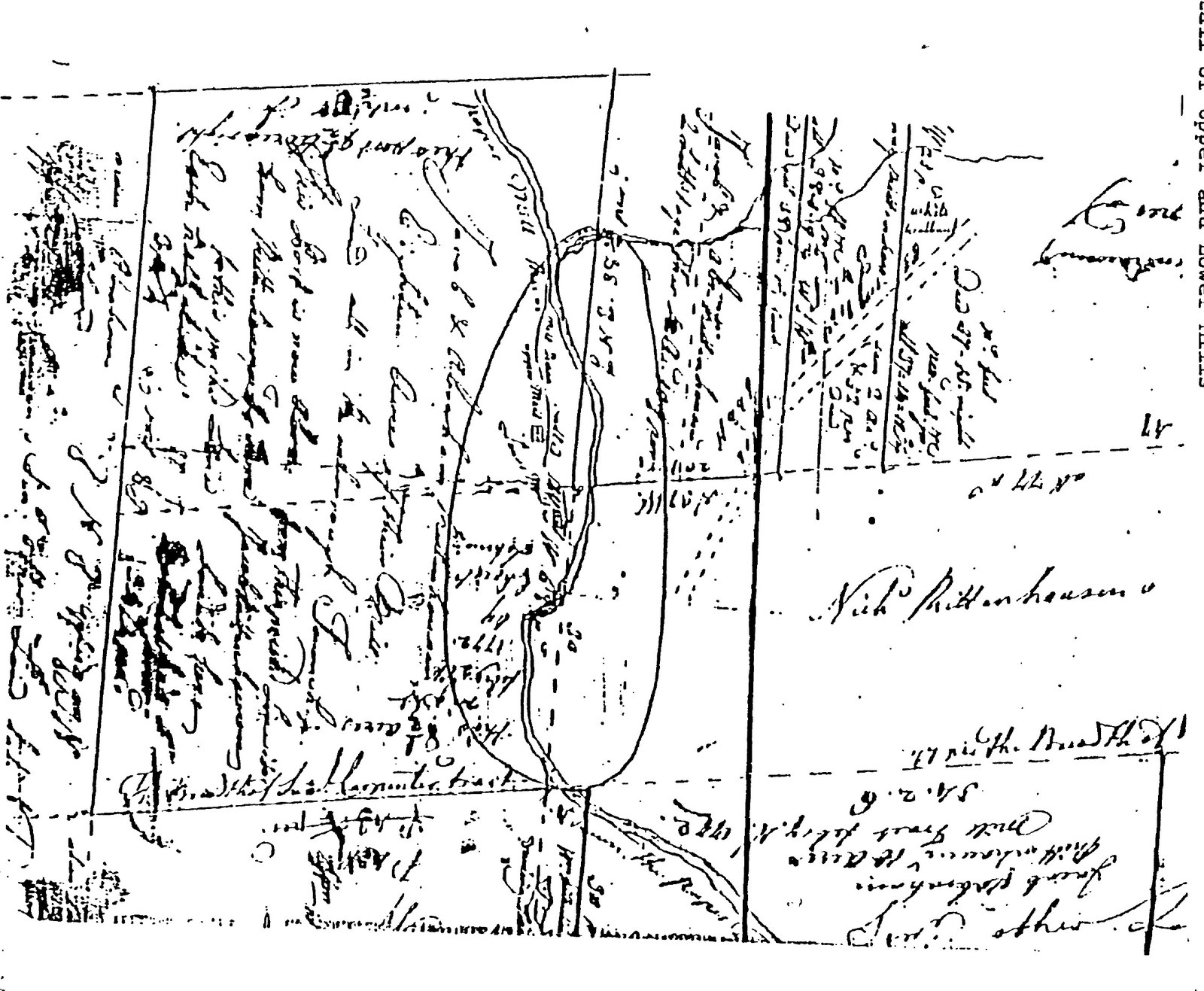
Which bank the 1690 building stood on, the record fixes only loosely. The standard account, following the National Register nomination’s tradition, puts it on the north bank of the run; the Friends of the Wissahickon puts it “across the creek from the homestead.” The nomination itself fixes the area rather than a footprint — the district’s eastern end, where two small runs join to form the Monoshone — and no map of the 1690 building exists. The earliest maps of the seat, the Lehman surveys of 1764 and 1772, show the successor mills that replaced it. Today no mill building stands here at all. Seven buildings survive — six houses and a barn — and below ground the seat survives as archaeology: head and tail races, mill pond sites, and the foundations of an early mill, verified by excavation and dated only as “possibly before 1736.” That foundation is not assigned to this mill by anything read; it may belong to a later one.
Five shillings a year, for 990 years
On September 29, 1690, William Rittenhouse (1644–1708), his son Claus, and three partners — the printer William Bradford, the ironmonger Thomas Tresse, and the land investor Robert Turner — leased the twenty acres from Samuel Carpenter and formed a company to build the mill. The partners were investors, and Bradford was a customer; the running of the place belonged to Rittenhouse alone. He was the one who knew what papermaking required — the site, the building, the technology — and he chose this ground for the flow and drop of the Monoshone, enough fall to drive a water wheel, and through it the trip hammers that beat rags into pulp. Bradford, writing to a London friend that fall, put it plainly: “Samuel Carpenter and I are building a paper mill about a mile from thy mills at Skulkill and we hope we shall have paper within less than four months.”
The founding bargain has a catch: it was apparently never written down. What survives is an indenture of 1705/6, made sixteen years later, reciting the original agreement — twenty acres for a term of 990 years at a rent of five shillings sterling a year — and recording that the mill was built but no lease ever signed. By that document, Turner’s administrator Francis Rawle, Bradford, and Tresse assigned all their rights to William, and the mill and twenty acres were demised to him for 975 years from September 29, 1705, still at five shillings a year. The indenture gives the parcel’s bounds, running from a spruce tree near Wissahickon Creek, part of the hundred acres Samuel Carpenter had from Thomas Harwood in 1693. One classic history, John Fanning Watson’s Annals of Philadelphia, names Garret Rittenhouse as the builder of this mill; every modern source names William, and Watson’s Garret is printed here only as his error.
Rags in, paper out
No description of the first mill building survives. The best modern assessment — printed as an assessment, not a fact — is that its wheel was probably undershot, hung in the creek’s own flow rather than fed by a race, and that the building went up relatively quickly and cheaply, from logs. Its hardware came from the family’s own trade network: a receipt of 1698 shows paper molds arriving from Johannes and Adolf Vorster, the Rittenhouses’ papermaking kin at Rozendaal in Holland.
The first proof the mill was working is a poem. Richard Frame’s A Short Description of Pennsilvania was printed by Bradford in 1692 on paper bearing the Rittenhouse watermark — the earliest evidence of production. Frame’s lines make the mill the last link of a Germantown chain: flax became linen, linen wore out into rags, and rags came back as paper. By 1696 Judge John Holmes could treat the place as a fixture: “The paper mill is here hard by / And makes good paper frequently… / Kind friend, when thy old shift is rent / Let it to the paper mill be sent.” The mill made printing paper, writing paper, brown and blue paper, and pasteboard. Its watermarks, in the order the historian Horatio Gates Jones gives them, ran: first the word “Company”; then WR with the clover leaf — the Klee-Blatt — in a shield under a crown, with “Pensilvania” beneath; then K.R. for Claus; then I.R. for Jacob, William’s great-grandson.
In 1697 the paper itself became rent. On September 24 of that year Bradford signed his quarter share of the mill over to William and Claus for ten years, taking his yearly rent in paper — seven reams of printing paper, two of writing, two of blue — under a £50 bond, in a lease Bradford wrote out in his own hand on the mill’s own paper, watermark and all. The lease fixes the first price list of American-made paper: printing paper at ten shillings a ream, with Bradford to have first refusal of all of it; writing paper at twenty shillings; brown paper at six. Jones computes the rent at £6 2s a year and states that by this lease Bradford held the monopoly of the entire printing paper made in America from 1697 to 1707 — that is the lease’s term, stated as a lease fact.
How long the mill’s wider monopoly ran, the sources argue about, and the argument is printed rather than settled. The nomination’s layered version gives an absolute monopoly until about 1710, when William De Wees built further up the Wissahickon, then a virtual monopoly for another generation, the exclusive hold ended by 1730. The Friends of the Wissahickon says flatly that for the next forty years the Rittenhouse family were the only papermakers in the colonies; the Ridge Avenue nomination says twenty years. What the record supports is narrower: this was the only paper mill from 1690 to 1710, and the extended family — Rittenhouse and De Wees together — stood alone until Willcox’s mill on Chester Creek in 1729.
Paper for a schism
In its second year the new mill’s paper carried a church fight into print. The Keithian schism split Pennsylvania’s Quakers in 1692, and Bradford’s press flooded with defiant pamphlets printed on Rittenhouse paper. That August, Bradford was arrested for “Publishing, Uttering, and Spreading a Malicious and Seditious Paper,” and his press was seized. Rittenhouse, a Mennonite, was never implicated — but the first paper mill in British North America spent its second year supplying a sedition case.
The flood
The mill lasted about ten years. The nomination’s words are the whole of the record: “The first mill was destroyed by a flood within about ten years. There are no descriptions or exact dates of this event.” William Barton, writing in 1813, concluded the mill had been destroyed by 1701, working from a letter by William Penn soliciting aid for the rebuilding — a letter since lost, possibly written in 1701 during Penn’s second visit to Pennsylvania. Through Barton, the substance of Penn’s appeal survives: the Rittenhouses had “sustained a very great loss by a violent and sudden flood, which carried away the said mill with a considerable quantity of paper, materials and tools, with other things therein, whereby they were reduced to great distress,” and Penn recommended them to anyone “disposed to lend them aid,” since they were “desirous to set up the paper-mill again.” Penn’s certificate also called William Rittenhouse “decrepit” — an odd word for a man born, like Penn himself, in 1644. The year of the flood is printed here as the sources give it, unsettled: the Friends of the Wissahickon says destroyed in 1700 and rebuilt by 1702; Barton and the nomination say by 1701; the German Historical Institute’s account says a flash flood around 1700; Jones prints “1700 or 1701.” The rebuilding belongs to the second mill’s story. This one’s whole life — lease, wheel, watermarks, prices, pamphlets, and flood — fits inside a single decade, and the village it started outlived it by centuries.
Timeline
| 1690 | September 29: William Rittenhouse, his son Claus, William Bradford, Thomas Tresse, and Robert Turner lease twenty acres from Samuel Carpenter and form the company to build the mill. |
| 1690 | Fall: Bradford writes to London that the paper mill is building, “about a mile from thy mills at Skulkill,” with paper hoped for within four months. |
| 1692 | Richard Frame’s A Short Description of Pennsilvania is printed by Bradford on paper bearing the Rittenhouse watermark — the earliest proof the mill was working. |
| 1692 | August: Bradford is arrested for publishing a “Malicious and Seditious Paper” in the Keithian schism pamphlet flood, printed on Rittenhouse paper; his press is seized. |
| 1696 | Judge John Holmes’s poem treats the paper mill as an established fixture of Germantown. |
| 1697 | September 24: Bradford leases his quarter share to William and Claus for ten years; the rent is payable in paper, and the lease fixes the mill’s prices — printing paper 10s a ream, writing 20s, brown 6s. |
| 1698 | A receipt shows paper molds arriving from Johannes and Adolf Vorster, the family’s papermaking kin at Rozendaal in Holland. |
| 1700/1701 | The mill is destroyed by flood (the year is unproven: 1700, by 1701, and around 1700 are all printed by the sources). |
| 1705/6 | An indenture recites the 1690 bargain — 990 years at five shillings a year, the mill built but no lease ever signed — and demises the mill and twenty acres to William alone for 975 years from September 29, 1705. |
| 1764 and 1772 | The Lehman surveys, the earliest maps of the seat, show the successor mills on the parcel — not the 1690 building. |