
The mill the flood paid for
The second Rittenhouse paper mill stands in this collection as a separate story because it was a separate building — raised on the same twenty acres at RittenhouseTown, on the Monoshone Creek (the run the old records call Paper Mill Run, on the Germantown side of the valley, not the run of the same modern name in Mount Airy), after the flood that destroyed the first mill on the ground about 1700. Its own story, told elsewhere in this collection, ends in that flood. This one begins in the wreckage.
The replacement was a better mill than the one it replaced. The first mill’s wheel had turned in the creek’s own flow; the new mill was served by a mill race — a dug channel that let the water fall onto an overshot wheel, steadier and stronger. The races outlasted the buildings: the head and tail races and the mill pond sites survive as archaeological remains in the RittenhouseTown historic district. Jones, writing the family’s paper-mill history in 1896, says the new mill was erected in 1702, “on another site a short distance below the first mill,” and was a much more substantial building. The Friends of the Wissahickon’s rounded account says the mill was “rebuilt by 1702.” The documents support a slightly more careful statement: built in 1702, and shipping paper by the June of 1703, when the mill’s great customer in New York wrote acknowledging a delivery of writing paper and asking for pasteboard.
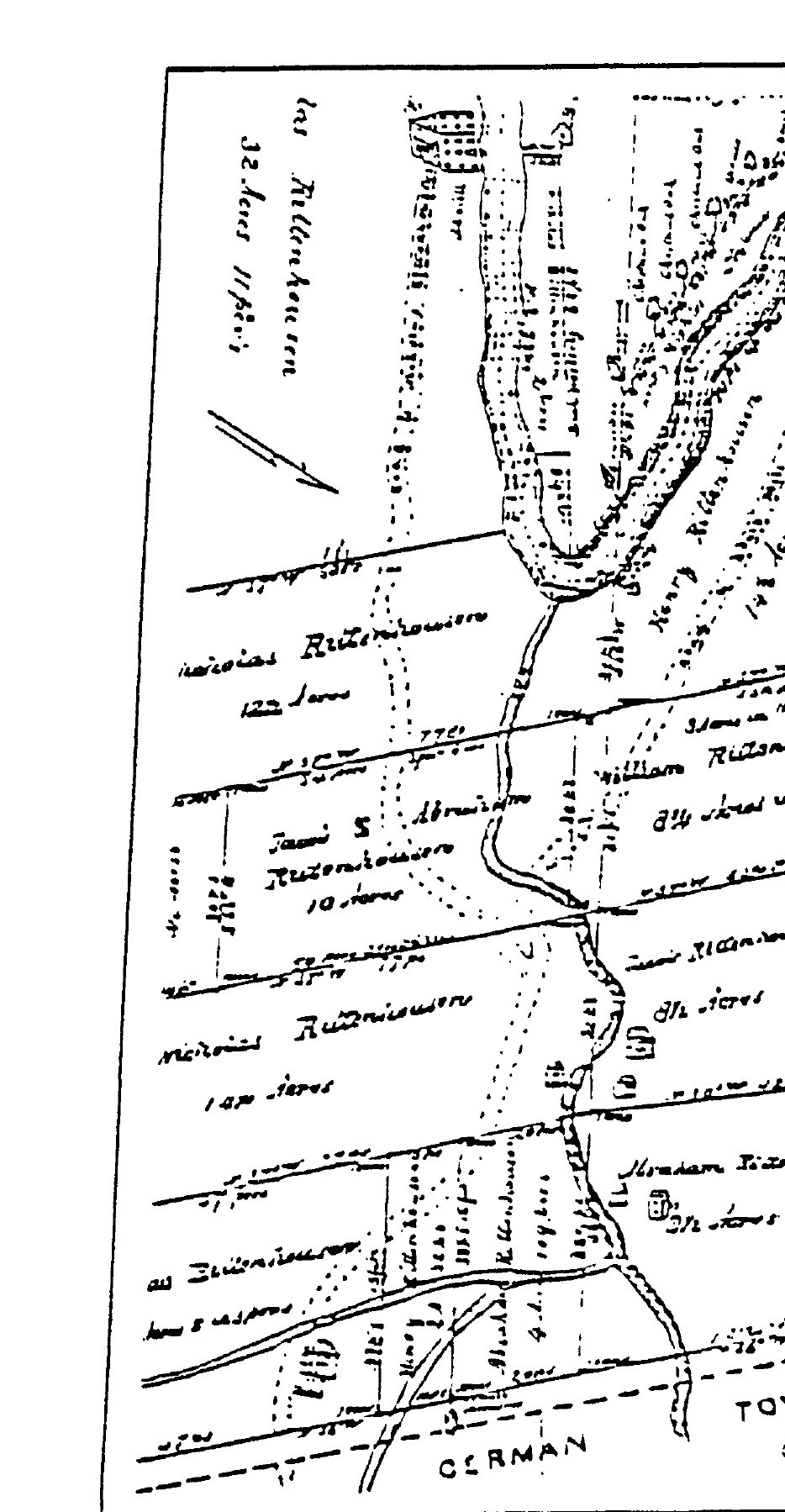
One question about this building no source read settles. A survey of the tract made by Lehman in 1764 shows two paper mills standing on the twenty acres, an upper and a lower. Which of the two was this rebuild, and which the later mill that followed it, the modern study of the family states plainly is unclear — and this account leaves it unsettled too.
Settled in wreckage
The flood did more than destroy a building. It dissolved the partnership that had owned the first mill, and the way each partner left is the real story of how this mill was financed.
Robert Turner, one of the four partners, died in 1700. His executor, Francis Rawle, assigned Turner’s quarter share to the Rittenhouses without compensation — the destroyed mill, in the modern study’s words, “was more of a liability than an asset.” A quarter of the first paper mill in the colonies was simply given away. Thomas Tresse, another partner, gave up his share in exchange for his portion of the materials salvaged from the destroyed mill — and the salvaged material went straight into the new building. Claus Rittenhouse’s letter of July 12, 1703, printed in full by Jones in 1896, gives the account entire: everything saved from the wreck came to £15 2s 4d; the press itself, valued at £5, 252 pounds of iron, 160 feet of plates, and the rest of the kit were reused on the new mill. One partner was bought out with debris.
The rest of the money came from the neighbors. Bonds in the Price family papers show several Philadelphians lending the Rittenhouses money in 1702 and 1703, most likely — the study’s careful phrase — to finance the rebuilding. The community put up the cash, and the Rittenhouses remembered who had.
William Bradford, the New York printer who had been the first mill’s chief customer and a partner in it, held out longest. He had given no help toward the rebuilding, and when he proposed, through Samuel Carpenter, that his old sole claim on the mill’s paper continue, Claus’s answer of July 12, 1703 refused him, in the spelling of the day: “considering this Country may want paper and severall here have been so kind as to assist us in ye Rebuilding the paper mill, wee dare not engage ourselves by any Contract or bond to any particulars, least it may not be in our power to comply without disappointing or disobliging the rest of our ffriends.” The same letter is working trade correspondence, not only a refusal — it carries an order for pasteboard of forty to fifty pounds, in two thicker sorts, to be delivered to Nicholas Pearse in about two weeks.
Here the record argues with itself, and the argument is printed rather than resolved. Jones, in his 1896 history, states his belief that Claus secured Turner’s share in 1697, Tresse’s about 1701 or 1702, and Bradford’s on June 30, 1704. That sits awkwardly against Turner’s death in 1700, with his executor’s assignment necessarily after it, and against the sole-ownership agreement of February 9, 1706 described below. Nothing read reconciles the two sequences.
One peppercorn a year
On February 9, 1706, Bradford at last sold his share, and the agreement of that date between Samuel Carpenter and William Rittenhouse granted the papermaker “All that Paper-Mill Scituate in the said County of Philadelphia and all that Tract of Land wherein the same Stands.” William now held all four shares — in the words of the National Register nomination for the district, he gained them “as a direct consequence of the financial difficulties brought about by the destruction of the first mill.” The disaster had made the mill a one-family business.
The famous succession followed at once, and its actual instrument is more interesting than the usual summary. Shortly after February 1706, William leased three of his four shares to his son Claus for the nominal rent of “one peppercorn yearly.” The write-ups say Claus inherited the mill; the peppercorn came first. William died on February 18, 1708, without a will, and by primogeniture — the eldest son taking all — Claus inherited the whole property in any case.
Claus ran the mill until his death in 1734. His will left his son William — the second William of the mill — the twenty acres “(which I purchased of Samuel Carpenter) Together with the papermill, Buildings & Appurtenances, thereunto belonging.” Note what the will names: one papermill. That single word carries weight elsewhere in this collection, in the dating of the third mill on the seat.
The trade spread inside the family while Claus ran this mill. He taught papermaking to his brother-in-law William De Wees and helped him set up his own mill further up the Wissahickon in 1710 — the Crefeld mill, whose story is also told in this collection. Until Thomas Willcox’s Chester Creek mill of 1729, every paper mill in the colonies stood in Rittenhouse or De Wees hands.
The working mill
The paper trail of the rebuild’s success is two numbers. In 1706 the second mill was valued for tax purposes at £40. In 1734, a fourth part of the mill and its land was valued at £80. In one generation the seat had multiplied in value several times over.
Bradford remained the chief customer, on the new terms — an ordinary buyer, not a contracted one. His letters of August 16 and November 7, 1709, quoted by Jones, order brown paper, pasteboard, and large writing paper, and send rags in part payment, with paper forwarded to him by land and by water. After 1713 his son Andrew set up printing in Philadelphia, and demand grew again. The mill made the same range as the first — printing, writing, brown and blue paper, and pasteboard — and the watermarks of Claus’s years, NR and KR, stand beside the earlier WR in the paper, with the clover besides.
While this mill was the working mill of the village, its most famous birth happened across the creek: David Rittenhouse, the astronomer and clockmaker, was born in the house numbered 207 on April 8, 1732. The mill he grew up beside was this one.
No end of its own
No source read gives this building an end of its own — no fire, no flood, no sale, no demolition date. It was superseded on its own seat by the third paper mill, built after Claus’s death in 1734, and the Lehman survey made before 1774 still shows two paper mills standing on the twenty acres, so this rebuild’s fabric, or its successor on its site, worked on beside the newer mill. Nothing of it stands above ground today; the seven surviving buildings of RittenhouseTown are houses and the barn. Whatever remained of it went with the rest in the clearance of 1891, when the property, sold to the Fairmount Park Commission, lost over forty structures — six of them mills — to demolition and dismantling.
Timeline
| 1700 | Robert Turner dies; his executor Francis Rawle assigns Turner’s quarter share to the Rittenhouses without compensation. |
| 1702 | The new mill is erected, a short distance below the first mill’s site (Jones, 1896); Philadelphians lend the Rittenhouses money on bonds in 1702 and 1703, most likely to finance the rebuilding. |
| 1703 | June 13: Bradford writes acknowledging writing paper delivered and requesting pasteboard — the new mill is working and shipping. |
| 1703 | July 12: Claus Rittenhouse’s letter to Bradford refuses an exclusive contract, records Tresse’s settlement for salvaged materials (£15 2s 4d saved in all; the press, iron, and plates reused on the new mill), and carries a pasteboard order. |
| 1706 | February 9: the sole-ownership agreement — William Rittenhouse holds all four shares. The mill is valued for tax at £40 this year. |
| 1706 | William leases three of his four shares to his son Claus for one peppercorn yearly. |
| 1708 | February 18: William Rittenhouse dies intestate; Claus inherits the whole property by primogeniture. |
| 1709 | Bradford’s letters of August 16 and November 7 order brown paper, pasteboard, and large writing paper, sending rags in part payment. |
| 1710 | Claus teaches his brother-in-law William De Wees papermaking and helps him set up the Crefeld mill further up the Wissahickon. |
| 1732 | April 8: David Rittenhouse is born in building 207, across the creek from the working mill. |
| 1734 | Claus dies; his will leaves his son William the twenty acres “Together with the papermill.” A fourth part of the mill and land is valued at £80 this year. |
| 1891 | The RittenhouseTown clearance follows the sale to the Fairmount Park Commission: over forty structures, six of them mills, come down or are dismantled. |