RittenhouseTown, the Rittenhouse family’s paper-making hamlet, stands in Roxborough on the Monoshone — a small stream the old maps also call Paper Mill Run. That name needs care at the start, because this valley has two Paper Mill Runs. The other one runs through Mount Airy and Germantown, miles away, and Glen Echo Mills stood on it. The two runs are different streams, and nothing in this story mixes them.
The paper mills on the Monoshone have their own stories in this collection. This page follows the family’s other mills. The Rittenhouses held a second frontage — on the main Wissahickon Creek itself — and there they ran grist mills, the mills that grind corn and grain. Before 1774, a survey drawn for the family showed two grist mills standing on their Wissahickon land, and a dated building list names five mills on that frontage. In the creek’s mill list of 1779, four of the eleven Roxborough mills carry the Rittenhouse name.
The land
Claus Rittenhouse — the name is Nicholas in English — was the papermaker’s son. Before 1734 he had acquired a fifty-acre parcel, beside the family’s original twenty-acre mill tract. His son William added ninety acres to the southeast and thirty-five to the northwest in 1741, making over two hundred acres in one piece.
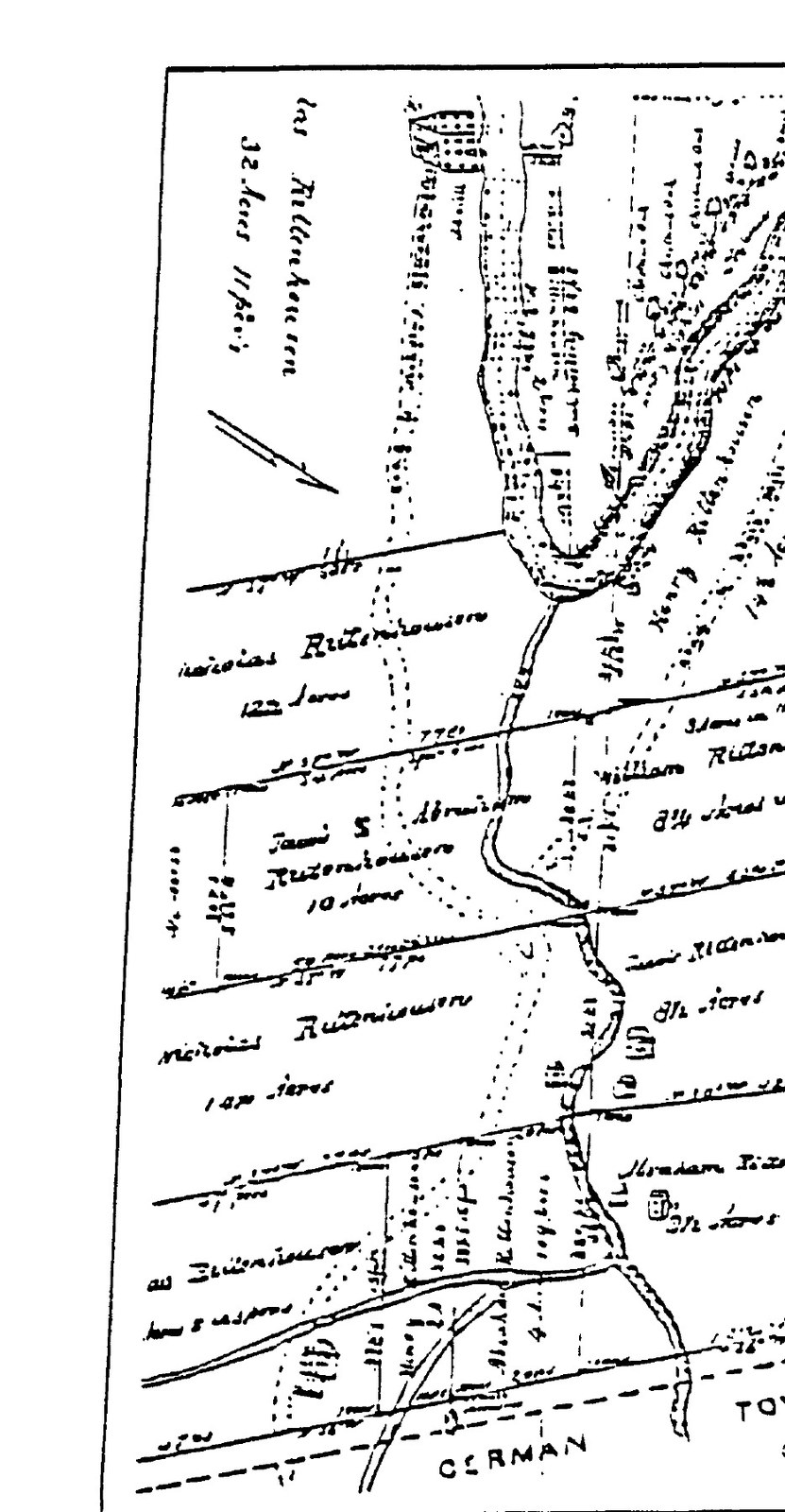
Before William’s death in 1774, the surveyor Lehman brought the survey of the land up to date, to show its division among William’s sons. The survey shows at least two mills and several houses on the original tract — and, in the words of the National Historic Landmark nomination that prints it, “two grist mills on the newly acquired land along the Wissahickon.” The mill holders named five years later, in 1779, are best read as the outcome of that division.
Five mills with dates
The nomination carries a dated building list for the family’s structures along the creek — the only dated Rittenhouse mill list in anything read for this story. It names the William Rittenhouse Mill, of 1746. It names the Henry Rittenhouse Grist Mill, of 1751. Then come two more under William’s name: the William Rittenhouse Grist Mill, built before 1760, and a second William Rittenhouse Grist Mill, built before 1772. Last comes the Nicholas Rittenhouse–Vanderen Mill, of 1772.
The William of 1746 is the land-buyer himself — the William who assembled the two hundred acres and died in 1774. The two later mills under his name read as two mills in turn, or side by side, under the one name; rebuilding on a seat was the valley’s habit. Which seat or seats they stood on, no source read proves.
Henry’s mill is dated, and that is nearly all the record gives: Henry himself is placed by nothing read for this story. His name matters again at the end of this account, in 1868.
The mill of 1772 joins the two surnames of the Hermit’s Lane mill — Rittenhouse and Vanderen. Whether it is that seat under a fuller name, or a third Vandaren mill on the creek, no source read decides, and this account does not decide it either.
The four names of 1779
In 1779 Horatio Gates Jones set down the mills of Roxborough in creek order — a list of their situations, from the creek’s mouth up. Four of the eleven are Rittenhouse grist mills: Martin Rittenhouse’s, held with John Vandaren — the Hermit’s Lane seat, which has its own story in this collection; then Nicholas Rittenhouse’s; then William Rittenhouse’s; and Abraham Rittenhouse’s.
If Jones’s order follows the creek, as he presents it, Nicholas’s mill fell between the Hermit’s Lane mill and RittenhouseTown, and William’s and Abraham’s fell between RittenhouseTown and the Holgate fulling mill. No source read fixes any of the three more closely than that. The seats are fixed to the reach, not to a bank.
Which men of the family the four names belong to is a harder question, and it stands open. William the land-buyer died in 1774, five years before the list; the William of 1779 is the estate’s name carried on, or a son of the next generation — unresolved. The name Nicholas runs on the land for a century: a Nicholas Rittenhouse mill still stood to be taken in 1868, and whether Jones’s Nicholas is Claus himself or a descendant, the list does not say. An Abraham Rittenhouse house of 1720 stands at RittenhouseTown; the Abraham of 1779 may be that house’s builder late in life, or a later Abraham of the name. Martin is traced no further than the list itself.
And the two lists do not join up neatly. Which of the five dated mills answers to which of Jones’s four names, the nomination does not say. The lists are related, but no source read maps one onto the other, and the match is not forced here.
The working mills
All four were grist mills, grinding corn and grain for the township on the family’s own two-hundred-acre tract. Jones’s Roxborough held at least eleven mills, eight of them grist mills; the Rittenhouses held four of the eleven, and the paper mill on the Monoshone besides.
Beyond that, the working record is silent. No millstones, no valuations, no hands, and no output figures for any of the four were found in anything read for this story. The tax lists that value their neighbours were not read for these names, and the gap is printed rather than filled.
After 1779 the four names leave the creek record, except through the taking. The family’s milling energy stayed on the Monoshone: Jacob made paper there until his death in 1811, and his sons Samuel and Enoch kept the operations after him. The creek grist mills pass out of the named record.
The end
The end, where it is recorded at all, came with the park. In 1868 the Fairmount Park Commission began acquiring the valley’s mill sites. Jane Mork Gibson’s list of the Wissahickon sites taken includes, among the first names, “the mills of Edward H. Amidown, Nicholas Rittenhouse, and Henry Rittenhouse.” So a mill under Nicholas’s name — and one under Henry’s, the Henry of the 1751 mill or his heir — still stood on the creek when the park took it, more than 120 years after the family’s creek milling began.
What the Commission did with the buildings it took is Gibson’s general pattern: they were “torn down or became derelict and decayed,” and the WPA finished most of what remained in the 1930s. That is the pattern, printed as the pattern; it is not either mill’s individual record.
For William’s and Abraham’s mills, no closing, taking, or demolition record was found in anything read. They leave the record with Jones’s list of 1779 and the nomination’s dated buildings. The Monoshone mills’ own end — sold to the Commission in 1891 and gradually dismantled — belongs to their stories in this collection, and is not borrowed for the creek seats.
The half the paper story leaves out
The standard accounts tell the Rittenhouse story as a paper story — on the Monoshone, ending at RittenhouseTown. The creek frontage is not in them. But the family’s own division survey shows two grist mills on the Wissahickon land before 1774: proof, from a survey made for the family itself, that the Rittenhouses ran mills on both waters. And the dated list gives that creek milling a shape the standard story never gives it — a first mill in 1746, and family names still on the land when the park took it in 1868.
Timeline
| Year | Event | Source |
|---|---|---|
| Before 1734 | Claus Rittenhouse has acquired a fifty-acre parcel | National Historic Landmark nomination, §8 |
| 1741 | William Rittenhouse adds ninety acres and thirty-five acres — over 200 contiguous acres in all | National Historic Landmark nomination, §8 |
| 1746 | The William Rittenhouse Mill | National Historic Landmark nomination, §8 |
| 1751 | The Henry Rittenhouse Grist Mill | National Historic Landmark nomination, §8 |
| Before 1760 | The William Rittenhouse Grist Mill | National Historic Landmark nomination, §8 |
| Before 1772 | The second William Rittenhouse Grist Mill | National Historic Landmark nomination, §8 |
| 1772 | The Nicholas Rittenhouse–Vanderen Mill | National Historic Landmark nomination, §8 |
| 1774 | William dies; Lehman’s survey divides the land among his sons, showing two grist mills on the Wissahickon land | National Historic Landmark nomination, §8 |
| 1779 | Jones’s list names Nicholas, William, Abraham, and Martin Rittenhouse | Jones, The Levering Family, p. 187 |
| 1868 | The Fairmount Park Commission begins acquiring; mills under Nicholas’s and Henry’s names are on its list | Gibson, Workshop of the World |