Richard Townsend's tie to the Wissahickon is a holding the deeds prove and his own pen never mentions. From March 25, 1689, he held the mill seat at the mouth of Wissahickon Creek — the 50½ leased acres of William Penn's "Shomack Park" tract, on the west bank where the creek meets the Schuylkill, inside what is now Wissahickon Valley Park — in copartnership with Joshua Tittery and John Tyzacke. The creek's first Penn-era saw mill and water corn mill stood on that seat by 1690, and in 1690–91 Townsend joined in conveying it to Andrew Robeson and Charles Saunders, whose "Robeson & Sanders Mill" the first tax list of 1693 rated at £350. He was a Welcome passenger of 1682, a millwright by trade, and the author of the most famous first-person account of the founding voyage. His testimony and the completing indenture of July 1691 are read in full for this account; his will is read as a published abstract, and the other deeds through transcriptions, at the grades their Sources entries carry; where the record stops, this account stops with it.
The crossing he wrote down
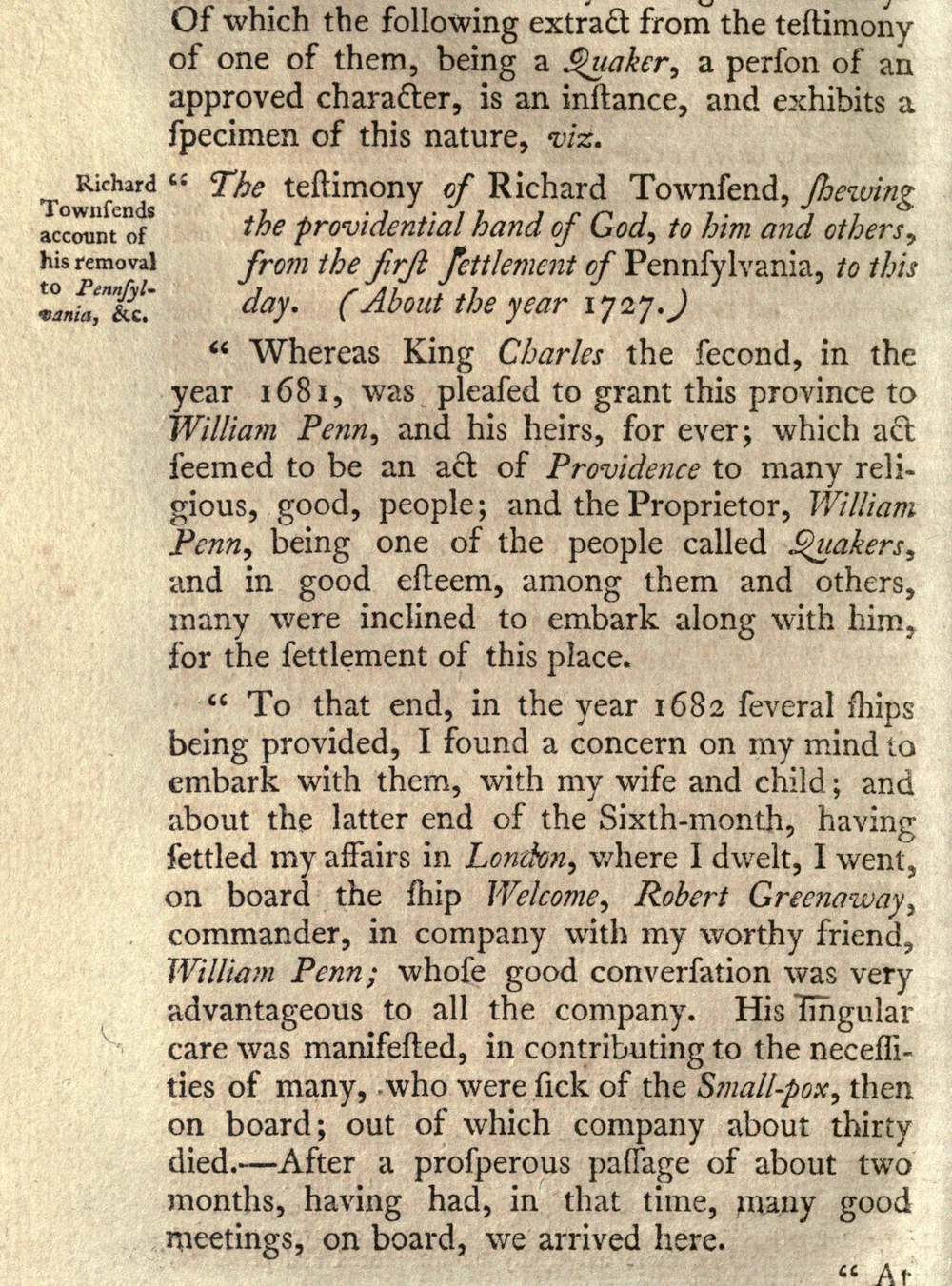
The First Purchasers list of October 25, 1681 names him in one line — "Richard Townsend of London Carpenter — 250" — a London carpenter who had bought 250 acres of Pennsylvania before he saw it. On September 1, 1682, he embarked in the Downs off Deal on the Welcome, Captain Robert Greenaway, with his wife Ann and a child. About thirty of the company died of smallpox on the passage; Penn, a fellow passenger, cared for the sick. After the ship reached the Delaware that October, Ann gave birth on board to their son James — so the Welcome scholarship reports it; Townsend's own account, remarkably, never mentions the birth.
Late in life he wrote the voyage down. His testimony, composed about 1727/28 in his eighty-fourth year, opens with his reason: "having been in this country near forty-six years, and my memory pretty clear, concerning the rise and progress of the province, I can do no less than return praises to the Almighty." Printed by Robert Proud in 1797 and twice reprinted since, it is the fullest survivor's account of the Welcome — the smallpox, the wilderness arrival, the first years of the province, all read as providence. It is also, for this valley, a document with a hole in it, and the hole is the story (below).
His purchase and his survey never did agree: against the 250 acres of the 1681 list stands Holme's survey order of February 28, 1682/3, directing 150 acres to be laid out for him north of the city. Both figures stand in this account, unreconciled, as they stand in the record.
A mill brought ready framed from London
The first mill of his testimony is not on the Wissahickon. In 1683 a company of ten partners — Penn, Caleb Pusey, and Townsend among them — set up a mill on Chester Creek, the province's first mill enterprise. The deed of 1705, as the Delaware County historian Ashmead prints it, shows Pusey erecting the mill for the company. Townsend's own sentence is the famous one: "I set up a mill, on Chester creek; which I brought ready framed from London." A millwright who brought a mill ready framed from London: the frame was his, the erection the company's, the ownership shared among ten. He sold his interest to Pusey before June 14, 1692 — every account agrees on the sale, and no two agree on its date, which is given as 1685, as "within a year" of arrival, and as "several years before" 1692. All three stand.
His own mill, and the gentle bull
The second mill of the testimony is his alone. In 1683 he settled on his own tract about a mile from Germantown and set up, in his words, "a house and a corn mill" — on Wingohocking Creek, at the seat later known as Roberts' Mill. The new settlement had almost no horses, and his customers carried their grain themselves: "people generally brought their corn on their backs many miles; — I remember one man had a bull so gentle, that he used to bring his corn on him, instead of a horse."
The Wingohocking mill's dates come down argued over — built 1683 in most accounts, 1684 in the Canoe Club study, about 1685 in others; demolished about 1873, or 1874, or 1878; ranked the first grist mill in Philadelphia County by Keyser and the second by a Library Company note — and this account prints the argument rather than settling it. One more passage of the testimony belongs here, though no mill is in it. His creek-mouth partner Joshua Tittery appears exactly once in Townsend's own narrative, and not at any mill: "I, with Joshua Tittery, made a net, and caught great quantities of fish; which supplied ourselves and many others."
The creek-mouth seat
The Wissahickon chapter of Townsend's life is written entirely in deeds. The seat was 50½ acres at the creek's mouth, part of the 500-acre "Shomack Park" tract. Robert Turner leased it on June 19, 1686 — to Joshua Tittery alone, the deeds' recitals say, for 101 years; later narratives that put Townsend in the 1686 lease are contradicted by the recitals, and the deeds control. On March 25, 1689, a copartnership indenture joined Tittery, Townsend, and John Tyzacke in the seat. On November 8, 1690, Tittery and Townsend assigned the unexpired lease to Andrew Robeson and Charles Saunders for £60, with half of "the tilled Land, Improvements, Houses, Saw and Corn Mills, and of all the Iron Work, Timber work Millstones and Tools." On April 4, 1691, Tittery — "with consent of the said Richard Townsend" — sold Tyzacke an undivided sixth of the seat, its houses, saw and corn mills, iron work, millstones and tools itemised again, for £15. And on July 11, 1691, the completing indenture — Turner, Tittery, Townsend, and Tyzacke's attorneys to Robeson and Saunders — conveyed the whole 500 acres plus the reversion of the mill lease, the "Houses Saw and Corn Mills" standing, for £105. That deed is read in full for this account. In 1693 the county's first tax list rated the seat to its new owners: "Robeson & Sanders Mill," £350, the highest valuation on its page.
Did he build them?
The creek-mouth seat is often given to Townsend as its builder — the Canoe Club study calls the Robeson mill one of three early grist mills "all built or designed by Richard Townsend," and Daly's Wissahickon prints the attribution too. The evidence read for this account does not carry it that far. The deeds prove the holding and the conveyance and name no builder. And Townsend's own testimony — written nearly forty-six years after he arrived, and remembering a framed mill from London and a gentle bull — names the Chester Creek mill and his Wingohocking mill, and says nothing of the Wissahickon at all: no creek, no Roxborough, no Robeson, no Saunders, in any of its three printings. So the grading stands here as it stands in the full biography: the holding and the conveyance are proven; "built by Townsend" is reported — the study's and Daly's claim, unsupported by his own account. A millwright copartner at a seat where mills stood may well have built them. The record does not say so, and neither does this account.
Tax man, flood, meeting house
The 1693 tax list rated Townsend himself in Bristol Township, first entry under the township's name; his own figures are illegible in the copy read and are not printed. In May 1697 the Governor and Council summoned him — Richard Townsend, Collector of Philadelphia County — to appear with his assessment duplicates and the money he had collected, "under ye pains & penalties" of the law, one of a dozen collectors called to account that week. In 1701 the great freshet cost him, in the meeting's record as McCracken reports it, "a great part of what he had owned"; contributions were taken for him at meeting, and the mill owner went to renting a house. The Canoe Club study adds that the flood severely damaged his Germantown mill.
His name stands twice on the Germantown Friends' meeting-house ground: a co-purchaser of the 50-acre lot in 1705, and a co-grantor of it to the Friends' trustees in 1711, for £200. He travelled to England in the ministry in 1707, as the genealogies report it; in 1713 he and Ann removed to Philadelphia Monthly Meeting, and his will would style him "of the City of Philadelphia."
The will, and a death in two months
He made his will on January 11, 1727/8 — millwright, of Philadelphia; Ann his executrix; five children named: James, Joseph, Hannah, Mary, and Sarah. He died in 1732 at his nephew Joseph's house in East Bradford Township, Chester County — and the month of his death is the record's open quarrel. The family genealogy of 1909 gives 28 January 1731/2; Greene, citing the Concord Monthly Meeting records, gives 28 First Month 1732 — March 28 in the Quaker numbering. His burial at Philadelphia on 30 First Month, reported through McCracken and through Greene, fits the March date, two days after death, and not the January, two months before burial. One side misread a Quaker month numeral; neither of the deciding works was read directly for this account, and both dates stand here unsettled. What is certain is the bound: on November 22, 1732, his widow Ann made her own will styling herself a widow, "of Roxberry" (Will Book E, p. 227). Her will was proved March 31, 1733, and his on April 14, 1733 — the executrix predeceased the probate. Ann's own death is itself conflicted: January 13, 1733 (the 1909 genealogy) against a burial on 15 First Month 1732/3, that is, March 15, 1733 (McCracken) — flagged, unresolved.
Two confusions travel with his name and are stopped here. Daly prints the creek-mouth man as "John Townsend"; the deeds name Richard throughout, and no John Townsend in the records read for this account is tied to a mill. And the "Richard Townsend" of the 1787 Collection of Memorials, who died in 1737, is a different man entirely — a Cape May minister. The millwright's death is 1732, in Chester County, with its month in honest dispute.
Timeline
| Year | Event | Source |
|---|---|---|
| 1645 | Baptized at Bucklebury, Berkshire, Nov. 30, son of Richard Townsend | Parish register, via McCurdy, PGM 30(2) |
| 1677 | Marries Ann Hutchins, 25th of Third Month; the place conflicts — Bucklebury or London | McCracken via McCurdy; Paxson/Greene |
| 1681 | On the First Purchasers list, Oct. 25: "of London Carpenter — 250" acres | The First Purchasers of Pennsylvania (PHMC) |
| 1682 | Sails on the Welcome, Sep. 1; about thirty die of smallpox; son James born aboard after arrival in the Delaware (not in his Testimony) | His Testimony; McCracken via McCurdy (the birth) |
| 1683 | Chester Creek mill erected by Caleb Pusey for the ten-partner company; Townsend a partner | Ashmead (1884), from the deed of Dec. 19, 1705 |
| 1683 | Settles by Germantown; sets up "a house and a corn mill" on Wingohocking Creek (build year also given as 1684 and c. 1685) | His Testimony; Keyser (1907) |
| 1686 | Turner leases the 50½ creek-mouth acres to Joshua Tittery alone, Jun. 19, for 101 years | The deeds' own recitals |
| 1689 | Copartnership of Tittery, Townsend and Tyzacke in the creek-mouth seat, Mar. 25 | Recited in the indenture of Apr. 4, 1691 |
| 1690 | With Tittery, assigns the creek-mouth lease to Robeson and Saunders, Nov. 8, for £60 | Lease addendum (study transcription; Osborne) |
| 1691 | Consents to Tittery's sale of a sixth to Tyzacke, Apr. 4, £15; joins the completing indenture, Jul. 11, £105 | Study transcription; deed read in full |
| 1693 | "Robeson & Sanders Mill" rated £350; Townsend rated in his own name in Bristol Township, Sep. 26 | First Tax List, PMHB Vol. 8 |
| 1697 | Summoned before the Governor and Council as a Collector of Philadelphia County, May 14 | Minutes of the Provincial Council, Vol. 1 |
| 1701 | Flood losses; contributions taken for him at meeting, 31st of Eighth Month | McCracken, as reported |
| 1705 / 1711 | Co-purchaser, then co-grantor, of the Germantown Friends meeting-house lot | Potts, The Potts Family (1901) |
| 1727/28 | Writes his Testimony; makes his will, Jan. 11 — millwright, of Philadelphia; Ann executrix | Proud (1797); Will Book E, p. 232 |
| 1732 | Dies at his nephew Joseph's in East Bradford; the month conflicts — Jan. 28, 1731/2, or Mar. 28, 1732 | 1909 genealogy; Greene via Peden & Launey |
| 1732 | His widow Ann's will, Nov. 22, styles her a widow; his own will proved Apr. 14, 1733 | Will Book E, pp. 227, 232 |