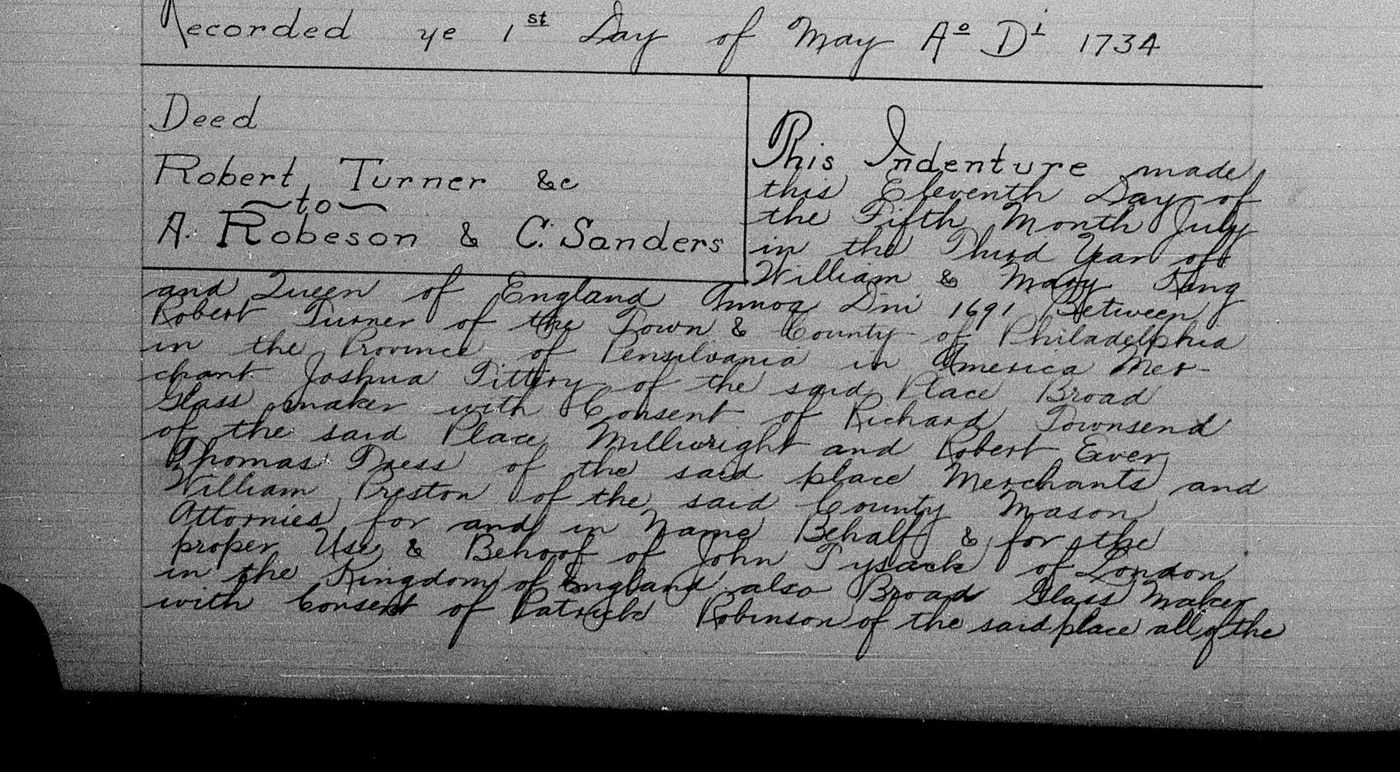
Andrew Robeson's tie to the Wissahickon comes first, because it is the whole story. In November 1690, Andrew Robeson (died 1694), a Philadelphia merchant, went into partnership with Charles Saunders — spelled Sanders in the deeds — and bought the mill seat at the mouth of Wissahickon Creek: the tract William Penn had named "Shomack Park." The purchase was completed by the deed of July 11, 1691, which gave the partners the whole 500 acres and the seat's standing mills — its "Houses Saw and Corn Mills" — for £105. Two years later the county's first tax list rated the "Robeson & Sanders Mill" at £350, the highest valuation on its page. Robeson held the seat until his death in November 1694. The mills were the first built on the creek in Penn's colony, and the ground — the west bank at the creek's mouth, in today's Fairmount Park — still holds a mill building, the Philadelphia Canoe Club's home. He is the elder Andrew Robeson, uncle of the later Chief Justice of the same name; the two men are kept apart in this account, as the records keep them.
A Scot in two colonies
No record read gives his birth — neither the Scottish place nor the year. His son's will names his brothers David and Thomas as living "in the Kingdom of Scotland," and the family kept the memory of a Scotsman's plaid into the 1830s. His first certain appearance is a deed of March 1, 1676, conveying him a share of the Propriety of West Jersey and styling him "late of London, Merchant, now of Clonmell in Ireland." He came to America about that year with his wife Elizabeth and his nephew Andrew.
In West Jersey he became a land man of the first rank. The proprietors' own minutes, printed in Samuel Smith's history of the colony, show him elected to the Council of Proprietors at Burlington on September 18, 1688, and styled in the same minutes "Andrew Robeson, the surveyor general" — the man who had computed the proprietors' great Indian purchase at three hundred thousand acres. The family genealogy, citing the New Jersey archives and the Gloucester County court minutes, adds the judicial side: a county judge in 1686, a justice in 1687, one of the surveyors who ran the line between East and West Jersey. By 1690 he was ready to move across the Delaware to the bigger stage — and to the creek.
The seat at the creek's mouth
Penn had granted the 500 acres to Robert Turner in 1684 and named it "Shomack Park." Turner leased the 50½ acres at the creek's mouth to Joshua Tittery in 1686, mill seat and water power included, and Tittery's partner Richard Townsend — the master millwright of entry 27 in this collection — built a saw mill and a water corn mill there by 1690, just below a natural dam on the west bank. When Robeson and Saunders bought in, they were not buying a site. They were buying a going business: houses, mills, millstones, iron work, and tools, all named in the 1690 lease addendum that brought them in.
The purchase
The buying took two instruments. On November 8, 1690, the fee was sold to Robeson & Saunders by the London partner's attorneys, and Tittery assigned them his lease for £60 sterling. On July 11, 1691, the great indenture completed it: Turner, Tittery, Townsend, and the attorneys conveyed the 500 acres and the reversion of the leased 50½ acres, mills and all, for £105. That deed was read in full for this biography — and it carries a story of its own: acknowledged in court in March 1692, it was not recorded until May 1734, forty-two years later. The chain of the creek's first mill seat slept in a drawer for two generations, and the three indentures of 1690–91 were transcribed for the first time only in 2023, when the mill building's history was documented for the state historic register. The genealogy states the partnership's purpose in one line: the two men "formed a partnership for the purpose of operating a flour-mill on Wissahickon Creek."
The richest line on the page
The county's first tax list, taken September 26, 1693, is the closest thing the seventeenth-century Wissahickon has to a balance sheet. On the Northern Liberties page, between Robert Turner at £200 and the Governor's Mill at £72, one line stands at the top: "Robeson & Sanders Mill — £350," taxed £1 9s 9d, the largest valuation on the page. A later note in the same volume places the mill, in so many words, on Wissahickon Creek. The partners' mill was, by the assessor's reckoning, the most valuable property in its district.
The tract worked a second trade at its western tip: the ferry across the Schuylkill to Lower Merion, landing the Welsh farmers whose settlements had no mills of their own. The proof is a road petition of December 1723, which describes the Germantown road as running "to Andrew Robinson's (Robeson's) mill and Ferry" and says the road had been used "for upwards of 30 years last past." Count back thirty years and the ferry is running by about 1693 — in Robeson's lifetime, though the start is an inference from the petition, and this account prints it as one. His name was still on the road twenty-nine years after he died.
Councillor and judge
His Pennsylvania career was four years long and reached the top of the colony. When Governor Benjamin Fletcher rebuilt the Council in April 1693, the minutes show Robeson and Robert Turner — the man who had sold him the mill seat — subscribing the Test and taking their places at the Council board on April 26. A month later Fletcher commissioned him one of the province's four judges. He sat through the spring of 1694; the minutes show him present on June 9, 1694, which the family genealogy gives as his last meeting. Other men's wills trusted him in the same years — trustee, executor, witness — the small change of standing in a small city.
His will, and the end of his line
His will is dated November 12, 1694, and a codicil November 16 — he was dying as he wrote. It styles him "Andrew Robeson of Philadelphia, Merchant," leaves everything to "my dear & loving wife" Elizabeth as sole executrix, asks his friends Robert Turner and John Moore to assist her, and gives the nephew in West Jersey 250 acres on Raccoon Creek. It was proved December 24, 1694. One silence matters: the will names no mill and no Wissahickon land. His ownership of the creek-mouth mills rests on the deeds and the tax list alone, and this account builds it there.
He was buried in the Friends' burying-ground at Third and Arch — the record noting, carefully, that he was "not a Friend." Then the line closed fast. Elizabeth's will, written ten days after his, left everything to their son Samuel, still under age; she was buried in September 1695. Samuel's will is dated September 21, 1699, and he was buried two days later, calling himself in it the "onlee son of Andrew and Elizabeth Robeson" — and directing, in the genealogy's summary, that his estate be sold and the proceeds sent home to his father's brothers in Scotland. The creek-mouth seat never descended in the elder Andrew's line. His nephew Andrew bought Shoomac Park about 1702, gathered in the Saunders half by deed in 1703, and founded the Shoomac Park Robesons whose name the seat carried — as "Roxborrow" by 1720, the root of the Roxborough name — until the Dobson carpet makers bought it about 1864 and the Fairmount Park Commissioners took the mill site into the park in 1872.
What the record does not say
His birth year is unknown. His will names no mill. The tax list's £350 for the mill stands against the family genealogy's £550 for the same line, and the list — read for this biography — is the figure printed. The genealogy also says Charles Saunders's widow sold his interest "to the partner, Andrew Robeson Sen."; the deed in the chain is dated October 5, 1703 and runs to Andrew Jr., the nephew, so the sentence is compressed past what the records allow. Elizabeth's and Samuel's wills are known from the genealogy's reports, not from originals read for this project. Whether the mill building standing at the creek mouth today holds any part of Townsend's 1690 corn mill is an open question — the city registered it as built about 1700 in 1963 and reports its documents lost. And no record read places this Andrew Robeson at the later Robeson mill seat up the creek, or at Whitemarsh; those belong to other generations and other entries.
Timeline
| Date | Event |
|---|---|
| Scotland, year unknown | Born; the family is Scottish (his son's will names the father's brothers in Scotland) |
| March 1, 1676 | A share of the West Jersey Propriety is conveyed to him, "late of London, Merchant, now of Clonmell in Ireland" |
| c. 1676 | Comes to America with his wife Elizabeth and his nephew Andrew |
| 1686–1688 | Gloucester County judge and justice (per the genealogy's citations); by September 18, 1688, West Jersey's surveyor general and a member of its Council of Proprietors |
| June 19, 1686 | (The seat) Robert Turner leases the 50½-acre mill seat at the creek's mouth to Joshua Tittery |
| By 1690 | Richard Townsend builds the saw mill and corn mill on the seat |
| November 8, 1690 | Robeson & Saunders buy into the seat: the fee, and the lease assigned for £60 |
| July 11, 1691 | The completing indenture: the 500 acres and the mill-lease reversion, "Houses Saw and Corn Mills," for £105 (recorded May 1734) |
| September 26, 1693 | The county's first tax list rates the "Robeson & Sanders Mill" at £350 |
| April 26, 1693 | Sworn to Governor Fletcher's Council at Philadelphia |
| May 29, 1693 | Commissioned one of the province's four judges |
| June 9, 1694 | Present at Council — the last meeting the genealogy claims for him |
| November 12, 1694 | His will: all to his wife Elizabeth; overseers Robert Turner and John Moore |
| November 16, 1694 | Codicil: 250 acres on Raccoon Creek, West Jersey, to his nephew Andrew |
| November 1694 | Dies at Philadelphia; will proved December 24, 1694; buried in the Friends' burying-ground, "not a Friend" |
| 1695 / 1699 | Elizabeth buried (September 1695); their only son Samuel dies (September 1699), directing his estate sold and the proceeds sent to Scotland |
| c. 1702 | The nephew Andrew buys Shoomac Park — the seat passes to his line by purchase |