John Vanderen's tie to the Wissahickon is ownership of its oldest mill seat. In 1755 he bought a half share of the Robeson mills at the mouth of Wissahickon Creek — the seat of the Robeson grist mill, sawmill, and nail factory, inside what is now Wissahickon Valley Park — and by 1760 he held the whole seat, which he kept for thirty-four years. Under him the complex took the name the Revolutionary records know it by: Vanderen's Mills. His mill dam is a landmark in Washington's orders for the attack on Germantown, and in 1779 he held a second grist mill up the creek besides. His will, his deeds, and the sheriff's sale that ended his estate are all read for this account; his birth and his origins are not recorded in anything read, and where the record stops, this account stops with it.
The vendue of 1755
He enters the record as a buyer. Henry Schellenberger, the Germantown miller who had bought a half share of the Robeson mills in 1752, died in the spring of 1755, and his executors put his estate up at public vendue on May 6, 1755. The highest bidder was John Vanderen, miller — of where, no record read says. On June 28 his deed was made: an undivided half of "Two Grist Mills with Two pairs of Stones under one Roof, sometime called Wissahickon Mills and now called Roxborough Mills," a half of the eight acres of mill ground, and ninety-six acres in Roxborough, for £1,115, Vanderen taking on the two mortgages Schellenberger had given — £600 and £500. The deed's figures do not reconcile on their face — the price, the mortgages, and a signed receipt for £215 in cash are all stated, and all are printed here as written.
Five years later a deed from Rudman Robeson, dated May 8, 1760 and read in full in its later recording, conveyed him three parcels by the mill land — some twenty-seven acres along the Schuylkill and the Wissahickon Road — for £309. The deed grants land and names no mill share; but from that time every record that names the seat names Vanderen alone, and the later title papers treat his holding as complete. That December he bought fifty-three acres along the creek from Wickard Levering for £265 — ground running down the middle of Wissahickon Creek by his own land. By the Revolution the miller of 1755 was the seat's owner outright, and the seat was known by his name.
A landmark of the Germantown march
On October 3, 1777, Washington issued his General Orders for the attack on Germantown. General Armstrong's division, coming down the Ridge Road, was to "pass by Leverings tavern & take guides to cross the Wessahiecon creek up [above] the head of John Vandeering's mill-dam so as to fall above Joseph Warners new house." A second line in the same orders sends Armstrong to take off "Pickets on the left of Vanderin's mill." The spelling is the army's; the mill is the creek-mouth seat, at the Ridge Road crossing — the editors of Washington's papers place it there, and the orders' geography fits no other seat he held. The next spring the name served again: Hamilton, writing to Greene on April 3, 1778, timed a movement "so as to get in the neighbourhood of Vandeering's Mill by tomorrow night," and a British officer's diary, as Washington's editors quote it, carried a night column "by way of Vanderen's Mill, crossed Wissahickon Creek, proceeded up the Schuylkill to Levering's Tavern." The diary passage is printed here as the editors quote it; the diary itself is not read.
The winter of the bolting cloths
On February 1, 1778, with the army at Valley Forge, Washington ordered Major John Jameson, with General Lacey, to "attempt to disable all the Mills upon Pennepack, Frankfort and Wissahicken Creeks, beginning Morrises at Frankfort, Vanderens on Wissahicken and Lewis's at Pennepack" — to keep their flour from the British in Philadelphia. Jameson answered the next day with the creek's whole milling economy in one sentence: the Wissahickon mills had furnished the city no flour, "as there are none of them that have their bolting Cloaths except Vanderen's Mathers's and Merediths." Of all the mills on the creek, only three could still bolt flour — Vanderen's, Joseph Mather's, and Meredith's. Mather was Vanderen's neighbour and friend, a fellow miller; ten years later he would be his executor.
Two mills in 1779
The Roxborough mill list of 1779, printed by Horatio Gates Jones in The Levering Family (1858), names eleven mills, nine of them on the Wissahickon. Vanderen stands in it twice — the only man who does. First: "John Vandaren's grist mill, (now owned by the Robesons)" — the creek-mouth seat, Jones writing in 1858, after the Robesons had taken it back. Second: "John Vandaren and Martin Rittenhouse's grist mill" — a partnership mill up the creek, the seat a later lane would be named for.
That second mill's story is told on the Hermit's Lane mill page of this collection, and its early record will not sit still. Jones names the partner Martin Rittenhouse; Daly, in 1922, names him Enoch Rittenhouse and dates the mill "very early in the 18th Century"; a surveyor's plan of 1760 notes a "new" mill of Nicholas Rittenhouse and John Vanderen upstream; a modern nomination gives "Nicholas Rittenhouse–Vanderen 1772." Three partners and three datings stand in the accounts, and this biography prints them all rather than choosing. The same disagreement touches the orders of 1777: Brandt and Washington's editors put "Vandaren's Mills" at the creek's mouth; Daly ties the name to the Hermit's Lane mill. Both readings stand.
His will
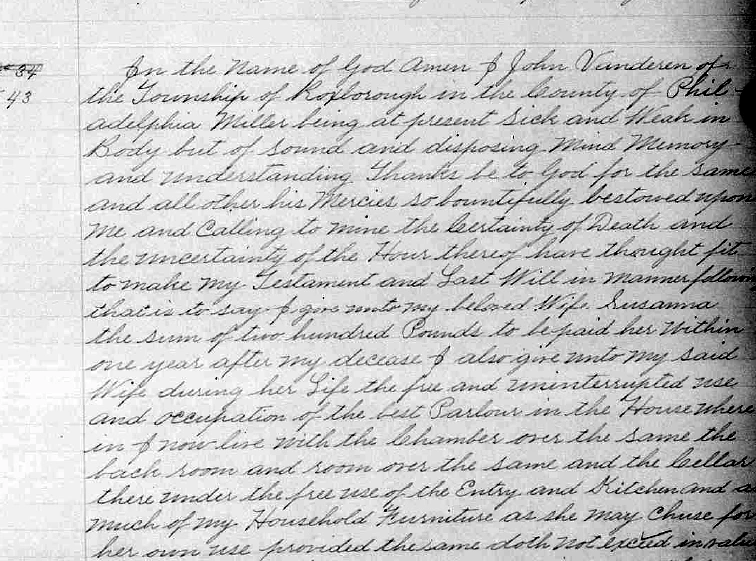
Vanderen made his will on July 21, 1785, "Sick and Weak in Body but of Sound and disposing Mind," and it is the most personal document any creek-mouth miller of his century left. His wife Susanna receives £200, £60 a year for life charged on the plantation and mill, and a household spelled out room by room — the best parlour and the chamber over it, the back room and the room over it, the cellar, free use of the entry and kitchen, furniture of her choice to £100, all the plate and tea ware, a new single-horse chaise and harness to be bought for her, his chair horse, a milch cow, stabling, the chaise house, half the flower garden, half the kitchen garden, and eight cords of firewood a year, delivered. His mother — named as he names her, "my Honoured Mother — M. Rovebach" — receives £12 a year for life. His six children, John, Charles, George, Joseph, Facey (the wife of Thomas Smith), and Susanna, share the residue. The plantation and mill — "being the Estate which I purchased at publick Sale as the Estate of Shellenberger" — are allotted to Charles and Joseph, at a value to be fixed by five disinterested men, four-sixths of it payable to the other children. George receives the house and land bought from Jacob Coleman. For his eldest son John, who has already received "four hundred Pound and upwards," the rest of his share is held in trust: the interest only, at most six per cent a year, for John's life, the principal to John's children as the eldest turns twenty-one — the executors, if unanimous, may pay sooner if they judge it better for John and his children. The terms are printed as written, and nothing is added to them. His executors are "my Esteemed Friend and Neighbour Joseph Matther," his son Charles, and his son-in-law Thomas Smith.
Earlier that spring he had tried to let the farm: the Pennsylvania Gazette of March 23, 1785 carries his notice, dated at Roxborough on March 19, offering a commodious house, a large barn, and ninety acres to let — "apply to JOHN VANDEREN, Miller, on the premises." The notice offers the farm; it does not name the mills.
The committee, and his death
In February 1787 the Pennsylvania Gazette printed the Assembly's business: "An Act to enable the committee of the estate of John Vanderen (who is non compos mentis) to sell and convey some parts of his real and personal estate, for the payment of some of his debts; to mortgage other parts of his real estate…; to lease for a term of years parts of his real estate…" The bill was read a second time and debated. It passed — the Commonwealth's digest of its laws records it as passed on March 7, 1787, a private act — so a committee of his estate existed from that winter, empowered to sell, mortgage, and lease for his debts. The act's full text is not read, and nothing beyond the documents' own words is known or said here about his condition. He died within the year that followed: his will was proved on May 7, 1788. No obituary for him has been found.
The breaking of the estate
The end came by law. A judgment of £300, recovered by Samuel Robeson as surviving executor of Elizabeth Vanderen — she had been executrix of Magdalen Robeson, the widow whose mortgages Vanderen had carried since 1755; no record read states Elizabeth's relationship to the miller — was put in execution against his executors in June 1789. The premises carried £5,000 and more in mortgages and judgments; they "remained unsold for want of buyers," and the rents were found insufficient to pay within seven years. On September 23, 1789, the sheriff sold the seat on its own ground. The sale notice describes what thirty-four years of Vanderen had made of it: two water wheels, three pair of stones and room for another pair, bolting and hoisting by water, "three hundred barrels of flour per week"; a stone dwelling house and stone barn; a small frame house and stone stable at the lower end; and "another stone tenement up the creek, where what was called the upper mill stands." Peter and Jonathan Robeson bought the whole — 263 acres in fourteen parcels on both sides of the creek, and twenty acres more across the Schuylkill — for £5,900. The Robeson family was back at its own mills, and "Vanderen's Mills" began its long fade into the Robeson name.
That December his executors sold the rest of his world: some 9,600 acres of western lands, in Westmoreland, Luzerne, Northampton, and Bedford counties — tracts on the Cowanshannock and the Kiskiminetas, in the Wyoming country, at Quemahoning — patented before the Revolution and sold at the Merchants' Coffee House to satisfy the debts, judgment creditors allowed to buy against what they were owed.
What remains
One claim made for him is not printed here as fact. A modern study of the seat places a "Vandaren's Hill" on Ridge Road in the Barren Hill movement of May 1778 and sends a Captain Parr toward it. No record read for this biography confirms it — not Washington's papers, searched under every spelling, and not Lafayette's memoirs, read at both of his Barren Hill passages — and the study cites no source for the sentence. It stands as an unverified claim, attributed to its maker.
Strip away the claims, and John Vanderen's documented life is a complete arc of a kind this collection rarely gets: an unnamed miller at a vendue in 1755; the owner of the creek's oldest seat for thirty-four years; a landmark in his enemy's and his general's orders alike; one of three millers still bolting flour in the hardest winter of the war; a testator who divided his gardens by halves and fenced his eldest son's inheritance in a trust; and an estate broken on the debts of its own assembling, sold on its own ground to the family that had built it. His beginning is missing — no record read says where he was born, who his father was, or where he learned his trade. The record gives the rest whole, and this account leaves the beginning empty rather than filled.
Timeline
| Year | Event | Source |
|---|---|---|
| 1755 | Highest bidder at the Schellenberger vendue, May 6; buys a half share of the Robeson mills and 96 acres, Jun. 28, for £1,115 subject to two mortgages | Deed, Book I, vol. 12, pp. 424–427 |
| 1760 | Deed from Rudman Robeson, May 8: three parcels by the mill land, some 27 acres, for £309 — read in full in its later recording | Deed, Book EF, vol. 3, pp. 177–180 |
| 1760 | Buys 53 acres along the creek from Wickard Levering, Dec. 22, for £265 | Deed, Book H, vol. 14, pp. 30–33 |
| 1777 | His mill dam is a landmark in Washington's General Orders for Germantown, Oct. 3 | Washington's General Orders, Oct. 3, 1777 |
| 1778 | Named in Washington's mill-disabling order, Feb. 1; Jameson reports his among only three creek mills with bolting cloths, Feb. 2 | Washington to Jameson; Jameson to Washington |
| 1778 | Hamilton times a movement by "Vandeering's Mill," Apr. 3 | Hamilton to Greene |
| 1779 | Holds two mills in the Roxborough list — his own at the creek's mouth, and one with Martin Rittenhouse | Jones, The Levering Family (1858), p. 187 |
| 1785 | Offers his farm to let, Mar. 19; makes his will, Jul. 21 | Pennsylvania Gazette, Mar. 23, 1785; Will Book U, pp. 103–107 |
| 1787 | The Assembly passes the act for the committee of his estate, Mar. 7 | Laws of the Commonwealth (1810), vol. II, entry 1258 |
| 1788 | Dies before May 7, when his will is proved | Probate, Will Book U |
| 1789 | The seat is sold by the sheriff to Peter and Jonathan Robeson, Sep. 23, for £5,900; his executors sell ~9,600 western acres, Dec. 30 | Sheriff's deed, Book EF, vol. 3, pp. 181–185; Pennsylvania Packet, Dec. 19, 1789 |