
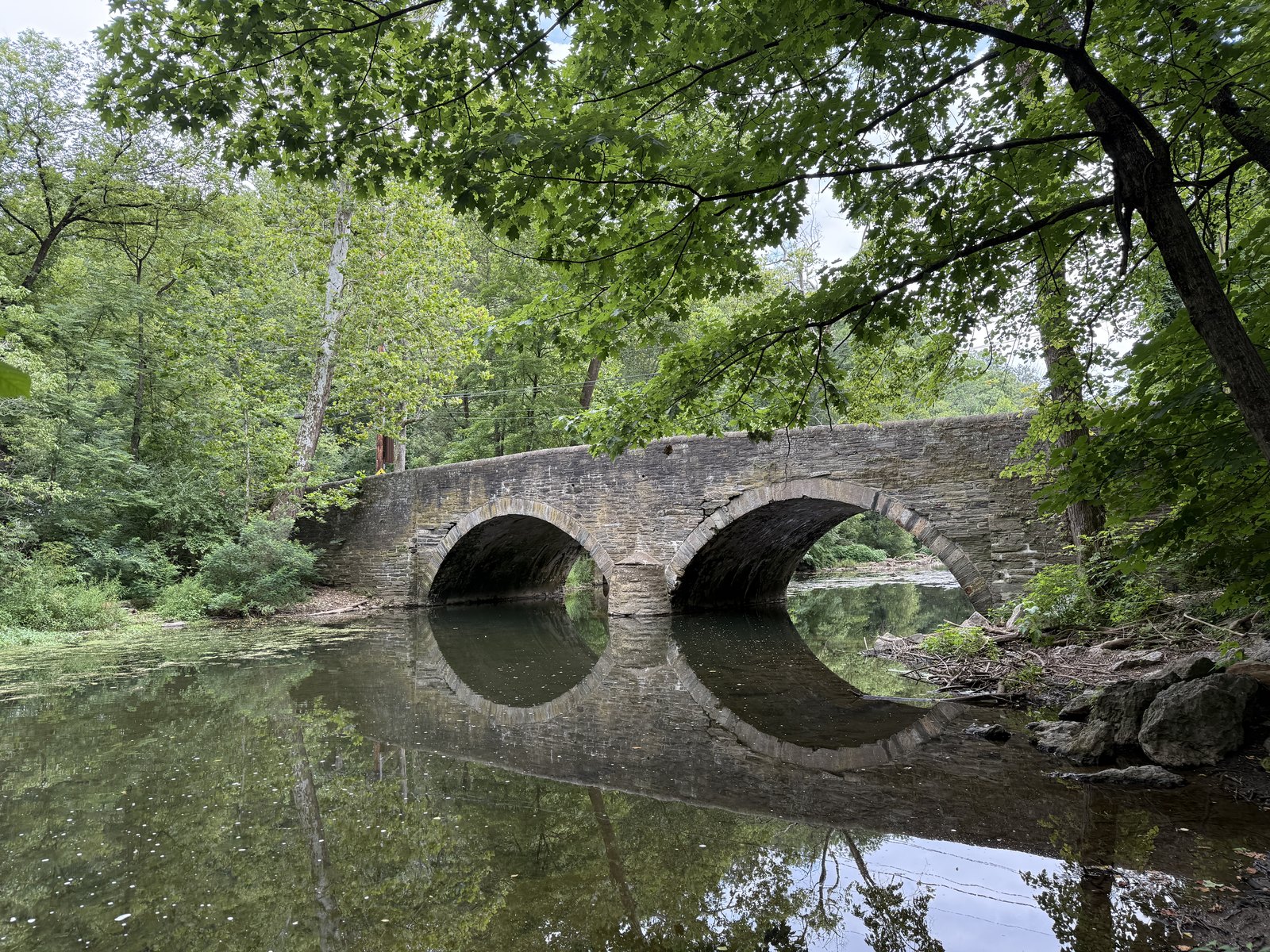
James and Isaiah Bell ran a grist mill on Wissahickon Creek. The mill stood where Bell's Mill Road crosses the creek in Germantown Township — today's Chestnut Hill, in northwest Philadelphia, inside Wissahickon Valley Park. A grist mill grinds grain into flour and meal, and this one was old before they ever saw it: Daniel Howell built a mill on the spot in 1710, and Jonathan Paul held it from 1738. The Bells bought it in 1801 and ran it for thirty-two years, until 1833. The road down to the creek took their name — Bell's Mill Road — and in 1820 the county built a stone bridge at their mill crossing that is still standing today. The creek is why they belong in this collection, and the creek is where their story starts.
Their story is also a genuine mystery — a small one, but a real one. For a hundred years, the books said the men who bought the mill in 1801 were John and James Bell. Then one local history said no — they were James and Isaiah Bell. When researchers for this project finally searched the records of the time itself, the records pointed at Isaiah. This article tells you what the records actually show, what they don't, and why the question is still officially open.
A mill seat older than the neighbourhood
The crossing where Bell's Mill Road meets the Wissahickon is one of the creek's old mill seats — a place where the falling water could turn a mill wheel, with a dam, a water channel, a mill building, and a lane. Daniel Howell's grist mill stood there from 1710. Jonathan Paul took it over in 1738, and the lane carried his name for a while: Paul's Mill Road. The Bells bought the mill in 1801. After them, in 1833, it passed to Issachar Thorp, who turned it into a calico print works — a factory that printed patterns on cotton cloth — and the lane picked up a third name, Thorp's Lane.
Three owners' names on one short road. The one that stuck was Bell's. The road is Bell's Mill Road today (you will also see it spelled Bells Mill Road, without the apostrophe — the Library Company of Philadelphia and the modern City of Philadelphia write it that way). Just east of the creek, where the road meets Germantown Pike, an 1848 map marked a little settlement called Mechanicsville — a store, a blacksmith, a few houses. That ground is now part of the Woodmere Art Museum's property. The mill itself is long gone, but the name the Bells left on the road never left.
One caution belongs here, because honesty is this project's rule: the year 1710 is the age of the mill seat, not of any building. Nobody knows whether the mill building photographed beside the bridge in the late 1860s was the same building the Bells owned in 1801. It may have been rebuilt more than once. No record found dates it, so this article doesn't either.
The bridge their neighbours asked for
For the Bells' first years at the mill, crossing the creek at their lane meant using a ford — a shallow place where wagons and riders went through the water. In 1818, local citizens petitioned the county for something better, and the county ordered a bridge built "over the Wissahickon across the ford at Bell's Mill Road." Whether the Bells signed the petition, pushed for it, or minded it, no record found says — the petition papers themselves sit in a city archive that this online-only project cannot reach.
In April 1820, the county commissioners advertised for builders, and that advertisement became the most important document in the Bells' whole story. It ran in three Philadelphia newspapers, six times in all, and it described one of the bridges this way: the bridge "to be erected at Isaiah Bell's Mill, over Wissahickon Creek, in the Township of Germantown."
Read that again. Isaiah Bell's mill. Not John's. Not James's. In 1820, in the middle of the Bells' time at the mill, the county itself — in print, in the newspapers of the day — called the mill Isaiah's.
The bridge was built that year, 1820: a stone arch bridge with two spans, at the mill crossing. It has now carried the road over the creek for more than two hundred years. It is listed as eligible for the National Register of Historic Places, the city is planning a major repair project for it, and a modern study calls it the only road link between Upper Roxborough and Chestnut Hill. The Bells' mill is gone. The bridge their mill crossing called into being is still at work.
John or Isaiah? The case of the second brother
Here is the disagreement, plainly. Two respected books about the Wissahickon — T. A. Daly's The Wissahickon (1922) and Francis Burke Brandt's The Wissahickon Valley (1927) — both say the mill passed "to John and James Bell in 1801." The Library Company of Philadelphia's records for two old photographs of the bridge say the same: the bridge was "named after former mill owners James and John Bell." Three sources, one answer: John.
But there is a catch. Those three may not be three separate witnesses at all. Daly thanked a local historian named John J. MacFarlane for help; Brandt wrote five years after Daly; and the Library Company's modern cataloguing does not say where its naming came from. They may all trace back to one older telling of the story — three copies of a single voice.
Against them stands one later book: Elizabeth Farmer Jarvis's Chestnut Hill Revisited (2004), which says "James and Isaiah Bell purchased the mill in 1801." Jarvis worked from local historical society photographs and research, and the same page of her book quotes an 1818 county document word for word — she was working from records, not repeating a rumour.
So the printed books split: John (1922, 1927, and the Library Company) against Isaiah (2004). What breaks the tie is not another book. It is the records from the Bells' own time:
- The 1820 bridge advertisement (above) names the mill as Isaiah Bell's — the only record from the period that names the mill's owner at all.
- The census lists — the government's head counts, taken every ten years — show a Germantown Township household headed by Isaiah Bell in 1800, 1810, and 1820. In 1800, the household right next to his on the list, on the very next line, is headed by James Bell. The two names Jarvis gives, side by side, in the right township, at the right time. And the trail starts even earlier: in the township's 1798 direct tax list, the handwritten name line for the Widow Paul's grist mill — a mill of two wheels, with a stone barn — reads "James & Isaiah Bell," the two names together as the mill's occupiers three years before the purchase (a record added in November 2026; the joint name is read from the handwriting — the modern index enters the two names separately).
- A newspaper report from 1808 names an Isaiah Bell together with a James Bell at a public meeting in Germantown.
- And John Bell is simply not there. In every census from 1800 to 1840, there is no John Bell household in Germantown Township, or in Roxborough Township next door, or in Bristol Township. No will for a John Bell shows up in the probate indexes either — the only John Bell will in the early published lists is from 1773, decades too early. John exists in the later books and nowhere in the records of his own time.
That is why this collection now calls them James & Isaiah Bell. It is a judgement about which evidence weighs more — the actual records of the period against later books that may share one source — and it was made as a formal ruling by the collection's editor in November 2026.
But it is not a settled fact, and this article will not pretend otherwise. Three honest cautions stand next to the ruling:
- No record found names the men who actually bought the mill in 1801. The deed — the legal paper from the sale itself — would name them exactly, but it sits in a city archive and cannot be read online, and this project works online only. The 1820 advertisement names the owner nineteen years after the purchase. Owners can change inside thirty-two years: a John could have bought the mill in 1801, died, and been followed by an Isaiah, and nothing found rules that out.
- The census and newspaper men are not proven to be the millers. Census lists of that era did not record jobs. The Isaiah and James Bell in Germantown Township fit the mill in place and time, and no record says in so many words that they are the same men.
- The name Isaiah Bell runs in more than one generation. A newspaper letter from 1803 already speaks of an "Isaiah Bell, now deceased" — so the Isaiah records of 1800–1833 may belong to more than one man, perhaps a father and a son.
Even the word "brothers" rests on the printed tradition rather than a record — the books present James and the second Bell as a pair, and the 1800 census puts their households on next-door lines, but no document found states their relationship. The conflict stays open in this collection, printed wherever the 1801 purchase is mentioned. If a deed or another record from the time ever surfaces naming the buyers exactly, the question closes. Until then: the records lean Isaiah, the old books say John, and both are printed.
What the old records actually show
Beyond the name question, the period records give Isaiah Bell a small, real outline — always with the warning that these records name a man in the township, and none of them calls him a miller.
In 1813 and 1814, Philadelphia's printed directories listed an Isaiah Bell among the managers of the Chesnut Hill and Spring House Turnpike Company — the company that ran the toll road from the top of Chestnut Hill out through Flourtown. That is the Bells' own neighbourhood and road network: as an older history puts it, "the road to Bell's mill crosses the turnpike." In 1818 and 1819, an Isaiah Bell was a director of the Bank of Germantown, the township's own bank. These are respectable, public roles — the marks of a man of standing in his township. They are printed here as context that fits, not as proof: the project's own research file keeps them in a separate, clearly marked box labelled not merged, because no record ties the turnpike manager or the bank director to the mill by name.
One more record is sadder and stranger. In July 1832, a Philadelphia newspaper's death notices recorded Isaiah S. Bell, aged twenty-one — described as "son of late Bell, of Wissahickon." The notice never gives the father's first name. A Bell of the Wissahickon was dead by 1832, and his young son followed him that summer — but the record does not say which Bell he was, and this article will not guess.
The researchers also checked the wills. The probate indexes through 1859 hold no will for a John Bell or an Isaiah Bell of the township. The one James Bell will they do hold — from 1853 — was opened and read, and it belongs to a different man: a James Bell "of the City of Philadelphia" who left city lots to a grandson and shares to his sons, with no mill, no job named, and no Germantown property. A namesake, checked and set aside. And the city directories hold a trap of exactly the dangerous kind: a city firm called "James & John, distillers" appears in the directories of the Bells' own years — the traditional pairing of names, in the right years, in the wrong place and the wrong trade, at a Cedar Street address in the city. No record ties those distillers to Germantown or to any mill. They are a warning about how common these names were, and they are part of why the old books' "John and James" cannot simply be taken on trust.
The miller who watched the hounds
Almost everything above is names, dates, and paper. Exactly one human glimpse of a Bell of Bell's Mill survives, and it comes from S. F. Hotchkin's 1889 history of Germantown, Chestnut Hill, and Mount Airy, passing on stories collected by a man named Townsend Ward. Ward wrote that "Mr. John Jordan's father-in-law, Mr. Bell, of Bell's Mill, near Chestnut Hill, used to tell of often having seen this lady riding across the country, following her father's pack of hounds."
The lady was Mary Robeson Bensell, daughter of Peter Robeson, whose family ran the Robeson Mills down at the mouth of the creek — the valley's other great milling family. She was famous locally for riding to hounds, and she kept riding into her ninetieth year; she died about 1856, aged ninety-six. So the Bell in the story — whichever brother he was; the passage never gives his first name — had watched her ride, more than once, and talked about it in his old age. His daughter married John Jordan, which ties the mill family into the township's web of marriages.
It is one sentence of testimony, passed from a storyteller to a collector to a printed book. It does not name the man. But it is the only place in the whole record where a Bell of Bell's Mill appears as a person rather than a name in a list — an old miller who remembered the valley's characters and told their stories. As far as the searches for this article found, no website or book about the Bells, the mill, or the bridge mentions it at all.
After the Bells
The Bells' time at the mill ended in 1833, when the seat passed to Issachar Thorp. (Thorp's own family account gives the year as 1835; the disagreement is printed in full in Thorp's biography in this collection. Either way, the transfer closed the Bell years.) How it happened — a sale by the brothers, a sale by an estate after a death — no record found says.
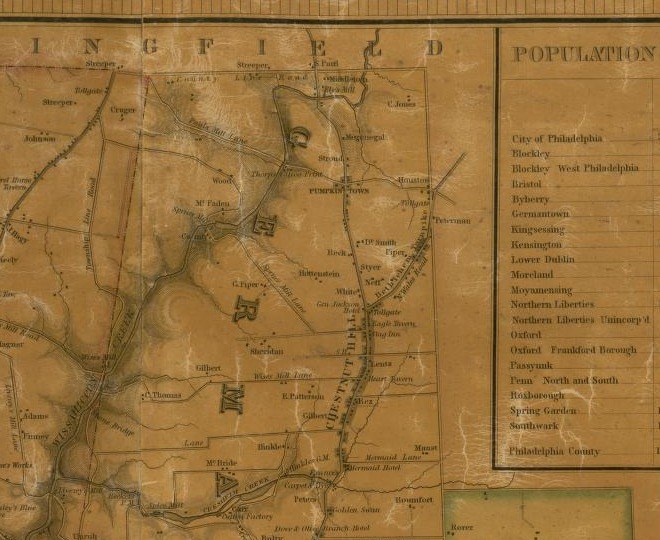
Thorp turned the grist mill into a calico print works, and an 1843 county map labels the spot "Thorps Calico Print" — useful evidence about the place, but it shows the seat in Thorp's time, not the Bells', and it is never captioned as their mill. Later the lot held John B. Bischoff's cotton mill, and after 1868 the city took the Wissahickon mill seats for Fairmount Park, the park that protects the valley today. The Bells' seat completes a full line of owners that this collection has now traced end to end: Howell, Paul, Bell, Thorp, Bischoff.
Around 1868 and 1870, photographers took stereo views — paired photographs meant to be looked at through a viewer for a 3-D effect — of the bridge and the mill building beside it. Those photographs are the closest thing to a picture of the Bells' world that exists. The building in them stood a generation after the brothers, and the Library Company's own cataloguing describes it as part of "Bishop's Mills" at the time of the photograph — a different mill complex down the creek from the Bells' seat, whose similar name (Bishop, Bischoff) causes endless confusion. The cataloguing and the ownership line do not sit easily together, and the disagreement is printed in the research file rather than smoothed over. What is certain is only this: the photographs show the crossing as it looked a generation later, not the Bells' mill as they knew it.
What we still don't know
- The second brother's name for certain — John or Isaiah. The period records lean Isaiah; the deed that would settle it cannot be read online, so the conflict stays printed and open.
- Either man's birth, family background, or death. No dates at all have been found for James or Isaiah Bell; the 1832 death notice of a young Isaiah S. Bell, "son of late Bell, of Wissahickon," does not name the father.
- Whether the two men were actually brothers — the word rests on the printed tradition; no record found states the relationship.
- What the Bells milled, how much, and with how many workers. No fire, flood, lawsuit, or sale at the mill during their thirty-two years appears in the newspapers searched.
- Whether either man left a will or an estate file that can be checked — the early administration indexes cannot be read online, so that door is closed, not empty.
- Whether the mill building in the 1860s photographs was the building the Bells owned.
- What an 1819 county map shows at the seat. John Melish's map of Philadelphia County prints the names of rural landowners and dates from the middle of the Bells' time — but no copy that can be examined online could be found, so what it shows at Bell's Mill is a permanent gap for this project.
Timeline
- 1710 — Daniel Howell's grist mill stands at the creek crossing — the start of the mill seat. (Daly, 1922; Brandt, 1927)
- 1738 — The mill passes to Jonathan Paul; the lane is called Paul's Mill Road. (Daly; Brandt)
- 1800, 1810, 1820 — Census lists show Isaiah Bell heading a Germantown Township household in all three years; in 1800, James Bell's household is on the very next line. (U.S. censuses, read from the images)
- 1801 — The Bells buy the mill — "John and James Bell" in Daly, Brandt, and the Library Company records; "James and Isaiah Bell" in Jarvis (2004). The conflict is unresolved. The deed has not been read.
- October 1808 — A Germantown public meeting names an Isaiah Bell together with a James Bell. (Poulson's newspaper, October 4, 1808)
- 1813–1814 — An Isaiah Bell is listed among the managers of the Chesnut Hill and Spring House Turnpike Company. Context that fits — not proof he was the miller. (Paxton's directory, 1813; Kite's directory, 1814)
- 1818 — On a citizens' petition, the county orders a bridge built across the ford at Bell's Mill Road. (Jarvis, 2004, quoting the county order)
- 1818–1819 — An Isaiah Bell serves as a director of the Bank of Germantown. (Poulson's, November 26, 1818; Franklin Gazette, November 25, 1819)
- April 1820 — The county's bridge advertisement names the mill "Isaiah Bell's Mill, over Wissahickon Creek, in the Township of Germantown." (Franklin Gazette; Poulson's; Democratic Press, April–May 1820)
- 1820 — The stone arch Bells Mill Road Bridge is built at the mill crossing. It still stands. (Library Company of Philadelphia records; City of Philadelphia, 2026)
- July 1832 — A death notice records Isaiah S. Bell, aged twenty-one, "son of late Bell, of Wissahickon" — the father's first name not given. (Philadelphia Inquirer, July 6, 1832)
- 1833 — The mill passes to Issachar Thorp, who turns it into a calico print works. (Daly; Brandt. Thorp's family account says 1835.)
- About 1868–1870 — Stereo photographs show the bridge and the mill building beside it, a generation after the Bells. (Library Company of Philadelphia)
- After 1868 — The city takes the mill seat for Fairmount Park. (Gibson, 1990)
A note on pictures
No portrait of James or Isaiah Bell exists in any source found, and none may be invented — this project uses only genuine photographs and documents. The best picture of their seat is a stereo photograph from about 1868 by J. L. Rogers, held by the Library Company of Philadelphia: the stone bridge, the mill building behind it, and two girls at the creek's edge. The photograph itself is old enough to be in the public domain, but it is not yet cleared for publication: the Library Company's item-level permission confirmation is still outstanding, and its credit line is required, so the picture is described here rather than shown, and publication with the photograph waits on that confirmation. A second stereo view from about 1870 is in the same position; its printed mount even gives the wrong location ("Ridge Avenue"), a mistake the Library Company's own record corrects, and the correction would be printed with any use. One picture is collected and cleared: Charles Ellet Jr.'s 1843 map of Philadelphia County (public domain, Library of Congress), which labels the seat "Thorps Calico Print" — it shows the place in Thorp's time, ten years after the Bells, and is captioned exactly that way, never as the Bells' mill. A modern photograph of the bridge as it stands today is also shown on this page, under its Creative Commons licence. The 1819 Melish map, the one map that might name the seat's owner in the Bells' own years, could not be examined online at all. The full picture search is logged in the project's image ledger for this story.