
The bridge is still there. The mill is not. Where Bell’s Mill Road crosses Wissahickon Creek in Chestnut Hill, in the Germantown Township part of today’s park, the stone bridge built in 1820 still carries the road over the water — and nothing of the mill buildings that stood beside it survives in any source read. The crossing is the seat’s fixed point. The county ordered a bridge here in 1818, on a citizens’ petition, “over the Wissahickon across the ford at Bell’s Mill Road,” and the bridge that followed still stands, old enough to be listed in its own right. Daly, writing in 1922, adds the seat’s place in the park’s geography: Thorp’s Lane, at this end of the valley, “marked the northern limits of the Park when the Fairmount Park Commission took charge.”
The seat and its owners
The working life of the seat runs back to 1710, when Daniel Howell built a grist mill here — two printed histories, Daly’s and Brandt’s, agree on the chain, and nothing further about Howell was found in the record read. In 1738 Jonathan Paul bought the mill, and his tenure lasted long enough to name the road: the valley’s old road names include “Paul’s Mill/Thorp’s Mill/Bell’s Mill Road,” one lane carrying three owners’ names in turn. The year 1710 dates the seat, not a building — no standing structure here is of 1710 in any source read.
John or Isaiah?
In 1801 the mill passed to the Bells, and here the record argues with itself, in the open. Daly and Brandt both print “John and James Bell.” But the period record weighs the other way: the County Commissioners’ bridge proposals of April 1820, advertised again and again that spring, name the place “Isaiah Bell’s Mill, over Wissahickon Creek, in the Township of Germantown,” and the censuses show Isaiah Bell heading a Germantown household in 1800, 1810, and 1820, with James Bell heading one in 1800 only, on the line immediately next to Isaiah’s. No John Bell appears in Germantown, Roxborough, or Bristol in any census from 1800 to 1840. The question is printed here unresolved: the later books say John, the records of the time say Isaiah, and this site’s biography of the family runs as James & Isaiah Bell on the strength of the period evidence. The one personal glimpse of any Bell at the mill comes at one remove — Hotchkin preserves an unnamed “Mr. Bell, of Bell’s Mill,” John Jordan’s father-in-law, who “used to tell of often having seen” Mary Robeson Bensell riding across country behind her father’s pack of hounds. It is testimony at one remove, and it is printed as such.
The calico printer
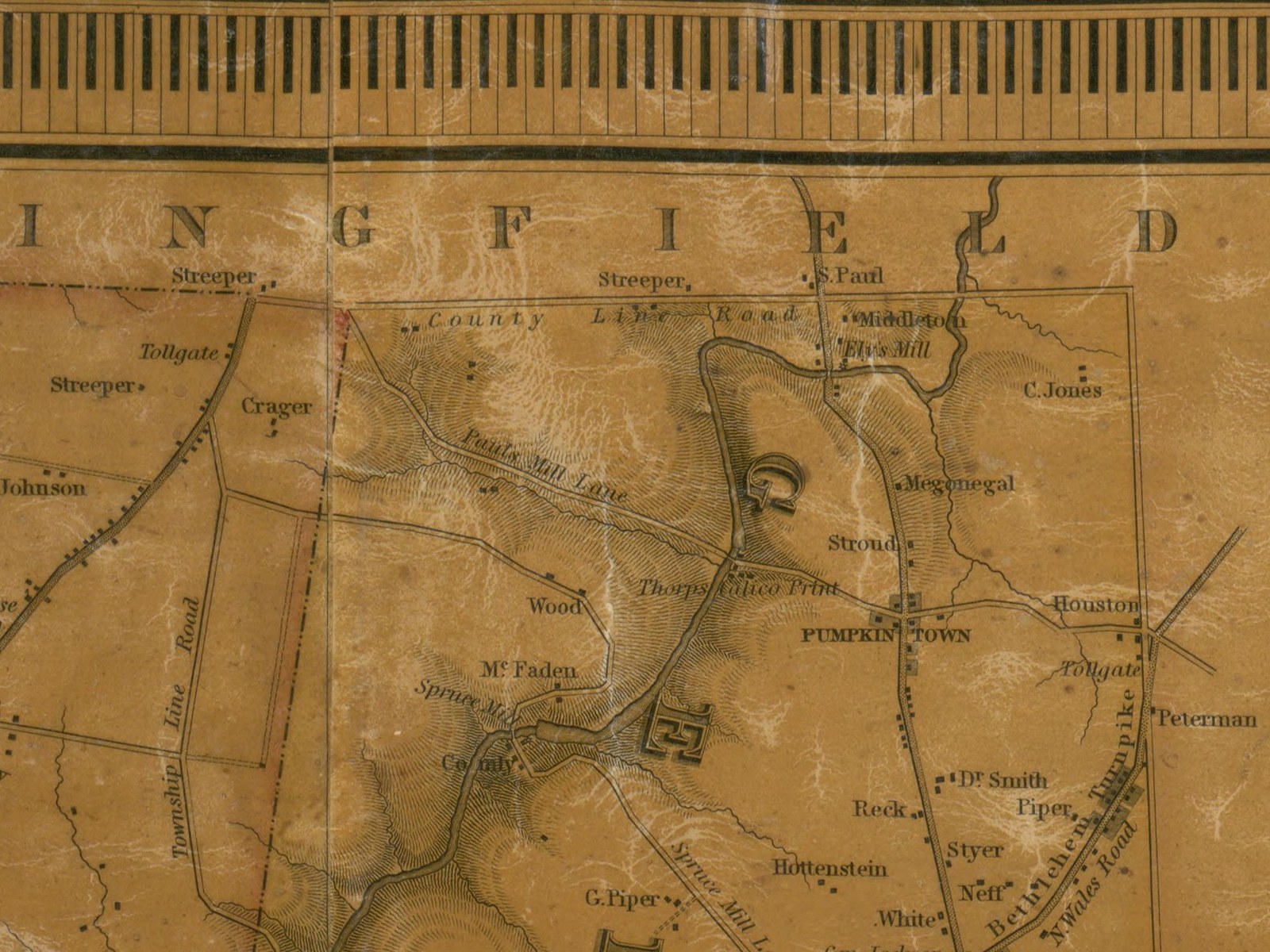
In the 1830s the seat changed trades. Issachar Thorp, an English calico printer, bought the mill — Daly and Brandt give 1833, Hotchkin’s family account gives 1835, and both dates are printed because the deed that would settle it survives only on paper, in the seat’s brief of title at the City Archives, and was not read. Charles Ellet’s map of Philadelphia County, surveyed in 1843, labels the works at the crossing “Thorps Calico Print,” fixing the seat in Thorp’s years by the map’s own printed name. Thorp is identified with the Philadelphia printer of Thorp, Siddall & Co., who were printing cottons from engraved copper cylinders near Germantown from 1809; the identification is well-supported but not document-proven, and the account says so. The firm’s wider fame rests partly on tradition: Bishop’s History of American Manufactures prints that the first lot of cotton goods printed in the United States by engraved rollers and water power reached Philadelphia in October 1810, and that one man and two boys could print 10,000 yards a day — but Bishop does not say Germantown, and the “first” is credited tradition, never established fact. Thorp’s obituary would later call him “among the first, if not the very first, that established Calico Print Works in the United States.” That is testimony, printed as testimony.
Army cloth
The partnership’s hardest years came from army cloth, not calico. During the War of 1812 the partners stood behind Thomas Parker’s government contract for 120,000 yards of woollen kersey at a dollar a yard — the court report and the sureties’ bond date the contract October 9, 1813; the Senate’s abstract says September 9, and the disagreement is printed rather than settled. One acknowledgment for $5,526.41 was assigned to Thorp, Siddall & Co. and verbally accepted “to be paid when in funds”; only $1,002.45 was ever paid at the time. The case went to court, and in April 1816 Parker v. United States reversed the judgments against Parker. When the partners finally petitioned the Senate, the report of March 21, 1822 — read in full — shows the principal had in the end been paid, and the partners were asking for interest only. It was denied. The calico printer of Bell’s Mill spent a decade chasing the United States for interest on army cloth.
The firm’s documented scale, meanwhile, lives in Delaware, not on the Wissahickon. The same partners ran the Simsville Mill on the Brandywine, a stone mill leased from 1813 whose 1820 return shows about 1,500 pounds of cotton a week and 61 persons at work; no Wissahickon record gives the Bell’s Mill works a workforce of any size, then or later.
Thorp died at Germantown on February 28, 1855. The physician’s return slip, read from the manuscript, says it plainly: “Mr Issael. Thorp died on the evening of the 28th inst: of old age — in the eighty second year of his age.” The property later passed to William Miller, Thorp’s brother-in-law, on Hotchkin’s family account, and Thorp’s son Thomas appears in McElroy’s 1859 directory as a calico printer on Thorp’s Lane — plausibly the son, printed as such.
The cotton mill
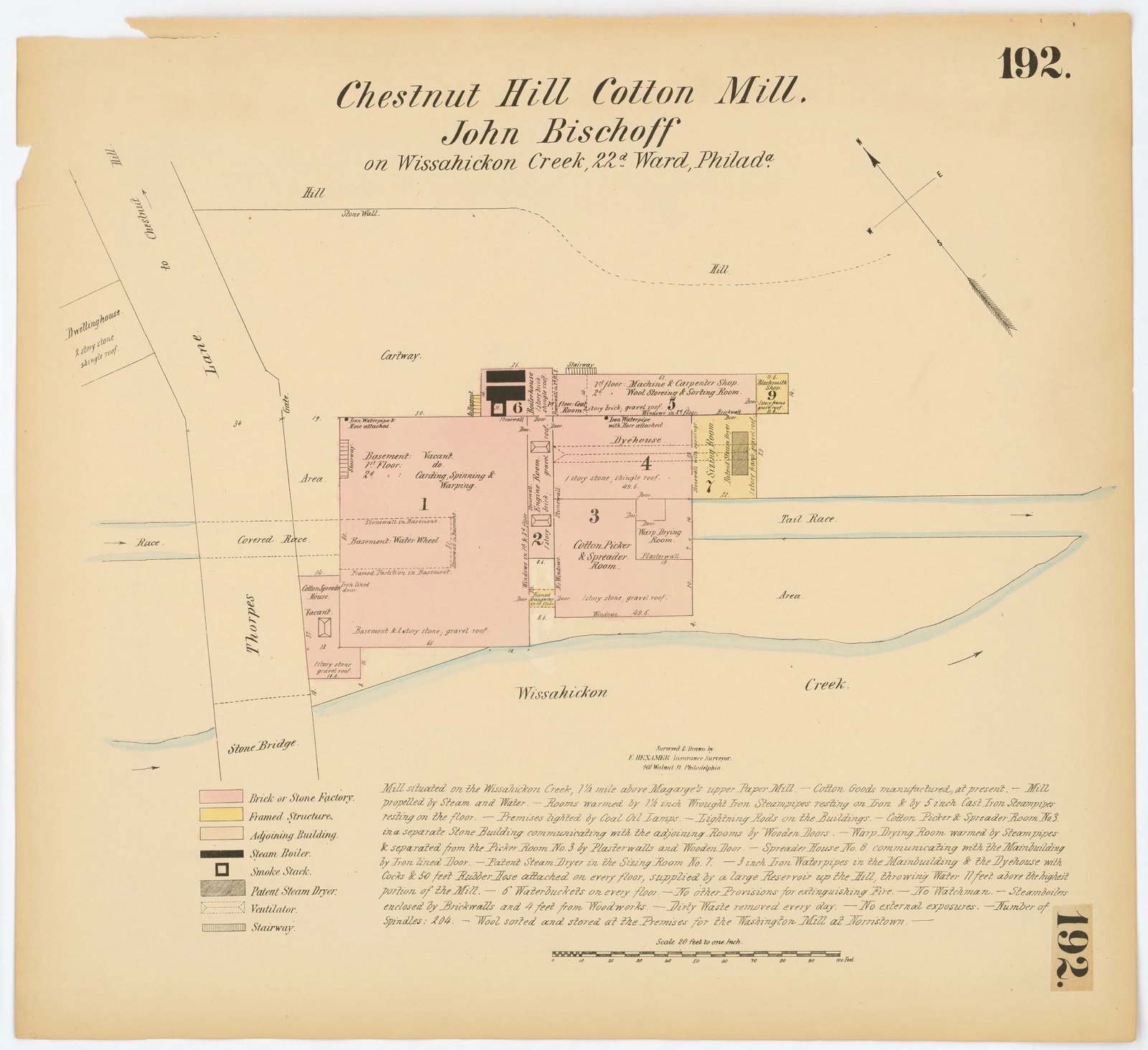
The seat’s last industrial tenant turned it to cotton. By 1866–67 the works at the northeast corner of Thorp’s Lane were John B. Bischoff’s Chestnut Hill Cotton Mill, documented in his fire-insurance survey: nine numbered buildings; a main building 50 by 65 feet of stone, with carding, spinning, and warping on the second floor; 204 spindles; steam and water power together; a dyehouse; a sizing room with a Patent Steam Dryer; machine and carpenter shops; a blacksmith shop; a covered race and a tail race. Wool was also sorted and stored on the premises for the Washington Mill at Norristown — this cotton mill doubled as another firm’s wool store. The survey states no number of hands anywhere; the workforce is a gap in the record. The insurer’s portrait is thorough — a reservoir-fed system of iron pipes “throwing Water 11 feet above the highest portion of the Mill,” six water buckets on a floor, boilers enclosed in brick four feet from any woodwork, dirty waste removed daily — and then, in the same survey: “No Watchman.” On the man himself, a hard caution: the record could not prove that the mill’s owner was the John Baptist Bischoff of the censuses, whose death certificate gives his occupation as “Musician,” and this site’s biography entry for him was removed for exactly that reason. The mill and its survey are facts; the miller’s biography is circumstantial, and only the mill is printed here.
Bishop’s Mills is not Bischoff’s
One more name must be kept apart. Bishop’s Mills was a different mill, near Chestnut Hill, already “destroyed by fire some time since” when newspapers reported iron stolen from it in January 1866 — while Bischoff’s stood insured and working. Two mills, never to be merged; the old photographs of a mill beside this bridge belong to the Bishop’s seat, not to this one, and one of them is catalogued with a “Ridge Avenue” location its own catalogue says is wrong. The tension is printed, unresolved.
The end
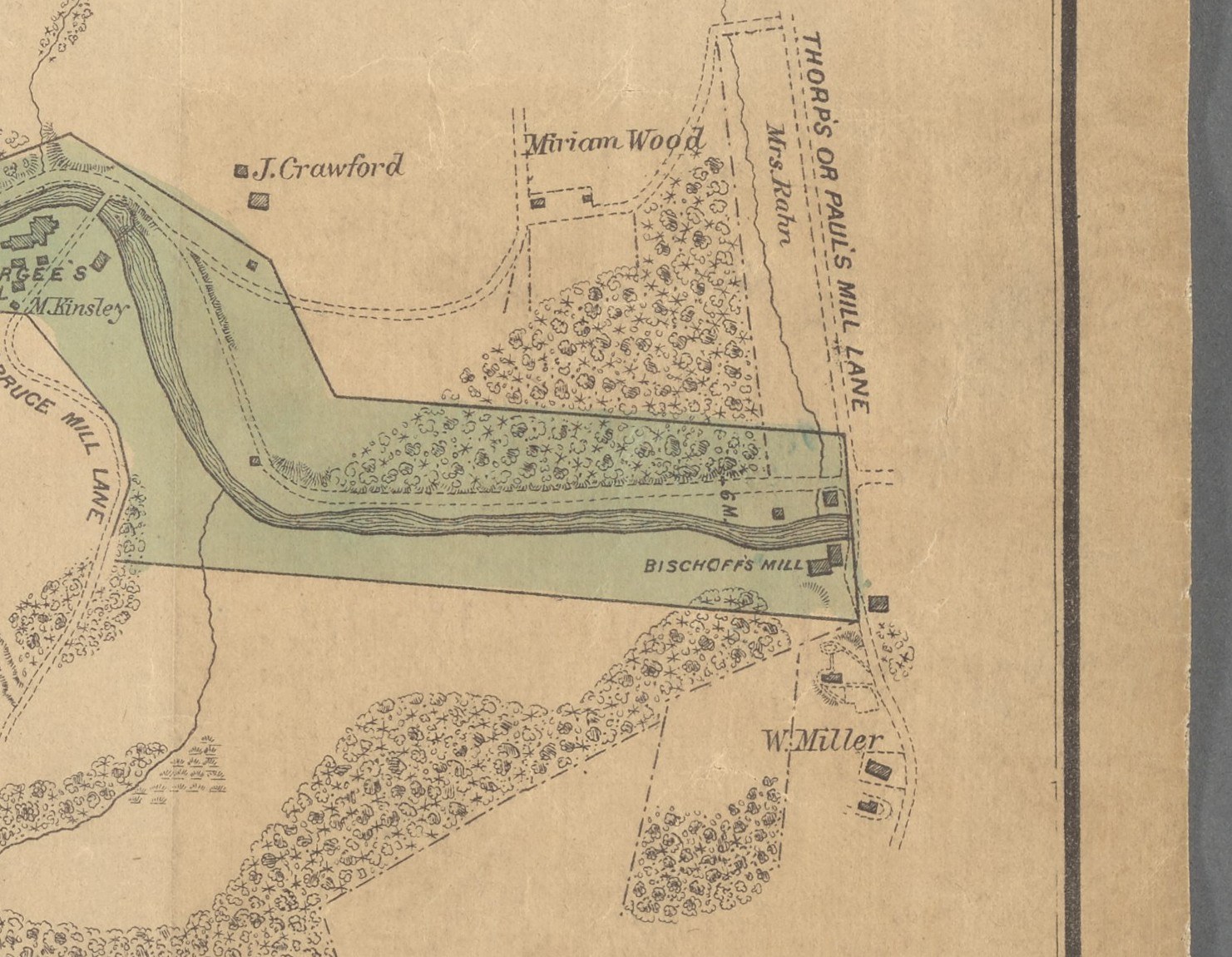
The end came with the park. Gibson’s history of Chestnut Hill lists “Bischoff’s Mill (at Bell’s Mill Road)” among the mill sites the Fairmount Park Commission began acquiring in 1868, and gives the fate of the taken mills in one sentence: “Once taken over by the city, the buildings were torn down or became derelict.” No demolition year for this mill was found, and the Commission’s printed reports name no seller for the seat, so no price can be printed. When the city’s surveyors drew the creek in 1869, they labeled the seat with the name of the tenure they found there: “Bischoff’s Mill.” The name the road still carries is older — Bell’s — and the bridge of 1820 still stands over the creek where the mill stood.
The Bells themselves have their own story among this site’s Historical Figures.
Timeline
| 1710 | Daniel Howell builds a grist mill on the seat. |
| 1738 | Jonathan Paul buys the mill. |
| 1801 | The Bells buy the mill — printed as John and James by Daly and Brandt; the period record weighs to James and Isaiah. |
| 1809 | Thorp, Siddall & Co. printing cottons from engraved copper cylinders near Germantown (Needles, 1884). |
| 1810 | The first lot of cotton goods printed in the United States by engraved rollers and water power reaches Philadelphia in October, by Bishop’s account — credited tradition, not established fact. |
| 1813 | Thomas Parker’s government contract for 120,000 yards of woollen kersey, with the Thorp partners as sureties — dated October 9 in the court report and bond, September 9 in the Senate abstract. |
| 1816 | Parker v. United States reverses the judgments against Parker (April). |
| 1818 | The county orders a bridge over the Wissahickon at the ford at Bell’s Mill Road. |
| 1820 | The Bells Mill Road Bridge is built; the County Commissioners’ bridge proposals name “Isaiah Bell’s Mill.” |
| 1822 | The Senate Claims report (March 21) shows the kersey principal paid and the partners’ claim for interest denied. |
| 1833 | Issachar Thorp buys the seat (Daly and Brandt); Hotchkin’s family account gives 1835. |
| 1843 | Ellet’s map of Philadelphia County labels the seat “Thorps Calico Print.” |
| 1855 | Issachar Thorp dies at Germantown on February 28. |
| 1859 | Thomas Thorp, plausibly the son, is listed in McElroy’s directory as a calico printer on Thorp’s Lane. |
| 1866 | Newspapers report iron stolen from Bishop’s mill near Chestnut Hill, a different mill, already ruined by fire (January 27). |
| 1866–67 | John B. Bischoff’s Chestnut Hill Cotton Mill stands on the seat, documented by its fire-insurance survey. |
| 1868 | The Fairmount Park Commission begins acquiring the valley’s mill sites; Bischoff’s Mill is among them. |
| 1869 | The city’s survey of the creek labels the seat “Bischoff’s Mill.” |