
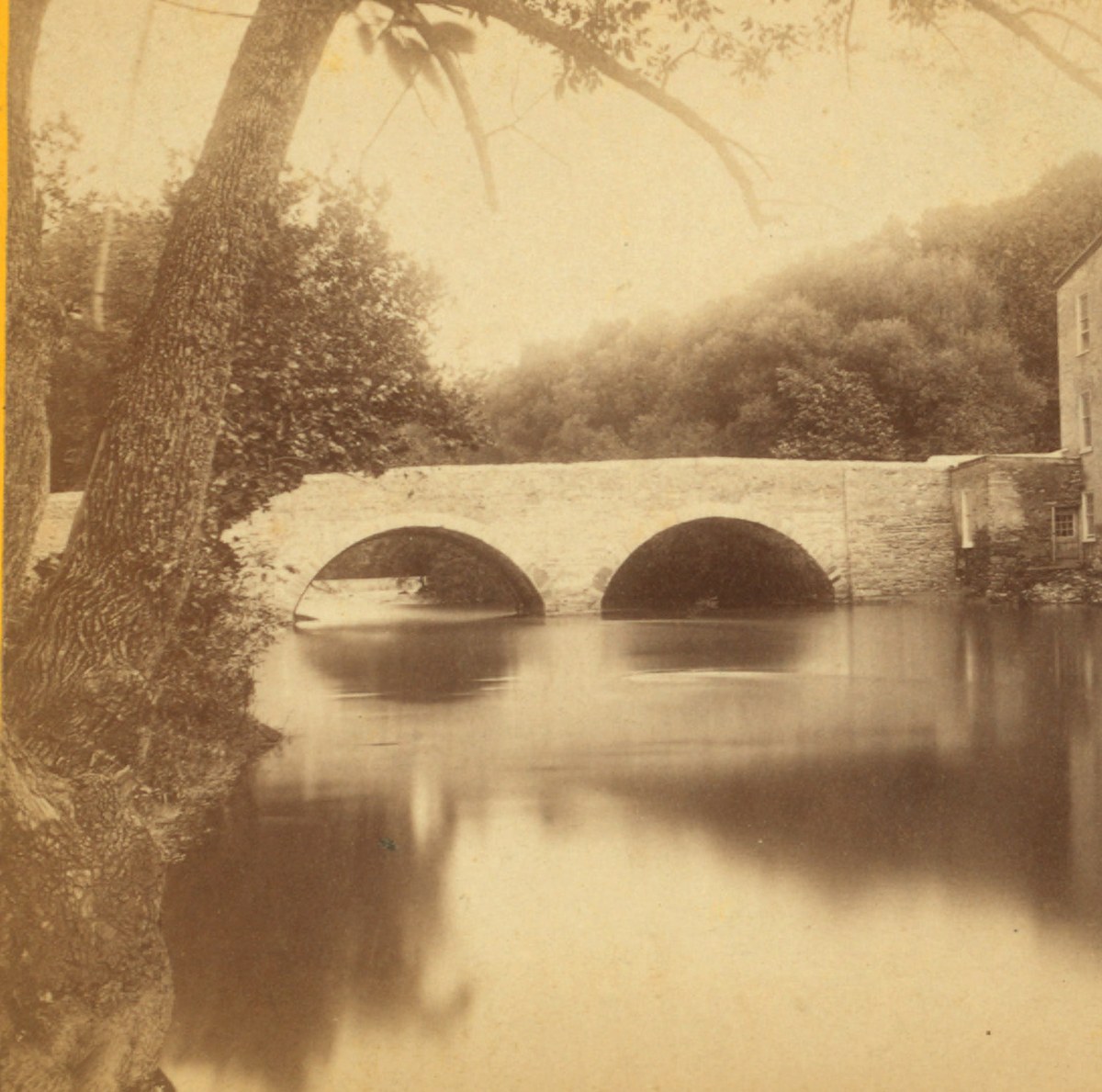
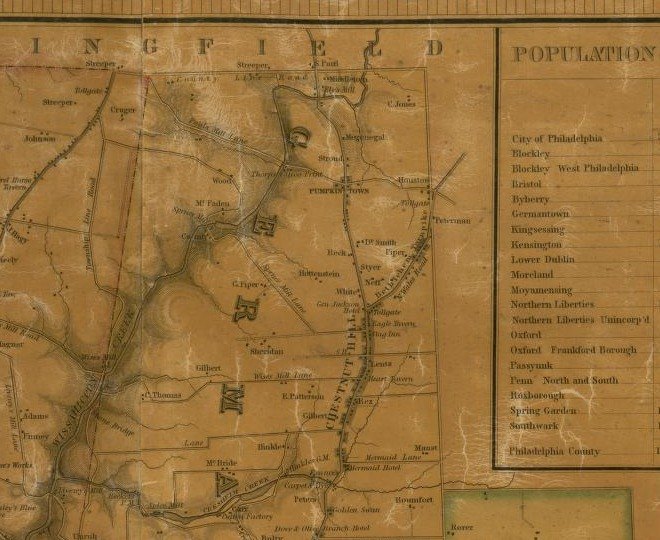
Issachar Thorp's calico print works stood on Wissahickon Creek at Chestnut Hill, in the Germantown end of Philadelphia — at the mill seat where Bell's Mill Road crosses the creek, on the lane that still carries his name: Thorp's Lane. Charles Ellet's great 1843 map of Philadelphia County says it in so many words. Lettered along the creek at that crossing, the map reads "Thorps Calico Print" — the only factory marked on that whole stretch of the creek.
Thorp was an English calico printer who came to America in 1809 and was printing cotton cloth with engraved copper cylinders — the newest method in his trade — the same year he arrived. His firm, Thorp, Siddall & Co., is credited in the old histories with printing the first cotton goods in the United States by engraved rollers and water power. He later ran a big cotton-spinning mill on Delaware's Brandywine Creek, chased the United States government for nine years over a War of 1812 army-cloth debt, and in the 1830s bought the old mill seat on the Wissahickon, where his name stayed on the map, the road, and the works for the rest of his life.
One honest note before the story, because this project prints it everywhere it matters: the proof that the English calico printer and the man who bought the creek seat are the same person is strong but not airtight. Seven separate lines of evidence all point the same way — the same rare name, the same trade, the same township, the right years, a map label, a census entry, and a family account. But no single document read so far names him in both worlds at once. The one record that could settle it — the deed of 1833 that sold him the mill seat — sits in a physical archive, and this project works online only. So the identification stands as well-supported, not document-proven, permanently. Everything below is written at that grade.
What calico printing was
A grist mill grinds grain into flour — that was the seat's first job, back in 1710. Calico printing is the other end of the cloth trade: taking plain woven cotton and printing coloured patterns onto it, the flowered dress goods of the day. Printers first did it by hand, pressing carved wooden blocks onto the cloth. In Thorp's generation the trade changed over to the copper cylinder — an engraved metal roller that could print continuously, driven by water power. A print works needed a creek: power to turn the machinery, water for washing and dyeing, and room to dry the printed cloth. That is why an English printer ended up on the Wissahickon.
1809: the cylinders arrive
The earliest solid account is Samuel H. Needles's history of Philadelphia's early mills, published in 1884. In a footnote — easy to miss, and the foundation of everything written about Thorp since — Needles records that in 1809, Thorp, Siddall & Co. were already printing cottons by machinery from copper cylinders at works near Germantown, using machinery imported from England, and that the firm was "a decade ahead of general progress in the United States." The family's own account, kept by his descendants and published in Hotchkin's 1889 history of Germantown, says the same thing from the other side: Thorp came from England in 1809 and started calico print works that year.
The bigger claim came later, and it is a claim — printed here as one. J. L. Bishop's History of American Manufactures (1868) records that the first lot of cotton goods printed in the United States by engraved rollers and water power reached Philadelphia on October 6, 1810, from Thorp, Siddall & Co.'s Bleach and Print works, "about six miles from Philadelphia." Bishop adds that partner Joseph Siddall had brought the cylinder machine over from England himself, and that with it, one man and two boys could print 10,000 yards of cloth a day. A Philadelphia list of "historic firsts" repeated the claim in the early 1900s, and Thorp's own obituary repeated it too (§ below). Bishop does not say the works were in Germantown — Needles says "near Germantown," and the family's account puts a works on the Wingohocking Creek side of the township, a different stream from the Wissahickon. The two works are never merged in this article. What is documented is the start: cylinders, imported machinery, 1809. The word "first" is the tradition's word, and it is printed that way.
The firm's paper trail
Philadelphia's directories give the firm its spine. Paxton's directory for 1813 lists, on page 417: "Thorp & Siddall & Co. calico printers, 59 N. 3d" — the firm's only entry, and the volume's only Thorp. By 1818–19 the firm had restyled itself "Thorp, Siddall & Co. merchants," and Issachar Thorp got his first personal directory lines: "Thorp Issachar, merchant, 59 N. Third" — listed beside "Thorp James, merchant," his partner James (the records call James a partner; the family history calls the partners brothers — both versions are printed in the full biography, and the difference is flagged there). The newspapers catch the firm in passing: in Poulson's American Daily Advertiser's shipping news in July 1815, and advertising a lost bank note it had drawn in November 1817.
The Brandywine mill, and a famous school
The firm's biggest venture was not in Philadelphia at all. In 1813 the partners — Issachar and James Thorp and Joseph Siddall of Philadelphia, with the Hodgson family of Delaware and a second Siddall, John — took over a stone cotton mill on Brandywine Creek in Delaware, at a place its owner Joseph Sims had named Simsville (the partners' own notices spell it "Sinsville"). It was a serious mill: four stories of stone, 60 by 40 feet, with 3,000 spindles installed. A young Franklin Peale — later of the United States Mint — finished his apprenticeship in the mill's machine shop in 1814, and in 1816 the Brandywine Manufacturers' Sunday School, a school for factory children, held its first meetings in the mill building.
The ending came in stages, and the partners announced the first stage themselves. Their notice in Wilmington's American Watchman (printed seven times, January to March 1818) says the partnership of John Siddall & Co. of Sinsville Factory was dissolved on October 26, 1817, with the Thorps and Siddalls carrying on at Sinsville under the same name. The government's own 1820 survey of manufactures found the mill still working but diminished: 1,800 of its 3,000 spindles turning, about 1,500 pounds of cotton a week, 61 people employed — and a complaint, in the firm's own answer, about cheap imported cloth undercutting them. A flood in February 1822 did about $1,000 of damage. By the summer of 1823 the mill was running 2,500 spindles with 70 to 80 hands, but that October its machinery — 2,544 spindles included — was advertised for public sale. The property itself went at sheriff's sale in 1825. The mill building burned in 1848, long after the Thorps were gone. (A second dissolution, sometimes supposed for 1823, was searched for in the newspaper record for this biography and not found — it is a gap, not an event.)
Nine years chasing the government
The firm's longest fight was over army cloth. During the War of 1812, the partners had supplied kersey — coarse woollen uniform cloth — under a government supply chain, and money owed to them got tangled in the failure of a contractor named Parker. The paper trail runs through a federal court case in 1816 (Parker v. United States, where the firm's assigned claim appears in the court's arithmetic: an order for $5,526.41, of which $1,002.45 had been paid — the $4,523.96 balance belongs to that 1816 court report, and to nothing else) and ends in Washington in 1822.
The ending is often mistold, so here it is exactly as the Senate's own report reads. The partners' petition to the U.S. Senate, reported on March 21, 1822, asked for interest only — the debt itself, the principal, had already been paid, after the Attorney General ruled in their favour. The sums in the report are a government certificate of $2,181.39 and a $2,559.50 debt owed them by the failed contractor Parker. The Senate Committee of Claims said no: "the prayer of the petitioners ought not to be granted." Nine years of paperwork, 1813 to 1822, for money the government admitted it owed — the principal recovered, the interest refused. Their old mill seat on the Wissahickon was still eleven years in the future.
The Wissahickon seat
The seat Thorp bought was already old, and its chain of owners is the spine of the creek's history at that spot: Daniel Howell's grist mill of 1710; the Paul family's mill from 1738 — the road was Paul's Mill Road; then the Bells' mill from 1801 — the road became Bell's Mill Road; then Thorp. Two printed creek histories, Daly (1922) and Brandt (1927), date his purchase to 1833. The family's own account dates it to 1835. Both dates are printed here, unreconciled — the deed that would settle it is the same deed that would prove the identification, and it is out of reach online. What the family account does give, in a son's words, is the place itself: "a calico print mill near Thorp's lane bridge, and several hundred acres of land… The mill was in a wild, weird place, in a deep hollow. The thickets were full of rabbits; peacocks and guinea hens ran wild." The son remembered his father refitting the old house throughout, and surveying it with a father's pride: "It was fine sport for us boys." That is testimony — a son's memory, written down half a century later — and it is the only description of the works from anyone who saw them.
The records that do survive check out around it. The 1840 census puts Issachar Thorp at the head of a nine-person Germantown household, the oldest man in it aged 60–70. Ellet's 1843 map prints "Thorps Calico Print" at the seat. And the 1850 census gives the single best line in his whole record: "Isachar Thorp," age 75, born 1775 in England, occupation: "Calico Printer" — forty-one years after the cylinders, at the head of a household of nine (his wife Catharine, 56, born in Pennsylvania, and seven children aged 29 down to 9), still naming the trade as his work.
Death, and what his friend wrote
For most of this project, no death record for Issachar Thorp could be found — the Philadelphia death registers searched under his own spellings came back empty — and the probate indexes hold no entry for him either; both negatives are printed as what they are. What existed was a window and an obituary. He was alive for the 1850 census. On March 6, 1855, the Philadelphia Inquirer printed an obituary signed "J. C." and dated March 5 — so he died sometime between the 1850 census and March 5, 1855; the notice gives no death date and no age. The record itself was read on November 12, 2026: a Germantown physician's return slip in those death registers — "Mr Issael. Thorp," died the evening of February 28, 1855, of old age, in his eighty-second year, certified by Alf: N. Green, M.D., on March 3, 1855. The slip spells the given name "Issael," not "Issachar" — the "Issacson" of the indexes is an artifact — so the date rests on convergence: the surname, the age, Germantown, and the obituary six days later. This article prints it with that basis.
The obituary, written by a man who had known him nearly fifty years, says he was English-born, a resident of Philadelphia county for half a century, and that he left a widow and numerous children. It calls him "among the first, if not the very first, that established Calico Print Works in the United States" — the tradition again, in a friend's voice. And it sums up his business life with unusual honesty for an obituary: he was "eminently skilful," "proverbially prudent and industrious," yet "through the imprudence of others, vacillating tariffs, and sudden panics, his best efforts frequently proved unprofitable." The Brandywine collapse and the nine-year fight for the army-cloth money are both in that one sentence — told the way his friend told it, without blame added here.
Catharine, and the trade carried on
His widow Catharine outlived him by twenty-five years, and her paper trail is fuller than his. The 1860 directory lists "Thorp Catharine, wid. Issachar, 1133 Girard"; the family is missing from Philadelphia in the 1860 census (searched — a census negative only), but her directory lines run on through 1867, and she heads a Ward 22 household in 1870 and is counted again, widowed at 86, in 1880. Her will — written in 1872, with codicils through 1875, and read in full for this project — was probated after her death on July 5, 1880: her estate divided in fifths among her son John W. Thorp, her daughters Susanna Thorp, Louisa Busby, and Helen Thorp, and a fifth held in trust for the children of her late son James. Two of her daughters were named to carry it out; Louisa, the one who acted, is the same Louisa whose 1910 death record names her parents — "Issaacher Thorpe and Catharine Miller," spellings as recorded — and so documents that Catharine was born a Miller.
The trade outlasted him at the lane, at least a little way. In 1859, McElroy's directory lists "Thorp Thomas, calico printer, Thorp's lane (C. Hill)" — plausibly his son Thomas, who was 20 in the 1850 household; the directory states no relationship, so "plausibly" is as far as it goes. The mill property itself stayed in the family connection: in later years it was bought by William Miller, a brother-in-law of Thorp's, and was still in the family in 1889. The seat's next working owner in the creek's line was the cotton miller John B. Bischoff, whose lot was taken for Fairmount Park in 1868 — the deed link between Thorp and Bischoff sits in the same unreachable archive file as the 1833 deed, and stands as a permanent gap.
The lane of three names
Thorp's most durable monument is the road. One lane, three names, one for each era of the seat: Paul's Mill Road, Bell's Mill Road, Thorp's Lane. Writing in 1922, Daly found old residents still using all three — "ancient inhabitants today who still speak of 'Paul's Mill Road' and (more frequently) 'Bell's Mill Road' when they mean Thorp's Lane." Five years later Brandt called this stretch the place where "the scenic beauty of the Wissahickon comes to an enchanting climax," and named its bridge the last of the ten Wissahickon bridges in Fairmount Park. And when the Fairmount Park Commission took charge of the valley in 1868, Thorp's Lane marked the northern limits of the park. The mill buildings are gone into the park landscape. Bell's Mill Road survives. The printer's name is still on the lane.
What is not known
Printed plainly, as this project prints every gap: no baptism or English hometown (the 1850 census says only born 1775, England); no marriage record read (his wife is documented from their daughter's death record); no burial place (the death itself is now dated — February 28, 1855 — from the Germantown physician's return slip, which spells him "Issael" and is his by convergence; see "Death, and what his friend wrote"); no will or estate file for Issachar himself in the indexes searched; the deed of 1833 (or 1835) unread — the purchase year, the price, and the seat's exact extent unsettled; when his time at the seat ended, and whether grain was still ground beside the printing; his workforce at the creek works. The government surveys of manufactures that might have caught the works reached an honest end without finding them: the 1870 schedules for the relevant Germantown and Manayunk sections were read in full — nothing; the 1880 Germantown sheets were not located on the rolls sampled (a bounded result, not a full negative); the 1860 schedules are restricted to physical FamilySearch Centers, unreachable online; no 1850 manufactures film could be found in the catalog. The works' documented span therefore rests where it rests: a map label in 1843, and a calico printer on Thorp's Lane in 1859.
Timeline
- 1809 — Thorp came to America from England (family account) and, with the Siddalls, was printing cottons by copper-cylinder machinery near Germantown (Needles, 1884).
- October 6, 1810 — The first lot of U.S. cotton goods printed by engraved rollers and water power (Bishop, 1868 — the credited tradition) reached Philadelphia from the firm's works.
- 1813 — Directory: "Thorp & Siddall & Co. calico printers, 59 N. 3d" (Paxton's). The firm took the Simsville cotton mill on Brandywine Creek (Boatman, 1957).
- October 9, 1813 — The government kersey contract at the root of the firm's long claim (court report; the Senate's catalog abstract says September 9 — the conflict is printed in the full biography).
- 1816 — Parker v. United States decided; the firm's assigned government order stood at $5,526.41, $1,002.45 paid.
- October 26, 1817 — Partnership of John Siddall & Co., Sinsville Factory, dissolved; the Thorps and Siddalls carried on (notice: American Watchman, Jan–Mar 1818).
- 1818–19 — First personal directory lines: "Thorp Issachar, merchant, 59 N. Third."
- 1820 — Government survey: Simsville mill running 1,800 of 3,000 spindles, 61 people employed.
- March 21, 1822 — Senate Committee of Claims denied the partners' petition — interest only; the principal had already been paid.
- October 1823 — The Brandywine mill's machinery, 2,544 spindles included, advertised for sale.
- 1833 / 1835 — Thorp took the Bell's Mill seat on Wissahickon Creek (1833: Daly and Brandt; 1835: the family account — unreconciled).
- 1840 — Census: Thorp heads a nine-person Germantown household.
- 1843 — Ellet's map prints "Thorps Calico Print" at the seat.
- 1850 — Census: "Isachar Thorp," 75, born 1775 in England, occupation "Calico Printer."
- February 28, 1855 — He died in Germantown, of old age, aged 82 — the death register's physician's slip reads "Mr Issael. Thorp"; the date is his by convergence with the obituary, not by the name's spelling.
- March 6, 1855 — His obituary printed in the Philadelphia Inquirer (signed "J. C."); on its own it fixed his death between the 1850 census and March 5, 1855, the window the death record has since closed.
- 1859 — "Thorp Thomas, calico printer, Thorp's lane (C. Hill)" — plausibly his son Thomas (McElroy's).
- 1868 — Thorp's Lane marked the northern limits of Fairmount Park (Daly).
- July 5, 1880 — Catharine Thorp died; her will (1872, codicils to 1875) divided her estate in fifths among her children and her late son James's children.
A note on pictures
No portrait of Issachar Thorp is known to exist — he died before photography reached ordinary people, and no painting or drawing of him has been found. None may be invented for him: this project uses only genuine photographs and artifacts with verified free-use rights. One genuine picture does survive of his works: a detail of Charles Ellet's 1843 Map of the County of Philadelphia (Library of Congress, public domain), cropped to the Wissahickon crossing at Chestnut Hill, where the map prints "Thorps Calico Print" along the creek at Paul's Mill Lane — collected for this project and face-checked letter by letter. The valley histories' own plates (Brandt, 1927) were reviewed but not collected: their rights status is not verified, so they are cited in the text only. The full photo log is in Thorp's IMAGES.md in the project files.