The Houlgates' tie to the Wissahickon is a mill. Their fulling mill stood on Wissahickon Creek in Roxborough, in Philadelphia — a cloth-finishing mill, where woven woollen cloth was cleansed and thickened under water-powered hammers. The family built the creek's first fulling mill by 1720, and a Houlgate name was still on the mill in 1779, when a list of the creek's mills called it "Matthew Holget and Christian Snyder's fulling mill," seventh of eleven. But no Houlgate in the surviving record ever held the whole mill. The tax lists and probate papers show it held in halves: one half in Houlgate hands — a fuller named John, then his son Matthew — and the other half with Christian Snyder, and after Snyder's death with his estate. Four men of the name stand in the records on this seat, and the records keep them apart: Mathew the founder, who came in the 1680s; Mathew the testator of 1770, whose will never mentions the mill; John the fuller, who died in 1778 without a will and holding half the mill; and Matthew of 1779, John's son, who administered his father's estate and carried the half until it left his name in 1783. This account keeps them apart too, and prints what the records cannot settle as unsettled.
The first fulling mill on the creek
The founder is Mathew Holgate — the name also comes down as Houlgate, and both spellings stand here as the records give them. A compiled family genealogy says he arrived at Philadelphia on August 31, 1685, on the Rebecca of Liverpool, a young Quaker carrying a letter of certification from Marsden Monthly Meeting. That arrival rests on the compilation alone: the certificate itself is not read, and the arrival is printed here as compiled, not proven. What stands on records read is the purchase: on March 18, 1698, John Jennett sold him eighty acres adjoining the Hermitage tract, ground that ran toward the creek south of Hermit's Lane. On that ground he built his fulling mill. Julius Sachse, who wrote of the German Pietists of the province, dates the building to 1720 and calls it the first fulling mill on the Wissahickon; Joseph Miles, in his history of Roxborough, says it went up before 1720. Sachse adds, dryly, that in the undertaking Houlgate "does not seem to have prospered" — and the paper bears him out. Within about twenty-five years the founder's eighty acres were sold by the sheriff to Peter Righter; the sources give the sale two dates, September 11, 1725 and December 6, 1728, and both are printed because neither record read reconciles them. Whether the founder was still living at the sale, no record read says. His death is stated nowhere. Miles adds one more fact: the mill's ruins were in time covered over by the workmen making the Wissahickon turnpike — the seat was buried where it stood, under what became the park drive. And the name outlasted the building in one place: a Roxborough road carried the mill's name, and tradition holds that General Armstrong advanced over Holgate's Mill Road in October 1777.
The will that never mentions the mill
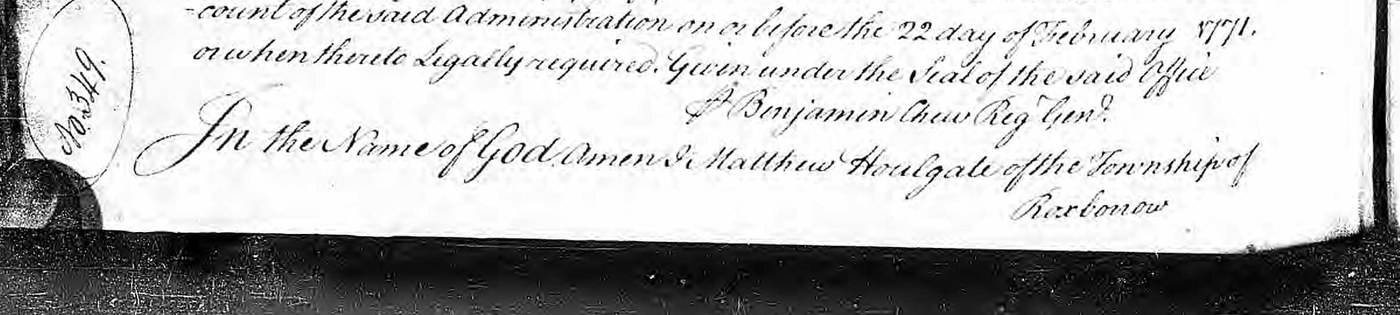
The next Mathew steps forward in a single document. On January 5, 1770, "Matthew Houlgate of the Township of Roxborow and County of Philadelphia Yeoman," being "very sick and weak in Body," made his will. It was proved on February 26, 1770, and it stands at pages 469–470 of Will Book O, No. 349 — the opening of it is the picture at the head of this page. A compiled genealogy calls this man "Junior" and makes him the founder's son; the will itself never calls him Junior and names no father, and that link is printed here as the compilation's, not the record's.
The will is the family's fullest surviving voice, and what it talks about is a household, not a mill. His wife Mary is to have "a sufficient Maintenance or every thing she stands in Need off during her Life," provided by his son John out of the real estate. His daughter Elizabeth, unmarried, gets £35 and "a Room in my House to dwell in, untill such time as she alters Her Condition." His daughters Sarah Moir and Mary Gruber get £5 each, and Margaret Colladay £5 — Margaret is the only Colladay among them; a compiled abstract of this will made Elizabeth a Colladay too, and the will itself says otherwise. His son William gets £100 in cash and no land. His son John gets everything else — "all the rest Residue and remainder of my Estate both Real and Portional," the clerk's own spelling — charged with the debts, the funeral, every legacy, and his mother's keep. John and William are the executors, and every legacy is payable by John two years after the death. The testator signed by mark.
And the mill? The will never mentions it. No mill, no mill land, no acreage, no tract, no neighbour, no boundary — only "my Real Estate" and "my House." Whatever John took under that residue clause, he took unnamed. The will cannot assign the fulling mill to this testator, and this account does not.
John the fuller, and the estate with no will
John Houlgate is the first of the family the tax record shows at the mill. In 1774 the Roxborough assessors charged him with 175 acres of land and a dwelling, two horses, five cows, fourteen sheep — and "½ a Fulling Mill," the whole rated at £21 14s, with the word "Incumbred" written under the total. Half a mill, in 1774 already. The half-share shape of this family's holding is not an accident of one document; it is there at the first certain sighting.
John died in 1778, before August 1, on a day no record gives — and he left no will. A compiled genealogy long said his will was proved on August 1, 1778; the record shows something else. That date is the date of an administration bond: John died intestate, and the file is Administration No. 32 of 1778. The administrator was his son — the bond names him in so many words, "Matthew Holegate Son of John Holegate late of Roxborough deceased" — bound with two sureties to make a true inventory and administer according to law. Matthew signed the bond in his own hand, "Mattw. Houlgate": a writing man, where the testator of 1770 had made a mark.
The inventory, appraised on July 30, 1779, is the fullest picture of the seat that survives. It styles the dead man "John Holeget fuller, late of Roxborrough Township," and its first line gathers his world into one entry: 180 acres of land, a stone dwelling house, a fuller's shop and kitchen adjoining the house, a barn and outhouses, and half a fulling mill — £3,200 the lot. Then a small frame house with three acres, £500; household furniture, £243 18s; his fuller's tools, £294; the tools of husbandry, a mare and colt, three cows, a whip saw and a cross-cut saw. The total foots exactly: £4,657 13s, in the depreciated money of 1779. A working fuller, then, with the shop against his house and half a mill on the creek — and one disagreement the records leave open: the tax list of 1774 gave him 175 acres, the inventory gives 180, plus the separate three. Both figures stand in print; nothing read reconciles them.
The administration papers name no widow, and no child but Matthew. Who legally took the 180 acres and the half mill when the estate was settled — the administrator's account, or a division by the Orphans' Court — is not read.
A mill in halves
Matthew, the son, is the Matthew of the creek list. In 1779 Horatio Gates Jones, setting down the mills of the Wissahickon in their order along the water, wrote the fulling mill down as "Matthew Holget and Christian Snyder's." The tax lists of the same year show Matthew charged per head and, on a second list, charged with his father's estate beside his own name — the administrator carrying the dead man's line. From 1780 through 1782 the lists style him fuller, as his father was styled. In 1782 the assessor set his holding out in full: fifty acres of land at £225, and "½ fulling Mill" at £225 — his father's half, at his father's trade, total £675.
The other half stood a few pages away on the same assessment: "Christian Snyder's Estate — 5 Acres &½ fullg Mill £225." Snyder had been a living name on the lists in 1779 and 1780; from late 1780 the lists carry his estate instead, so his death about 1780 is read from that change of styling, no death record having been read. In 1782, then, the mill's two halves sit side by side in the record — the fuller son's half at £225, the dead partner's estate's half at £225 — and Jones's two names of 1779 are the tax record's own shape. That the two halves together made the whole mill is the natural reading of the two lines, and it is printed as a reading, not as a document.
Then the mill leaves the family. In 1783 Matthew holds forty-five acres and a dwelling, and there is no mill on his line; in 1785 he holds forty-eight acres and two dwellings, and still no mill. Who took his half after 1782, and who took Snyder's, no record read says. In 1786 a "Martin Holeget" stands on forty-eight acres at the same land value as Matthew's of 1785 — the page plainly reads Martin, and that Martin is a clerk's slip for Matthew is possible, not proven; he is kept apart here, as the record keeps him.
If the John of the 1770 will — the testator's son and executor — is the John who died intestate in 1778, then Matthew of 1779 is the testator's grandson, and the mill's halves run grandfather to father to son. That identification is probable, not proven: the same township, the same trade, the mill's continuity, and one man, Charles Border, who witnessed the will in 1770 and appraised the inventory in 1779. It is printed here at that grade, and nowhere in this account as more.
The men the records do not place
A Roxborough reader of these lists meets more Houlgates than the four of this story, and honesty requires naming them without absorbing them. In 1779 the lists tax John Houlgate's estate and a John Houlgate per head, side by side — a second, younger John, or a line carried over; the lists never explain him. Later a "John Holeget, Mason" holds forty-odd acres in 1782–83, a "John Holegate's Estate" holds forty acres in 1785, and a "John Holeget, Schoolmaster" holds forty-one acres in 1786; no record read ties any of them to the per-head John of 1779 or to the dead fuller. A Samuel Houlgate holds three acres in 1774 and dies before 1781, his small estate paid by a neighbour. A Cornelius Houlgate, weaver and then farmer, stands on the lists from 1780 to 1786. A Matthias Houlgate appears once, in 1774, with a freeman's mark and no figures — that he is Matthew under another form of the name is unproven. The Williams conflict inside the lists themselves: an estate in 1782, a living William on the same acres from 1783 — the pages do not resolve it. And two Williams are kept off this seat entirely: a William Houlgate with a fulling mill in Gwynedd in 1774, on Montgomery County ground, and a William Houlgate whose fulling-mill land bounded a Germantown mill lot in a deed of 1783. Same name, same trade, different water. They are not merged with the Roxborough men, and neither is any of the men above.
One more identification is refused, plainly. A compiled genealogy gives this generation a Matthew who was a militia officer — second lieutenant in the Flying Camp in 1776, a captain in 1778, lieutenant colonel of the Germantown battalion from July 31, 1779. Whether that officer is the fuller of these lists has not been tested against the published Pennsylvania Archives service records; that record is not read, and this account does not make the miller a colonel.
What the record does not say
The founder's Quaker paper — the Marsden certificate the compilation describes, and any meeting record of his — is not read; his 1685 arrival stands at compilation grade. The 1770 testator's probate inventory, filed under his will as No. 349 of 1770, is indexed and not read; it could still name mill equipment or land, and it is the one unread paper that might move the mill question for his generation. A second probate, a "Mathew Holget" of 1788, is likewise indexed and not read — it may be Matthew of 1779's own estate paper, and it might close his story. John's administration account is not read, and no Orphans' Court division of his land and half mill has been read. Who held either half of the mill after 1782 is not read. The tax years between the years read here are not claimed as empty: the lists were read for 1774 and 1779 through 1786 in the years named in the sources, and no absence is printed for the rest. What stands is the shape of the thing: a family that built the creek's first fulling mill, lost its founding ground to a sheriff's sale, and was still at the trade two generations later — holding, as the records insist on showing it, half a mill at a time.
Timeline
| Date | Event |
|---|---|
| August 31, 1685 | Mathew Holgate arrives at Philadelphia on the Rebecca of Liverpool, with a Marsden Monthly Meeting certificate (compiled account; the certificate is not read) |
| March 18, 1698 | John Jennett sells the founder 80 acres adjoining the Hermitage tract (Patent Book A, p. 104) |
| By 1720 | The founder builds the first fulling mill on the Wissahickon (Sachse: 1720; Miles: before 1720) |
| September 11, 1725 / December 6, 1728 | The founder's 80 acres pass to Peter Righter at sheriff's sale (two dates in the sources) |
| January 5, 1770 | Matthew Houlgate of Roxborough makes his will — no mill named; residue to his son John, £100 to his son William (Will Book O, pp. 469–470, No. 349) |
| February 26, 1770 | The will is proved; letters to John and William |
| 1774 | John Houlgate assessed in Roxborough: 175 acres and "½ a Fulling Mill" |
| Before August 1, 1778 | John Houlgate dies, intestate |
| August 1, 1778 | Administration bond: his son Matthew administers the estate (Administration No. 32 of 1778) |
| July 30, 1779 | John's inventory appraised: "fuller"; 180 acres, stone house, fuller's shop, and half a fulling mill, £3,200; fuller's tools £294; total £4,657 13s |
| 1779 | Jones's list of the creek's mills names the fulling mill "Matthew Holget and Christian Snyder's" |
| 1780–1782 | Matthew styled fuller in the Roxborough lists |
| 1782 | Matthew holds 50 acres and "½ fulling Mill £225"; Christian Snyder's estate holds 5 acres and the other "½ fullg Mill £225" |
| 1783 | Matthew holds 45 acres and a dwelling — no mill on his line |
| 1785 | Matthew holds 48 acres and two dwellings — no mill |
| 1786 | A "Martin Holeget" stands on 48 acres at Matthew's 1785 land value (identity unproven) |