Heinrich Schellenberger's tie to the Wissahickon is a change of address. In March 1750 he was a miller living at his own mill in Germantown; by the middle of that month he had moved to the Robeson mill at the mouth of Wissahickon Creek in Philadelphia — the seat of the Robeson grist mill, sawmill, and nail factory, inside what is now Wissahickon Valley Park — and he announced the move in the German-language press so that the people who owed him money could find him. Two years later he stood as executor for a fellow miller, Casper Moyer of Bristol Township, selling Moyer's grist mill on the edge of Germantown. Then the record closes. No birth, no family, and no death for him has been proven: one passenger of his name who arrived in 1739 is a candidate, one Philadelphia estate of 1783 may be his, and three other men of similar name have to be kept apart from him. This is his biography at the length the record honestly supports — two newspaper notices, a friend's will, and the silences around them, printed as silences.
The notice that is his whole biography
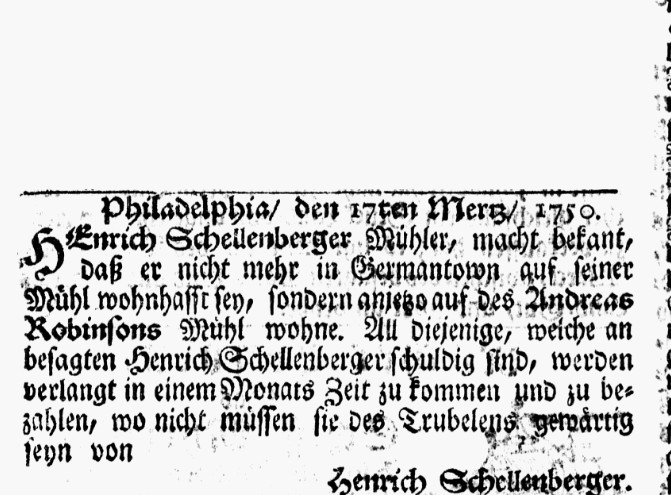
On March 17, 1750, the Pennsylvanische Fama — a German newspaper printed in Philadelphia by Benjamin Franklin and Johann Böhm — carried his announcement, read today in the original German:
"Heinrich Schellenberger Mühler, macht bekant, daß er nicht mehr in Germantown auf seiner Mühl wohnhafft sey, sondern anjetzo auf des Andreas Robinsons Mühl wohne."
Heinrich Schellenberger, miller, makes known that he is no longer living in Germantown at his mill, but now lives at Andreas Robinson's mill. "Robinson" is the German form of Robeson, and the mill meant is Andrew Robeson's, at the creek's mouth — the identification is stated here, not silently substituted, because the notice prints the name as it prints it. The rest of the notice is business: everyone who owes Henrich Schellenberger money has a month to pay, or they will bear the costs. It is a dunning notice wrapped around a change of address, and it is the only writing of his that survives.
The notice was long cited — through Edward W. Hocker's genealogical data on Pennsylvania's German settlers — as dated March 16, 1750, and as standing in Christopher Sower's German paper. Both details fail against the original: the Fama had no March 16 issue (its March issues are the 10th and the 17th), and the notice as read stands in the Fama. Whether it also ran in Sower's Pensylvanische Berichte is unknown; that paper's 1750 issues are not read.
What the notice proves, in its own words, is residence: a miller living at the Robeson mill from March 1750. That he operated the mill is the natural reading of a miller moving onto a mill seat, and earlier accounts print it so; the notice itself speaks of living, not working, and this account keeps the two apart.
His own mill in Germantown
Before the move, he lived "auf seiner Mühl" — at his mill — in Germantown. The phrase does not say whether he owned that mill or tenanted it, and nothing read identifies which Germantown mill it was; the town and its township held several mill seats in 1750. What the notice does show is a working miller with a business of his own: he had debtors, plural, and he set them terms. When he left for the creek's mouth, he left as a man with a trade, a clientele, and accounts to settle.
The Robeson seat he moved to was one of the creek's oldest. The Robeson family had built and held its mills at the mouth of the Wissahickon from the 1690s, with working operators layered over the family's ownership across the century. Schellenberger is the earliest documented outside operator after the founding generation. How long he stayed, and on what terms — lease, wages, or a share — no record read states. The seat's next documented operator is John Vanderen, in 1777, and the Robesons themselves were back by 1789; those are facts about the seat, offered as context, not facts about Schellenberger's tenure.
Executor for a friend: the Moyer mill sale
His second appearance is an act of trust. On June 12, 1752, Casper Moyer of Bristol Township, near Germantown, made his will — written in German, translated by Christian Lehman — and named as his executors "my Trusty Friends Henry Shelleberg and Rudolph Surber," with full power "to Sell and Convey my Mill and all my Lands whatsoever." Moyer's wife was Barbara; his children, unnamed in the will, were to be put out to trades with their mother's consent. The will was proved on June 16, 1752, and the executors were ordered to file an inventory of the estate by July 16. That inventory has not been found in the online estate files, searched under ten name forms; it stands as a gap, and what Moyer's mill held is not known.
On July 23, 1752, the executors advertised the sale in the Pennsylvania Gazette: "To be SOLD, A Grist-mill, and about four acres of land, a good stone house, cooper's shop, and bake-house, about a quarter of a mile from Germantown, the estate of Caspar Myer deceased… apply to Henry Shellenberg, and Rudolph Surber, executors."
Even the will's address in the books will not sit still. The index cites it as Will Book J, page 548; the filmed book that carries the text holds it on a page numbered 327; the printed abstracts call it their entry number 327 and say "Recorded p. 548." The will itself is identified beyond doubt — date, place, executors, and witnesses match everywhere — and all three citations are printed here as they stand.
The mill that cannot be placed
It would be easy to put Moyer's grist mill on the Wissahickon, and it would be wrong on the present evidence. Neither the will nor the advertisement names a creek, a road, or a neighbouring owner; the one locator, a quarter of a mile from Germantown, points to the village edge, and Bristol Township drains toward Tacony Creek. A modern nomination's "Shellenberg's Mill" stands on the Wingohocking — a different water, and a lead only. So Moyer's mill is not placed on the Wissahickon in this account, and the sale's outcome is unknown: whether the mill sold, and to whom, no record read says. The episode belongs in Schellenberger's biography as the measure of the man — a fellow miller put a mill, a widow, and his children's futures in his hands — not as a creek fact.
One warning belongs here, because the names invite the error: a different Casper Moyer died in 1748, leaving a widow named Albertina, Bucks County sureties, and a farm inventory of £92 16s 11d with no mill in it. He is not the Bristol testator of 1752, and his file says nothing about Schellenberger.
The men who were not him
The name was not rare, and the records of the same decades hold several men who must not be merged with the miller. A Henry Shellenberg witnessed the will of Archibald Poek of Abington in October 1749, five months before the Fama notice; the will, read in full, shows him first among the witnesses — but the will book is a recorded copy, the name in it is a clerk's writing rather than the man's own hand, and the identification stays unverified. An Abraham Shelleberg was a Germantown executor in 1749/50 and a sheriff's-sale name in May 1752. A Simon Shellenberger died in the city before September 1783, leaving a widow Mary and a £9 household. And a Henry Shellenberger of Hatfield Township was taxed there from 1783 to 1789 — assessed in 1786, 1788, and 1789 as a living man with 83 acres, a dwelling, horses, and cows, and never with a mill. A living taxpayer of 1786–1789 cannot be a man whose estate was administered in 1783, and nothing ties the Hatfield farmer to Germantown, to milling, or to the creek. He is split from the miller, and the split is printed, not assumed.
A possible death, unproven — and a possible arrival
For the miller's own end, there is one candidate. A Henry Shellenberger died in the City of Philadelphia before May 27, 1783, when Margaret Rutter took out administration on his estate (No. 52 of 1783) on a £1,000 bond, with Christopher Hantsman and Jacob Rutter as sureties. The file holds the bond only — no inventory, no account — and it states no township, no occupation, no land, and no kinship for Margaret Rutter. A miller of 1750 dying in 1783 is age-plausible; nothing else joins this man to the creek's mouth. His own will was searched for in the Philadelphia indexes under every spelling and not found, a negative that rests on machine search of the index films and is printed at that strength. Church and town records searched for 1740–1765 hold nothing for him at all.
For his beginning, there is likewise one candidate. A Heinrich Schellenberg arrived on the Jamaica Galley from Rotterdam and qualified at Philadelphia on February 7, 1738/9, aged 22, signing his name on the oath lists — the only man of the surname in the standard passenger lists before 1750, and about thirty-three in the March of the Fama notice. Age and trade fit; nothing in any record read ties the passenger to the miller, and he is printed as a candidate only. The same ship carried a Caspar Mayer and a Jacob Swerber — names that echo the Moyer will's circle — but Mayer is a common name, no Rudolph was aboard, and the pattern is a lead, not a link.
What remains
Strip away the candidates and the namesakes, and Heinrich Schellenberger's documented life is twenty-eight months: a move to the creek's mouth in March 1750, and a friend's trust discharged in the summer of 1752. Within those months stands something real — the earliest documented outside miller at the Robeson seat, a man whose Germantown debtors were told where to find him, and whose name a dying miller wrote into his will as a trusty friend. The rest — his birth, his family, his Germantown mill, his tenure's length, his death — the record has not given up, and this account leaves those spaces empty rather than filled.
Timeline
| Year | Event | Source |
|---|---|---|
| 1738/9 | A Heinrich Schellenberg, aged 22, arrives on the Jamaica Galley and qualifies at Philadelphia, Feb. 7 — a candidate for the miller, unproven | Strassburger & Hinke, vols. I–III |
| Before Mar. 1750 | A miller living at his own mill in Germantown, with debtors of his own | Pennsylvanische Fama, Mar. 17, 1750 |
| 1750 | Announces his move to Andrew Robeson's mill at the mouth of Wissahickon Creek, Mar. 17; debtors given a month to pay | Pennsylvanische Fama, issue 109 |
| 1752 | Named an executor of Casper Moyer of Bristol Township, with power to sell Moyer's mill, Jun. 12 | Will of Casper Moyer (film 21724, image 302) |
| 1752 | Moyer's will proved, Jun. 16; inventory ordered by Jul. 16 — the inventory is not read | Will of Casper Moyer |
| 1752 | Advertises Moyer's grist mill for sale, "about a quarter of a mile from Germantown," Jul. 23 | Pennsylvania Gazette, issue 1232 |
| 1783 | A Henry Shellenberger dies in the City of Philadelphia; administration to Margaret Rutter, May 27 — possibly the miller, unproven | Administration No. 52 of 1783 |