William McCallum ran a carpet factory called Glen Echo Mills on Paper Mill Run, a small stream in Mount Airy, Germantown, at what is now Carpenter Lane and Lincoln Drive in Philadelphia. Paper Mill Run flows into Wissahickon Creek, so McCallum's factory stood on Wissahickon water, in the valley that is today part of Wissahickon Valley Park. He and his brother Andrew bought the mill seat in 1831, and William ran the works — through steam power, power looms, and a famous lawsuit — until he died on February 10, 1875. The creek is why he belongs in this collection, and the creek is where his story starts.
His story is also a courtroom story, and a surprising one. In 1862 the Germantown Water Company sued McCallum over what his factory was sending down the run. The court sent three experts to examine the stream — one of them was Dr. Joseph Leidy, the most famous scientist in America — and the case went all the way to the Pennsylvania Supreme Court. It is still quoted in water-law cases today. This article puts together everything the surviving records actually say about McCallum: the mill, the blankets, the lawsuit, and the questions the records leave open. Where the record stops, this article says so.
A carpet factory on a little creek
The mill seat was old before the McCallums arrived, and its early history comes from an unusual source: the findings of fact in McCallum's own lawsuit, sworn court record rather than tradition. An oil-mill stood on Paper Mill Run before 1812. About 1812, Jacob Clemens tore it down and built a stone factory, making woollen goods and discharging the works' refuse water into the run — the same discharge the lawsuit would turn on fifty years later. A later owner, William Jones (1825–1828), made flannels, yarns and satinets there, and the court preserved his complaint: the run's water was scarce, and on water and horse power he "could not do work enough to make it pay."
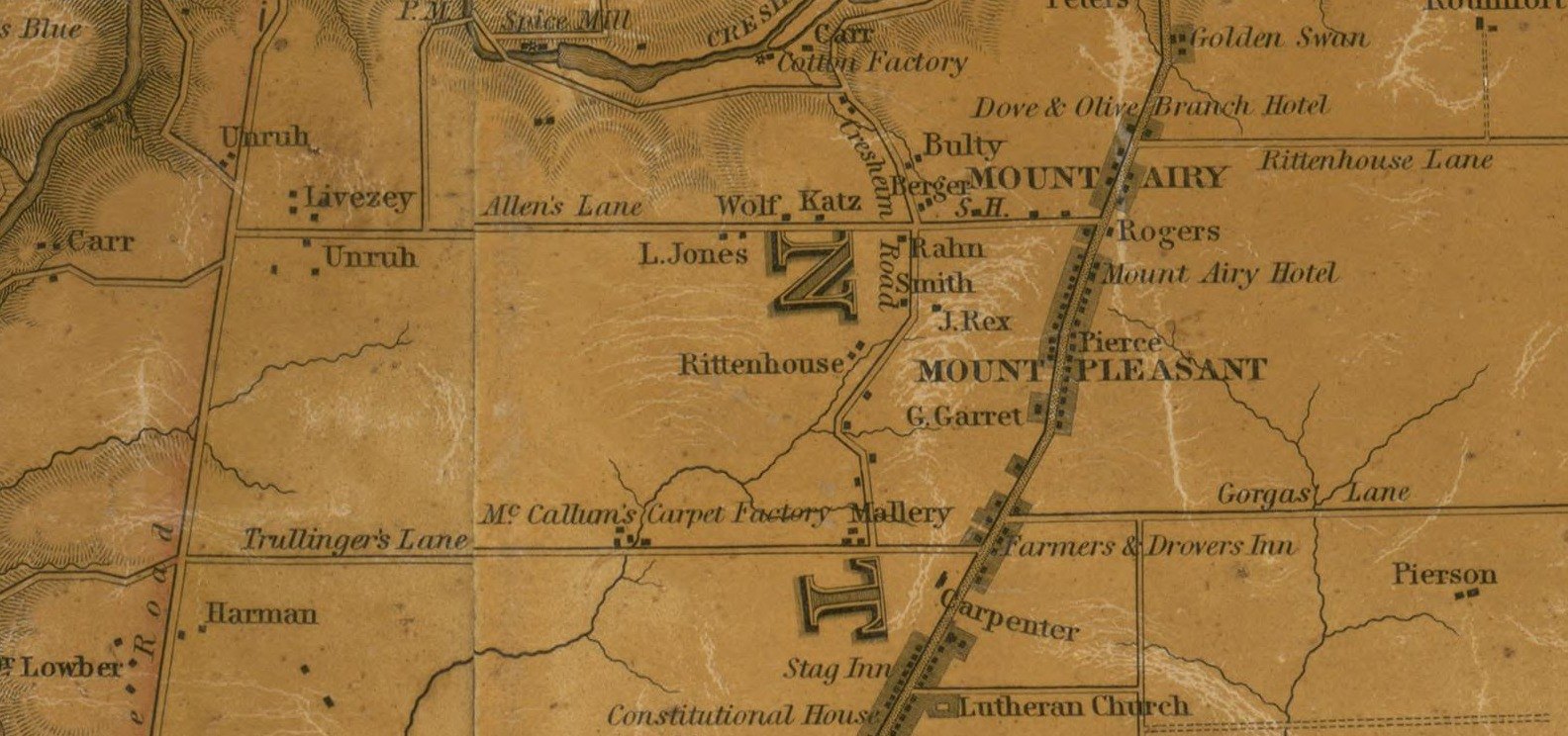
One naming trap belongs here, because it catches almost everyone. The works made carpet — never paper. A 1951 court opinion quoting McCallum's case actually calls it a "paper mill," but the original report describes carpets, rugs, blankets and flannels from first page to last, and the 1843 county map prints the works as "McCallum's Carpet Factory." The paper is in the stream's name — Paper Mill Run — not in the product.
Two brothers from Scotland
On November 18, 1831, Andrew McCallum bought the mill seat for the firm of A. McCallum & Co. His brother William was the firm's other member — a partner from the first day, not a later heir. William was born at Inverness, Scotland, in 1804 (his death record gives the year; the censuses, as censuses do, give 1801 and 1803). No passenger list records his arrival: the Philadelphia lists for about 1825–1832 have been searched, and they hold no William McCallum. The brothers kept making rugs and added carpet making, along with druggets, blankets, flannels and staircloths. They put in a steam engine in 1835 and a weaving building in 1837. For the firm's first fourteen years, part of the work stood on a second Wissahickon tributary, Cresheim Creek; in 1845 they built a large addition on Paper Mill Run and gathered everything there. The 1843 map already shows the result: "McCallum's Carpet Factory," printed on Trullinger's Lane — the lane later renamed Carpenter Lane.
Andrew's will left the property to William, and when Andrew died in 1859, William became sole owner. By 1861 the city directory shows the grown-up firm: McCallum & Co. — W. McCallum, H. McCallum, A. J. Sloan & Orlando Crease — carpets, 509 Chestnut Street. Two cautions ride with those names, and this project prints them rather than smoothing them: no record found states how Hugh McCallum was related to William, so none is claimed here; and a younger William H. McCallum in the records is Hugh's son, a different man entirely.
Blankets for the army, trouble for the water
In 1851 the Germantown Water Company had built its reservoirs on the same little run, below the factory, and by the time of the lawsuit it supplied 681 houses and more than 4,000 people. For ten years, factory and waterworks shared the stream. Then came the Civil War.
Carpet sales were dull, so in September 1861 the firm took a government contract to make army blankets. For eight months the mill ran night and day, with two sets of hands, blankets and carpets together. Blankets were woven with the grease still in the wool and then scoured clean with soda ash and soap — and the greasy, soapy wash water went into the run. A second contract, signed directly with the United States in September 1862, started the blanket work again. That fall, the Water Company sued: its water, pure since 1851, had turned foul and undrinkable.
The case's legal shape matters, so here it is plainly. The Water Company was the one suing; William McCallum was the defendant. His defence was a real legal doctrine called prescription: the mill had discharged into the run openly since 1812 — far longer than the twenty-one years the law asks — so, he argued, it had earned the right to go on. The Water Company's answer was that the blanket years were not the old use at all, but a bigger, dirtier new one. Both sides were partly right, which is why the case is interesting.
The winter a scientist walked the creek
The first hearing, in November 1862, ended without a quick order: Judge Ludlow refused the injunction for the moment and stood the case over so the water could be scientifically analyzed. The court appointed three men to examine the stream and report: Dr. R. E. Rogers, the city engineer Strickland Kneass, and Dr. Joseph Leidy — the University of Pennsylvania anatomist who was then the best-known naturalist in the country.
Their report, dated January 12, 1863, is one sentence long in its conclusion: the sources of the impure water "can be traced only to the Carpet Works." Leidy walked the run himself and wrote down what he saw: below the factory, the creek's sides patched with "bluish-black and reddish filth" — hairs, wool, cotton filaments, particles of dye-stuffs — and a grey-blue slime running from the factory to the waterworks pool; above the factory, no trace of it. One detail of wording matters to this project: later accounts sometimes say Leidy "testified." He did not. He was a court-appointed commissioner who examined the stream and reported in writing — which is stronger evidence, and better documented, than the loose version.
The injunction followed in February 1863 (the newspapers reported it issued on $10,000 security), and the court later found that from then on the water "continued to be sweet, pure, wholesome, drinking-water." The engineer on the commission had pointed out that the fix was not complicated — piping, or a settling reservoir for the factory's refuse, would have kept it out of the run. The court made the injunction permanent on December 30, 1865. McCallum appealed, and the Pennsylvania Supreme Court decided against him in an opinion dated January 7, 1867: a right earned by one level of use cannot be stretched to cover a heavier one, and no one may foul water so as to make it "corrupt or unhealthy" for the people below. The judge who wrote the opinion, Justice Read, put his own fieldwork into it: "I have gone over the whole ground and examined the stream and the works for my own satisfaction." The last line of the report is dry and final: "Decree affirmed and appeal dismissed at the costs of the appellant." The injunction stopped the discharge. It did not close the mill — McCallum ran it for eight more years.
How many people worked at Glen Echo?
Nobody knows — and the honest version of this story prints all four documented answers instead of picking one. 250 hands about 1846, a figure that traces to an 1891 Germantown scrapbook. 325 hands in May 1880, counted by an insurance surveyor, who even broke it down: 100 men, 100 boys, 125 girls. 400 hands the same month, May 1880, in the firm's own petition to Congress asking for a tariff commission — a petitioner asking for protection had reasons to count generously. 300 hands in 1886, in a newspaper's survey of the moved factory at Wayne Junction. The government's own factory censuses could not settle it: the 1870 schedules for the mill's district have been read through and hold no entry for the firm, and the district's 1880 sheets were never located. Four numbers, four sources, no winner — that is the record, and any article that gives you just one of them as "the" workforce is leaving the rest out.
The death the books got wrong
For years, the standard account of the firm let readers assume McCallum died around 1892 — it says, of the years after 1887, "McCallum died, Sloan retired, and Hugh McCallum's sons took over." That death belongs to Hugh McCallum, whose death certificate is dated August 19, 1891. William's own death record, found in November 2026, is earlier and exact: William McCallum died on February 10, 1875, aged 71, "Proprietor of Glen Echo Mills," at his home on Cresheim Lane in Germantown, and was buried at North Laurel Hill. The city's death-certificates index, checked in November 2026, carries the date twice — "Wm McCallum," born about 1804 at Inverness, "Propr Of Glen Echo Mills," and a second entry spelled "William McCullum," a Scotland-born "Manufacturer" — and neither entry names his parents; Hugh's 1891 death is indexed twice too, with no parents named either, which is the newest ground for this project's standing line that no record states how Hugh was related to William. Two honest gaps ride with the correction. No will or estate file for William was found in the Philadelphia probate indexes searched. And no newspaper obituary for him has been found either — the January-to-March 1875 papers were searched, and the search came back empty, and an exact search of the Newspapers.com Obituary Index for February 1875 came back empty too. A man whose lawsuit fills twenty pages of a law book can still die without an obituary anyone has found. The silence is printed here as a gap, not filled in.
After William: leased mills and the move off the creek
Everything after 1875 belongs to his successors — Hugh, Orlando Crease, and A. J. Sloan — and this article keeps their acts separate from his. In 1875, the year William died, the firm began making power-loomed Wilton and Brussels carpets, the expensive end of the trade; no record found ties that decision to William himself. By May 1880 the firm no longer even owned its mill: the insurance survey lists the owners as Hugh McLean & Sister, with McCallum, Crease & Sloan as lessees. Who the McLeans were, and what the lease said, only the deed records could tell — and those are physical records this online-only project does not pull, so the puzzle is printed as a permanent gap.
Two more printed conflicts belong to the successors' years. Orlando Crease's retirement is given as 1884 in one source and 1887 in another — yet the firm's own newspaper advertisements run "McCallum, Crease & Sloan" unchanged through 1888, so neither year is confirmed and this article asserts none. And the firm's move to a new factory at Wayne Junction is usually dated 1885, but no 1885 newspaper item about it was found; the earliest evidence is a newspaper factory survey of October 22, 1886, which lists the firm already there with 90 looms and 300 hands. The date is printed here the way the record leaves it: carried, flagged, unconfirmed. The old Glen Echo buildings on Paper Mill Run stood until a developer demolished them in 1920, and the Lincoln Drive extension erased what was left of the site.
What we still don't know
- The deed chain for the mill seat — who sold what to whom between the McCallums and the 1880 lease — is a physical record, unreachable online. It would also settle a side conflict: the court record traces the 1831 sale through the seat's earlier owners, while the standard secondary account names a seller, James Burk, and an "adjoining mill."
- The workforce, as above: 250, 325, 400, or 300, depending on who counted and when.
- Crease's retirement year (1884 vs 1887), and the exact year of the Wayne Junction move.
- Hugh McCallum's relationship to William — stated in no record found.
- William himself, personally: no letter, no interview, no obituary, no portrait. What survives is the business and the lawsuit, documented unusually well — and a man visible in what he built and what he defended.
Timeline
| Date | Event |
|---|---|
| c.1812 | Jacob Clemens builds the stone factory on Paper Mill Run; woollen goods; refuse discharged into the run. |
| Nov 18, 1831 | Andrew McCallum buys the seat for A. McCallum & Co. — Andrew and William, brothers. |
| 1835 | Steam engine installed. |
| 1843 | Ellet's county map prints "McCallum's Carpet Factory." |
| 1845 | All the firm's work gathered at the Paper Mill Run seat (the Cresheim Creek work moved in). |
| 1859 | Andrew dies; William becomes sole proprietor. |
| 1861 | The firm in print: McCallum & Co. — William, Hugh, A. J. Sloan, Orlando Crease — 509 Chestnut. |
| Sept 1861 – May 1862 | First army-blanket contract: the mill runs night and day. |
| Nov 7, 1862 | The Germantown Water Company sues William McCallum. |
| Jan 12, 1863 | The court's commission (Rogers, Leidy, Kneass) reports: the impurity traces "only to the Carpet Works." |
| Feb 1863 | Injunction issued (newspapers report $10,000 security); the water runs clean again. |
| Dec 30, 1865 | The injunction is made perpetual. |
| Jan 7, 1867 | The Pennsylvania Supreme Court affirms: "Decree affirmed and appeal dismissed at the costs of the appellant." |
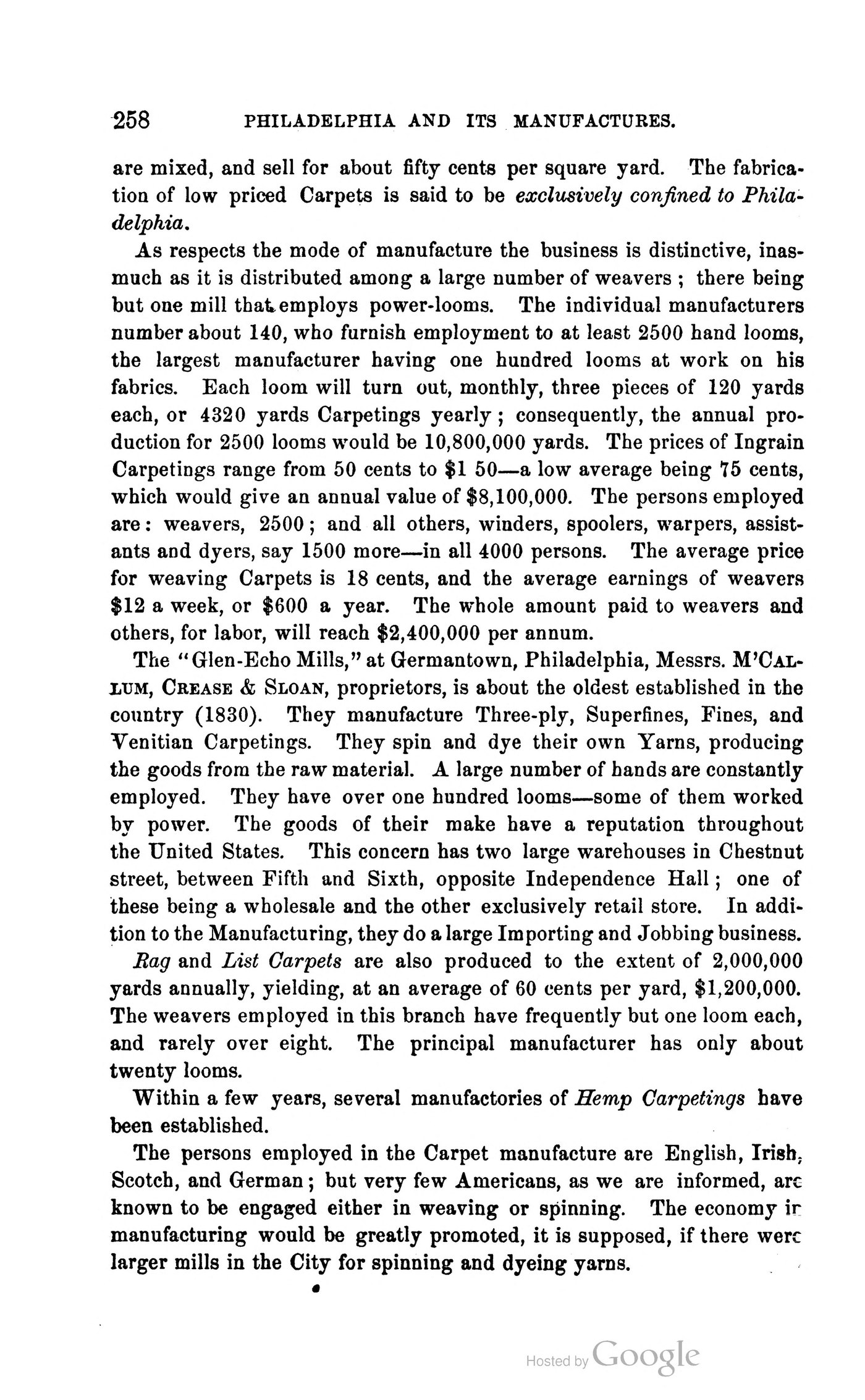
| 1867 | Freedley's Philadelphia and its Manufactures (p. 258): Glen-Echo Mills, "over one hundred looms," "a large number of hands" — no headcount. |
| Feb 10, 1875 | William McCallum dies, aged 71, "Proprietor of Glen Echo Mills"; buried North Laurel Hill. No obituary found. |
| 1875 | (Successors) Power-loomed Wilton and Brussels production begins. |
| May 1880 | (Successors) Insurance survey: the firm as lessees under owners Hugh McLean & Sister; 325 hands. The firm's petition to Congress the same month claims 400. |
| 1884 / 1887 | (Successors) Crease's retirement — sources conflict; the firm's name runs unchanged in its ads through 1888. |
| 1885 (carried, flagged) | (Successors) The move to Wayne Junction; earliest newspaper evidence found is Oct 1886 (300 hands). |
| Aug 19, 1891 | Hugh McCallum dies — the death behind the old "c.1892 McCallum died" confusion. |
| 1920 | The original Glen Echo buildings on Paper Mill Run are demolished. |
A note on pictures
No portrait of William McCallum is known to exist, and none is used or imagined for him. The pictures gathered for his story are: a detail of Charles Ellet Jr.'s 1843 map of Philadelphia County that prints "McCallum's Carpet Factory" on Trullinger's Lane (Library of Congress, public domain), and the page of Freedley's 1867 Philadelphia and its Manufactures (p. 258) that describes Glen-Echo Mills. The 1880 insurance-survey plates of the works were read online through the Greater Philadelphia GeoHistory Network, but that site requires permission to reproduce its materials, so the plates are cited, not reprinted. The full search is written up in the project's image ledger for his story.