Glen Echo Mills stood on Paper Mill Run at Carpenter Lane in Mount Airy, where Lincoln Drive crosses the lane today. Paper Mill Run is a small stream: it rises south of Allen’s Lane, runs down through Mount Airy, and joins Wissahickon Creek below. One thing needs saying at the start, because this valley plays the same trick twice: this is the Mount Airy Paper Mill Run, in Germantown. It is not the other Paper Mill Run — the Monoshone at RittenhouseTown, miles away in Roxborough. Glen Echo stood on the Germantown run, and everything in this story happened on that water.
At its height the works was the biggest factory on the creek’s waters: five buildings, a steam engine of 230 horsepower beside the water power, and hundreds of hands making carpets. Nothing of it stands today. The firm left in 1885, the buildings came down in 1920, and a short street off Carpenter Lane — Glen Echo Street — is all that keeps the name.
An oil mill, then a stone factory
Before 1812, an oil mill stood on the seat. Who built it, and when, no record read for this story says.
About 1812, Jacob Clemens tore the oil mill down and built a stone factory in its place. The new works made woolen goods from the start.
On September 24, 1825, William Jones bought the works from Clemens. For about three years he made flannels, yarns, and satinets there. The run’s water was so scarce that he kept horse power working beside the water power. On July 22, 1828, he sold the works back to Clemens.
Two brothers from Scotland
On November 18, 1831, Andrew McCallum bought the works for a new firm, A. McCallum & Co. Andrew and his brother William (1806–1875) were weavers born in Inverness, Scotland, who had learned the trade in Kilmarnock, the Scottish carpet town. They made rugs first. Carpets followed, and carpets became the works.
The firm was bigger than this one seat. Until 1845 it also ran a second arm on Cresheim Creek — one firm working on two creeks. Which Cresheim seat it used, no record read says.
The works grew in stages. In 1835 a steam engine, a boiler house, and a dye house went up — water alone was no longer enough. A frame weaving building followed in 1837. In 1845 came the large addition: a four-story stone spinning mill, 50 by 100 feet. After that, the whole business worked here.
In 1846 the works took in six Jenks three-ply ingrain power looms — among the first power looms for ingrain carpet in America, by the account handed down in Jellett’s scrapbook.
Blankets, night and day
Andrew McCallum died in 1859, and William became sole proprietor. By 1861 the firm traded as McCallum & Co. — William McCallum, Hugh McCallum, A. J. Sloan, and Orlando Crease — with a city warehouse at 509 Chestnut Street.
Then came the Civil War. From September 1861 to May 1862 the works ran night and day, with two sets of hands, on blankets for the United States Army. A second government contract followed in the fall of 1862.
In 1867, Edwin Freedley’s Philadelphia and Its Manufactures described the “Glen-Echo Mills” of M’Callum, Crease & Sloan with “over one hundred looms constantly employed.” The book also calls the firm “the oldest established in the country (1830).” Read that line as the firm talking about itself: Freedley’s book was built from copy the firms supplied.
The water war
Carpet dyeing drinks clean water, and Glen Echo lived on the run’s water. In 1862 the Germantown Water Company built a reservoir above the mill, and its waste pipe emptied into Paper Mill Run above the works. The McCallums sued. Their bill was filed on November 7, 1862, and the case — McCallum v. Germantown Water Co., 54 Pa. 40 — is still the fullest description of the works that survives.
The court did something rare. It sent three men to the stream itself: a commission made up of the engineer Strickland Kneass, Dr. R. E. Rogers, and Dr. Joseph Leidy — the great naturalist, one of the most famous scientists in America. The three walked the run and reported what they found.
Leidy’s report, dated January 12, 1863, describes the water below the works in a scientist’s plain words: a “bluish-black or reddish filth,” and an “iron-gray slime” on the stones. His conclusion did not flatter the mill that had brought the suit: the fouling below the works, he reported, was traceable only to the carpet works itself.
Kneass, the engineer, spoke to the injury the mill complained of, and he said it had a simple fix: carry the reservoir’s waste water to the Wissahickon by another route. And Justice Read, the judge who would decide the case, came and walked the stream himself before he ruled.
The mill won. The court ordered the company stopped — a first injunction on February 16, 1863, a permanent one on December 30, 1865 — and the ruling was upheld on January 7, 1867. The court’s opinion preserves the works’ own account of itself: a woolen and carpet factory that depended on the run’s clean water for its dyeing. For all that, none of the accounts of Glen Echo posted online today tells this story — not the scientist on the stream bank, not the judge’s walk, not the case at all.
Never a paper mill
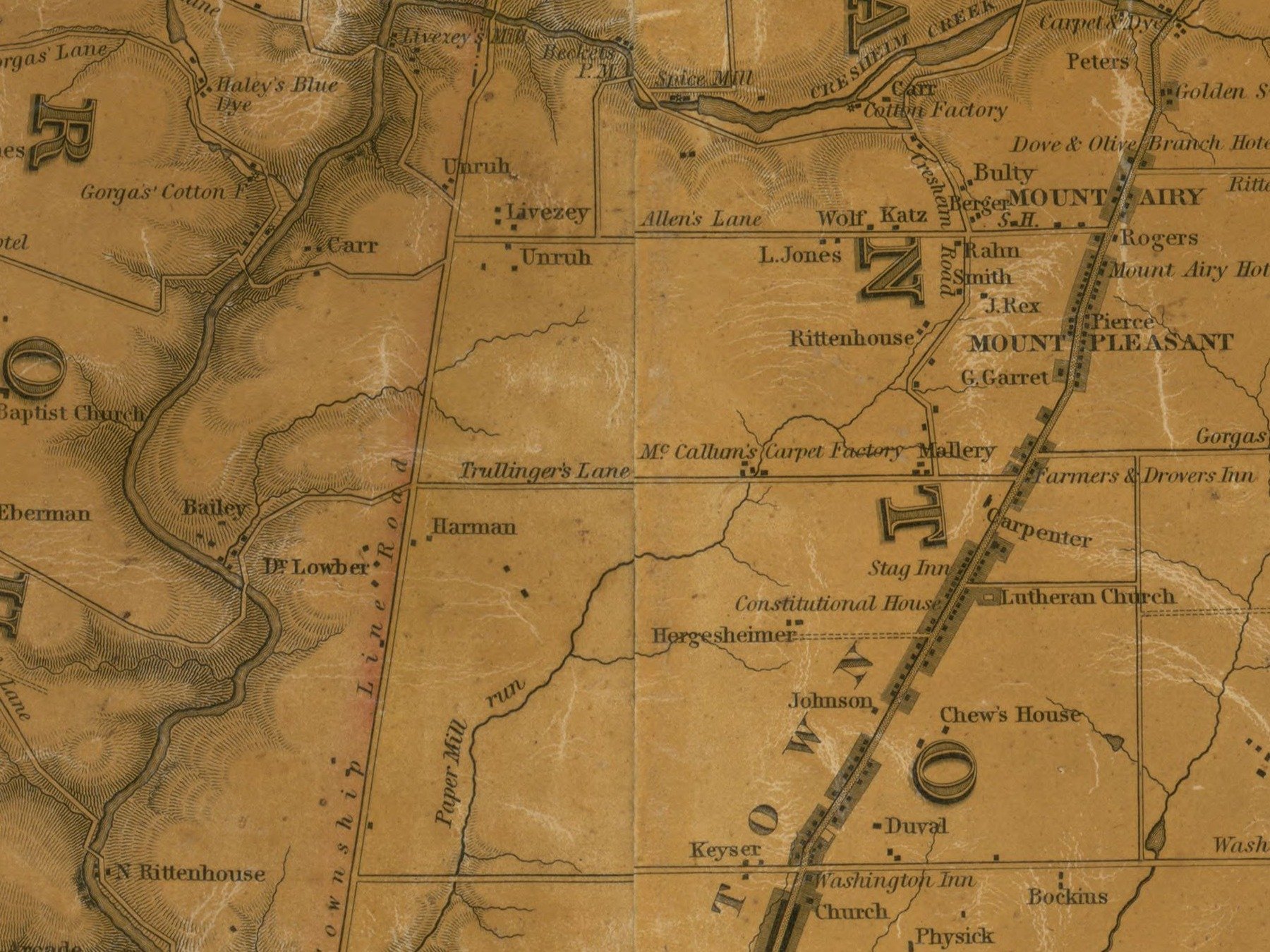
The stream’s name has misled people. A later court opinion, citing this case in 1951, calls Glen Echo a “paper mill.” It never was one. The mill’s own case, describing its own goods, says woolens and carpets, and so does every other record: Ellet’s 1843 map (“McCallum’s Carpet Factory”), Sidney’s 1847 map of Germantown (“A. McCallum & Co. Carpet Factory”), Freedley’s book, and the Hexamer insurance surveys. Carpets and woolens — never paper.
Tenants in their own mill
William McCallum died on February 10, 1875. His death notice names him “Proprietor of Glen Echo Mills.” His own story — the Inverness weaver who built the firm — is told in this site’s Historical Figures collection.
From 1875 the works power-loomed Wilton and Brussels carpets.
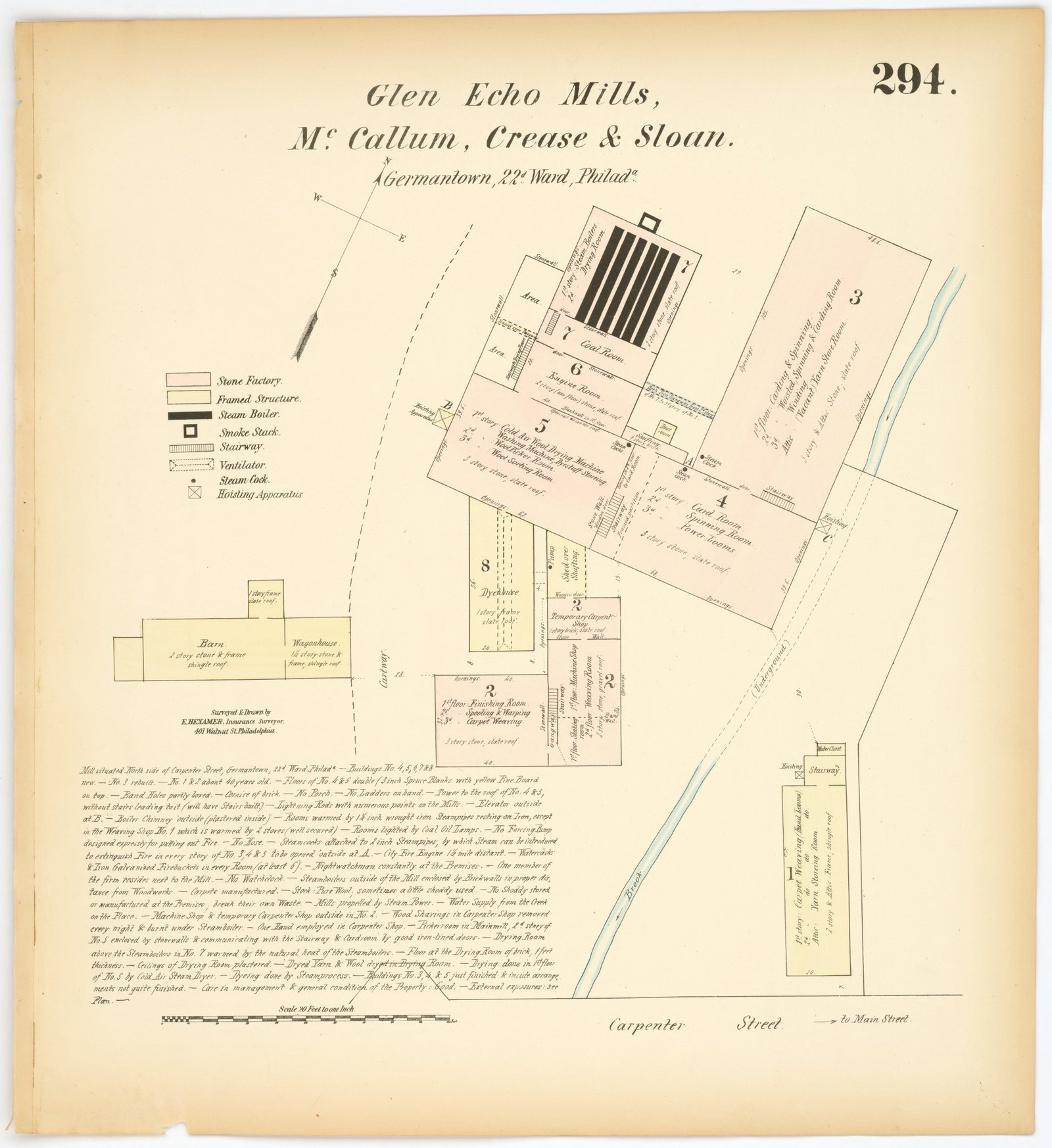
On May 5, 1880, the Hexamer surveyors drew the works for the third time. Five buildings stood on the seat: the four-story stone spinning mill, its engine house, and dye houses, with a 230-horsepower engine and seven boilers, water and steam working together. The survey counts 325 hands: 100 men, 100 boys, and 125 girls. The firm’s own petition to Congress that same month says 400 hands, and an account from about 1846 says 250. The numbers disagree, and they are printed here as they stand.
The survey’s ownership line holds a quiet surprise. The owners are named as Hugh McLean & Sister — and McCallum, Crease & Sloan appear as lessees: tenants. The family firm had become tenants in their own mill.
The end
In 1885 the firm moved away to Wayne Junction and built the New Glen Echo Mills at 130 West Berkley Street, on four and a half acres. The name went with the firm; the Carpenter Lane works stayed behind. The move is dated 1885 — the first newspaper account found, from October 1886, already reports 300 hands at work in the new mills.
The old buildings stood on into a new century. In the early 1900s the extension of Lincoln Drive cut across the ground. In 1920 a developer who had bought the property tore the complex down.
Today there is nothing to see. Stand at Carpenter Lane where Lincoln Drive crosses it, and you are standing on the seat of the biggest factory on the creek’s waters. Glen Echo Street, just off the lane, keeps the name.
Timeline
| Year | Event | Source |
|---|---|---|
| Before 1812 | An oil mill stands on the seat | Workshop of the World, from the Hexamer record |
| c. 1812 | Jacob Clemens tears down the oil mill and builds a stone factory | Findings in McCallum v. Germantown Water Co., 54 Pa. 40 |
| 1825 | William Jones buys the works on September 24; makes flannels, yarns, and satinets | Deed chain, read for the project’s William McCallum dossier |
| 1831 | Andrew McCallum buys the works on November 18 for A. McCallum & Co. | Deed chain, as above |
| 1835 | Steam engine, boiler house, and dye house added | Project dossier |
| 1845 | The four-story stone spinning mill, 50 by 100 feet, is added | Workshop of the World |
| 1846 | Six Jenks three-ply ingrain power looms taken in | Jellett’s scrapbook, via Workshop of the World |
| 1861–62 | Army blanket contracts; the works run night and day | Jellett’s scrapbook, via Workshop of the World |
| 1862 | The water company builds its reservoir; the McCallums sue on November 7 | McCallum v. Germantown Water Co., 54 Pa. 40 |
| 1863 | Leidy’s report, January 12; first injunction, February 16 | 54 Pa. 40 |
| 1865 | Permanent injunction, December 30 | 54 Pa. 40 |
| 1867 | The decree is affirmed, January 7; Freedley’s account is printed | 54 Pa. 40; Freedley, Philadelphia and Its Manufactures (1867), p. 258 |
| 1875 | William McCallum dies, February 10 | His death notice |
| 1880 | Hexamer survey: owners Hugh McLean & Sister; the firm as lessees; 325 hands | Hexamer plate 1513, May 5, 1880 |
| 1885 | The firm removes to Wayne Junction | Carried date; Philadelphia Inquirer, October 1886 |
| 1920 | The original complex is demolished | Workshop of the World, note 2 |