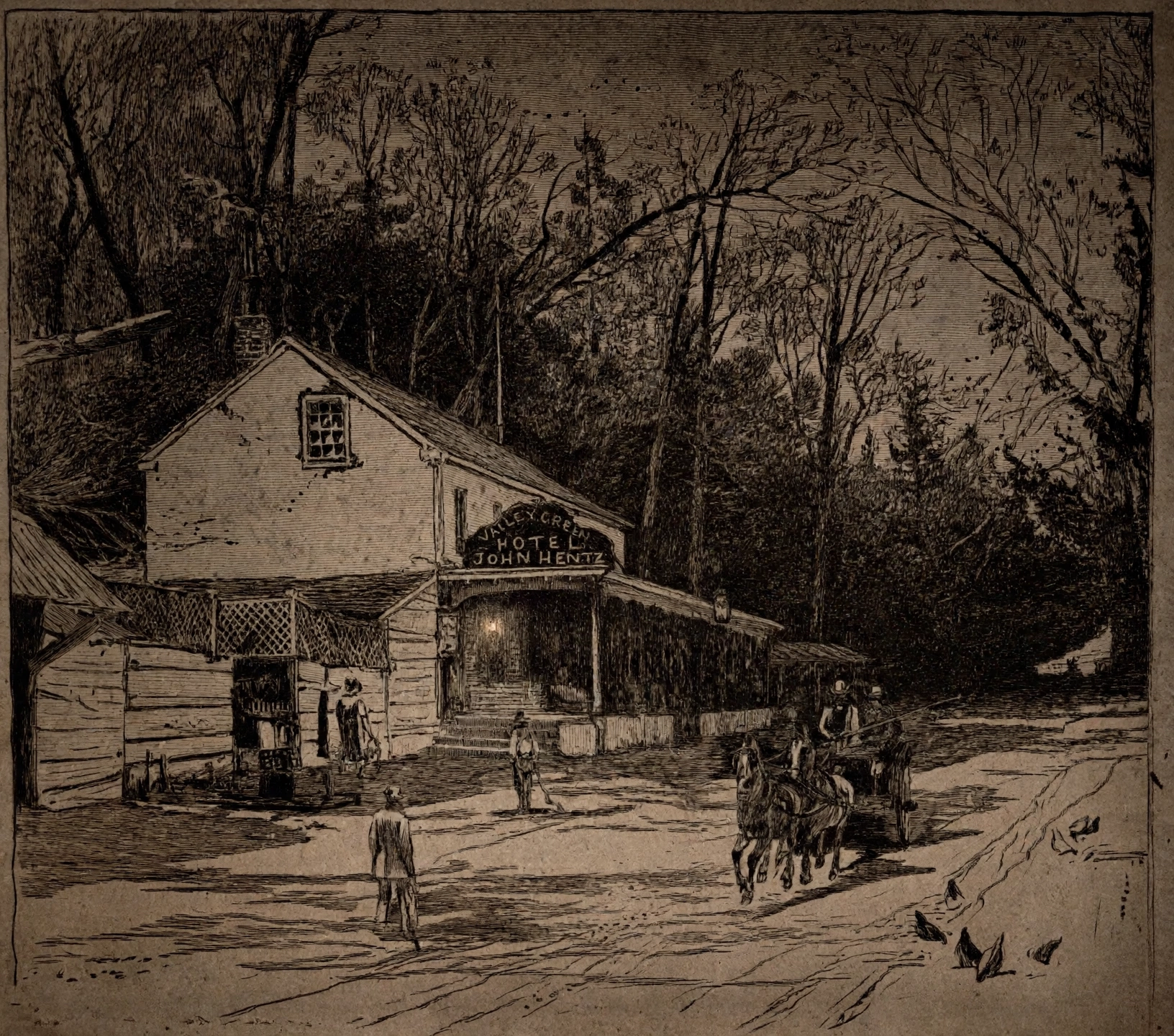
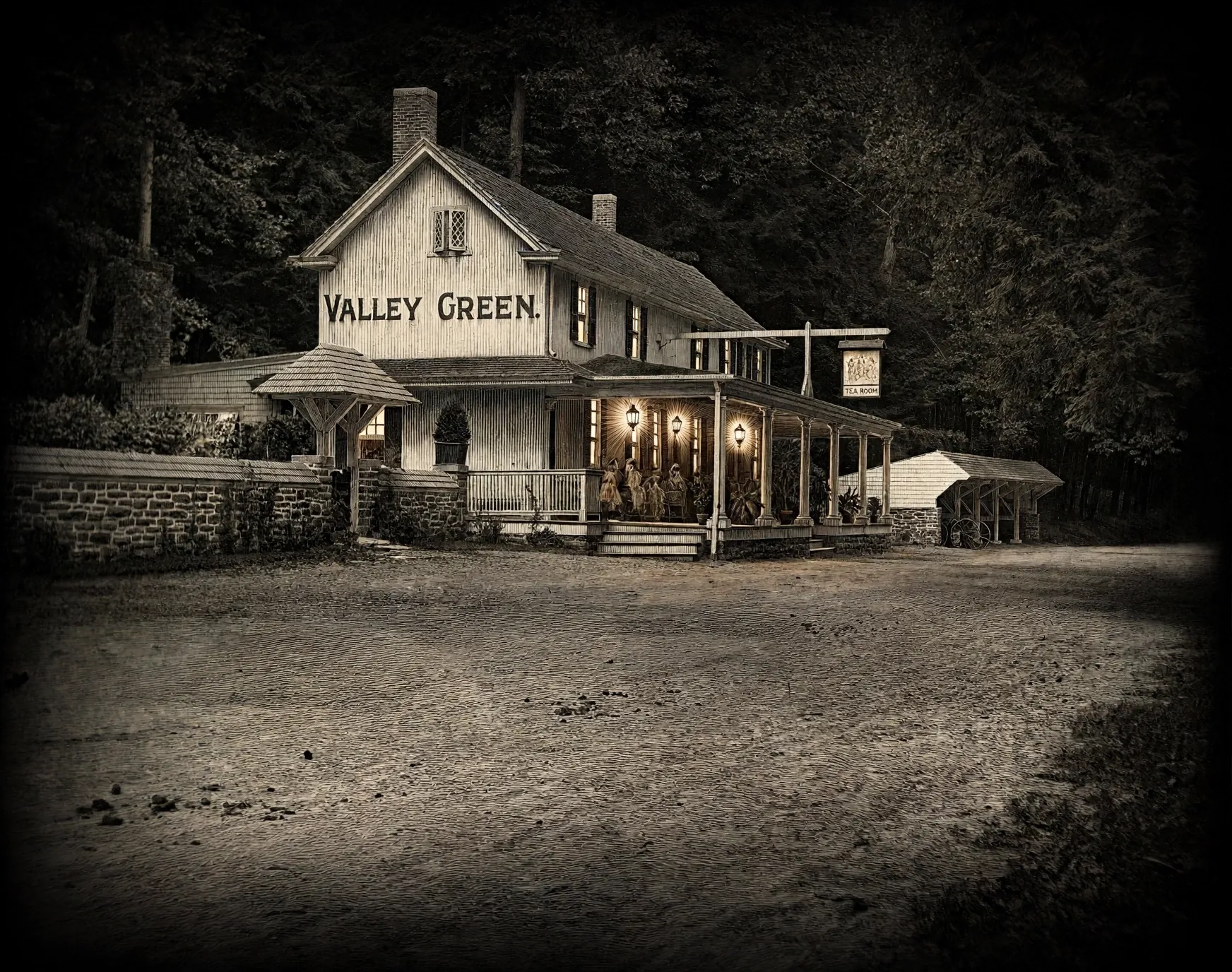
The house stands at the bottom of its own road, where the drive gives out at the creek, and it has stood there since about 1850 — though three accounts of who built it survive, and they do not agree, and the paper that would settle it lies in an archive across the river of years. What is certain is the succession of keepers the directories kept: Rinkers in the fifties, Simon Markley by 1860, John Hentz's name painted on the porch by 1893.
The ground was Thomas Livezey's, the Glen Fern miller's, and in 1850 Edward Rinker leased three acres of it — with leave to build a small temperance hotel and to keep boats on the creek. Temperance: the house that would grow famous for its dinners began by refusing the bottle. The first patrons reached it by Wise's Mill Road, before the turnpike came down the valley, and the boats were part of the trade from the beginning: a house on the water, for the water.
The house is sometimes given a much older birth — an inn on this spot since 1683, the telling goes. The record will not carry it. The drive itself was not opened as a thoroughfare until 1850, and the old maps show no building standing here before that year. The 1683 date is a legend the house wears like a borrowed coat; underneath it, the building is a creature of 1850, which is old enough.
Local tradition, unproven, says the first keeper, Edward Rinker, ran off with another woman, and his wife married his brother and kept the house. No newspaper or court record of it is known, and the directories point the other way — a Mary Rinker, widow of an Edward, appears in Manayunk in 1860, which would make Edward dead, not fled.
It was no innocent house. In 1884 the city's survey of the creek named four hotels as the worst pollution on the water — ahead of every ruined mill — and Valley Green was one of them, its wash and waste running straight into the Wissahickon. The surveyors wrote it down in columns, the way men write down weather.
The survey's own words for this house are not delicate: privies over a little brook, nearly dry most of the time, their waste washed into the creek by every heavy rain; a hog-pen and chicken-house by the brook; all sink and waste water directly to the creek; oyster shells and garbage on the bank; an unprotected manure pile near the top of the bank. Of the four hotels on the drive, two — this house and the Maple Spring — drained their privies to the water. The indictment is part of the house's history and is given in full.
By the century's end the house was tired, and the verdict went out against it — dilapidated: raze it, and build anew. The demolition of Valley Green was the reasonable opinion of 1899.
The recommendation had a name on it: Jesse T. Vogdes, in a park scrapbook clipping of about 1899, advised razing the dilapidated Valley Green Hotel and building anew. What happened instead was a subscription. A committee under Charles W. Henry raised the repair money — $1,221.59, one account says; $1,228, says another; the six dollars and change between them are still unaccounted for — and the house was mended instead of murdered.
In 1901 the keeping of the house changed hands and changed character. A committee of Chestnut Hill women, arranged by Lydia T. Morris, took over its management, and the old hotel became a tea room: light refreshments and afternoon tea for riders and pedestrians, and in winter for the skaters on the creek. It was in these years that the house took the name it carries now — Valley Green Inn — and the women kept it into the 1930s.
The mending had to be done again on a larger scale: in the 1930s some $30,000 was raised for repairs, the work was completed in 1937, and the house passed into the care of the Friends of the Wissahickon, whose stewardship has carried it ever since. The park's own archive holds the paper trail of the century — alteration drawings, a heating plan, surveys: the house documented the way a living building is documented, because it never stopped living.
The house declined to be demolished. Money was raised by subscription; the keeping of it passed to a committee of Chestnut Hill women — or so the valley's histories tell it; the repairs, at least, are real, and were made again in 1937. The other six houses on this creek are gone, or shut, or reduced to stones in the grass. This one is open. It still serves dinner today, including catfish and waffles, the same dish it served when the carriages came.
The temperance house didn't stay dry: in the 1980s, more than a century after Edward Rinker's lease, Valley Green got its first liquor license.
Of the seven, it is the only house still breathing. Knock gently. It is not accustomed to being the ghost.