In the Cresheim Valley · the women who ran Buttercup Cottage · not one of the seven inns
The Two Sisters of Buttercup
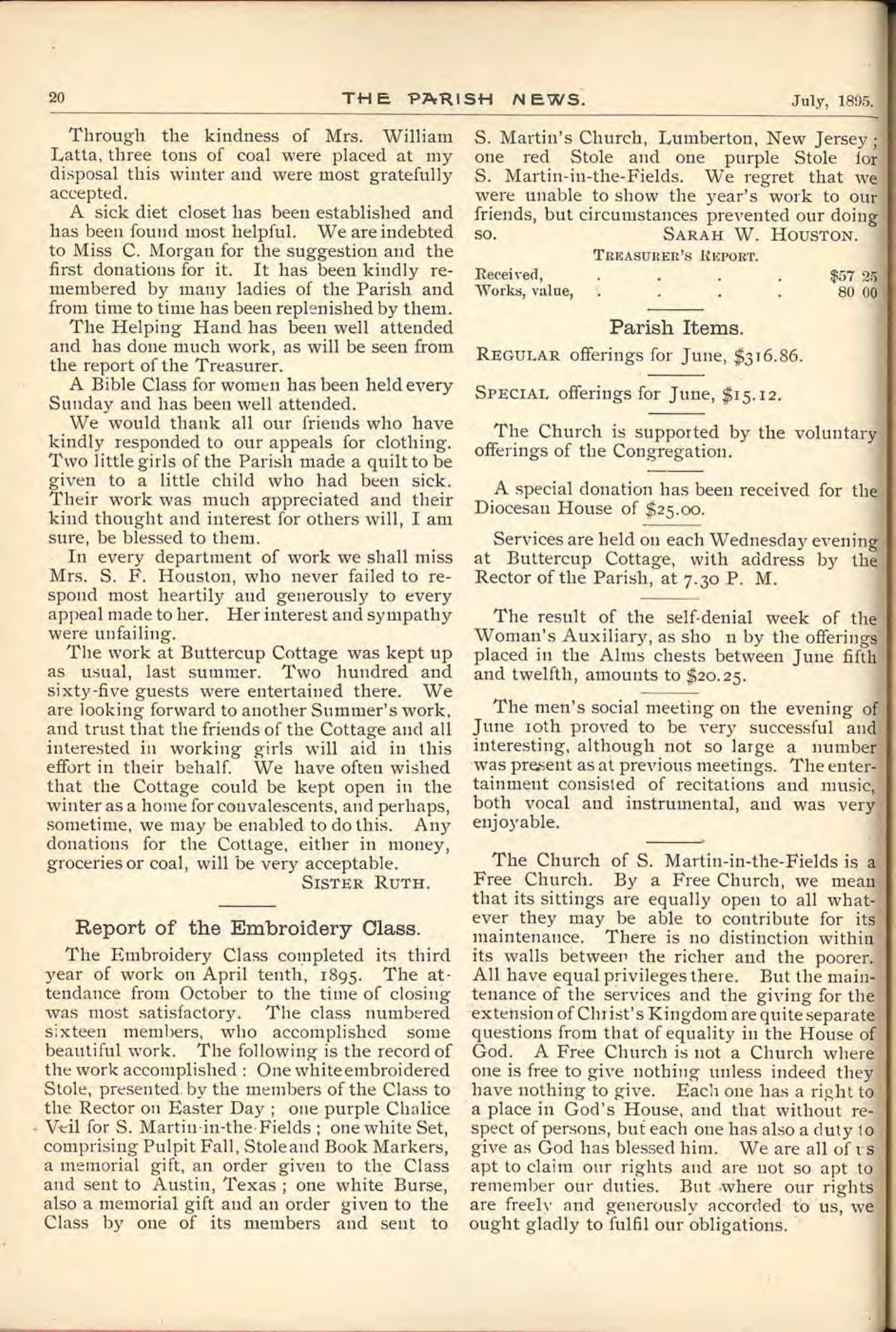
The closest thing to a portrait of either sister that survives: Sister Ruth’s own report in St. Martin’s Parish News, July 1895 — “The work at Buttercup Cottage was kept up as usual, last summer. Two hundred and sixty-five guests were entertained there” — signed, at the foot of the left-hand column, SISTER RUTH. No photograph of her, or of Sister Elizabeth, has ever been found. Public domain.
Every short account of Buttercup Cottage calls them nuns, and lets it go at that — two figures in dark dresses at the edge of somebody else’s summer. They were not nuns, exactly. They were Episcopal sisters of the Sisterhood of the Good Shepherd, out of New York, sent down each summer to a stone farmhouse in the Cresheim Valley to run a vacation home for working girls. And for the cottage’s first decade and more, they were not the background of the place. They were the place. Their names were Elizabeth and Ruth, and nobody has ever told their story, because almost everything about them had to be dug out of a parish newspaper that nobody had read for them in a hundred years.
Sister Elizabeth was there first in every way that mattered. She was one of the three charter members of her Sisterhood, and before Buttercup she had spent her life at St. Barnabas’ House in New York — among the women of the tenement houses and the city hospitals, the emigrants on Ward’s Island, the prisoners in the Tombs and the House of Detention. Her memorial says she had a wonderful memory for names and faces, and that her work among the women was invaluable. Then, in the winter of 1881, out visiting poor families on a cold, icy day, she fell and fractured her thigh. She was never able again to do work requiring much walking. Inactive she could not be: she labored on among the women at St. Barnabas’, then took charge of St. Clement’s Mission House, knowing every woman and child who came, studying their wants, until her health, delicate for years, began to fail.
Buttercup was the work her broken body could still do, and from 1890 she gave it her summers — her time, the Bishop of New York wrote, divided between Buttercup Cottage in the summer and the Sisters’ house in the winter, where the Clothing Bureau furnished the work she loved. At the cottage, her memorial says, “her one aim was to make the girls’ brief vacations as bright and happy as possible, also planting some thoughts in their minds which might soften their hardworking lives.” Picture her there, then, from the one description of the cottage written from inside it, by a girl in September 1891: the long porch, the bookcase full of books to suit every taste, the games in the sitting-room after tea — and no walking work left in any of it, because the woman who ran the house could no longer walk to her poor. Her last work was done on January 9, 1897. On January 15, her memorial says, she “passed on to the complete rest of Paradise.” She had given the cottage every summer of its life, making other people’s rest bright.
Sister Ruth is the one the girls’ letter lets us hear working. The games, that same letter says, divided the girls into sides — “Philadelphias and Athletics,” “Buttercups and Daisies” — “and I cannot begin to tell you what fun we have… sometimes I can scarcely wait until Sister Ruth, who keeps the score, as we call it, announces the result.” On Wednesday evenings there were services at the cottage, the Rector addressing the girls at half-past seven. And when the season ended, Ruth wrote it up for the parish: two hundred and sixty-five guests entertained in the summer of 1894, a hundred and two in another year, the hope — hers, in print — that the cottage might one day stay open all winter as a home for convalescents. The reports are signed the way she was known: SISTER RUTH, in capitals, no surname, as if a surname were a thing the work had no use for.
Then came the summer the ground moved. In the spring of 1900 the Sisterhood of the Good Shepherd itself went out of existence, and its last sisters were made deaconesses. The Living Church reported where each would go, and of Ruth it said she would be at St. Martin’s, Germantown, “where she will also have charge of Buttercup Cottage.” The order ended; the work didn’t. That summer she was at the cottage as always — “occupied during the summer in the care of Buttercup Cottage,” the parish paper notes in the autumn, “now taking a well-deserved vacation” — and the full season in her next report still runs the way it always had: opened June 1, first guests received that day, closed September 15, well filled, the girls staying two or three weeks. Elizabeth was three years dead. Ruth ran the house alone, and by every printed sign ran it the same.
How long she ran it, no record found can say in her own voice again. The Chestnut Hill Local gives her eighteen years in charge of the program and calls her a key founder of the place, and arithmetic from 1889 lands that near 1907 — near, but not on, any dated page. The parish register then moves her on paper: at the end of 1915, and again in January 1916, Sister Ruth was transferred as a communicant to Trinity Church, Asbury Park, New Jersey. And by late 1920 she was dead — the deaconess school’s bulletin lets it out sideways, in a sentence about a house at Asbury Park that reverted to the school “by the death of Sister Ruth.” No obituary has been found. No grave has been found. The cottage, meanwhile, outlived her: in June of 1934 the parish was still inviting its friends to a Buttercup Donation Day, “to aid in giving a vacation in the country to working girls” — run by then by hands no source names.
Two things about these women are usually stated that this page will not state. The first is a surname for Ruth. A modern edition of her Sisterhood’s minute book identifies her as Ruth Moore Buffington, set apart as a deaconess on April 25, 1900 — but the identification rests on a New York Times page of April 26, 1900 that nobody working on this page has yet opened, and no document yet read ties that name to this cottage. Elizabeth’s cited surname, Dawson, rests the same way on an unopened page of The Churchman. When those pages are read, the names will be printed here, with their sources. Until then the women keep the only names the cottage itself ever gave them. The second is a face. Search where you like — the parish paper, the Sisterhood’s reports, the histories, the archives catalogues — there is no photograph of Sister Elizabeth, and no photograph of Sister Ruth. What survives of them is the work, described by the girls who received it, and two pieces of print: a bishop’s memorial of the sister who could no longer walk, and a report of two hundred and sixty-five guests, signed by the sister who kept the score.
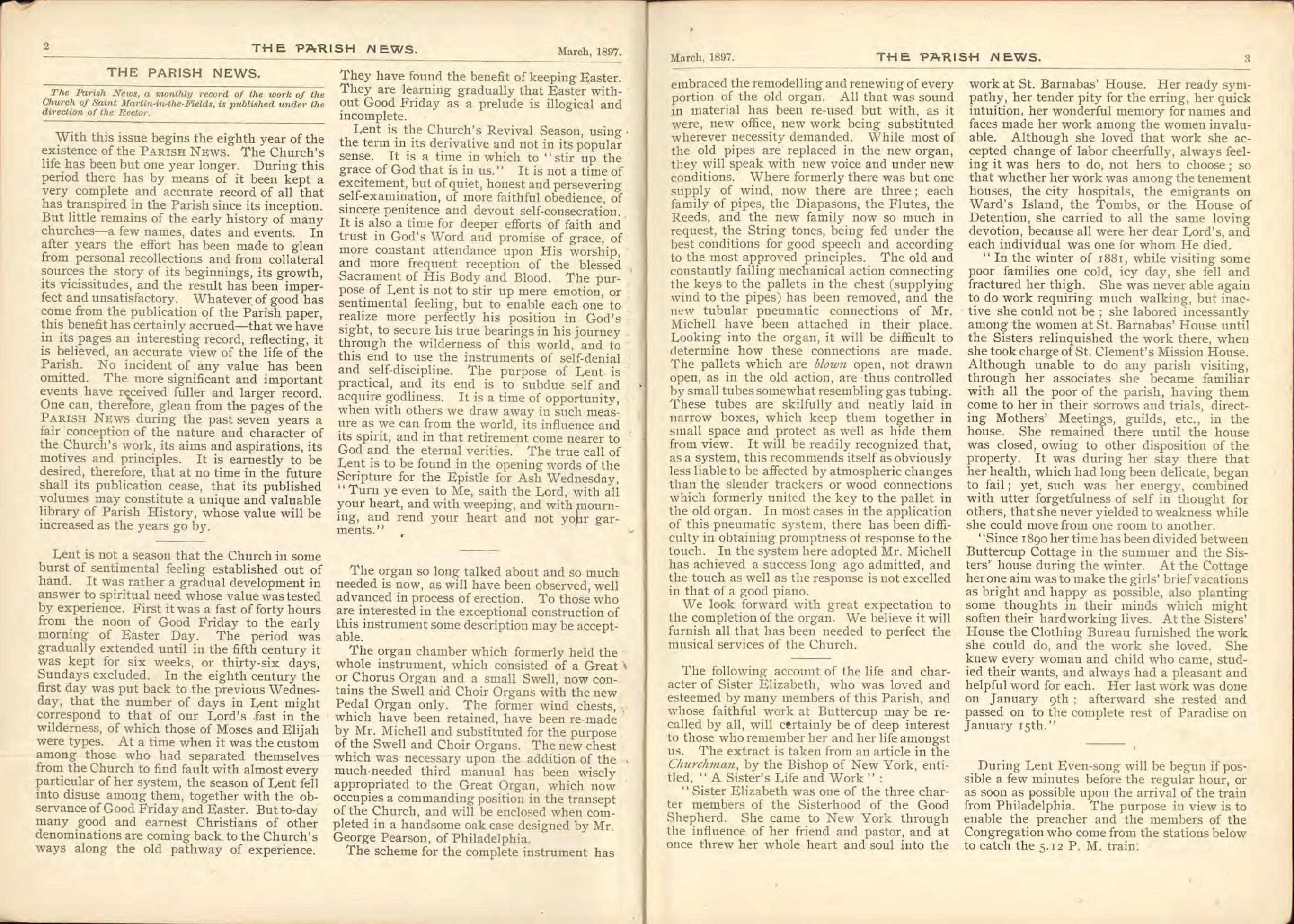
Sister Elizabeth’s memorial, as St. Martin’s parishioners read it in the Parish News of March 1897 — the extract from the Bishop of New York’s “A Sister’s Life and Work” begins at the foot of the left-hand page and runs down the right: the fall on the ice in the winter of 1881, the summers divided between Buttercup and the Sisters’ house, and her last work on January 9 and her death on January 15. Public domain.
The Cellar
What this page rests on, what was checked and not used, and what could not be reached. This page is a companion to the Buttercup Cottage page, which tells the house’s story and prints the disagreements about it; this page tells the two women who ran the house, and only them. Every claim below is stated at the strength of its source, and the two weakest links in the chain are named as such, in the open.
Who they were, and what they were not
Sister Elizabeth and Sister Ruth were members of the Sisterhood of the Good Shepherd, an Episcopal (Anglican) sisterhood organized in New York in 1869, working at Buttercup Cottage under the parish of St. Martin-in-the-Fields, Chestnut Hill. They were not Roman Catholic nuns; the word “nun” in print about them is Elizabeth Farmer Jarvis’s caption shorthand (“An Episcopal nun, Sister Ruth, supervised”) and is not repeated here as a description. From April 25, 1900, Ruth was a deaconess. The cottage’s day-to-day staffing by the two sisters — named as a pair in print from 1890 — is the arrangement every period source shows; a third sister is named at the cottage in none of them. Parish News of St. Martin-in-the-Fields, c. June 1890 (first-season notice, naming both sisters); Sisterhood of the Good Shepherd, annual reports 1890–1896 (two Sisters in charge each summer); Jarvis, Chestnut Hill Revisited (Arcadia), p. 50, caption.
Elizabeth: the memorial, read from the page
The fullest account of either woman is the memorial of Sister Elizabeth reprinted in the Parish News of March 1897 from The Churchman, where it appeared as part of “A Sister’s Life and Work,” by the Bishop of New York. The page image is printed on this page as its second plate and was read for it directly, not from a transcription: “Sister Elizabeth was one of the three charter members of the Sisterhood of the Good Shepherd… Her ready sympathy, her tender pity for the erring, her quick intuition, her wonderful memory for names and faces made her work among the women invaluable… In the winter of 1881, while visiting some poor families one cold, icy day, she fell and fractured her thigh. She was never able again to do work requiring much walking, but inactive she could not be… Since 1890 her time has been divided between Buttercup Cottage in the summer and the Sisters’ house during the winter. At the Cottage her one aim was to make the girls’ brief vacations as bright and happy as possible, also planting some thoughts in their minds which might soften their hardworking lives… Her last work was done on January 9th; afterward she rested and passed on to the complete rest of Paradise on January 15th.” The memorial also records her work among the tenement houses, the city hospitals, the emigrants on Ward’s Island, the Tombs, and the House of Detention, her charge of St. Clement’s Mission House after the Sisters relinquished St. Barnabas’, the Clothing Bureau at the Sisters’ house, and that her health “had long been delicate.” The year of her death, 1897, is fixed by the memorial’s appearance (The Churchman, February 13, 1897; reprinted March 1897) and by the January dates it gives. The surname Dawson, attributed to her in a modern edition of the Sisterhood’s minute book on the strength of that same Churchman article, was not seen on the Parish News page, which names her only as Sister Elizabeth; the full Churchman page (February 13, 1897, p. 256) has not been opened, and the surname is not used on this page. Parish News of St. Martin-in-the-Fields, March 1897, pp. 2–3 (Internet Archive item parish-news-18901962_202401, page image read for this page); The Churchman (New York), February 13, 1897, p. 256 — cited, not opened.
Ruth: the reports are hers
Sister Ruth’s own printed reports in the Parish News are the record of her work, and two of them were read for this page from their page images. The first plate on this page is the July 1895 issue, p. 20: her report closes the Helping Hand account with the cottage’s season — “The work at Buttercup Cottage was kept up as usual, last summer. Two hundred and sixty-five guests were entertained there. We are looking forward to another Summer’s work… We have often wished that the Cottage could be kept open in the winter as a home for convalescents… Any donations for the Cottage, either in money, groceries or coal, will be very acceptable. SISTER RUTH.” The same page’s Parish Items add: “Services are held on each Wednesday evening at Buttercup Cottage, with address by the Rector of the Parish, at 7.30 P. M.” The 265 of that report is the summer of 1894, matching the Civic Club Digest’s “Inmates (1894) — 265.” A second report in her name (printed 1894, read in the Archive’s text) counts “one hundred and two girls” the year before its season; a third, printed with balances to April 30, 1902, describes a season opened June 1 with the first guests received that day and closed September 15, “well filled, most of the guests remaining two or three weeks” — the season that report covers, likely the summer of 1901, and not labeled on this page as a proven 1902 season. The score-keeping is the girls’ own testimony: the letter of September 1, 1891, printed in the Parish News of January 1892, describes the evening games, the sides’ names, and Sister Ruth announcing the result. The parish items of autumn 1900 (read in the Archive’s text) place her “occupied during the summer in the care of Buttercup Cottage” that year and afterwards on “a well-deserved vacation”; a like item of November 1903 has her returned from vacation “since the closing of Buttercup Cottage” — a season’s closing, not the program’s. Parish News, July 1895, p. 20 (page image, printed as the first plate); Parish News, January 1892 (“About Buttercup Cottage”); reports of 1894 and of the year to April 30, 1902, and parish items of 1900 and 1903, in the same run, read in the Archive’s OCR text.
1900: the order ends, the sister stays
The hinge of Ruth’s story is carried, for now, on a collaborating research pass’s transcription (November 6, 2026) of The Living Church, May 5, 1900 (Internet Archive item livingchurch0022vari, whose existence and coverage were verified for this page; the passage itself has not yet been re-read from its page image, and is labeled here accordingly): six women made deaconesses on St. Mark’s Day, April 25, 1900, four of them Sisters of the Order of the Good Shepherd, “which now goes out of existence”; the order’s works included “Buttercup Cottage, near Germantown, Philadelphia”; and “Sister Ruth goes to St. Martin’s-in-the-Field’s, Germantown, where she will also have charge of Buttercup Cottage.” No birth names are printed in that account, and none are taken from it. What stands independently of the transcription is the summer that followed it: the parish paper’s own items (above) show Ruth in sole care of the cottage in the summer of 1900 and a full season reported under her name through the spring of 1902. The Living Church, May 5, 1900 (transcription as labeled); Parish News items of August and autumn 1900 and report to April 30, 1902 (Archive text).
Ruth after Buttercup, and the two surnames
Two closing records are likewise carried on the collaborating pass’s transcriptions from the parish paper’s own run, and are stated on the page at that strength: the parish register entries of December 27, 1915 and January 6, 1916, transferring Sister Ruth as a communicant to Trinity, Asbury Park, New Jersey (the entries do not mention Buttercup); and the Alumnae Bulletin of the New York Training School for Deaconesses, in a passage following a balance of September 28, 1920, recording that “by the death of Sister Ruth a house at Asbury Park reverted to the Deaconess School” — from which this page says only that she had died by late 1920. No obituary, burial place, or death date for her has been found in any source opened. The identifications offered by the modern annotated edition of the Sisterhood’s minute book — Sister Ruth as Ruth M. (Ruth Moore) Buffington, on the strength of The New York Times, April 26, 1900, p. 2, and Sister Elizabeth as Elizabeth G. Dawson, on the strength of The Churchman article above — are printed on the Buttercup Cottage page as probabilities and are not used as names on this page, because neither cited page has been opened. A warning the record itself supplies: a “Miss M. F. Buffington” appears in The Living Church of August 18, 1900; she is a different person, and nothing about her is evidence about Sister Ruth. Parish News register entries and Alumnae Bulletin passage (transcriptions as labeled, November 6, 2026); Richard J. Mammana, ed., The Minute Book of the Sisterhood of the Good Shepherd, 1871–1922, modern annotated edition (index-level), citing New York Times, April 26, 1900, p. 2 (not opened) and The Churchman, February 13, 1897, p. 256 (not opened); The Living Church, August 18, 1900 (the different Buffington, noted to prevent conflation).
The missing photographs
No photograph of Sister Elizabeth or Sister Ruth is reproduced on this page because none has been found: not in the Sisterhood’s printed reports, not in the Parish News across its whole run (searched in full text for this project), not in the two Chestnut Hill histories, and not in the archives catalogues searched for the cottage page (Chestnut Hill Conservancy, Fairmount Park, Library Company, Library of Congress). The search is stated as a search, not a proof that no portrait exists anywhere — a likeness may sit in the Sisterhood’s own papers or a family album beyond this page’s online-only research rule — and if one is found and can be cleared, it belongs at the head of this page. Until then the two plates printed here are the genuine artifacts: the sisters’ own parish paper, carrying Ruth’s signed report and Elizabeth’s memorial. Both are public domain.
Read, unreached, and still to pull
Unreached, in the order they are wanted: The New York Times, April 26, 1900, p. 2 — the single page that would settle Ruth’s surname, behind the Times’s own archive; The Churchman, February 13, 1897, p. 256 in full — the page that would settle Elizabeth’s; The Living Church, May 5, 1900, to be re-read from its page image so its passage stands at the same strength as the plates; the Sisterhood of the Good Shepherd’s own archive, if it survives, for the sisters’ reception records and any portrait; and the Asbury Park years — Trinity Church’s register beyond the transfer lines, and any deaconess-school record of Ruth’s death and burial. The cottage’s own unreached list (the Parks Department history file, the 1900 census household, the deeds, Contosta’s 2014 parish history) is kept on the Buttercup Cottage page and is not repeated here.