In the Cresheim Valley · a summer home for working girls · not one of the seven inns
Buttercup Cottage
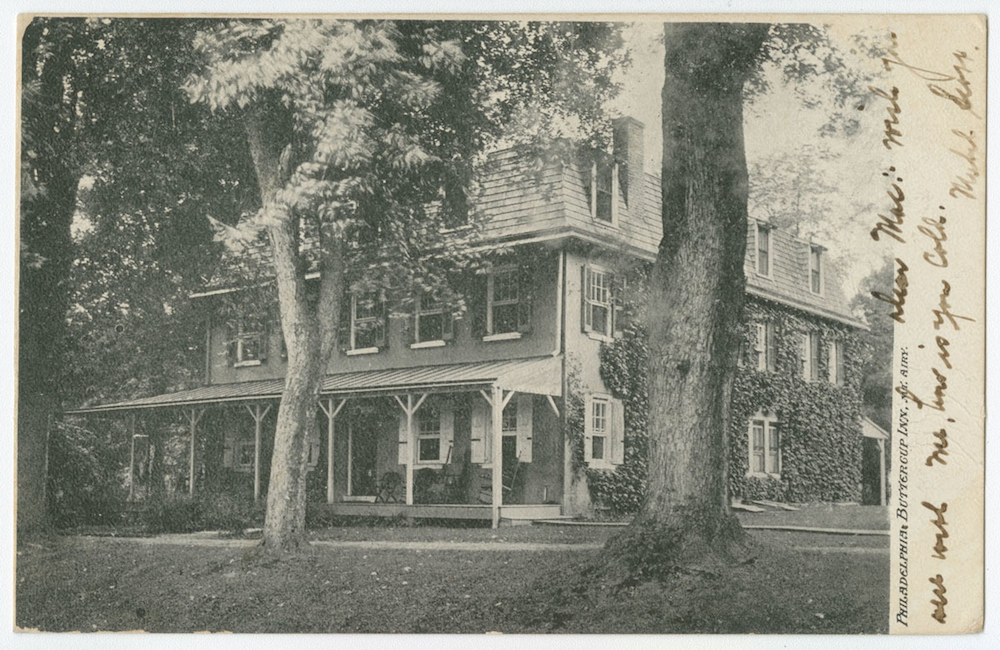
Buttercup Cottage in its working years, on a postcard of about 1905 — printed, in the loose way of postcards, “Philadelphia’s Buttercup Inn, Mt. Airy.” Three stories and a porch the length of the house: room for some two dozen girls a week, all summer. Public domain.
Up a wooded valley where the Cresheim Creek runs down to the Wissahickon, a stone farmhouse spent a generation as a summer home for working girls — young women out of the mills, shops, and kitchens of Philadelphia who could not afford a vacation anywhere else on earth. It opened in the summer of 1889. It was run by a board made up entirely of women, and staffed day to day by two Episcopal sisters. Its name was Buttercup Cottage, and almost everything the world now repeats about it is a little bit wrong.
The gift behind it was Henry Howard Houston’s. Houston (1820–1895) was Chestnut Hill’s great builder — the Wissahickon Inn, the church of St. Martin-in-the-Fields, the whole garden suburb of Wissahickon Heights stood on his land and his money. He bought this early-nineteenth-century farmhouse and its grounds in the Cresheim Valley — who built the house, no source found for this page can say — and let the cottage’s program use it rent-free. His daughter Gertrude, later Gertrude Houston Woodward, was president of the board of managers, a board of socially prominent Chestnut Hill women at a time when an all-women board running anything was unusual enough to remark on.
The women who actually ran the house were the Sisters of the Good Shepherd, an Episcopal sisterhood working in the parish of St. Martin-in-the-Fields — and it is their printed annual reports, and St. Martin’s own parish paper, not the newspapers, that carry the cottage’s real record. The Sisterhood’s 1890 report is the first of them: “Buttercup Cottage,” at Mount Airy, a “Summer Home for Working Girls,” opened the first week in June and was placed in charge of the Sisterhood; a comfortable old-fashioned farmhouse with surrounding grounds “was given for the purpose”; “a band of ten young ladies furnished the necessary funds for its support,” and tried to give their “less-favored sisters some of the brightness of their own young lives”; and one hundred hardworking girls stayed from one to two weeks, and in some cases longer. St. Martin’s Parish News, looking back at that first summer, counts it differently — a hundred and twenty-three girls as guests in the summer of 1889 — and the two counts are printed here together, not reconciled. In 1891 the Sisterhood reported that it had charge of Buttercup Cottage “during its two summers of existence” — the arithmetic that confirms the 1889 start — and that when the cottage closed for the season, one of the sisters stayed on to work in the parish, under the Rev. Jacob Le Roy. In 1893 the report runs: “Buttercup Cottage, the Summer Home for working girls at Chestnut Hill of which the Sisterhood has charge, was enlarged and improved last summer. 210 girls enjoyed a respite from the hard toil for their daily bread, and as they expressed it were ‘children again.’” Two hundred ten girls in a single summer, through a house that held some two dozen at a time. The reports for 1894, 1895, and 1896 each show the same arrangement: two Sisters in charge, every summer.
The Philadelphia Inquirer watched the seasons too. On June 5, 1892, it announced the cottage’s opening for the summer on Cresheim road in Mt. Airy: working girls who could afford neither shore nor mountains were invited as guests for two weeks at a time; the season before, 150 girls had been entertained and many more turned away for lack of room; and Houston had paid for an addition that could hold about twenty-five more. Sisters Elizabeth and Ruth, of the Sisterhood of the Good Shepherd, would “again take charge” — the paper names the pair the annual reports leave as “two Sisters.” Miss Gertrude Houston was president; the treasurer was Miss Sophia Weygandt of Germantown. A year later the paper carried the cottage’s Donation Day — Friday, May 26, 1893, tea from four to six — with word that the house badly needed furniture, and that groceries and money would also be gladly received.
The two sisters the Inquirer names can now be followed in the parish’s own print. Sister Elizabeth was a charter member of the Sisterhood; from 1890, The Churchman’s memorial — reprinted in St. Martin’s Parish News in March 1897 — says, her time was divided between Buttercup Cottage in the summer and the Sisters’ house in the winter; her last work was on January 9, and she died on January 15, 1897. Sister Ruth’s span is longer. She is named at the cottage from the first seasons; her own report in the Parish News of July 1895 counts two hundred and sixty-five guests the summer before. In the spring of 1900 the Sisterhood of the Good Shepherd itself went out of existence, and The Living Church reported the making of its last deaconesses — and that Sister Ruth would go to St. Martin’s, Germantown, “where she will also have charge of Buttercup Cottage.” She kept charge, that is, after she became a deaconess, and a later report in her name still describes a full season at the cottage, opened June 1 and closed September 15, guests staying two or three weeks. The parish register then moves her, at the end of 1915, to Trinity, Asbury Park, and by late 1920 she was dead — the deaconess school’s bulletin mourns her in those words, and no others. The Chestnut Hill Local gives her eighteen years in charge of the program and calls her a key founder of the place. Her probable identity is Ruth Moore Buffington, one of the Good Shepherd sisters set apart as deaconesses in 1900; the surname rests on a modern edition of the Sisterhood’s minute book citing a New York Times page of April 26, 1900 that has not yet been opened, it is tied to this cottage by no document yet read, and it is given here as a probability, not a fact.
Who could come — on this, the record disagrees with itself in print, and this page prints the disagreement. In 1895 the cottage’s own board described itself to the Civic Club of Philadelphia’s Digest of charitable institutions, in an entry compiled from the organization’s own return: a summer home where working girls unable to pay full board could spend “two or three weeks at a nominal price, $1 a week”; the cottage “accommodates 23 at one time”; its managers were a “Board of 13 Managers, women”; and, in the entry’s plain words, “There are no restrictions of color or creed.” Against that stands Elizabeth Farmer Jarvis’s history of Chestnut Hill: the cottage was for “single, white working women,” “set up for Protestants, ‘but Catholics and others are admitted if willing to conform to the rules,’” holding “up to 22 boarders,” who were “asked to contribute what they could.” The parish historian David Contosta likewise remembers a retreat for white working girls. The Chestnut Hill Local splits the difference in its own way: twenty-five girls at a time, a flat dollar a week, an age floor of sixteen that no period source found states. No winner is picked here: the board’s printed word of 1895 says one thing, and the neighborhood’s later histories say another, and both are on the record. Even the board’s own price does not stay at one figure in print: the Digest’s dollar a week of 1895 stands against St. Martin’s Parish News in June 1906, which says that nearly a third of the cottage’s expenses were met by such of the girls as could pay “from one to three dollars a week” — both are period print, and both are left standing. What the sources do agree on is the shape of a summer: girls came for two or three weeks at a time, in their hundreds across a season — 150 in 1891, 210 in 1892, 265 in 1894, and 261 in the summer before June 1906, a notice that called that year the cottage’s seventeenth — and around the house there was a playground, an apple orchard, a cow pasture, and the Cresheim Creek to swim in.
Of the thousands of girls who came up the valley summer after summer, not one civil name survives in any source found — no register, no guest list, no diary under a real name. What survives instead is closer to the house than a register would be: two letters the Parish News printed from the cottage itself, both unsigned with any real name. The first is dated September 1, 1891, and written by one of the girls — “we girls,” she says — to a friend who could not come. She walks her through it: up the long winding lane to a red and white barn and a quietly grazing cow, and then the house — “a quaint, old structure, two and a half stories high, built of yellow stone,” with a long porch the whole width of the house, a parlor with its tall bookcase, a sitting-room with a small cabinet organ, bedrooms shared two and three to a room. Her days run on bells: rising at seven, prayers at half-past, breakfast, a long tramp, dinner at half-past one, croquet on the meadow, tea at half-past six, and games in the sitting-room — bean-bag and ring-toss, the girls divided into “Buttercups and Daisies,” with Sister Ruth keeping the score. There was no gas in the cottage; she took her candle up the old-fashioned stairs feeling “part of an old time story.” On Tuesdays and Fridays the girls walked to Mr. Houston’s and came back “laden with fruit and a large jug full of the most delicious buttermilk I ever tasted,” and the walks ran to the Wissahickon Inn, Indian Rock, Devil’s Pool, Valley Green, and the ruins of an old mill. As one of the girls said, in her hearing: “My two weeks here seem like a happy dream, from which I will not awake until I am home again.” The letter is signed only “Your loving friend.” The second letter, dated August 13, 1892, adds the doors: Miss Houston had painted flower names on them — poppies and buttercups on the Sisters’ doors, wild roses, forget-me-nots, violets, and clover on the rest — “there were twenty-three of them including ourselves.” It is signed “Mollie Buttercup.” That is a cottage pen-name, not a proven guest’s surname; both letters are printed here as what they are — voices from inside the house — and neither is turned into a named guest. The other voices are the ones this page has always had: the sisters’, quoting the girls, in 1893 — they were “children again” — and a postcard of the cottage, dated 1924, sent by a writer whose name is lost: “This is the peacefullest place ever was.”
How it ended, the record will not say in one voice, and this page no longer tries to make it. The Chestnut Hill Local’s history — and the Chestnut Hill Conservancy’s own captioning — holds that the newspaper stories stop after the summer of 1911, that the program ended then for reasons nobody recorded, and that the cottage stood unused for many seasons. St. Martin’s own paper tells a different, stranger sequence. In the Parish News the cottage is present from 1889 through a Donation Day notice in June 1906; then the word Buttercup does not appear in that paper again from 1907 through 1933; and then, on June 10, 1934, the paper invites its readers once more — Buttercup Cottage “will welcome once more its many friends” on Monday, June 11, from three until six, on Old Cresheim Road at the foot of Emlen Street, in aid of “the good work done by Buttercup Cottage in giving a vacation in the country to working girls.” A present-tense invitation, in 1934, to support a working-girls’ vacation — twenty-eight years after the parish paper last mentioned the place, and twenty-three years after the Local’s ending. That notice does not prove the summers ran without a break in between, and this page does not claim they did. It proves the ending cannot be set in 1911. Jarvis adds that during some of the World War I years the Houston family lived in the cottage themselves, to save coal in the fuel shortages, and that the building survived into the mid-1950s — and the Sisterhood’s historian, following a parish history of the cottage written in 2014, says it remained in operation until the early 1950s, a lead carried here as a lead, not a reading of the document itself. The hard records side with a long-lived building: the Houston estate was still drawing property plans of the Buttercup Cottage complex in 1955; the city placed the house on the Philadelphia Register of Historic Places on May 28, 1957; an architecture firm drew alterations and additions to it in 1958; and the Fairmount Park Commission was still drawing it in 1963. No single closing year is declared here, because no source found earns one. The day and year the house came down, no record found for this page can give: the claims are 1958, the late 1950s, and after 1964, and they stand in the Cellar as claims.
The land became parkland in pieces. In 1906 Houston’s daughters — Mrs. George Woodward and Mrs. Charles Henry — gave the city some twelve acres along the Cresheim Creek (the Parks Department’s cataloguing of the family’s letter of April 11, 1906, calls the same gift fifteen acres; both figures stand here), ground that included the drowned picnic lake called Lake Surprise, just south of the cottage; the cottage’s own parcel followed much later, deeded by the Woodward Estate to Fairmount Park in 1964 by the Local’s account. The estate’s surveyors in 1922 were mapping lots on a “Buttercup Lane”; the city’s own records carry the cottage at 7400 Emlen Street.
The house is gone. Its stone barn was left standing and went on working — Girl Scouts camped and gathered in it, and by one account it hosted outdoor theater — until, in April of 1982 by the Local’s telling, vandals burned it. No report of that fire has been found in any newspaper of its own week; what the fire took, an early account of the ruin remembers: the great wooden doors, the interior catwalk, the window frames charred in their openings.
What stands today, at the trail entrance where Emlen Street meets Cresheim Road, is the barn’s stone shell and its chimney, the iron doors and the stone steps, in unsigned park woods. No account describes even a foundation left of the house itself. Since the spring of 2023 the ruin has had keepers again: Noah Raven, a Chestnut Hill teenager who founded a group called Monarch Defenders, working in partnership with the Friends of the Wissahickon — the invasives pulled out, a native meadow planted where the porcelain berry choked the walls, trails cut, nest boxes up, on a little under an acre around the stones. The girls came for the fresh air and the creek. The meadow is, in its own way, the same idea, still running.
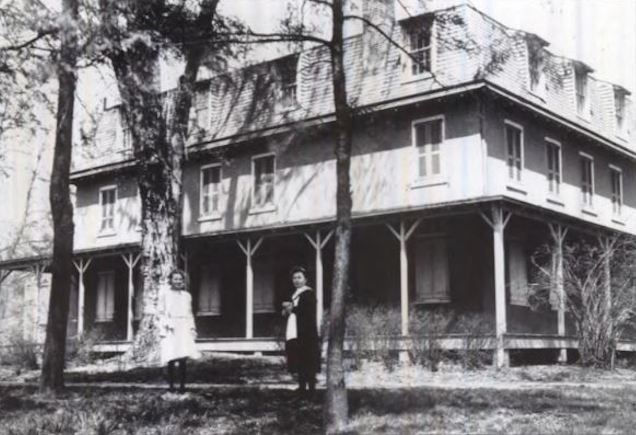
The cottage from its lawn, with Gertrude Houston Woodward — the board’s president, and the founder’s daughter — standing before the porch she presided over. Public domain.
The Cellar
What this page rests on, what was checked and not used, and what could not be reached. The two published accounts of Buttercup Cottage on the web today are a 2016 newspaper history and a 2026 restoration article; this page was built instead on the operators’ own printed reports, two Chestnut Hill histories, the city’s building records, and the park’s and the family’s own archives catalogues — and it prints the disagreements between them instead of choosing silently.
Identification, and what this place is not
Buttercup Cottage stood on the Cresheim Creek in the Cresheim Valley, in what is now Wissahickon Valley Park, reached today from the trail entrance at Emlen Street and Cresheim Road; the city’s building records carry it at 7400 Emlen Street. It is not one of the seven inns of the Wissahickon, and it is kept apart here from Houston’s Wissahickon Inn, from his mansion Drum Moir, and from St. Martin’s Church itself, each mentioned only where a source ties it to the cottage. It is also a different parcel from the surviving France–Hinkle farmhouse at 7801 Cresheim Road, with which it must not be merged, and a different place entirely from the “Buttercup Cottage” of Springfield Hospital in Maryland, which is search noise. Philadelphia Architects & Buildings (Athenaeum of Philadelphia), Buttercup Cottage project record, 7400 Emlen St; Friends of the Cresheim Trail, trail map page (Emlen St & Cresheim Rd access, “Buttercup Cottage”); the France–Hinkle separation from a Philadelphia Historical Commission nomination for 7716 Navajo St citing Bromley 1895 plate 35 and the 22nd Ward atlas of 1911, plate 30.
The barn that survives is described as the cottage’s barn by the Chestnut Hill Local; Jarvis calls the ruin “possibly an old mill building.” Both descriptions are carried here unresolved. Of the house itself, no source describes a surviving foundation; the page does not imply one. Chestnut Hill Local, “Cresheim Valley Drive ruins were once a summer retreat for young women,” July 20, 2016; Elizabeth Farmer Jarvis, Chestnut Hill Revisited (Chestnut Hill Historical Society/Arcadia), p. 50.
The parish paper: St. Martin’s Parish News, 1890–1934 (collaborating research pass, November 6, 2026)
A second collaborating research pass (November 6, 2026) read the run of St. Martin-in-the-Fields’ Parish News held at the Internet Archive (1890–1918, 1920, 1933–1936, 1939–1946, 1949–1962) by text search. The load-bearing items below were then checked for this page against the Archive’s own OCR text of that run, and are quoted from that check; a page-image check remains the final step, and the items are labeled here so no reader mistakes their status. From that run: the first-season notice (opened “last summer,” 123 girls, Sisters Elizabeth and Ruth named, the Rector as chaplain holding two services a week, Donation Day June 7, gifts to Miss Gertrude Houston); the girl’s letter dated Buttercup Cottage, September 1, 1891, printed in the issue of January 1892 under the heading “About Buttercup Cottage” with the paper’s own introduction — “a very interesting description of the life of the girls at Buttercup Cottage” — from which the story’s account of the house, the bells, the games, and the buttermilk walks is taken, signed only “Your loving friend”; the letter dated Buttercup Cottage, August 13, 1892, signed “Mollie Buttercup” (flower names painted on the doors; “twenty-three of them including ourselves” — a pen-name, not a guest’s civil name); the August 1900 items (the cottage formally opened June 18, its first guests received June 4, and Sister Ruth “occupied during the summer in the care of Buttercup Cottage” that year); Sister Ruth’s report in July 1895 (265 guests the summer before, matching the Digest’s 1894 figure) and a separate mid-1890s report in her name (102 girls); the March 1897 reprint of The Churchman’s memorial of Sister Elizabeth (charter member; summers at Buttercup from 1890; died January 15, 1897); Sister Ruth’s report printed with balances to April 30, 1902 (a season opened June 1 and closed September 15 — the season that report covers, likely the summer of 1901, not a proven 1902 season); the June 1906 Donation Day notice (Monday, June 11; the seventeenth year; 261 guests the summer before; girls who could pay paid “from one to three dollars a week,” meeting nearly a third of the expenses); the register entries of December 27, 1915 and January 6, 1916 transferring Sister Ruth as a communicant to Trinity, Asbury Park, with no mention of the cottage; and the June 10, 1934 notice quoted in the story. In that same text search — run in full for this page, not only sampled — the word “Buttercup” does not appear in the paper’s OCR text between the June 1906 notice and the June 1934 notice, nor after 1934 through the end of the run; the 1911 issues are in the run and do not mention it, and later Donation Day notices in the paper are for the House of Rest on Wayne Avenue. OCR text can garble a word past recognition, so that silence is a text-search result, not a proof; and silence in one parish paper is not proof of closure in any case, and the page says no more than that. Two further period items from the same pass: The Living Church, May 5, 1900, on the deaconesses made April 25, 1900 — four of them Sisters of the Good Shepherd, an order that “now goes out of existence,” its works including “Buttercup Cottage, near Germantown, Philadelphia,” with Sister Ruth to be at St. Martin’s, Germantown, “where she will also have charge of Buttercup Cottage” (no birth names are printed on that page, and none are taken from it); and the Alumnae Bulletin of the New York Training School for Deaconesses, in a passage following a balance of September 28, 1920, recording that by Sister Ruth’s death a house at Asbury Park had reverted to the school — the text says only “Sister Ruth,” and the surname that a modern editor supplies in a footnote is not in it. The Sisterhood’s own 1890 report, by contrast, was read in full for this update and is quoted from the page itself, at the collection cited below. Parish News of St. Martin-in-the-Fields, Internet Archive item parish-news-18901962_202401 (run as catalogued there); The Living Church, May 5, 1900, Internet Archive; Alumnae Bulletin of the New York Training School for Deaconesses, Internet Archive — all three carried on the collaborating pass’s transcriptions, November 6, 2026; Sisterhood of the Good Shepherd, Twenty-First Annual Report (1890), anglicanhistory.org (PDF), read in full.
The operators’ own record: the Sisterhood reports
The period evidence comes in three kinds. First, the printed record of the women who ran the house: the Sisterhood of the Good Shepherd’s annual reports, opened and read in full. Second, the board’s own directory entry of 1895 (quoted under Who could come, below). Third, the newspapers: two Philadelphia Inquirer pieces — “Buttercup Cottage a Summer Home for Working Girls Conducted by P. E. Sisters,” June 5, 1892, p. 2, and “Donation Day at Buttercup Cottage,” May 21, 1893, p. 7 — located and transcribed in a collaborating research pass (November 6, 2026) from the Inquirer’s archive, and quoted on the page from that transcription; they await a page-for-page check against the Readex edition, which is on the pull list. Beyond them, the parish historian’s citations name six issues of the Germantown Guide (August 9, 1890; April 25 and August 8, 1891; June 11, 1892; June 1, 1895; May 30, 1896) and two Inquirer Society columns (December 8 and 15, 1895) — citations only, the bodies unread. The Chestnut Hill Local’s statement that the cottage received “generous coverage” until 1911 remains unverified beyond these items. The 1891 report (pp. 7–8) has the Sisterhood in charge of Buttercup Cottage, “a summer home for the working girls of that city,” “during its two summers of existence” — independent arithmetic for the 1889 start — with a sister remaining after the season “to work in the parish of St. Martin-in-the-Fields, Rev. Jacob Le Roy, rector.” The 1893 report (p. 11) records the enlargement of the summer of 1892, the 210 girls of that season, and their words as the sisters relayed them. The 1894, 1895, and 1896 reports, read in index text, each place two Sisters in charge of the cottage for the summer, the sisters spending the rest of the year in the parish. Sisterhood of the Good Shepherd, Twenty-Second Annual Report (1891), pp. 7–8, anglicanhistory.org (PDF); Twenty-Fourth Annual Report (1893), p. 11, anglicanhistory.org (PDF); reports for 1894, 1895, 1896 at the same collection (index-level). The parish link is put most briefly by the Sisterhood’s modern editor: Buttercup was “a ministry of St. Martin in the Fields, Philadelphia” (Richard J. Mammana, ed., The Sisterhood of the Good Shepherd 1871–1922, minute book edition — index-level).
The board, and Sister Ruth
The board’s officers, as the record names them: Gertrude Houston Woodward, president throughout — “Miss Gertrude Houston” in the Inquirer of June 1892, “Mrs. George Woodward” in the Civic Club Digest of 1895, the same woman under her maiden and married names. Jarvis describes the board of managers as all-female and “socially prominent”; the Local calls Gertrude the first president and says Houston let the program use the house rent-free. Treasurer in 1892 was Miss Sophia Weygandt of West Upsal Street, Germantown (Inquirer); treasurer by 1895 was Mrs. John McArthur Harris of 5305 Main Street, Germantown (Digest) — a change of officeholder, printed as such. The Digest gives the board’s size — “a Board of 13 Managers, women” — and names no other manager; no full roster has been found in any source opened. The Local names the program’s longtime head as Sister Ruth, “a devoted member of St. Martin’s,” in charge eighteen years with “a few more summers” after — arithmetic that lands near 1911 and fits the Local’s own ending, though not the longer tradition. Jarvis names her independently, in the caption to the cottage’s photograph: “An Episcopal nun, Sister Ruth, supervised.” The identification of Sister Ruth with Ruth Moore Buffington — set apart as a deaconess on April 25, 1900, with Sisters Julia, Helena, and Isabelle, and dead by 1920 — rests on the Sisterhood’s modern editor’s edition of its minute book, citing The New York Times, April 26, 1900, p. 2, a page that has not been opened; The Living Church’s own account of that same service, read in the collaborating pass, prints no birth names at all. The identification has not been tied to Buttercup by name in an opened document; it is printed on the page as a probability, and the surname is not used as a fact anywhere on it. Sister Elizabeth’s cited surname, Dawson, rests likewise on an unopened page — The Churchman, February 13, 1897, p. 256 — and is not printed on the page. Chestnut Hill Local, 2016; Jarvis, Chestnut Hill Revisited, p. 50, caption 82; Mammana, minute book edition (index-level), citing New York Times, April 26, 1900, p. 2 (not opened) and The Churchman, February 13, 1897, p. 256 (not opened).
Who could come, and on what terms
The eligibility and terms are printed on the page in three voices, unreconciled. (1) The board’s own, verified for this page at p. 59 of the Civic Club of Philadelphia’s Digest (1895), opened and read in full: “Object — A summer home for working girls, where they can spend two or three weeks at a nominal price, $1 a week. The cottage accommodates 23 at one time. Admission — Applicants must be working girls who are unable to pay full board for their summer holiday. There are no restrictions of color or creed. Management — By a Board of 13 Managers, women. Two Protestant Episcopal Sisters are in charge of the house. Income — From voluntary contributions. Inmates (1894) — 265. Officers — President, Mrs. George Woodward, Wissahickon Heights, Philadelphia; Treasurer, Mrs. John McArthur Harris, 5305 Main Street, Germantown.” The Digest’s preface states that its entries rest on written returns furnished by the organizations themselves — this is the board describing itself in 1895. (The scan’s text layer garbles the price as “$13.”; the printed page reads $1 a week, and the neighboring entries show the era’s spectrum plainly — one home in the same pages restricts itself to “only white persons,” another boasts “no distinctions of color.”) (2) Jarvis’s: the cottage was for “single, white working women,” “set up for Protestants, ‘but Catholics and others are admitted if willing to conform to the rules,’” accommodating “up to 22 boarders,” who were “asked to contribute what they could.” Contosta’s later narrative likewise remembers a retreat for white working girls. (3) The Chestnut Hill Local: twenty-five girls at a time, a flat $1 a week, and an age floor of sixteen; no period source opened states an age for Buttercup’s guests. Capacity therefore stands at 23 (Digest), 22 (Jarvis), 25 (Local) — and the Inquirer’s 1892 “addition that can accommodate about twenty-five girls” is the addition, not a proven total, and may be the Local figure’s ancestor. The season totals are different years, not contradictions: 150 entertained in 1891 (Inquirer, June 1892), 210 in the summer of 1892 (the Sisterhood’s report), 265 “inmates” in 1894 (Digest, in the period’s institutional word); Contosta’s “about 275” is secondary. The grounds’ amenities — playground, orchard, pasture, swimming in the creek — rest on the Local and on modern retellings, not on period print. Civic Club of Philadelphia, Civic Club Digest of the Educational and Charitable Institutions and Societies in Philadelphia (1895), p. 59, Internet Archive; Jarvis, Chestnut Hill Revisited, p. 50; Chestnut Hill Local, 2016.
The house, and Houston
Henry Howard Houston was born October 3, 1820, and died June 21, 1895; the year 1847, often given as his birth year in quick accounts, is when he came to Philadelphia. His Chestnut Hill building program — the Wissahickon Inn, St. Martin-in-the-Fields, the Cricket Club grounds, some three thousand acres and the largest landholding in northwest Philadelphia — is context from the Friends of the Wissahickon, which states the Buttercup connection in one sentence: “Houston established Buttercup Cottage as a summer vacation retreat for working women in 1889, making his daughter Gertrude the first board president.” No source opened documents a role for Houston beyond buying the house and grounds and installing Gertrude. The house itself was a residence or farmhouse of the early nineteenth century; its builder has not been identified in any source reached. One modern account’s statement that Houston built it is wrong — he bought it — and that account’s history is not relied on anywhere on this page. The name “Buttercup Cottage” is in period use by 1891, in the Sisterhood’s own report, so the name dates to the program’s start; the prettier claim that it was named for buttercup meadows rests on a single modern blog and is not asserted here. Friends of the Wissahickon, “Henry Houston Statue” (Trails to the Past), fow.org; University of Pennsylvania Archives, Houston Estate Papers, UPT 50 H843, biographical note; Chestnut Hill Local, 2016; Sisterhood report, 1891.
The endings — now three, and none declared
The parish paper’s sequence (above) is now the period spine: present 1889–1906, absent 1907–1933 in that paper, a present-tense working-girls solicitation on June 10, 1934, then absent again through 1962. Against it: The Local: coverage stops after the summer of 1911, the reason unrecorded, the cottage “unused for many seasons.” The Conservancy’s own Night of Lights caption likewise dates its use “until the early 1910s.” Jarvis: the Houston family lived in the cottage during some World War I years, conserving coal, and “this building survived to the mid-1950’s.” The Sisterhood’s historian, citing David R. Contosta’s A Brief History of “Buttercup Cottage” (May 2014, written for St. Martin’s parish): the cottage was “in operation until the early 1950s, when its derelict buildings were sold.” A 2013 account of the ruin gives demolition in the late 1950s; the Local gives it after the 1964 deed. Against all of these stand the drawn and listed records: an estate property plan of the Buttercup Cottage complex dated June 28, 1955; alteration and addition plans dated April 14, 1958, by the firm of Hatfield, Martin & White, whose project list carries the cottage at 7400 Emlen St; a Philadelphia Register of Historic Places listing dated May 28, 1957; and a Fairmount Park Commission drawing of the cottage dated June 24, 1963. No demolition date or permit was found in any record reached, and none is printed on the page. A collaborating research pass (November 6, 2026) adds two demolition claims not re-opened for this draft: Contosta’s caption dates the demolition to 1958, and a Hidden City account places it not long after the 1964 gift; both are carried here as claims, bounded by the drawn and listed records above. Contosta’s 2014 history — the document both modern traditions lean on — could not be reached online, and is the first item on the unreached list below. Chestnut Hill Local, 2016; Chestnut Hill Conservancy, Night of Lights slideshow, PastPerfect item 2018.57.4; Jarvis, p. 50; Mammana (index-level) citing Contosta, 2014; “The Ruins of Buttercup Cottage,” buttercupcottage-blog, Aug. 4, 2013; Fairmount Park Historic Resource Archives, FP.2011.009, Drawer W12 (three drawings); Philadelphia Architects & Buildings, project record and Hatfield, Martin & White project list.
The land
The 1906 gift: the Chestnut Hill Local’s history of the Wissahickon’s gates records that Houston’s daughters, Mrs. Charles I. Henry and Mrs. George W. Woodward, “had donated some 12 acres along the Cresheim Creek in 1906,” including the Lake Surprise ground “near where Cresheim Road ends at the ruins of Buttercup Cottage Barn.” The 1964 transfer of the cottage parcel itself rests on the Local’s 2016 history alone — “In 1964, Fairmount Park was deeded the property by the Woodward Estate” — and no deed book and page for either transfer was located. The family’s paper trail for both runs through the Houston Estate Papers at the University of Pennsylvania (UPT 50 H843, real-estate series running to 1964) and at the Pennsylvania State Archives (MG-154, 1895–1964), neither searched at folder level. The estate maps of 1922 naming “Buttercup Lane” are in the Penn papers’ Series IV. George McNeely, “Gates to Paradise: Entries to the Wissahickon,” Chestnut Hill Local, Aug. 16, 2019; Chestnut Hill Local, 2016; UPenn Archives, Houston Estate Papers finding aid and Series IV maps inventory (Clarke, “Map of 0.0413 Acre Lot on Buttercup Lane,” 1922, items 4:3:14:1–2); PA State Archives, MG-154 (index-level).
The barn and the fire
The barn’s afterlife rests on the Local: left standing when the house came down, “used by Girl Scouts as well as other programs for various events,” then falling out of use. A 2013 account adds outdoor theater to the barn’s uses and preserves the fire’s material losses — the large wooden doors, the interior wooden catwalk, charred window frames; the same account found the ruin already carrying its later folk life, a metal buttercup cut into the chimney front and a painted scene on the back wall. A 2026 account’s claim that the site served as a Parks Commission center through the mid-1900s is unsourced and conflicts with the Local’s sequence; it is not used. A commenter’s memory of a 1960s Girl Scout camp in the barn, left on a 2025 social post, is an unverified anecdote and is recorded here only as a lead. For the fire itself there is exactly one source: the Local’s “in April, 1982, it was burned down by vandals” — month and year, no day, no department, no arrest. No report in the Inquirer, the Daily News, the Bulletin, or the Local itself from 1982 was located; those archives sit behind paywalls that were not searched, so the fire’s news layer is recorded as unreached, not as nonexistent. Chestnut Hill Local, 2016; buttercupcottage-blog, 2013; Grid Magazine, 2026 (read, not relied on for history).
The photographs
The cottage standing is photographed at least four times over. A view of about 1912, credited to the Germantown Historical Society, is printed in Jarvis’s Chestnut Hill Revisited (p. 50, photograph 82) and digitized in the Chestnut Hill Conservancy’s online catalogue. The Conservancy holds a further Buttercup photograph (accession 1997.20) whose sameness with the 1912 view is not established. A postcard dated 1924, carrying the “peacefullest place” message, survives through a 2013 blog; its original holder is unknown, and it is treated as a lead, not a plate. One photograph had to be refused: the Library of Congress’s Pictorial Archives of Early American Architecture holds a print long catalogued as “Buttercup Cottage” (No. 4092, reproduction LC-USZ62-136628, no known restrictions on publication) — but the Library’s own title carries a corrected identification, taken from Jarvis’s Mount Airy (2008): the house in that photograph is the Matthias Milan house on Cresheim Road, a small stone cottage behind a picket fence that matches no description of this house’s scale. It is not reproduced here as Buttercup Cottage; the correction is recorded because anyone searching the national archive for this cottage will meet that photograph first, under this cottage’s name. And the Fairmount Park archives hold a print catalogued simply “Buttercup Cottage n.d.” (Photographic Prints Collection, FP.2010.002, container 7.5), not digitized; the archives’ stated terms require contacting them for authorization to publish, which this page’s research rules do not do. The Conservancy’s reuse terms are likewise unstated on its records — permission, not assumption — so the Conservancy photographs are cited here as evidence and not reproduced. The ruins photograph printed in the Chestnut Hill Local is Pete Mazzaccaro’s, under that newspaper’s copyright. Jarvis, p. 50, via Chestnut Hill Conservancy PastPerfect item 2005.3.1-.4; Conservancy PastPerfect item 2018.57.4 (accession 1997.20); buttercupcottage-blog, 2013; Library of Congress, PAEAA No. 4092; Fairmount Park Historic Resource Archives, FP.2010.002 finding aid.
The two plates printed on this page are this project’s own cleared artifacts, both public domain: the postcard of about 1905 (its printed caption calls the house “Philadelphia’s Buttercup Inn, Mt. Airy” — the postcard trade’s name, where every other source says Cottage), and the photograph of Gertrude Houston Woodward standing before the house, the same three stories and the same long porch from the lawn. The ruin itself is deliberately not pictured: every serviceable modern photograph of it is under copyright — the Local’s, the restoration group’s — and this page reproduces only what it can clear. The stones are described in the story instead, which is also what a visitor finds: no sign, no plaque, and nothing to read but the walls.
The restoration
The living part of the story is the best documented of all: Noah Raven’s own account of three years of restoration at the site, published in Grid Magazine on January 1, 2026 — the meadow planted from seed and plugs on just under an acre, the porcelain berry and stiltgrass pulled, five bags of trash in a single early cleanup, trails surfaced with woodchips and flat stones, bat and bird boxes up, monarchs and a scarlet tanager by the third year, and the small vandalisms recorded as plainly as the plantings. The work runs in partnership with the Friends of the Wissahickon, begun mid-May 2023; no permit or authorization document beyond that partnership was located, and none is claimed here. The site has no official page of its own with the Friends or with Philadelphia Parks & Recreation; it is unsigned parkland, and the meadow group’s own pages are the record of its care. Grid’s history paragraph, it should be said, repeats the errors this page exists to correct — the restoration reporting is used, the history is not. Noah Raven, “Three years of restoration at Buttercup Cottage,” Grid Magazine, Jan. 1, 2026; Monarch Defenders, monarchdefenders.org (index-level); Friends of the Wissahickon, “Henry Houston Statue.”
Read, unreached, and still to pull
Unreached, in the order they are wanted: Contosta’s A Brief History of “Buttercup Cottage” (St. Martin’s parish, May 2014), formerly published on the parish website and not recovered online; the Parks Department’s own history file for this cottage — “Wissahickon Valley Park, Buttercup Cottage: History — brief of title, correspondence, images, maps, memos and newspaper clippings, 1849–2023,” in the Philadelphia Parks & Recreation archives (its ArchivesSpace record was verified November 6, 2026) — a brief of title and the newspaper clippings in one folder, the single richest unexamined source on the cottage, held for in-person research and so outside this page’s online-only rule; the Bromley atlas plates for this parcel (1895, plate 35; 22nd Ward, 1911, plate 30), whose printed label for the cottage is unverified; the Library of Congress item page for PAEAA No. 4092 beyond the photograph itself; and Jarvis’s Mount Airy (2008), p. 12, which corrects that photograph’s caption. Not yet searched: the 1900 census — taken in June, in season, the one record that could name the cottage’s summer household of matron, servants, or even guests — whose Ward 22 enumeration districts are mapped and waiting; and Gopsill’s city directories, 1889–1907, whose volumes are online and unopened. A second research pass (November 6, 2026) ran the seams the first had not: no Historical Commission designation file for the 1957 listing is posted online — listings of that era predate the modern nomination form, and the older files are staff-held; the Sanborn fire-insurance sets cover the city in principle but the sheet for this parcel is unidentified, as is the 1930 Dallin aerial plate that frames it; the Diocese of Pennsylvania’s journals stand unsearched rather than empty — The Living Church’s archive has since been searched for the May 5, 1900 deaconess item, in the collaborating pass recorded above; and the parish historian’s two books — Contosta’s A Philadelphia Family, whose page 33 is the passage on this cottage (read only in Google Books snippets in the November 6, 2026 pass, its “weeklong” wording in conflict with the primary one-to-three-week stays), and his parish history A Venture in Faith — could not be opened in full in any preview. Also unopened, and now the two pages that would settle the sisters’ surnames: The New York Times, April 26, 1900, p. 2, and The Churchman, February 13, 1897, p. 256; and Contosta’s May 2014 parish history of the cottage, whose former parish-website address returns no page and no archived copy was found on November 6, 2026. No obituary for Gertrude Houston Woodward was found in any online source; her husband’s exists (Philadelphia Inquirer, May 27, 1952, p. 14) and has not been read. The largest unsearched layer is the one the Local’s ending rests on: the rest of the Philadelphia newspaper run, 1889–1911 and April 1982, in its paywalled archives, beyond the two Inquirer items transcribed in the collaborating pass. Until those are read, this page’s account of the program’s end and of the fire is exactly as firm as the sources above say it is — and no firmer.