The mill across from the front door
The third paper mill the Rittenhouse family built at RittenhouseTown stood on the Monoshone Creek — the small tributary, called Paper Mill Run in the period, that joins Wissahickon Creek near the big creek’s mouth. (That run is the Germantown-side one at RittenhouseTown, not the Mount Airy run that carries the same modern name.) The ground is today’s 206–210 Lincoln Drive. The surveyor George Lehman, drawing the family’s twenty acres in 1764, marked two paper mills on it, an upper and a lower, and the lower mill stood across the creek from the family’s own homestead of 1707 — the mill the Rittenhouses could see from their front door. Nothing of it stands today. The National Register nomination for the district adds one live thread: foundations of an early mill, possibly earlier than 1736, have been verified in the village center and were under archaeological investigation in 1990–91, and the nomination says the lower mill is possibly the building being investigated. Possibly is the nomination’s word, and it is kept at that grade here: whether the excavated foundations are this building’s, nothing read proves.
Built on borrowed money
The mill’s builder was the second William Rittenhouse, son of Nicholas — the Claus Rittenhouse who had run the family’s first mills. Claus died in 1734, and his will mentioned only one mill on the property, so the third mill came after his death. When was it built? The date the accounts give, about 1736, is a reconstruction by the historian Stephanie Green, carried in the nomination, and it is printed here at that grade: it may have been built in 1736, probably in partnership with William’s main customer, the printer Andrew Bradford, because in that year the two borrowed £100 at six percent for seven years from one George Jones, on a debt bond preserved in the Price papers. A hundred pounds was a substantial sum, on the order needed for a new building — the third Rittenhouse paper mill was debt-financed, and the customer co-signed. William added land around it: ninety acres to the southeast and thirty-five to the northwest in 1741, on top of a fifty-acre parcel his father had acquired, until the family held over two hundred acres in one piece. Lehman’s updated survey, made before William’s death in 1774, shows the two paper mills on the old tract and the family’s grist mills on the new land. Paper passed down the family: William’s son Jacob stands in the Roxborough list of 1779 as “Jacob Rittenhouse, paper,” and Jacob continued the manufacture of paper until his death in 1811.
Paper, then cotton, then wool
After Jacob came his sons Samuel and Enoch, who kept the operations up. Sometime after Samuel’s death in 1821, it is thought that Enoch converted the mill to a cotton factory — “it is thought” is the nomination’s own hedge, and it is kept. After that the mills were leased out, to outsiders and relatives both, and the lessees are named nowhere in the nomination: from here on, the record stops saying who actually ran this mill. It is not known precisely when paper making was abandoned at the site, but by the 1850s the mills were converted to other uses. One named firm does surface at the seat in those years, half-hidden behind initials: the Philadelphia directories of 1857 and 1858 both print “Rittenhouse M. B. & N., millers, Wissahickon.” Nicholas B. Rittenhouse is the named partner. “M. B.” is initials only, in both years — a later directory offers a possible match, “Rittenhouse Martin B., late miller, Wissahickon,” but the identification is unproven, and whether the firm’s mill was this building or another on the complex, nothing read states.
The woolen works of 1866
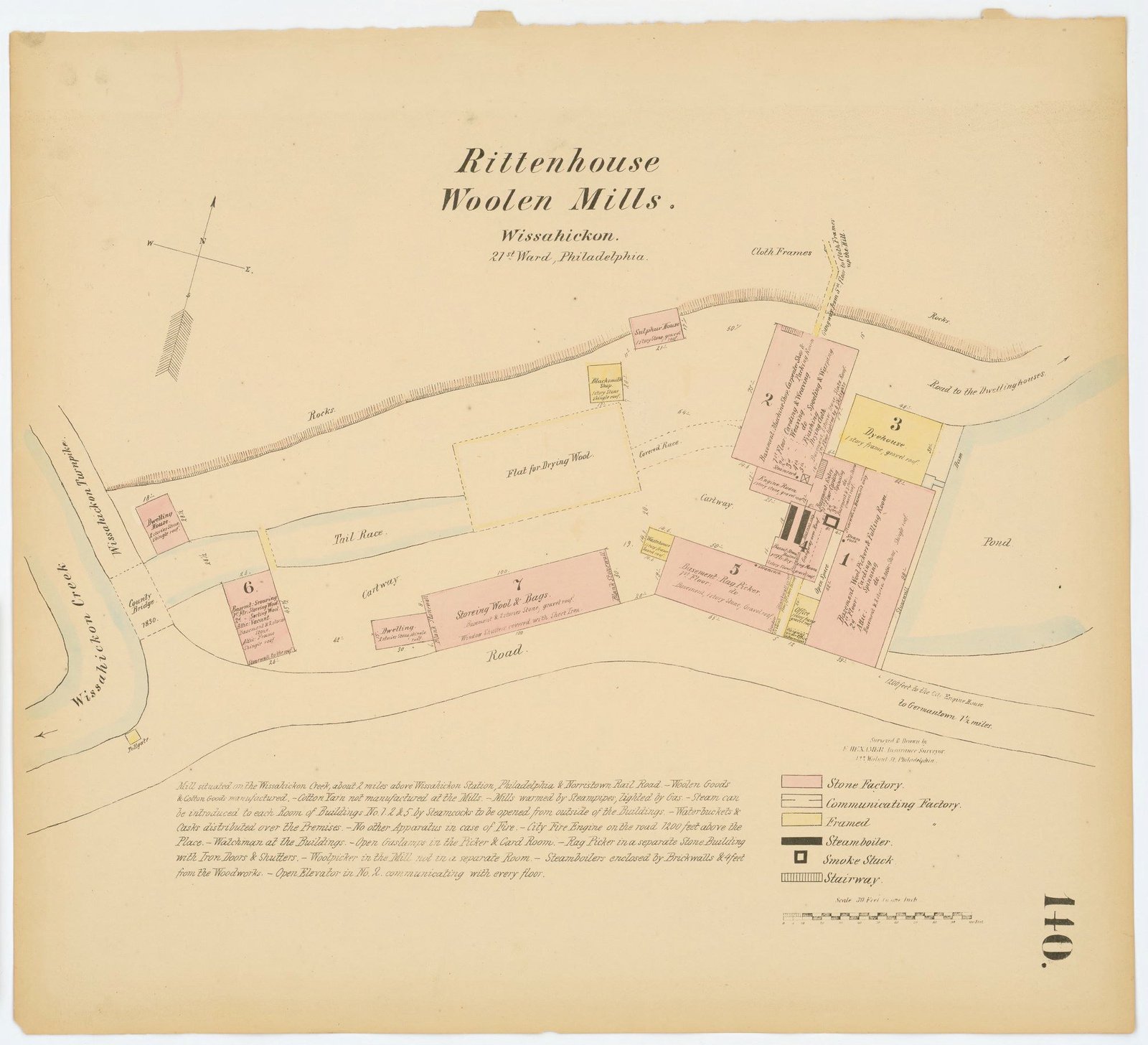
The mill’s last documented trade was not paper at all, but wool. The Hexamer insurance survey of 1866 — the surveyors who drew industrial buildings for the fire-insurance companies — records the plant as the “Rittenhouse Woolen Mills,” on Wissahickon Turnpike at its northeast corner, and names no owner, tenant, or client anywhere on the plate. Read closely, the plate gives the works whole: seven numbered buildings along the tail race below the mill pond. The main stone mill held wool pickers and fulling in its basement, carding on the first floor, spinning above. A second four-floor stone mill held machine and carpenter shops below, then carding and weaving, spooling and warping, and finishing and cloth-drying at the top, with an open elevator to every floor. Around them stood a frame dyehouse, a boiler house with its stack, a rag-picker building, a building for scouring, storing, and sorting wool, and a stone storehouse a hundred feet long for wool and bags — plus a sulphur house, a blacksmith shop, an office, a washhouse, two dwellings, a flat for drying wool, and cloth frames at the race’s head. The surveyor’s note corrects any easy summary of the product line: “Woolen & Cotton Goods manufactured. — Cotton Yarn not manufactured at the Mills.” The works wove cotton goods from yarn it did not spin. The mills were steam-heated and gas-lit, stood about two miles above Wissahickon Station, and kept a watchman; the nearest city fire engine was 1,200 feet away. The city’s own surveyors agreed with the insurance men: the Cresson park survey of 1868–69 labels the complex the “Rittenhouse Woolen Coy Mill.” One earlier map entry needs its caution: Barnes’s map index of 1855 lists a “Rittenhouse Mill: Wissahickon Creek below Rittenhouse Lane,” naming the main creek — but the Rittenhouse seat stands on the Monoshone at its mouth, and the entry is carried as this complex’s, creek-checked.
The photograph, and the mill that may not be in it
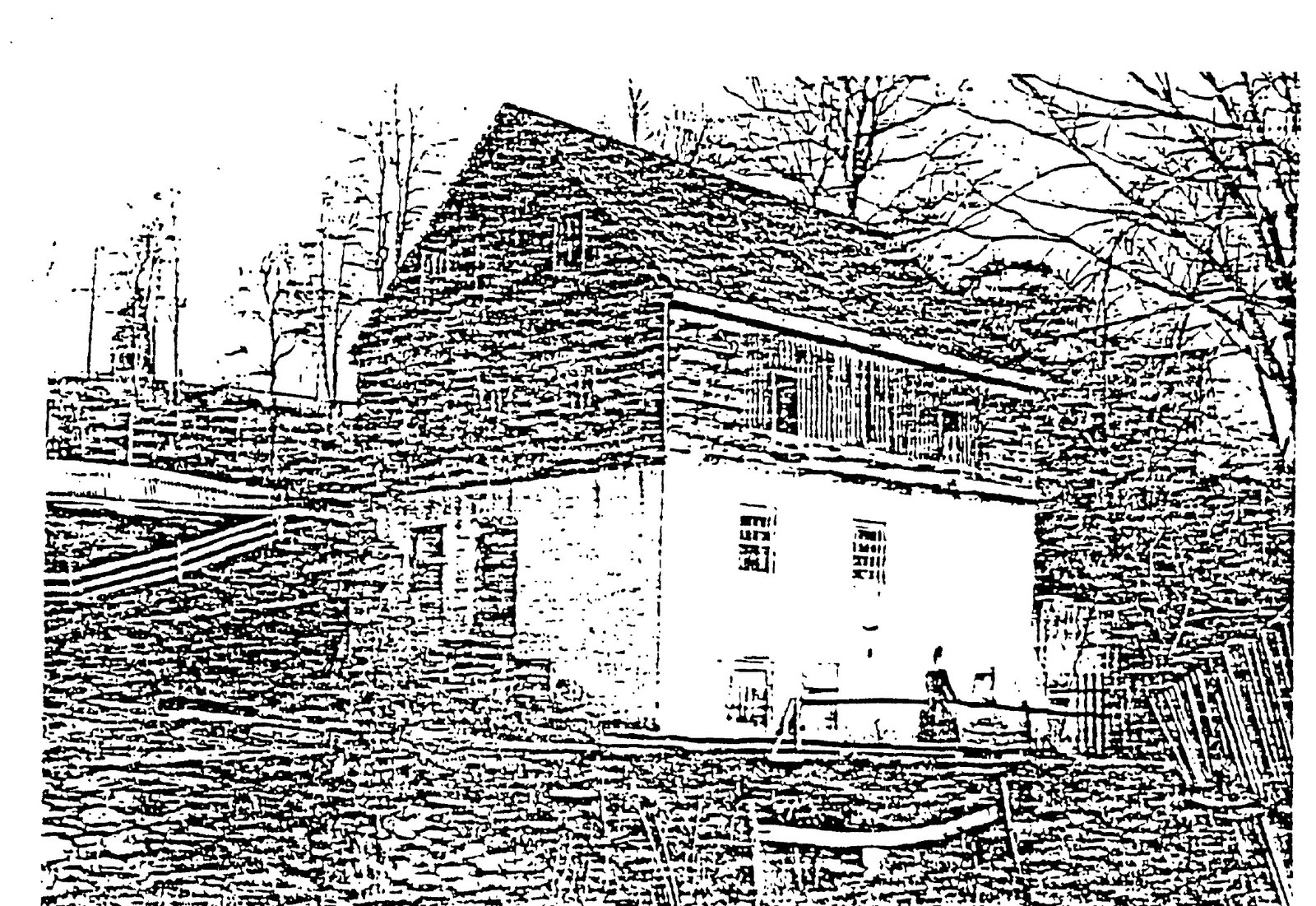
This is the one mill on the seat that was photographed. In 1889, two years before the end, a photographer named Shoemaker pictured the whitewashed stone mill building, a woman standing on the footbridge in front of it. Even his name comes down split: the nomination’s text credits “Thomas B. Shoemaker,” while its own caption for the photograph reads “1889 Thomas H. Shoemaker Photograph,” with the negative located in the Library of Congress. The disagreement sits inside one document, and it is printed here rather than resolved. And the photograph carries a deeper doubt. The nomination raises the possibility of a fourth paper mill on the seat: an additional mill at the mouth of Paper Mill Run, thought to have been erected by Jacob sometime after 1772. No document settles whether the references describe a new building or the modernization of an earlier one — but a watercolor sketch made in 1816 by the English artist Joshua Watson depicts a building quite different from the one in the 1889 photograph, and on that evidence the nomination finds it plausible that a fourth paper mill was built. So the famous photograph may show Jacob’s later mill, not the lower mill of about 1736. The nomination’s own verdict on the identification is “likely” — likely this is the lower mill — and likely is where this account leaves it.
The end
The mill survived until 1891. That year the Rittenhouse property was sold to the Fairmount Park Commission — over forty structures, including six mills — and the Commission began the gradual dismantling of the complex; the Friends of the Wissahickon put it plainly: in 1891 the Commission demolished the Rittenhouse mills and most of the buildings that had fallen into disrepair. The lower mill is the only mill on this seat with both a photograph and a demolition year: the documented end of the first papermaking address in America, two hundred and one years after the family’s first mill rose on this same small creek in 1690.
Timeline
| 1734 | Nicholas (Claus) Rittenhouse dies; his will mentions only one mill on the property. |
| c. 1736 | The second William Rittenhouse builds the third paper mill on the seat — the “lower mill” — probably in partnership with his main customer Andrew Bradford, the two borrowing £100 at 6% for seven years from George Jones (Green’s reconstruction, as carried in the nomination). |
| 1741 | William adds ninety acres to the southeast and thirty-five to the northwest; the family comes to hold over two hundred contiguous acres. |
| 1764 | Lehman’s survey of the twenty acres shows the upper and lower mills; the lower mill stands across the creek from the 1707 homestead. |
| 1772 | Lehman’s updated survey again shows the two paper mills on the old tract and the grist mills on the new land. |
| 1774 | The second William Rittenhouse dies. |
| 1779 | Jacob Rittenhouse stands in the Roxborough list as “Jacob Rittenhouse, paper.” |
| After 1772 | A fourth paper mill at the mouth of Paper Mill Run is thought to have been erected by Jacob; whether it was a new building or a modernization of an earlier mill is not known (nomination). |
| 1811 | Jacob Rittenhouse dies, having continued the manufacture of paper until his death. |
| 1816 | Joshua Watson’s watercolor sketch depicts a mill on this seat quite different from the building in the 1889 photograph. |
| After 1821 | Samuel Rittenhouse dies; Enoch is thought to have converted the mill to a cotton factory, and the mills are afterward leased out (nomination, its hedge kept). |
| By the 1850s | The mills are converted to other uses; precisely when paper making was abandoned at the site is not known. |
| 1855 | Barnes’s map index lists “Rittenhouse Mill: Wissahickon Creek below Rittenhouse Lane” (the seat stands on the Monoshone at its mouth; the entry is carried as this complex’s, creek-checked). |
| 1857–58 | The Philadelphia directories print “Rittenhouse M. B. & N., millers, Wissahickon” — Nicholas B. Rittenhouse the named partner; “M. B.” initials only. |
| 1866 | The Hexamer insurance survey records the “Rittenhouse Woolen Mills”: seven numbered buildings along the tail race, woolen and cotton goods manufactured, no cotton yarn made on site; the plate names no owner, tenant, or client. |
| 1868–69 | The Cresson park survey labels the complex “Rittenhouse Woolen Coy Mill.” |
| 1889 | The mill is photographed — credited to Thomas B. Shoemaker in the nomination’s text and to Thomas H. Shoemaker in its caption; the negative is located in the Library of Congress. |
| 1891 | The mill is demolished as part of the creation of Fairmount Park; the property sold to the Fairmount Park Commission that year held over forty structures, including six mills. |