Peter Koch owned a paper mill on Wissahickon Creek. The mill stood on 45 acres of land with meadow — "well water'd," as the Pennsylvania Gazette put it when the mill was sold after his death — next to his plantation at Chestnut Hill, above Germantown, on the Germantown Township side of the creek, in the stretch of valley that is now part of Wissahickon Valley Park. Koch died at that plantation on September 10, 1749. His day-to-day life was in Philadelphia, where he was a merchant with a house on Water Street and a wharf named after him — Kock's Wharf. The creek is why he belongs in this collection, and the creek is where his story starts.
His story is also a mystery story, because for more than 270 years almost nobody knew his name. He survived in print as "the late Mr. Koch" — no first name — in a footnote in a 1922 history of printing in Maryland. This article puts together everything the surviving records actually say about him: the merchant in Benjamin Franklin's newspaper, the paper mill on the creek, the sale of his estate, and the questions the records leave open. Where the record stops, this article says so.
Two spellings, one man
The first clue is a spelling problem. Philadelphia had two newspaper worlds in the 1740s. Christopher Sower printed a German-language paper in Germantown, and it is Sower's paper that recorded Koch's death, his plantation, and his mill. Benjamin Franklin's Pennsylvania Gazette served English readers — and in the Gazette, this same man is spelled Kock. Search the Gazette for "Koch" and you find nothing. Search for "Kock" and his whole career appears: advertisements, a wharf, a house, and the long printed settlement of his estate. Same city, same trade, same death year, same creek plantation. One man, two spellings — and the second spelling is where most of his life was hiding.
A merchant on Water Street
His first trace may be a ship's list. On September 9, 1738, a Peter Koch, age 36, qualified at Philadelphia from the ship Glasgow, out of Rotterdam by way of Cowes, and signed the oath list with his mark — a clerk wrote "Peter (X) Koch" and he made his cross. The name, the age (he would have been about 47 when he died), and the port all fit the merchant of this story, and no other arrival of the name before 1743 was found in the lists searched — so the identification is graded probable, not proven; later passenger indexes add that he travelled "with wife & child." His earliest trace in his own affairs is a Gazette advertisement of May 5, 1743, offering land, nails, and goods for sale. Over the winter of 1743–44 he moved to a house on Water Street, the merchants' street along the Delaware River, and the paper carried his removal notices.
In November 1744 he advertised something small and personal: a lost gold seal ring, marked with his initials "P K" under a crown. He offered twenty shillings for its return. It is the only object in the whole record that feels like his — a working merchant's seal, the thing he would have pressed into wax on letters and bills.
By September 1745 the ship Victory was lying at Kock's Wharf. The wharf carried his name in the paper's shipping news, which means it was part of the port's working waterfront, known by him. It was still called Kock's Wharf in the spring and summer of 1749, the last months of his life. No partner or firm name ever appears. Peter Kock traded under his own name, from his own wharf, and Sower's death notice summed him up in one accurate word: merchant.
The plantation on the creek
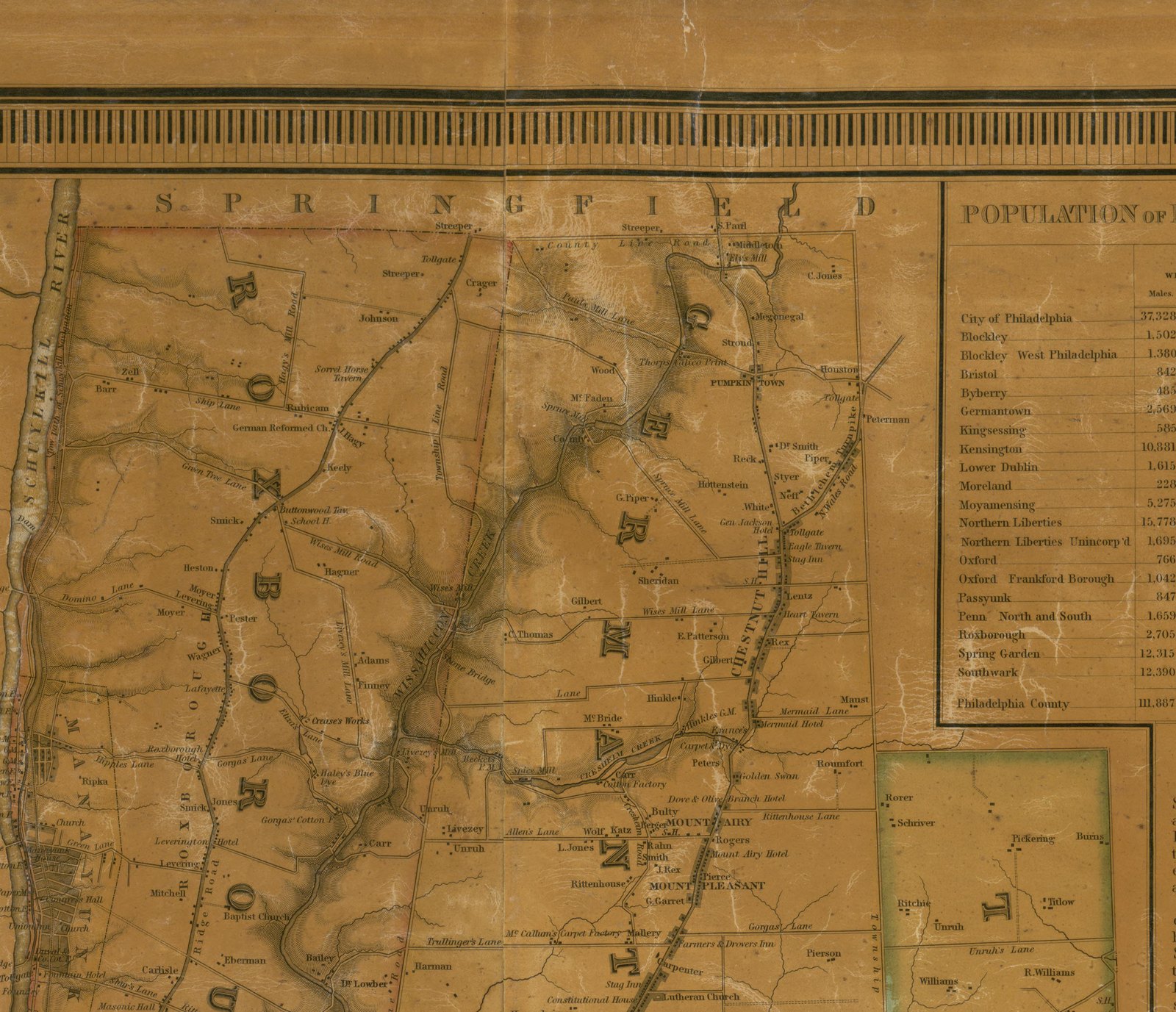
The city was only half his life. In September 1745, the Gazette carried his notice of a mare strayed from his plantation in Germantown Township — the first printed sign of the country property, miles northwest of the wharves. That plantation stood at Chestnut Hill, on Wissahickon Creek above Germantown, in today's northwest Philadelphia.
When the plantation was advertised for sale in June 1752, after his death, Sower's paper described it in full: 200 acres at Chestnut Hill, next to a neighbour named Wigart Miller, with several houses and a paper mill right beside it. A farm of that size with houses and a mill was a serious property — land to feed people, and falling creek water to drive mill machinery.
Here is the puzzle at the heart of his story. In June 1746, the Gazette advertised a land sale next door, describing the spot as "joining to Matthew Muris's Paper-Mill, on Wissahickon, and to the Plantation of Mr. Kock." Read that again: in 1746, the paper mill beside Kock's plantation belonged to Matthew Muris — not to Kock. Yet by the time Kock's estate was settled, a paper mill on the creek was sold as his. When did the mill become his, and how? Did he buy Muris's mill in the last three years of his life? Buy land and build? Lease it? No record that has been found says. The deed books that would answer the question cannot be read online, and this project works online only — so the gap is printed here as a permanent gap, not a guess.
One more caution belongs in this section, because the record demands it: nothing found calls Koch a papermaker. He was a merchant who owned a paper mill, the way a merchant might own a warehouse or a wharf. The only papermaker actually named at his mill appears later — and he matters to the end of this story.
Death at the plantation, and an estate sold in print
Peter Koch died on September 10, 1749, at his plantation on the creek. Sower's paper printed the notice six days later. It gives no cause of death, no age, and no family. No other record found supplies a cause or an age — but the family, when it finally surfaced, came from a document nobody had opened: his own will.
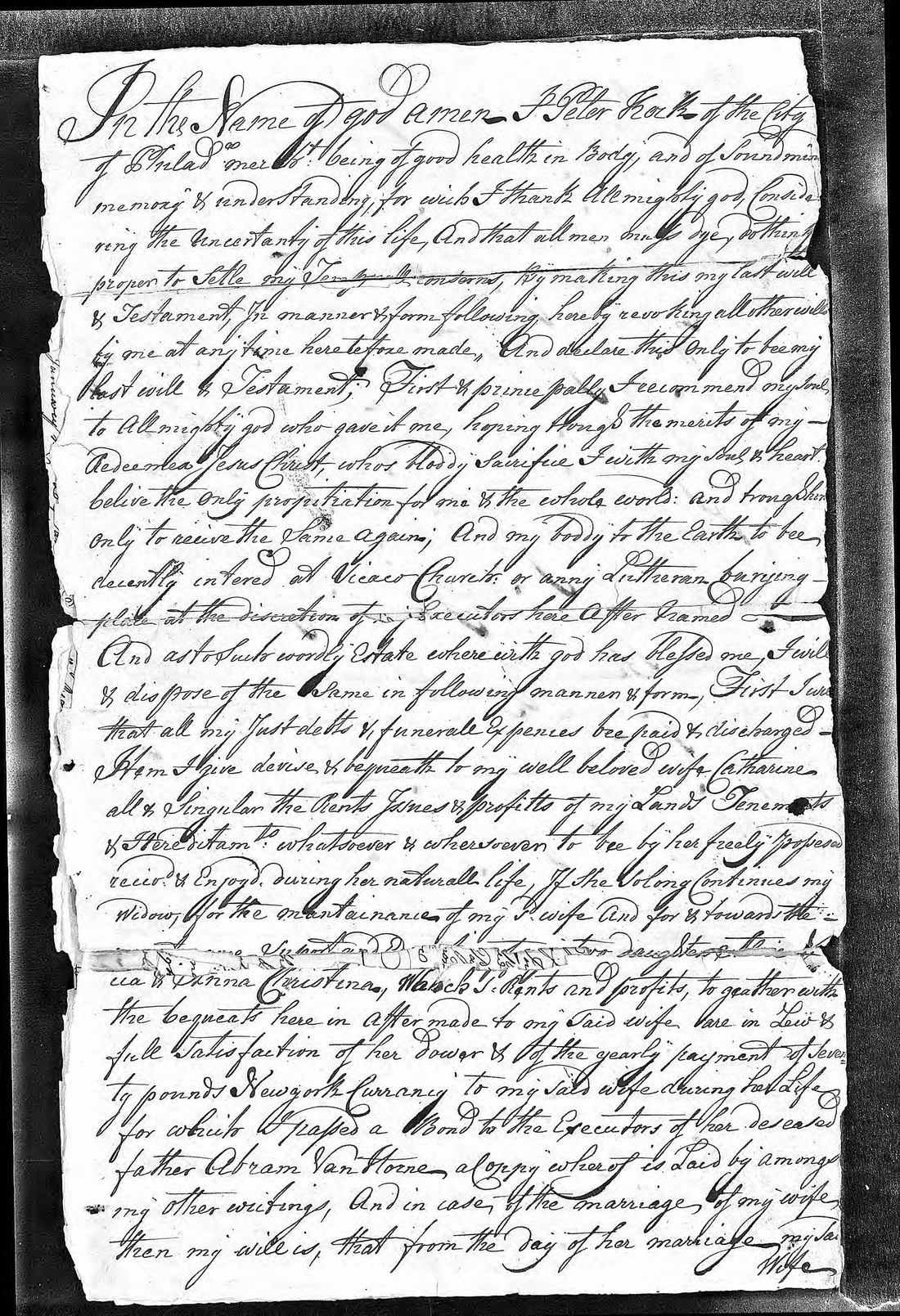
He did leave a will — though finding it took until November 2026. Researchers had searched the published abstracts of Philadelphia will books J and K for his years and found nothing, and that negative comes with a limit, stated honestly: the published volume that would verify it sits behind a research-library restriction that cannot be reached online, so the check stands on the transcribed abstracts. The will itself was never in those books: it sat in his estate's probate file — Philadelphia Administration File #78, on Ancestry — where a research return opened it in November 2026. Dated July 1747, it names his wife Catharine, his two daughters Alice Nerica and Anna Christina, his brother Fredrick, his sisters Anna Catharina and Christina, and leaves £8 a year to his old mother in Sweden. It names no paper mill — his lands pass in general words only. His estate was nevertheless settled by administrators, William Clymer and Charles Edgar — and their names are doubly solid: the Gazette printed them in the act, and the administration bond in the file, dated December 12, 1749, names them on its docket.
There is a second probate citation, and it is printed here because printing conflicts is this project's rule. A research session in November 2026 read the Philadelphia Administration Index as recording "Kock, Peter — 1749, No. 98, Administration Book F, page 146." A second session, sent to verify it on the same film, could not find that entry again — it found an Adam Kock and a Frederick Kock instead — and Administration Book F itself has no readable film online. So that index citation stands unverified: two careful reads of the same index disagree. But the estate file settled the page itself: on the bond's docket, in the clerk's hand, stands "Registered in Book F, page 294." The 146 was a misread; the citation is corrected to page 294, and the correction is printed here rather than quietly swapped in. The administrators' names never depended on any of it — Clymer and Edgar stand on the Gazette's own notices and on the bond.
In December 1749, Clymer and Edgar advertised an auction — a "vendue" — at "the plantation late of Peter Kock deceas'd," set for January 2. The sale list is the fullest picture of his household that survives: farm and household goods, a copper still, a large organ — and three enslaved people, two men and one woman, sold with the rest of the estate. The Gazette notice gives those three people no names. But the estate's own inventory, taken on December 8, 1749, names the enslaved people it lists: Pompey, valued at £40; a girl whose name reads Minte (the reading is uncertain), £35; Dick, £50; Jackey, £40; and a woman, Nancey, £40 — five people. Whether the three sold that January were among the five, no record says, and this article does not claim it. The inventory restores their names; nothing found restores more — no record traces any of the five further. They are stated here as the records state them: part of Peter Koch's estate, and part of his story. The plantation itself was not sold that day — it was offered to rent.
The winding-up rolled on in print. In February and March 1750, his Water Street house, stores, and wharves were advertised to let, and his estate's debts were called in. Then came the land sales, and with them a numbers problem that this article will not tidy away. Sower's paper, in June 1752, offered the plantation whole: 200 acres, several houses, the mill adjacent. The Gazette, in October 1752, auctioned the mill by itself: 45 acres of good land and some meadow. The two notices may describe a sale in lots — the Gazette item is plainly just the mill parcel — but neither paper says so, and no deed has been found to settle it. Both figures stand here, unreconciled, exactly as the two papers printed them.
The October 1752 mill sale adds two names and one warning. The mill was sold "by order of the heirs of Derrick Lefferts and Anne Kock," and buyers were told to apply to Charles Edgar — the same administrator from 1749 — or to Christopher Lehman in Germantown. Who were Anne Kock and Derrick Lefferts? The notice does not say. Derrick's connection is unstated. Anne's possibilities narrowed in 2026: Koch's will names his wife — Catharine — and his daughters, Alice Nerica and Anna Christina, so Anne was not his widow and not a daughter as the will names them; a widow, a daughter, or other kin were the guesses before the will was read, and the first two are now ruled out by it. Beyond that, the record gives the names and nothing else, and this article gives them the same way.
The mill that kept his name
Mills often kept a dead owner's name, and Koch's did. In August 1755 — six years after his death — Sower's paper carried a notice from a papermaker named Nicolaus Hasselbach, working at "the former Koch mill" on Wissahickon Creek, three miles from Germantown. The mill was still standing, still making paper, still called Koch's.
Hasselbach is the reason Koch's name survived at all. He had come to America in 1749, the year Koch died, and his first documented American workplace is Koch's mill. He went on to Baltimore, set up as a papermaker and printer, and the printing type his widow sold to William Goddard in 1773 printed Baltimore's first newspaper. When the historian Lawrence Wroth wrote Hasselbach's chapter in 1922, he mentioned the mill's dead owner in passing — "the late Mr. Koch" — and there the trail went cold for a century, until a Germantown librarian's life work gave the man back his first name. Edward W. Hocker spent years reading Germantown's old German newspapers and abstracting them; in Hocker's abstracts, the death notice reads Peter Koch, merchant, of Philadelphia.
Koch's mill also stands in a bigger story. Paper making in America began on this creek: in 1690, William Rittenhouse built the first paper mill in the colonies on a branch of the Wissahickon in Germantown. The Dewees family had a paper mill on the creek at Crefeld, in Chestnut Hill, from 1710. Was Koch's mill that same Dewees mill, passed hand to hand — or a separate seat nearby? The records found so far do not say, and the deeds that would decide it are the same unreachable ones. It stands here as an open question, printed next to the other one: this project would rather show you two honest questions than one invented answer.
What we still don't know
- When and how Koch got the mill (in 1746 it was Matthew Muris's; by his estate's settlement it was his).
- Whether his mill was the earlier Dewees mill at Crefeld or a seat of its own.
- Whether the 200-acre plantation and the 45-acre mill parcel were one sale in lots or two different sales.
- Why his estate sits in an administration file when he left a will — the file styles Clymer and Edgar both "administrators" (bond and Gazette) and "Executors & Trustees" (the inventory), and no record found explains the change.
- His birth and birthplace, and the name of his church — his will leaves £100 to the church where his family was to be buried, without naming it.
- What became of Pompey, Minte, Dick, Jackey, and Nancey — the five enslaved people his inventory names. No record found traces any of them further.
Timeline
- September 9, 1738 — A Peter Koch, age 36, arrives at Philadelphia on the ship Glasgow and signs the oath list with his mark — the probable arrival of this article's subject. (Strassburger & Hinke, Pennsylvania German Pioneers, Lists 53A/53C)
- May 5, 1743 — Kock advertises land, nails, and goods in the Pennsylvania Gazette — his earliest known trace. (Gazette)
- Winter 1743–44 — He moves to a house on Water Street, Philadelphia. (Gazette)
- November 29, 1744 — He advertises a lost gold seal ring, "P K" under a crown, 20 shillings reward. (Gazette)
- September 12, 1745 — The ship Victory lies at Kock's Wharf. (Gazette)
- September 19, 1745 — A mare strays from his plantation in Germantown Township. (Gazette)
- June 19, 1746 — A neighbouring land sale is described as joining "Matthew Muris's Paper-Mill, on Wissahickon, and to the Plantation of Mr. Kock." (Gazette)
- July 16, 1747 — Koch makes his will: wife Catharine, two daughters, brother, sisters, a mother in Sweden — and no mention of any mill. (Administration File #78)
- April–October 1749 — Kock's Wharf is still named in the paper's wharf items. (Gazette)
- September 10, 1749 — Peter Koch dies at his plantation on Wissahickon Creek. (Sower's newspaper, September 16, 1749, via Hocker's abstracts, p. 14)
- December 8, 1749 — His estate inventory is taken (about £1,057) — and names five enslaved people: Pompey, Minte, Dick, Jackey, and Nancey. (Administration File #78)
- December 1749 — Administrators William Clymer and Charles Edgar advertise the estate vendue at his plantation: household and farm goods, a copper still, a large organ, and three enslaved people; the plantation to be let. (Gazette, Dec 12, 19, 26, 1749)
- February–March 1750 — His Water Street house, stores, and wharves are offered to let; estate debts called in. (Gazette)
- June 16, 1752 — His Chestnut Hill plantation — 200 acres, several houses, adjacent paper mill — is advertised for sale. (Sower's newspaper, via Hocker, p. 34)
- October 1752 — The Gazette auctions the paper mill itself: 45 acres, "well water'd," sold by order of the heirs of Derrick Lefferts and Anne Kock. (Gazette, Oct 12, 19, 26, 1752)
- August 1, 1755 — The mill, now "the former Koch mill," is at work again in print, with papermaker Nicolaus Hasselbach there. (Sower's newspaper, via Hocker, p. 51)
A note on pictures
No portrait of Peter Koch exists in any source found — none is expected for a merchant of 1749 — and no photograph can be captioned as his mill, because the mill's exact seat has not been fixed to a modern parcel. The pictures collected for this story are public-domain maps: Charles Ellet Jr.'s 1843 map of Philadelphia County and a detail of the Chestnut Hill and upper Wissahickon ground where the plantation stood (Library of Congress). They show the neighbourhood, not the mill. The full picture search, including the hunt for a readable scan of the Gazette pages that name him, is logged in the project's image ledger for his story.