Nicholas Hasselbach's American story is anchored to Wissahickon Creek. On August 1, 1755, the Germantown newspaper of Christopher Sower carried a notice from "Nicolaus Hasselbach, papermaker at the former Koch mill, on Wissahickon Creek, three miles from Germantown," offering to hire out his servant. The mill was Peter Koch's paper mill (see Peter Koch's biography); Koch had been dead six years, and the creek neighbourhood still called the place by his name. Hasselbach is the only papermaker ever named at that mill. From the creek he went on to printing in Philadelphia and Chestnut Hill, then to Baltimore, where he set up the town's first press — and in late 1769 or early 1770 he was lost at sea. This is his story, told from the records, with the record's own conflicts left standing where they belong.
The notice that puts him on the creek
The 1755 notice survives in two independent scholarly transmissions: Edward Hocker's abstracts of Sower's newspaper (1980) give it in full, and Oswald Seidenstricker quoted the same item in 1893 — "paper maker in the late Mr. Koch's paper mill on the Wissahicken." The original newspaper issue was not read; Sower's paper does not survive online for 1755. But the notice's content is precise. Hasselbach was the mill's papermaker in residence, and he had a servant of his own there — Wilhelm Stroud, twenty years old, "accustomed to farm work," offered for hire. A passing journeyman does not hire out his own servant from his workplace. In 1755, Nicholas Hasselbach was keeping a Wissahickon paper mill in production.
Where exactly Koch's mill stood was never fixed to a parcel — his own biography places it in the Chestnut Hill neighbourhood, and whether its seat was distinct from the older Dewees paper-mill seats nearby, or a successor on one of them, remains an open question in both dossiers. The seats are not merged here.
A signature in the ship list
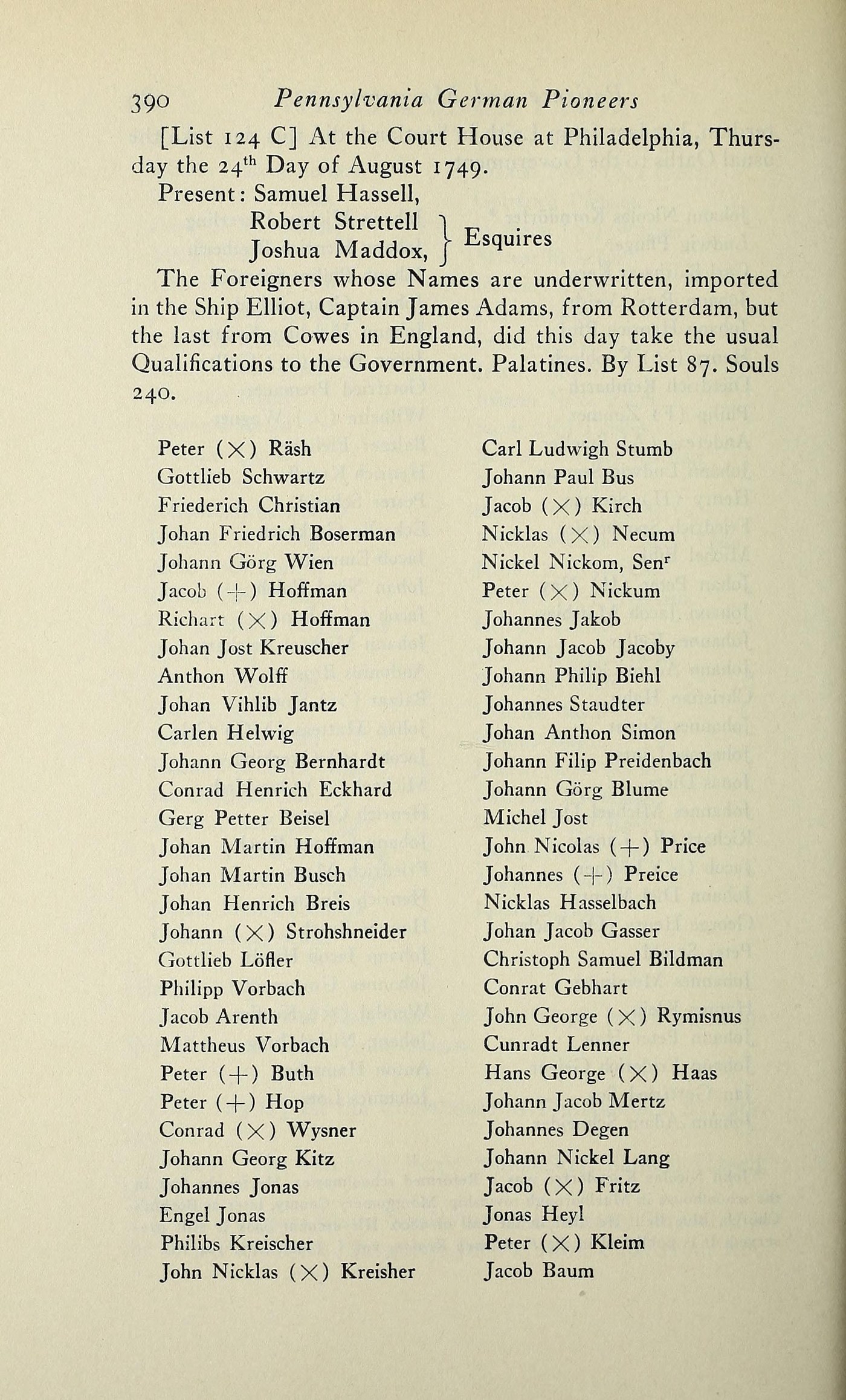
Hasselbach landed the year Koch died. The printed oath list of the ship Elliot (Strassburger and Hinke's Pennsylvania German Pioneers, vol. I, p. 390) records the foreigners imported from Rotterdam via Cowes taking the qualifications at the Philadelphia Court House on Thursday, August 24, 1749 — 240 souls — and among the signers stands "Nicklas Hasselbach," without a mark, in a column of neighbours who made theirs. One conflict rides on the date: I. Daniel Rupp's rival list prints the same passengers under October 25, 1748. This account follows the Pioneers edition, made from photographs of the original signed lists, with the date in the document's own heading; Rupp's dating is printed here as the conflict it is.
His birth is unknown. Isaiah Thomas, the first historian of American printing, wrote that Hasselbach "was born in Pennyslvania" — disproven by the ship list itself. A baptism sometimes offered for him (Raubach, Prussia, December 1728) is flagged as speculation in the very article that offers it, and is not adopted here. He was a German immigrant of 1749; beyond that, the record of his beginnings is the ship list and, by tradition, a training under Christopher Sower at Germantown — "he is said to have learned printing from Christopher Sower" (Wroth), and Thomas adds that he "also acquired a knowledge of papermaking" and followed it "some time near that place." The tradition is printed as tradition.
The missing six years — and a mill on another river
From 1755 to 1762 the record read for this biography is silent, except for one contested item. James Magee, lecturing in 1935, said Hasselbach "built in 1757 a paper mill on Trout Run, which empties into the Schuylkill River near Miquon Station" — later the site of Hamilton's Riverside Paper Mills. John Bidwell's modern catalogue says instead that in 1757 John Johnson sold him a paper mill. Built or bought, the two accounts cannot both be the whole story; Bidwell's book is print-only and stands at citation level here, and Magee's reason for the building — paper shortage at his print shop — sits oddly with a print shop first documented in 1762. What is firm: the year 1757 in both, and Magee's geography. His Trout Run runs to the Schuylkill at Miquon, not to the Wissahickon — so the episode, whatever happened, is background to the creek story, not part of it.
The silent partner
In July 1762 Hasselbach surfaces in a second trade. Seidenstricker places him in partnership with the printer Anthony Armbruster, their office in Moravian Alley (Bread Street), next door to the Moravian church. Thomas calls him Armbruster's "silent partner," and the surviving evidence agrees with the adjective: Armbruster's own newspaper announcement of the office (July 15, 1762) names only himself, one joint imprint survives, and a German calendar for 1763 is attributed "either by A. Armbrüster or by Armbrüster & Hasselbach" — Seidenstricker's own uncertainty, kept. A full-text search of the early American newspaper databases for 1749–1775 finds no occurrence of his name in any spelling: his working life ran in the German-language world, and the English papers never had occasion to print him.
Chestnut Hill, opposite the Ship
In December 1762 the printer Henry Miller took over a house in Second Street, between Race and Vine, "till then occupied by the printer Nicholas Hasselbach, who removed his business to Chestnut Hill, north of Germantown" (Seidenstricker). He had come back to the mill's neighbourhood — as a printer this time. His Chestnut Hill imprint survives in Seidenstricker's list: a German business and household almanac for 1764, "printed and to be had at N. Hasselbach's, opposite the Inn of the Ship." Whether the almanac appeared in other years is not known, and whether the move also put him back at the mill is stated nowhere — the documented move is the printing office. Wroth's last Pennsylvania sighting puts him in Philadelphia in April 1764.
Baltimore's first printer
Baltimore Town had no printer, and Hasselbach saw his chance. On July 6, 1765, Thomas Harrison transferred him the lot next to the Market House — now the northwest corner of Gay and Baltimore Streets — where he probably set up his press (Wroth, from the deed record). More Baltimore property followed. His press, the first in the town, printed school books and small works in German and English; of its output, one item survives with certainty: John Redick's Detection of the Conduct and Proceedings of Messrs. Annan and Henderson, a 47-page pamphlet of 1765 — the earliest known example of Baltimore printing, its only known copy in the Garrett library at what is now Evergreen Museum. He contemplated a German translation of the Bible (Thomas) — a plan, never a printed book — and the famous anecdote of the hearer who answered a missionary, "I go to Baltimore last month, where I see Dutchman make him," comes with Thomas's own warning attached: perhaps what was in the press was a spelling book. The county-seat petition sheets of 1768, printed in English and German with no imprint, "may and probably were" his work — that is Wroth's inference, and it is printed here as his inference.
He bought on credit: his estate papers show three bonds to George Milligan dated April 4, 1767. A land transaction of October 26, 1769 is his last dealing in the record (carried at citation level, from Bigwood's 2015 essay). Late in 1769 or early in 1770 he sailed for Europe "to arrange there the details of a business venture, the nature of which is unknown" (Wroth) — and was lost at sea. Baltimore went without a printer for nearly three years.
The estate papers tell it straighter
Hasselbach died intestate, and his Maryland probate — read for this biography in the original records — corrects the retellings. His widow Catherine's administration bond is dated December 12, 1771. The inventory, taken January 10, 1773, totals £1,675.18.9½, and it is mostly not a printing office: shop stock of cloth, dry goods, and groceries; household goods; "The Printing Materials & Paper belonging to the office" at a single £110; and £1,220 in Baltimore real estate, including a house and lot in Gay Street at £480. The first printer of Baltimore died a merchant-landlord who kept a press. One embellishment dies against this document: the twenty-one violins that a modern essay places among his effects are not in the inventory, which was read in full.
In 1773 Catherine sold the printing materials to William Goddard, who printed Baltimore's first newspaper with them; Thomas says Goddard later sold part of the fonts to Francis Bailey of Lancaster, and a Baltimore tradition that Goddard thought he was buying Caslon type comes with Wroth's own caveat — no evidence Sower was casting type commercially before 1772. Catherine's first account, sworn July 7, 1775 (by then she was Catharine Aikenhead, remarried), charges the estate with £1,703.1.9½, pays out £372.19.3 — Milligan's bonds, the Southit bond, a court judgment, fees in tobacco, her commission — and leaves a balance of £1,330.2.6½. Wroth's "nearly two thousand pounds sterling" is his rounding of those figures, in the wrong currency; the account itself is the correction. Catherine — who appears in this biography as context only, not as one of the project's subjects — remarried twice more in the telling of Wroth's sources, and died in 1807 in her eighty-second year. Her maiden name, and the marriage itself, appear in no record read; the Germantown church registers that might hold them are closed to online readers, and the gap stands.
Timeline
| Date | Event | Source |
|---|---|---|
| 24 Aug 1749 | Signs the oath list of the ship Elliot at Philadelphia (Rupp dates the same list 25 Oct 1748 — conflict printed) | Pennsylvania German Pioneers, vol. I, p. 390 |
| 1 Aug 1755 | Papermaker at the former Koch mill on Wissahickon Creek, offering to hire out his servant Wilhelm Stroud | Sower's Germantown newspaper, via Hocker (1980) and Seidenstricker (1893) |
| 1757 | A paper mill enters the record: built on Trout Run (Magee) or bought from John Johnson (Bidwell) — unreconciled | Magee (1935); Bidwell (2013), citation level |
| Jul 1762 | Silent partner of Anthony Armbruster, printer, Moravian Alley, Philadelphia | Thomas (1874); Seidenstricker (1893) |
| Dec 1762 | Henry Miller takes his Second Street house as Hasselbach removes his printing business to Chestnut Hill | Seidenstricker (1893) |
| 1763 | Prints the German almanac for 1764 at Chestnut Hill, opposite the Inn of the Ship | Seidenstricker (1893) |
| Apr 1764 | Last Pennsylvania sighting, at Philadelphia | Wroth (1922) |
| 6 Jul 1765 | Receives the Baltimore lot next to the Market House, now Gay & Baltimore Streets | Wroth (1922), from the deed record |
| 1765 | The Redick Detection — earliest known Baltimore printing; only surviving specimen of his press | Wroth (1922) |
| 4 Apr 1767 | Three bonds to George Milligan at Baltimore | First administration account, 1775 |
| 1768 | County-seat petition sheets probably from his press — Wroth's inference | Wroth (1922) |
| 26 Oct 1769 | Last Baltimore land transaction (citation level) | Bigwood (2015), via Wikipedia |
| Late 1769 / early 1770 | Lost at sea on a voyage to Europe | Wroth (1922); Thomas (1874) |
| 12 Dec 1771 | Widow Catherine's administration bond, Baltimore County | Maryland Prerogative Court records |
| 10 Jan 1773 | Inventory taken: £1,675.18.9½ in all; printing materials £110 | Baltimore County inventories |
| 1773 | The widow sells the printing materials to William Goddard | Thomas (1874); Wroth (1922) |
| 7 Jul 1775 | First account: £1,703.1.9½ accounted for; balance £1,330.2.6½ | Baltimore County administration accounts |
What to see today
Nothing of Hasselbach's mill survives to see: the former Koch mill on Wissahickon Creek is gone, and its seat was never fixed to a modern parcel — the creek at Chestnut Hill, three miles above Germantown, is the ground his notice names, and that is the honest form of the visit. At Chestnut Hill his printing office stood opposite an inn long gone. In Baltimore, the corner of Gay and Baltimore Streets is a modern intersection; the one surviving product of his press, the Redick Detection of 1765, is at Evergreen Museum, in the Garrett library. And the page of his arrival — the Elliot oath list with his unsigned-mark name among the signers — can be read in Pennsylvania German Pioneers, vol. I, p. 390.