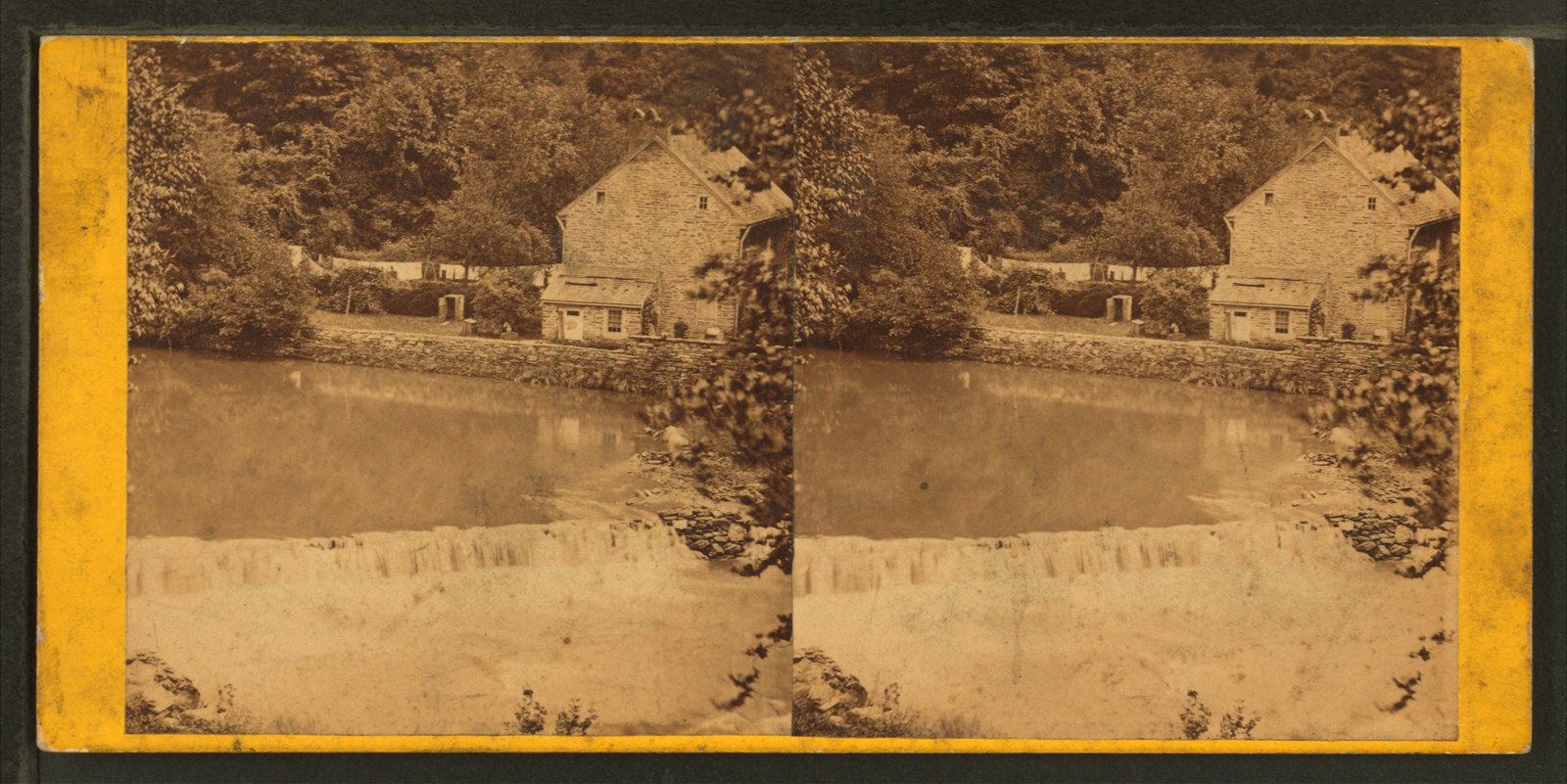
Every mill on Wissahickon Creek is gone, and this one went last. The paper mills at the foot of Wise’s Mill Road, just above Valley Green, were the final working mills on the creek — the last of the Wissahickon mills, as Frederick Brandt titled his chapter about them in 1927. The buildings were taken down in 1884. The dam that powered them is still there.
The seat and the dam
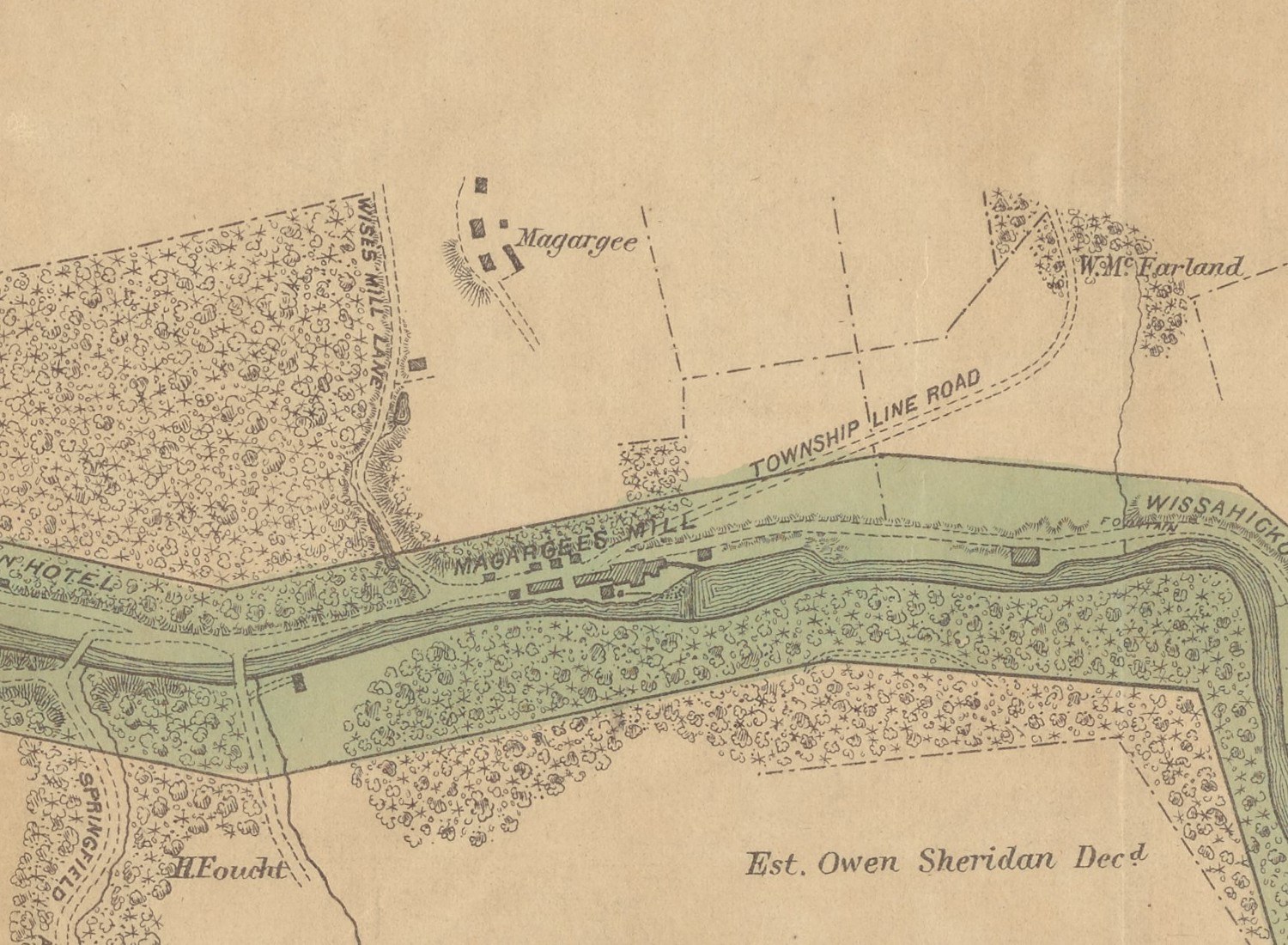
The seat stands on the main stem of Wissahickon Creek, inside the city of Philadelphia, about a mile and a half below the Montgomery County line at Northwestern Avenue. It has its own small tributary: the Philadelphia Water Department’s fish-passage study places the dam “just upstream of the confluence of Wissahickon Creek and Wises Mill Run,” and adds the sentence this whole story hangs on — “the dam still remains.”
The road and the name
Even the road is part of the record. Brandt dates Wise’s Mill Road to 1738, and a Library Company of Philadelphia collection note gives the road’s older name as “Weiss’s (Wise) Mill Road” — the name is German before it is English. One caution belongs here at the start: no “Wise family” running a mill at this seat was verified in anything read. “Wise’s” is the road’s name, and this account prints it as a name, not as a family.
1731 or 1737
The Library Company of Philadelphia’s catalog record for the firm’s lithograph says the paper mill here was “originally built for William Dewees in 1731.” That makes this a second, later DeWees seat — not the Crefeld paper mill of 1710 — and the two are kept separate in this collection. Against the date stands a second one: notes in the Affel Canoe Club study cite Contosta and Franklin’s Metropolitan Paradise for a drawing of “the Upper Magargee Mill, built in 1737.” 1731 and 1737 are both printed here; neither is preferred. Brandt adds that a grist mill stood at the seat as early as 1738, but that paper was then manufactured on this spot “for nearly 150 years.”
The century gap
Then the record goes quiet for a century. Between the grist mill of 1738 and 1844, no operator of this seat is named in anything read. That gap is printed, not filled.
Charles Magarge
In 1844 Charles Magarge rented the mill. He was president of the Bank of Germantown, according to the Library Company record, and in 1853 he bought the works outright and expanded them to house a Fourdrinier paper machine. The firm’s own name for the place was the Wissahickon Paper Mills, and its paper was the celebrated “Wissahickon Paper.” Brandt explains the fame: “Here still flows the spring-filtered water whose purity made possible the whiteness and quality of the celebrated ’Wissahickon Paper.’” The power was the creek itself, held back by the dam above Wises Mill Run.
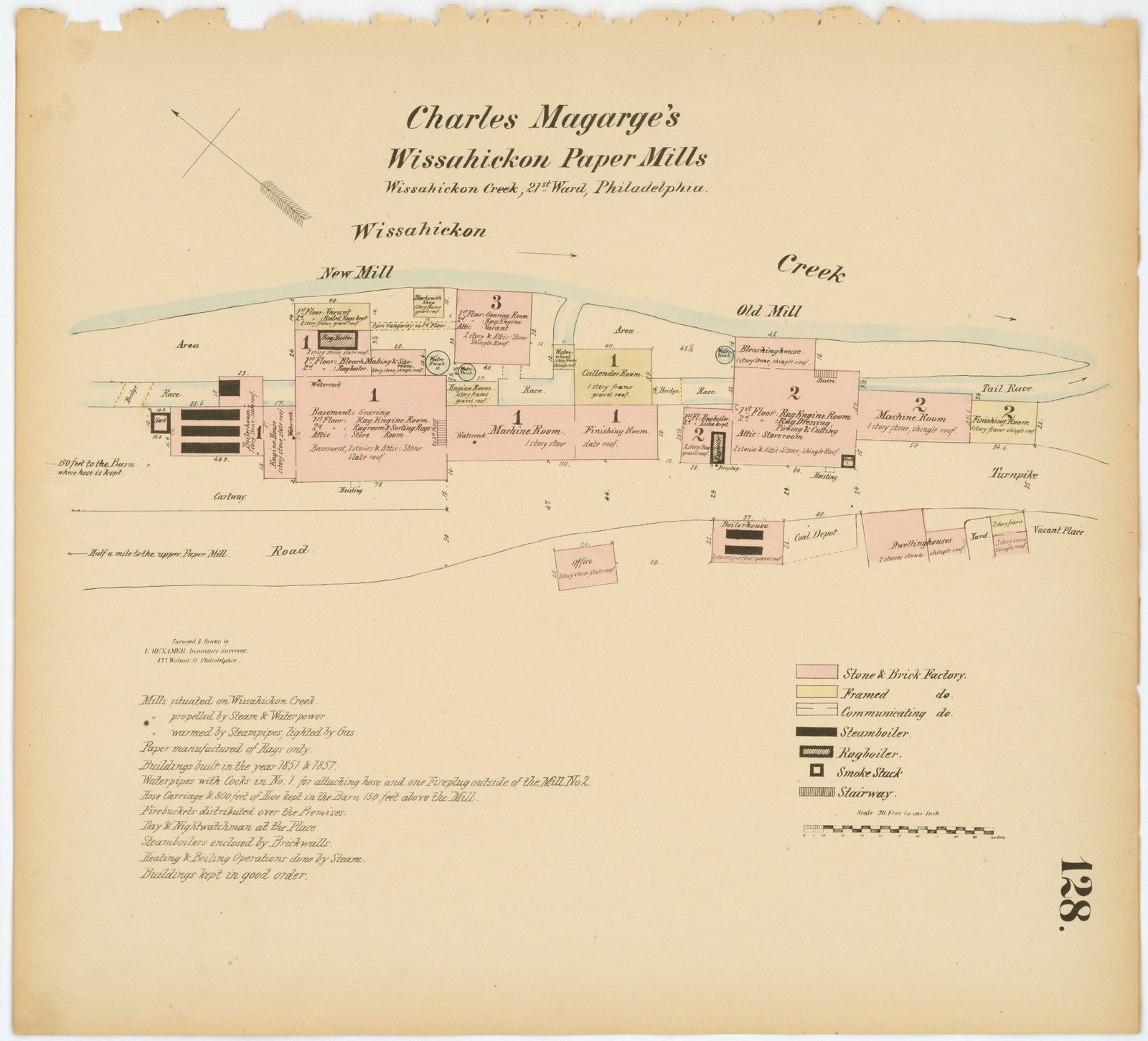
The works at their height survive in a picture. William E. Winner’s oil painting “Magarge Paper Mill,” from about 1858, shows “the main building, boiler house, machine room, and chimney” of the expanded mill; a lithograph by A. Frey, made after the painting, carried the image as the firm’s advertisement, with the firm’s city warehouse named in its title at 30 South Sixth Street. The Hexamer insurance survey drew the mills in 1866 — plate 128, “Charles Magarge’s Wissahickon Paper Mills.” The Library Company catalog makes one more claim for this mill: “It was the first mill to use wood pulp to make paper.” That sentence is printed here in the catalog’s own words, as the catalog’s claim, and at no higher grade — this account does not adopt it as a finding. The name itself comes down spelled three ways — Magarge in Brandt, the survey, and the Library Company record; Megargee in Daly; Magargee in the Paper Trade Journal and the later surveys — one firm under three spellings, all printed as found.
Three mills on the Wissahickon
Magarge’s reach ran beyond this one seat. In 1859 the same Charles Megargee took over the Thomas Mill seat upstream and made a paper mill of it, so at its height the firm held paper mills at two Wissahickon seats. And when the Paper Trade Journal reported the firm’s failure in October 1877, it said the firm owned and operated “three upon the Wissahickon” — the Upper and Lower mills here, and a third, leased mill the Journal calls Hanwell. Hanwell is not located anywhere in what was read: a Hexamer plate, volume 4, plate 272, names Edward Magarge as the client of a “Hanwell Paper Mill,” and that is all this account prints of it. The same failure report added that the Park Commission had recently purchased the ground of one of the three, “the owner, however, being granted the privilege of operating it for ten years longer.”
The failure
The failure itself is documented in the Journal’s own columns, and it reads like a slow collapse. The firm suspended in October 1877 — Magarge’s sickness first, and then a mortgage judgment (the Godey judgment) broke his credit. A creditors’ meeting put the firm’s indebtedness at $200,200 against assets of $175,600. On November 3, 1877, the creditors adopted a composition of fifty cents on the dollar, and by December 8 the settlement was being consummated. The firm traded on: its advertisements — “Wissahickon and Hanwell Mills Papers,” listing 30, 32 and 34 South Sixth Street — run through 1878 and into April 1879. For the leased Hanwell mill, the Journal of July 13, 1878 carried both a news item and Magarge’s own advertisement: the mill still running, his lease from the Commissioners of Fairmount Park expiring July 16, 1878, and the plant offered at private sale for $15,000 — one Fourdrinier machine, four engines, a rag boiler and cutter, turning out 85,000 to 100,000 pounds a month of fine book paper. Two things often carried with this story were not found in the twenty-six Journal issues searched, and they are printed at a lower grade for that reason: that Alexander Balfour was co-lessee of the third mill in 1878, and that he purchased Megargee’s Wissahickon interest in 1879. What the Journal does state, in its own words, is the end. On April 28, 1883: “Alex. Balfour is moving the machinery from the Wissahickon Mill to his new mill at Philadelphia.”
The end, in two steps
So the last mill ended in two steps, and the sources keep them separate. The work ended in 1883 — the Water Department study states it flatly: “Magarge Mill closed in 1883, but the dam still remains.” The buildings stood one year more. John T. Daly, writing in 1922, gave this seat its distinction: when the park commissioners cleared the valley after 1873, “All these establishments, with the single exception of the Megargee Paper Mill near Chestnut Hill (which was allowed to stand until 1884) were immediately torn down.” Brandt’s word for 1884 is “removed.” The mill’s office survived the demolition in a new job — Brandt, on the ground in 1927, found it “still in use as a Park Guard House.” And the demolished mills had a second life of their own: the Lotus Inn, built in the 1880s at the foot of Shur’s Lane, “was constructed… using materials from the demolished Megargee Mills,” and served catfish and waffles there until the park expansion closed it in 1916.
The fountain
The last miller left his name somewhere no mill history mentions. Half a mile beyond Valley Green stands the Pro Bono Publico fountain of 1854 — the first drinking fountain in Philadelphia, according to Daly. It was “the joint gift of John Cook, by whom it was erected, and Charles Megargee, owner of the land, whose famous paper mill, in a nearby meadow, was the last industrial establishment left standing along the Wissahickon.” Brandt adds the fountain’s inscriptions: “Pro bono publico” — “Esto perpetua.” For the public good; may it last forever.
The family after the creek
The family outlasted the creek. The Hexamer indexes carry the firm’s later mills — the Dove Mills (Magargee Brothers, 1882; Estate of Theodor Megargee, 1894) and the Spring Lawn Mill of the Megargee Paper Mills (1894). The Wissahickon closure of 1883–84 did not end the family in paper; it ended paper on this creek.
The dam still remains
What is left at the seat is the dam, and the dam is now a problem in its own record. The Water Department study records that Tropical Storm Floyd in 1999 “severely damaged” it and “breached the right side,” so the creek now flows around the dam’s downstream right side, wearing the bank away toward Forbidden Drive; the study recommended the dam’s removal or modification, and its language calls the broken dam a major safety hazard. Brandt, seventy years earlier, had seen it gentler: “Battered and broken, the old dam beyond the Guard House marks the departed glory of the missing mill.” The dam still remains.
Timeline
| 1731 | The paper mill at the foot of Wise’s Mill Road is built for William Dewees (Library Company of Philadelphia catalog record; a second source dates the Upper Magargee Mill to 1737 — see 1737). |
| 1737 | Alternative building date for the Upper Magargee Mill, from a drawing caption in Contosta & Franklin, Metropolitan Paradise, as cited in the Affel Canoe Club study’s notes (citation grade). |
| 1738 | Wise’s Mill Road is dated to this year, and a grist mill stands at the seat (Brandt). |
| 1844 | Charles Magarge rents the mill (Library Company record). |
| 1853 | Magarge purchases the mill and expands it to house a Fourdrinier paper machine (Library Company record). |
| 1854 | The Pro Bono Publico fountain is erected, the joint gift of John Cook and Charles Megargee (Daly). |
| 1858 | William E. Winner paints “Magarge Paper Mill,” showing the expanded works; A. Frey’s lithograph after it advertises the firm (about this year; Library Company record). |
| 1859 | Charles Megargee takes over the Thomas Mill seat and makes a paper mill of it — the firm’s second Wissahickon seat (Daly). |
| 1866 | Hexamer’s insurance survey of the mills, volume 2, plate 128: “Charles Magarge’s Wissahickon Paper Mills.” |
| 1877 | The firm suspends in October (Magarge’s sickness, then the Godey mortgage judgment); the Paper Trade Journal reports it owned and operated “three upon the Wissahickon” (October 20). A creditors’ meeting sets the indebtedness at $200,200 against assets of $175,600 (October 27). A composition of fifty cents on the dollar is adopted (November 3), and the settlement is being consummated by December 8. |
| 1878 | The leased Hanwell mill is offered at private sale, asking $15,000, its Fairmount Park lease expiring July 16 (Paper Trade Journal, July 13). The firm’s “Wissahickon and Hanwell Mills Papers” advertisements run through this year and into April 1879. |
| 1882 | The Hexamer indexes carry the Dove Mills for Magargee Brothers — the family’s paper-making continues off the creek. |
| 1883 | Alexander Balfour moves the machinery out of the Wissahickon Mill (Paper Trade Journal, April 28). The mill closes (Philadelphia Water Department study). |
| 1884 | The mill buildings are removed — the single exception allowed to stand until this year when the park commissioners cleared the valley (Daly; Brandt). The mill office survives as a Park Guard House. |
| 1880s | The Lotus Inn is built at the foot of Shur’s Lane using materials from the demolished Megargee Mills (Friends of the Wissahickon). |
| 1894 | The Hexamer indexes carry the Dove Mills for the Estate of Theodor Megargee, and the Spring Lawn Mill for the Megargee Paper Mills. |
| 1916 | The Lotus Inn closes under the park expansion (Friends of the Wissahickon). |
| 1927 | Brandt records the old mill office in use as a Park Guard House and the dam standing “battered and broken.” |
| 1999 | Tropical Storm Floyd severely damages the dam and breaches its right side (Philadelphia Water Department study). |