The upper mill
Cresheim Creek is the Wissahickon’s own tributary, running down through Mount Airy and Chestnut Hill to meet the bigger creek, and in the early 1800s Peter Bechtel Sr. built two paper mills on it. The home mill — Bechtel Paper Mill No. 1 in this collection — stood low on the creek. This was the second seat, the upper mill, and it was the smaller of the two: one pair of paper engines against the home mill’s two, and its own dam, a pond of about four acres giving some thirty feet of head and fall, five feet less than the home mill’s water.
How far above the home mill it stood, the record gives twice and disagrees with itself. The advertisement that offered the Bechtel estate for sale in 1838 placed this mill “within half a mile of Lot No. 1, on the same Stream.” David Hinkle, whose family’s mill stood further up the creek and whose recollections were printed in 1889, remembered the upper Bechtel mill as “about a mile above” the lower. The advertisement was a seller’s document, written to sell the pair as neighbours; Hinkle’s was a memory set down half a century later. Both distances are printed here, and neither is preferred. The tract itself ran to about twenty-four acres. Nothing standing on the ground today is attributed to this seat in any source read.
Sold out of the estate
Peter Bechtel Sr.’s will of 1837 names no mill at all, so this seat enters the written record not through the will but through the sale that followed his death. In 1838 his executors advertised the estate in lots, and the upper mill was Lot No. 3, described in the advertisement’s own words:
“…a Stone Paper Mill 35 by 45 feet, 2½ stories high, with one pair of Engines, but would run two a great part of the year, a Stone Drying House 24 by 33 feet, a Stone Sizing House, a large Stone Mansion House, 18 by 40 feet, two stories high, a large Stone Barn, 26 by 40 feet… This Mill is supplied by a Dam which covers about 4 acres of land; head and fall about 30 feet, and in a good repair.”
The sizing house is worth noticing: the home mill’s description lists no such building, so the smaller works had one room the bigger one is not recorded having. The advertisement also names the man then working the mill — it stood “now in the occupancy of Joseph Bechtel.” A third Bechtel at a Bechtel mill sounds like family, but no record read proves his exact relation to Peter Sr., and this account does not guess one.
The executors’ account, settled after the sale, carries the seat’s only priced record: “Messuage Paper Mill and Tract of Land Sold to Joseph Carr — $6,000,” with Carr’s bond and mortgage for $3,000 among the estate’s assets — half the price carried on credit. One caution rides with that line, and it is printed rather than smoothed over: the account does not name the lot it sold. That the mill Carr bought for $6,000 was this Lot No. 3 mill is a correspondence between the account and the advertisement, not a proven identity, and it is carried at that grade here.
Carr’s Pleasant Mills
Joseph Carr’s name, not Bechtel’s, is the name this seat carried through its longest documented years — but when his years began is a genuine puzzle. Hotchkin’s history of Germantown, Mount Airy and Chestnut Hill (1889) prints Hinkle’s account: “The upper mill was owned about sixty-five years ago by Joseph Carr, who made cotton laps.” Sixty-five years before 1889 is about 1824 — some fifteen years before the executors’ sale of 1839. Either Carr held or worked the mill long before he bought it, under a tenancy the deed-side record does not show, or Hinkle’s “sixty-five years” was loose. No record read settles it, and the two dates stand side by side.
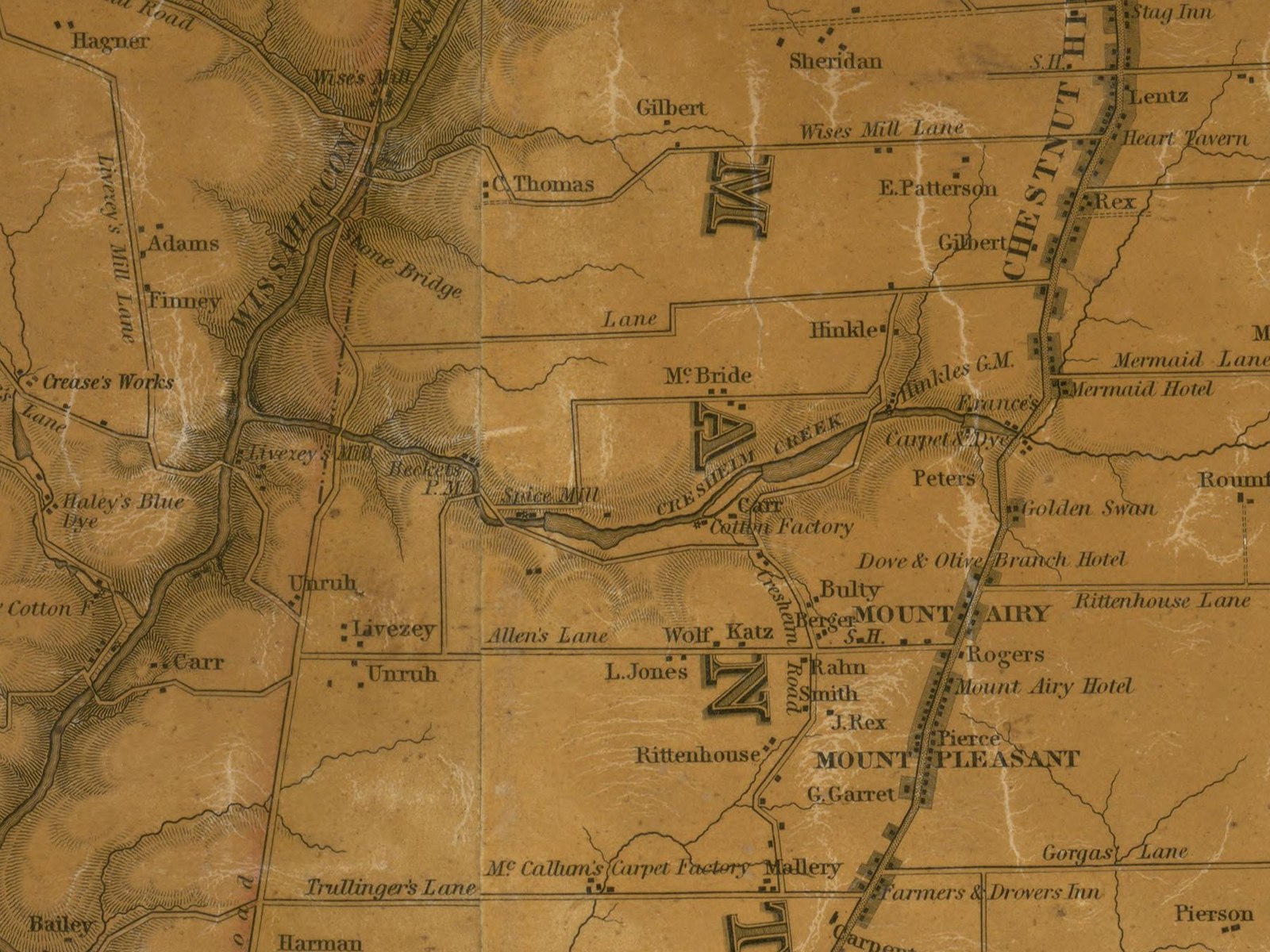
What Carr made here is not in doubt, and it sets this seat apart from every other mill on the creek. He turned the paper mill to cotton laps — the prepared cotton batts that spinning mills fed into their machines. No other Cresheim seat is recorded making them. The maps carry his name, not the Bechtels’: Charles Ellet Jr.’s map of Philadelphia County, surveyed in 1843, prints the seat “Carr Cotton Factory,” and Scott’s map of Germantown in 1856 prints “Carr’s Pleasant Mills.” McElroy’s city directories list “Carr Joseph, manuf. Cresheim, Mt Airy” in 1857, 1858 and 1859. The Bechtel name covers barely a generation of this seat’s life; the Carr name covers the maps.
The last years, and an end nobody recorded
After Carr, the mill was rented to Thomas Randall & Son, who manufactured woolen yarn — paper first, then cotton, then wool, one small works changing its trade with each tenant. Hotchkin gives no dates for the Randalls. They are the last operators named for this seat in anything read; an earlier working list for this collection named David Hey here, but nothing read puts Hey at Carr’s mill — he belongs to the Cresheim seats further down — and that line is not carried.
By 1889 the upper mill stood idle. Hotchkin’s sentence is the whole of it: “The upper mill is also unoccupied, and owned by Mr. Houston.” Whether this seat’s ground reached H. H. Houston together with the fifty-three-acre home-mill tract of 1882, or separately, no source read states. No fire, no taking, and no demolition date for this mill exists in anything read. When the Houston and Woodward ground passed to the city in the early 1900s as an addition to Fairmount Park, whatever still stood on the seat went with the park-making, at a date no source gives. No output figure and no workforce figure for this mill was read in any era — the thinnest file of the Cresheim mills, printed at the weight the record allows.
Timeline
| c. 1824 | David Hinkle’s recollection, printed by Hotchkin in 1889, places Joseph Carr at the upper mill about this year, making cotton laps — some fifteen years before the executors’ sale; the two dates are printed unresolved. |
| 1838 | The Bechtel executors advertise the estate; the upper mill is Lot No. 3, “now in the occupancy of Joseph Bechtel,” with its stone paper mill, drying house, sizing house, mansion house and barn, a dam of about four acres, and about thirty feet of head and fall. |
| 1839 | The executors’ account records a messuage, paper mill and tract of land sold to Joseph Carr for $6,000, half of it on Carr’s bond and mortgage; the account does not name the lot, so the match to Lot No. 3 stands as correspondence, not proven identity. |
| 1843 | Ellet’s map of Philadelphia County prints the seat “Carr Cotton Factory.” |
| 1856 | Scott’s map of Germantown prints the seat “Carr’s Pleasant Mills.” |
| 1857–1859 | McElroy’s directories list “Carr Joseph, manuf. Cresheim, Mt Airy” in each of the three years. |
| 1889 | Hotchkin records the upper mill unoccupied and owned by Mr. Houston, after a tenancy by Thomas Randall & Son, who made woolen yarn. |
| Early 1900s | The Houston and Woodward ground passes to the city as an addition to Fairmount Park; no date for this seat’s end is given in any source read. |