
Cresheim Creek is a tributary of Wissahickon Creek, running down through Germantown, Mount Airy, and Chestnut Hill to meet the bigger creek near its lower end. For a century the lower reach of the Cresheim was a row of working mills, and the lowest of the Bechtel paper mills stood near the creek’s mouth, on its south bank. It made paper first, then wool, then cotton, and it is the one Cresheim mill of which anything still shows: traces of its walls remain visible on the creek today.
The seat, fixed by a lawsuit
The record that fixes this mill’s place is not a mill history at all. It is a lawsuit — Faux v. City of Philadelphia, decided May 1, 1929 — over whether the lane above the mill was a public road. Tracing the claimant’s land, the court stated that Bechtel’s Mill Road ran to the property along the north side of Cresheim Creek, “the mill being on the south side of the creek, about 1,200 or 1,500 feet west of the McCallum Street bridge.” The road itself kept the mill’s names in turn: Billmeyer’s Mill Road in the deeds, then Bechtel’s Mill Road, and Cherry Lane today. Hotchkin, who knew the ground and wrote in 1889, placed “the lower mill of the Bechtels” two ways in a single passage — “near where the creek empties into the Wissahickon, and near Allen’s lane railroad station,” and also “about a quarter of a mile above its mouth.” Both of Hotchkin’s distances are printed here; they do not quite agree, and the court’s measured figure is the tighter fix. Ellet’s map of Philadelphia County, surveyed in 1843, faces the seat with the mill’s own name: “Bechtel’s P.M.”
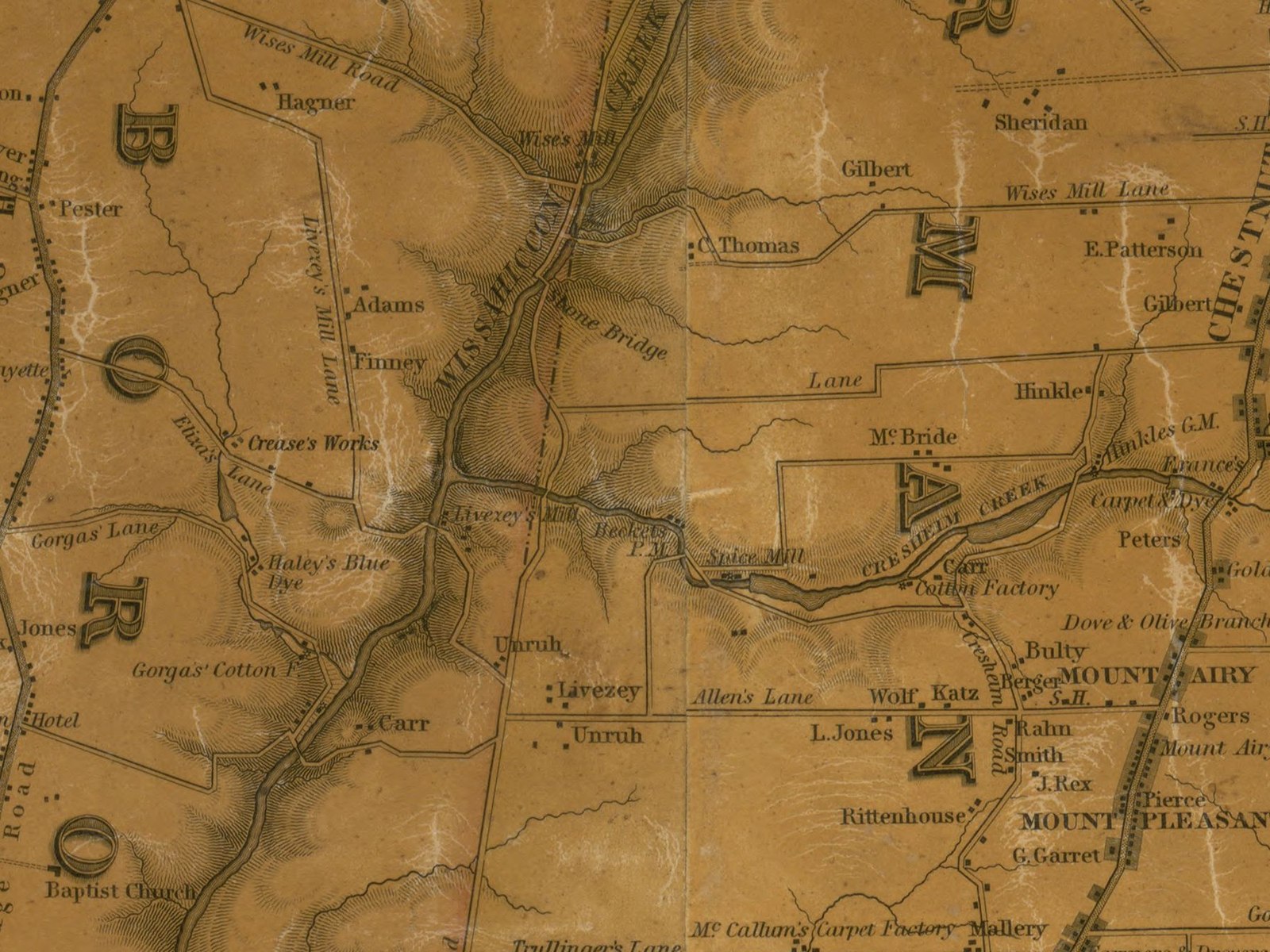
Peter Bechtel’s paper mill
The mill Peter Bechtel built was not the first on the spot. When his executors advertised the property in 1838, they recorded that he had built his mill “in the place of one which stood a few feet above, on the same stream.” Who built that earlier mill is named nowhere in anything read. Bechtel’s own paper mill went up about 1800, and Hotchkin says it worked at paper “for many years.” The one measure of its working scale comes from the Census of Manufactures of 1820, as printed in Bishop’s History of American Manufactures: Peter Bechtel at Cresheim is counted with 10 hands and 600 reams of paper a year. But the same printed list credits a second Germantown paper-maker, “Billmeyer & Co.,” with 6 hands and 1,000 reams — and which set of figures belongs to which shop is not certain on Bishop’s page. Both are printed here as found, and neither is chosen. Peter Bechtel Sr. died in 1837. His will, dated July 18 of that year, devises his “Plantation or tract of Land… near Germantown” — and names no mill anywhere in it. That silence is printed plainly: the will is not evidence for this mill, and this account does not use it as any.
The estate sale, and the machine in the inventory
In September 1838 the executors advertised the mill property as Lot No. 1 of the estate sale, and their advertisement is the fullest description any Cresheim mill gets: “a Stone Mill House 40 by 50 feet, 4 stories high,” with “two Paper Engines, calculated to make the finest kind of Paper”; beside it a stone drying house 80 by 34 feet and three stories high; a stone mansion house; two stone tenant houses; a large new stone barn; and land “accumulated by purchases at different times,” about 52 acres in all. The advertisement’s proudest claim was the water: the mill “has a great command of water — about 35 feet head and fall — and a quantity sufficient, except in very dry seasons, to run the Engines constantly.” In 1839 Peter Bechtel Jr. bought the home tract for $8,000, and $6,500 of the price stood on bond and mortgage — a financed purchase, on the executors’ own account. Peter Jr. died in January 1842, and his estate inventory shows what the home mill had become by then: a cylinder paper machine valued at $2,500, a steam boiler, and two paper engines. The mill was a mechanised, partly steam-assisted paper shop in 1842 — which sits awkwardly beside Hotchkin’s cleaner story that the seat made paper only until 1833 and then changed trades. Paper machinery was still on the floor a decade after the paper era is said to have closed, and both versions are printed.
Hill’s Mill: wool, then cotton
After 1842 the seat passed to Joseph Hill. Hotchkin’s account is short: “Joseph Hill tore down the old mill, erected a new one, and worked it at woolen spinning.” The paper trail puts Hill’s tenure loosely in the 1840s and 1850s. Barnes’s map of 1855 prints “Hill & Wild Woollen Mill” above Allen’s Lane, and McElroy’s directory of 1859 lists the firm on the ground — Milton Hill and Jacob Wild, manufacturers, on Cresheim Road near Mermaid Lane. The trade then turned again: the seat’s later history, as carried in this collection’s research, gives Hill’s Mill as a cotton factory from about 1850 to 1879, standing beneath the McCallum Street Bridge. So the product of this one seat ran paper, then wool, then cotton across its working life. One record will not settle into that chain: Smedley’s atlas index of 1862 carries a “Hill’s Carpet Factory” on Cresheim Creek below Paper Mill Lane — further up the creek than this seat’s fixed place. It may be this mill under a loose locator, or a second Hill seat. Nothing read decides it, and it is printed as an open question.
The long quiet
No fire ended this mill, and no park taking. It simply stopped. The Faux court, looking back from 1929, said milling on the tract had ceased “forty or fifty years” before — about 1879 to 1889 by that arithmetic. In 1882 H. H. Houston acquired the tract, 53 acres by the court’s figure, and Hotchkin wrote in 1889 that the lower mill “has not been used for several years, and is owned by H. H. Houston.” The successor building was still standing about 1900, when it was photographed facing up the creek with the McCallum Street Bridge behind it — a photograph held by the Chestnut Hill Conservancy, whose rights were not cleared for use here. Henry Houston dismantled the mill at a date the photograph’s caption does not give. What is left is what the Chestnut Hill Local’s caption said in 2019, under that same photograph: “Traces of the mill’s walls remain visible today.” Of all the mills on Cresheim Creek, this is the one seat whose own fabric still shows above the ground.
Peter Bechtel himself has his own full story among this site’s Historical Figures.
Timeline
| c. 1800 | Peter Bechtel Sr. builds his paper mill on Cresheim Creek, on the place of an earlier mill that stood a few feet above it; the earlier mill’s builder is nowhere named. |
| 1820 | The Census of Manufactures, as printed by Bishop, counts Peter Bechtel at Cresheim with 10 hands and 600 reams a year; the same list credits “Billmeyer & Co.” with 6 hands and 1,000 reams, and which figures belong to which shop is not certain. |
| 1837 | Peter Bechtel Sr. dies; his will, dated July 18, devises his plantation near Germantown and names no mill. |
| 1838 | September: his executors advertise the mill property as Lot No. 1 of the estate sale — a stone mill house 40 by 50 feet, four stories high, two paper engines, a stone drying house 80 by 34 feet, about 52 acres, and some 35 feet of head and fall. |
| 1839 | Peter Bechtel Jr. buys the home tract for $8,000, of which $6,500 stands on bond and mortgage. |
| 1842 | January: Peter Bechtel Jr. dies; his estate inventory lists a cylinder paper machine valued at $2,500, a steam boiler, and two paper engines in the mill. |
| 1843 | Ellet’s map of Philadelphia County faces the seat “Bechtel’s P.M.” |
| 1855 | Barnes’s map prints “Hill & Wild Woollen Mill” above Allen’s Lane. |
| 1859 | McElroy’s directory lists Milton Hill and Jacob Wild, manufacturers, on Cresheim Road near Mermaid Lane. |
| c. 1850–1879 | Hill’s Mill works as a cotton factory beneath the McCallum Street Bridge (dates carried at index grade from Jarvis, 1990). |
| 1862 | Smedley’s atlas index carries “Hill’s Carpet Factory: Cresheim Creek below Paper Mill Lane” — a locator further up the creek than this seat’s fixed place; unresolved. |
| 1882 | H. H. Houston acquires the 53-acre tract. |
| 1889 | Hotchkin: the lower mill “has not been used for several years, and is owned by H. H. Houston.” |
| c. 1900 | The successor mill is photographed facing up Cresheim Creek, the McCallum Street Bridge behind it (photograph held by the Chestnut Hill Conservancy; not reproduced here). |
| 1929 | Faux v. City of Philadelphia fixes the seat — the mill on the south side of Cresheim Creek, about 1,200 to 1,500 feet west of the McCallum Street bridge — and dates the end of milling to “forty or fifty years” before. |
| 2019 | The Chestnut Hill Local captions the c. 1900 photograph: “Traces of the mill’s walls remain visible today.” |