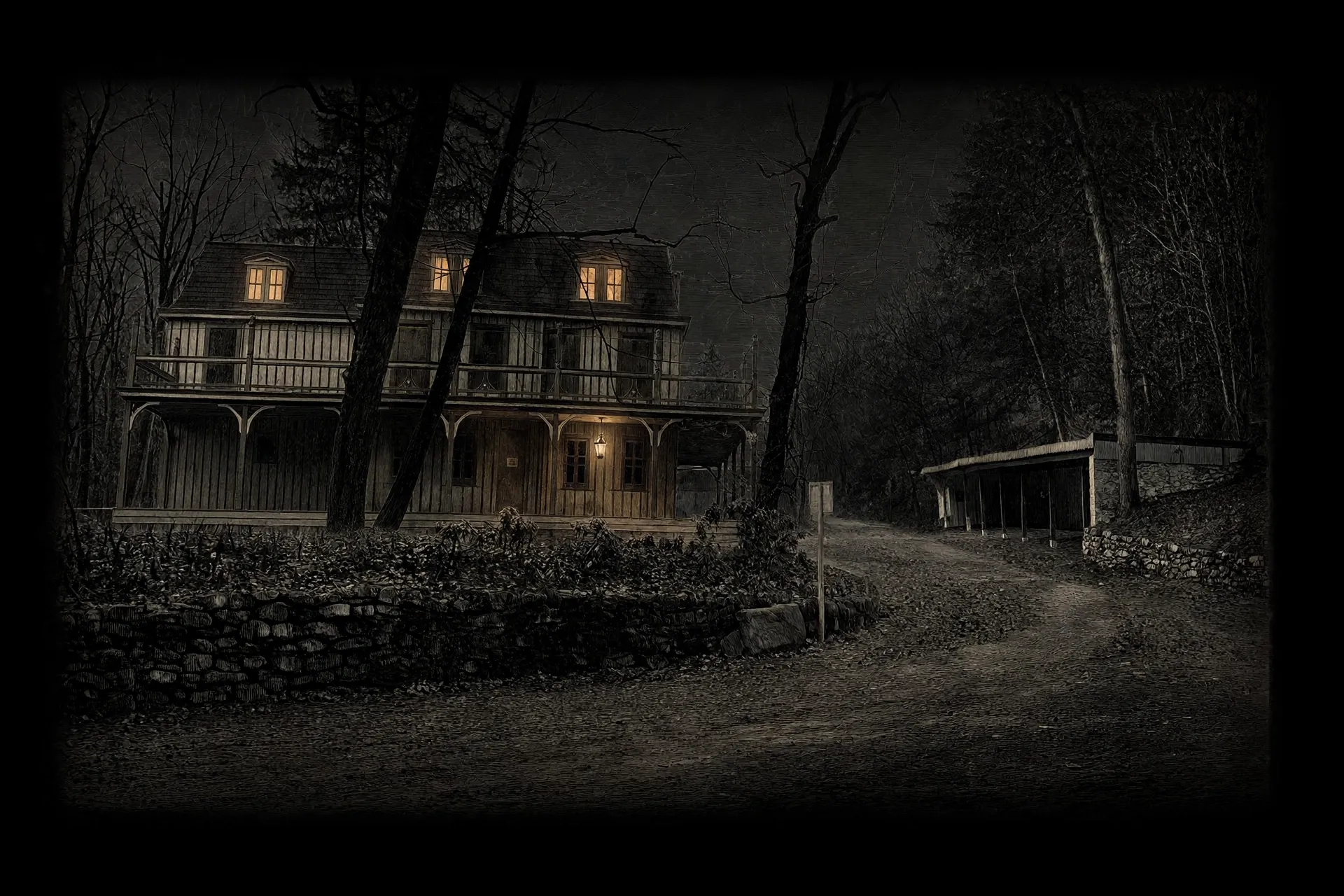
One photograph of this house survives, and it was never in any archive. The keeper of this ground had it all along — a card-mounted print, gone soft at the edges: the inn in winter, two stories of board siding under a mansard roof, a balcony running the full width, an arched veranda below, and to the right a long open carriage shed with a wall of stone at its end. The Library Company's cabinets hold only its bridge. The house was here, in the keeper's hands, the whole time.
They say it was built in the 1880s out of another building's bones — timbers salvaged from the demolished Megargee Mills, carried to where the drive meets Rittenhouse Street, just outside the park's first boundaries. Outside the line, the park's liquor laws did not reach it. The Crawford stage ran past its door; horsemen and winter sleigh parties stopped for the house dinner, catfish and waffles.
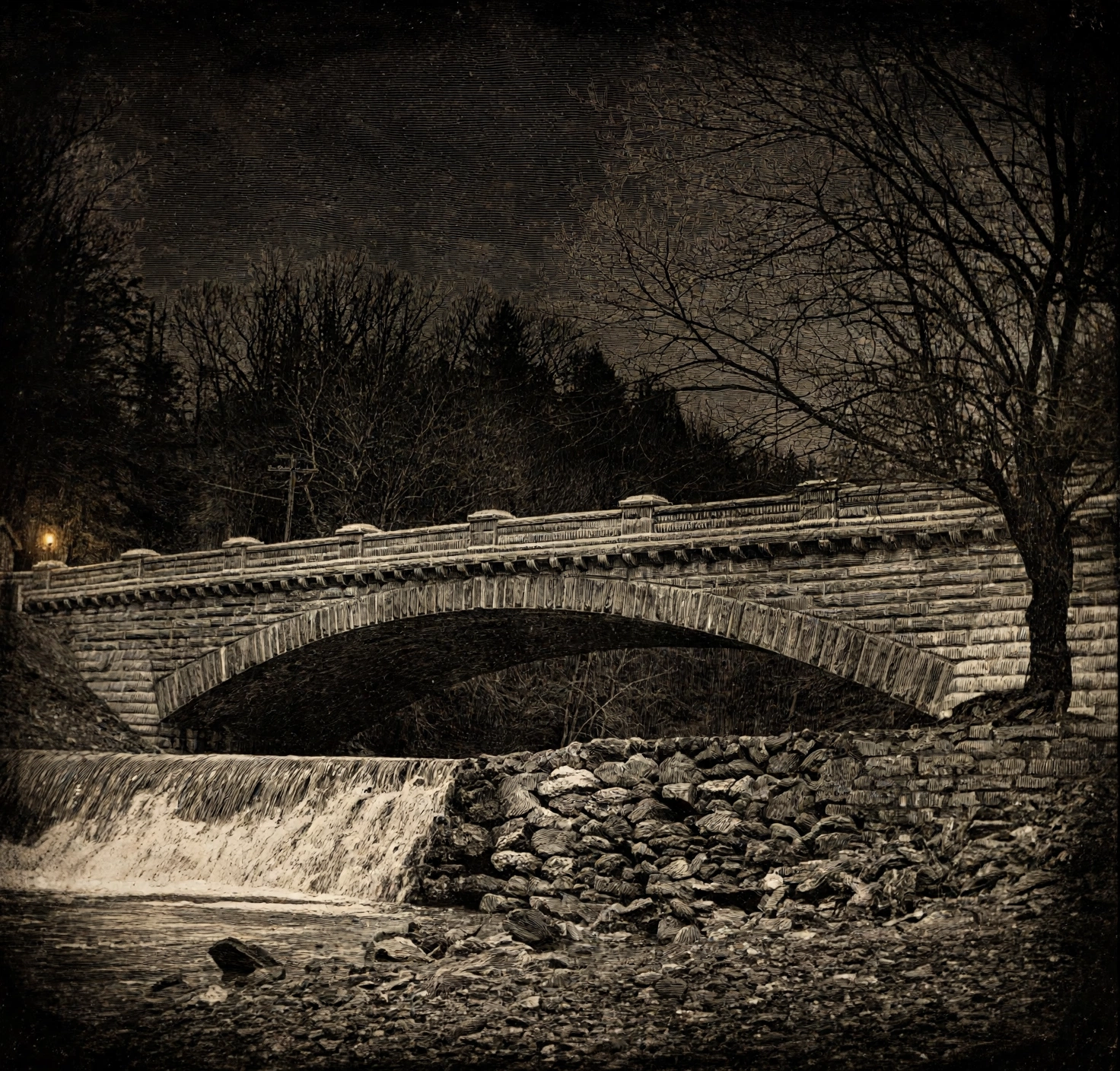
The directories keep its keepers the way they keep everyone, a line a year: Frederick Miley in 1887; then Charles Mehler — junior in 1899, the "junior" gone by 1904, whether dropped or a different man is not known. In 1896 and '97 the city built a stone bridge over the creek for the traffic of this crossing, and the bridge took the inn's name.
The bridge took the inn's name, and then lost track of it. The stone bridge of 1896–97 replaced the covered Old Red Bridge at this crossing, and the library's records call it the Lotus Inn Bridge, but they disagree on its history. One record says the Lotus Inn Bridge was “replaced by the Blue Stone Bridge in 1920”; another says the Blue Stone Bridge itself was “also known as the Lotus Inn Bridge,” built in the same 1896–97. The catalogs disagree on whether this was one bridge with two names or two bridges in turn.
The directories could never settle the house's address, either: Rittenhouse at the drive, Wissahickon Avenue east of Walnut Lane, the drive at Shur's Lane — five forms across the years, all kept as printed. The ground itself is plain enough: the foot of Shur's Lane, where the drive meets Rittenhouse Street, a step outside the park's first boundary line.
One evening survives entire. A man named Bart Haley, called the Soothsayer by the newspapers, described it to Christopher Morley years later: a hired hansom out from the city, a seat on a honeysuckled balcony over the creek, and chicken and waffles "served with the proper flourish by a colored servitor named Pompey." Nothing else is known about Pompey. He would have been working the Mehler years, about 1908 to 1910. No census-taker's line for him is known.
The evening can be dated, roughly, by its teller: Haley said “ten years ago” to Morley, which puts the hansom ride about 1908 to 1910 — the Mehler years, the inn's last. And one small mystery is never explained: why Lotus? No source explains the name. It hangs over the door of an inn built from a dead mill's timbers, unexplained.
By 1911 the directories have dropped the house. In 1920 Morley walked the drive and wrote the shortest obituary any inn on this creek received: "Only a few paces on was the abandoned foundation of the Lotus Inn." Whether the park's 1916 expansion took it, and what was paid, and to whom — the paper is not there. And why Lotus? Nobody wrote that down either.
But the photograph has a tell, and the keeper read it years ago: the shed. A section of its stone wall stands beside the trail to this day, in the woods at the bend of the drive — and in our own time the keeper took the old print and drew the house back into a photograph of the trail as it stands, the inn risen where the wall still stands. The séance does the same work by older rules. The house is not lost. It is here, in its picture, in its wall, and in its name — which the bridge below still carries over the creek.