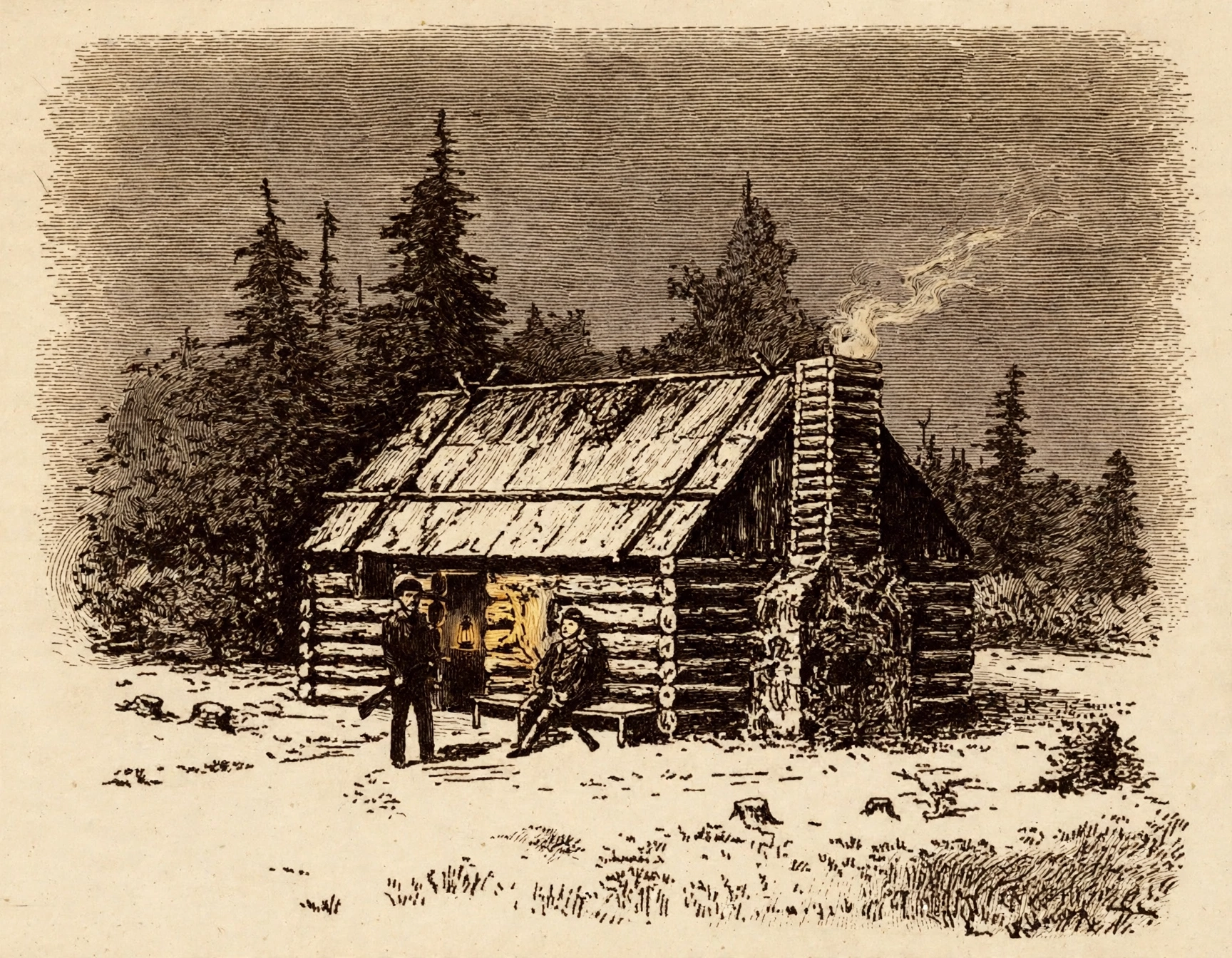
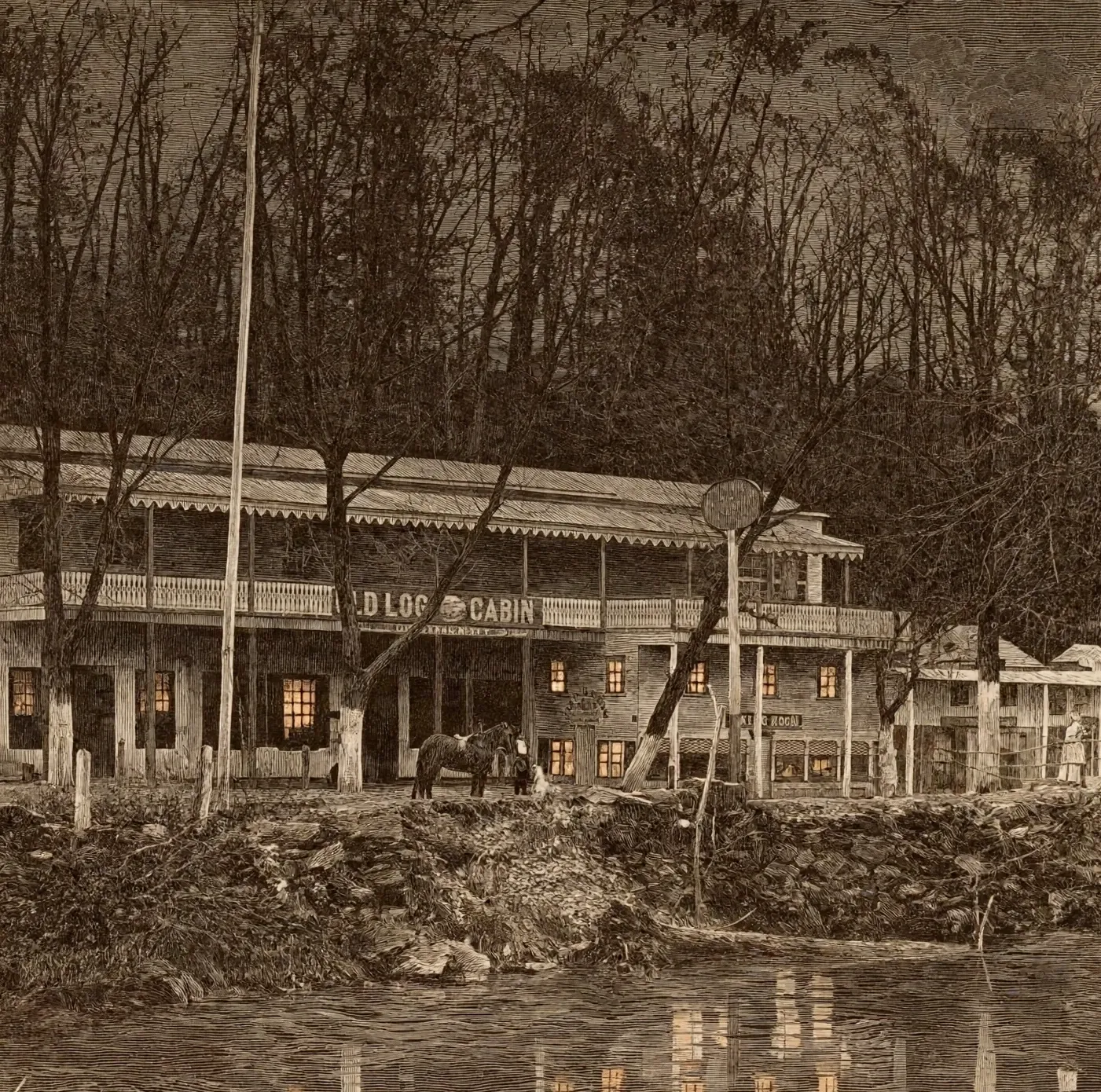
Begin with the lie in the name. The Old Log Cabin was not built of logs. A reporter who walked through it in October 1860 — the Press, an eyewitness — found the cabins whitewashed plank: a bar room, an ice-cream booth, boats for hire at twelve and a half cents the hour. What the house kept was a menagerie: a raccoon, an eagle, a crow — and two bears, who had learned the house's best trick. Given a bottle of sparkling water, the bears bit through the cork and the twine and drank it down. Strangers came up the creek just to watch them do it.
The keeper the directories name is Thomas Lewellen — spelled Lewellen in the books, whatever later writers made of it — at the tavern from 1855 to 1860. He is the only keeper firmly documented. The ground itself belonged to the Rittenhouse estate, the paper family whose mills had stood on this creek since before the republic. In March 1864 the estate put the old stand up at auction: "a well established Tavern Stand known as the 'Log Cabin,'" the sale notice called it, on four acres and a fraction, running to the middle of the creek. The gavel fell at nine thousand dollars. The buyer's name the papers did not keep.
Six months after the sale, the cabin had its worst night in print. On the evening of Wednesday, 7 September 1864, a fight that began with racial taunts and thrown stones ended with a pistol shot. One paper names the wounded man John Hepps; two later reports name him William F. Sider. The man charged, Lloyd Douglass, kept a cigar and liquor store at 637 Lombard Street — he was a guest that night, not the keeper. Witnesses put their horses under the cabin's shed and came out of the house to say what they saw. Who kept the house by then — who poured in the bar room that night — the torn page of the newspaper no longer says, and no other paper is known that does.
The end, at least, is written down by the men who did it. The Fairmount Park Commission's report for 1871 reads, in full: "The 'Log Cabin' buildings were removed, and the grounds were cleared and graded." The artist Benjamin Evans painted the house anyway, and dated his sheet 1874, and wrote under it "Torn down 1874" — three years after the Commission swore it was gone. Both are in the Sources. The name outlived the building: for decades afterward the park's guidebooks still directed strangers to the springs, the troughs, and the boat hire "at Log Cabin," as if the house were standing just out of the picture.
Two park maps bracket the removal. The park guide map of 1876 (AS-54) prints “Log Cabin (Removed)”. Bushnell’s park map of 1897 prints “LOG CABIN” at the Hermit Lane crossing with no word “removed” — twenty-six years after the Commission’s report. The 1897 sheet has no legend and nowhere says it marks former places; its label is printed just as the standing hotels’ labels are, though it carries no building mark beside it, as theirs do, and the map gives no key to say what that means. Both labels are given as printed; this page does not claim the house was standing in 1897.