Two mills above the Bechtel mills
High on Cresheim Creek — the Wissahickon tributary that runs down through Germantown and Mount Airy to the main creek — two mill seats stood above the Bechtel paper mills, in the corridor between Germantown Avenue and the creek’s fall toward Allen’s Lane. One was a grist mill that became a shoddy mill. The other was a carpet mill that became a woolen mill. They had different beginnings and different ends, but one buyer links them: David Hey, who owned both by the late 1860s and ran them as a single business.
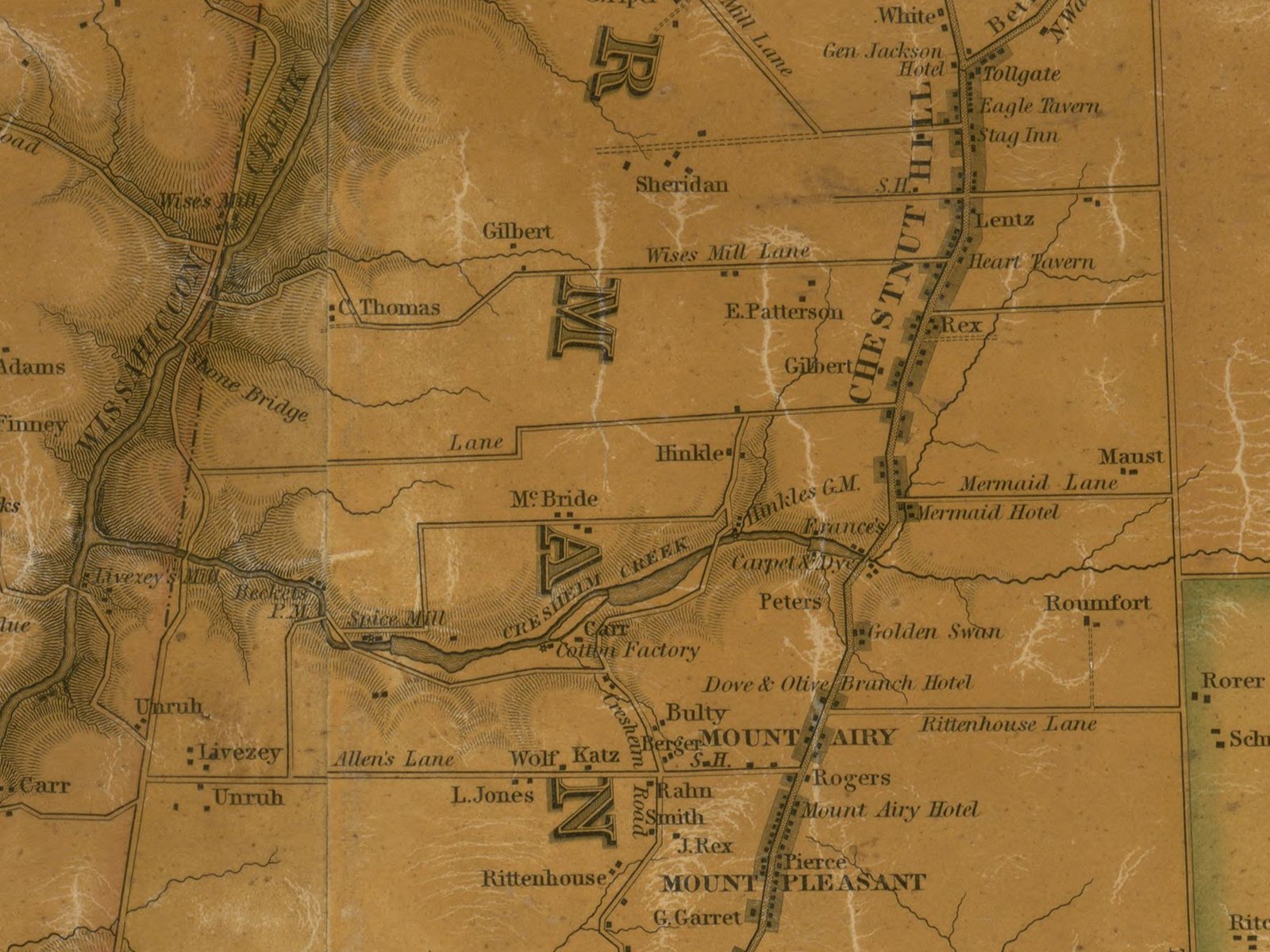
The seats are told apart throughout this account, because the record keeps them apart. The grist mill stood on the north side of the creek, above the upper Bechtel mill. The carpet mill stood further up, on the south side, reached in the 1880s from the lane by the house of Charles Megargee. Even their order on the creek is disputed. Charles Ellet Jr.’s map of Philadelphia County, drawn in 1843, places the France carpet works below the Hinkle grist mill. The Germantown historian S. F. Hotchkin, walking the creek in 1889, puts the Hinkle mill below the France seats. The two orderings cannot both be right — Ellet is the earlier source and the mapmaker, Hotchkin the later source and the local man — and the disagreement is printed here rather than settled. Of the buildings themselves, nothing stands: the lower mill was a ruin by 1889, and of the upper works, a modern caption to an old photograph concludes that no features visible in it remain.
The Hinkle grist mill
The lower seat began with flour. David Hinkle told Hotchkin his family’s milling history, and Hotchkin printed it: David’s father built the grist mill on the north side of the creek and ran it until his death, and his son Jesse Hinkle “continued the business, and ran a custom mill, and ground feed” — a custom mill being one that ground the grain farmers brought to it. No record read gives the year the mill was built.
The Hinkles sold to two brothers. J. & E. France bought the mill and “made shoddy there” — shoddy being wool pulled out of old rags and cloth, ready to be spun again. McElroy’s city directory for 1859 prints the firm as “France Erwin & John, carpet manuf.” on Cresheim Road near the Chestnut Hill railroad; Hotchkin’s Hinkle account names the brothers “John and Irwin France.” Whether the second brother’s name was Erwin or Irwin, the records read do not settle — the spellings are printed as they come.
David Hey bought the seat sometime between 1859 and 1867. No deed for the purchase was read; the bracket is set by the directories. McElroy’s still lists the Frances in 1859, and the 1867 directory lists “David Hey & Brothers (David, John, Levi & Richard Hey), woollen manufacturers, Chestnut Hill.” By then Hey held both Cresheim seats.
Fire on Cresheim Road
The grist mill’s textile life ended in one afternoon. On May 21, 1875, Hey’s shoddy mill on Cresheim Road burned — a stone mill 90 by 35 feet, “totally destroyed” by about one o’clock, the Philadelphia Inquirer reported the next day. The loss was put at $18,000 — $10,000 of it machinery, $5,000 stock, $3,000 the building — against $7,000 of insurance. The manager, J. Stoebley, was badly burned about the hands, arms and face carrying goods out of the flames, and about 25 hands were thrown out of work. The same report carried the detail that shows how the two seats were worked as one business: Hey “had another mill near by, which would be ready for operation in about two weeks.” One fire barely paused him.
The burned mill was never rebuilt. Hotchkin, fourteen years later, closed its account in a sentence: “The mill is in ruins ever since. Mr. Hey still owns the property.” When the ruin was finally cleared away, no record read says.
The carpet mill that became Cedardale
The upper seat had a trade of its own before the Frances. Above Jesse Hinkle’s flour mill, the Hinkle account says, “was a comb factory, afterward used by John and Irwin France as a carpet factory.” Who made combs there, and when, is in nothing read.
How early the France carpet works stood there is itself disputed. Ellet’s 1843 map indexes “France’s Carpet Factory” where Germantown Road meets Cresheim Creek, and the map’s face prints “France Carpet & Dye Works” — a carpet works on this seat by 1843, on the map’s evidence. Hotchkin dates John France’s carpet making to “about 1849,” reckoning it forty years before his own writing. The six years between the map and the memory are printed as a conflict, not split down the middle. John France lived at Chestnut Hill and later removed to Camden, New Jersey.
Hey’s purchase — the same 1859-to-1867 bracket as the lower seat — changed the works again: “Mr. David Hey changed the mill into a shoddy mill,” Hotchkin says, and it took the name Cedardale. On July 7, 1880, fire started in the picker room of the Cedardale Valley Woolen Mill. The Inquirer described a wooden building two stories high with a stone attic, 92 by 44 feet, with a picker room 53 by 30 feet; it burned from about eleven in the morning. The insurance was $20,000 — $1,000 on stock, $4,000 on the building, $15,000 on the machinery, a machinery figure that says more about the works’ scale than any description that survives.
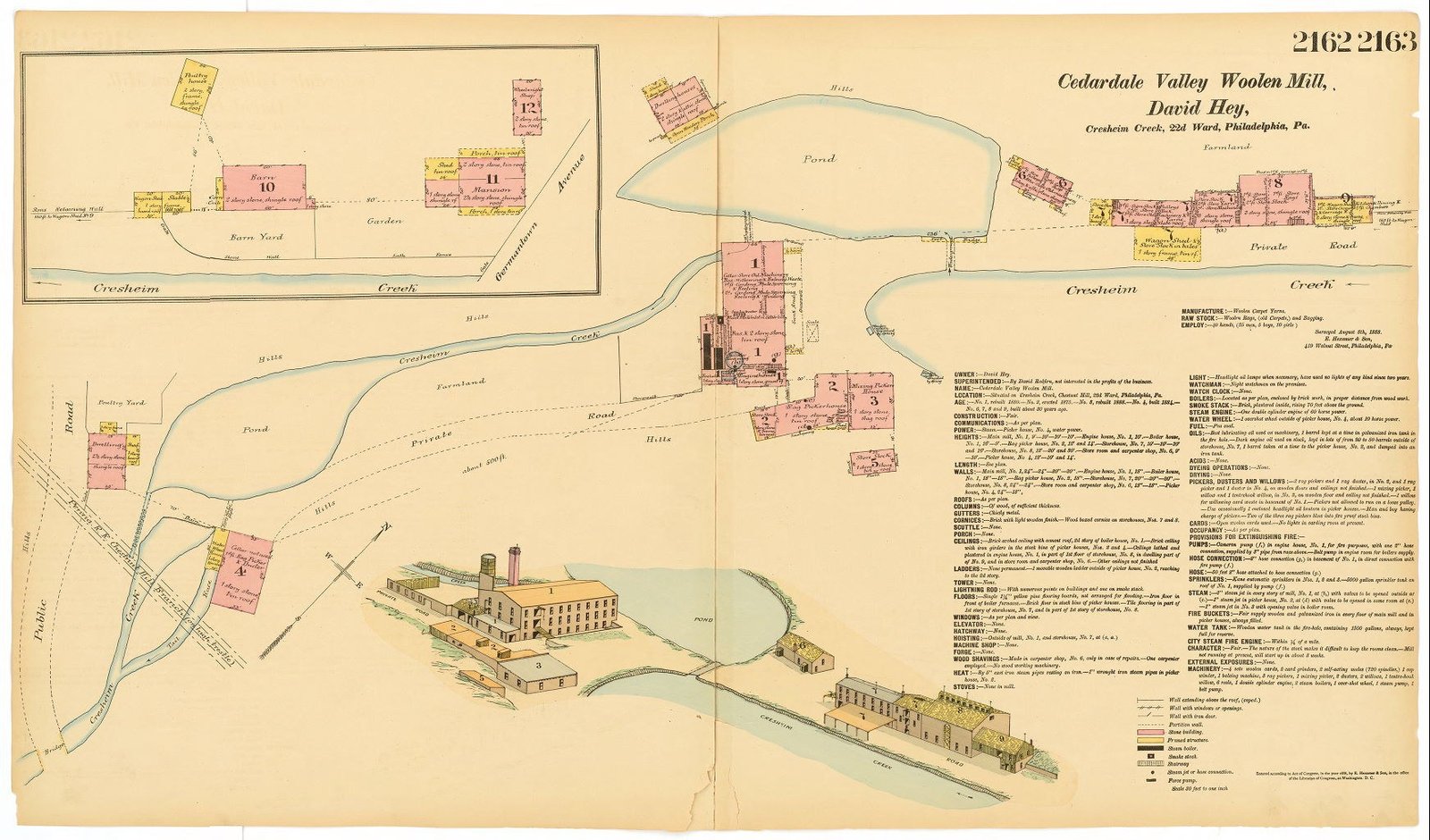
Hey rebuilt the same year. An insurance survey of 1888 counts nine buildings at Cedardale: the first “rebuilt 1880,” the second “erected 1875,” the last four “erected about thirty years ago.” The power was steam, with the picker house still driven by the creek’s water, and the product was woolen yarn. The survey gives no count of the workforce.
The rag dealer who bought the mills
Hey’s two purchases were one strategy, and its other end was in the city. He was a Yorkshire-born dealer in rags and paper stock, in business at 3rd and Callowhill by 1850 — and the mills he bought on Cresheim Creek were the kind that turned rags back into wool. Rags came in at the city shop; shoddy and yarn went out at the creek. The four brothers of the 1867 firm — David, John, Levi and Richard Hey — were the family’s American generation, and Richard stayed in the mill business beside David to the end of his life. When Richard was buried in March 1894, the report stated that the brothers had operated the shoddy mill on Cresheim Creek and that it was “now owned and operated by David Hey.”
The works were still running on January 26, 1897, when a workman, William Raynor, died at work in the mill — the last dated proof of operation found. That date matters, because a modern account of Chestnut Hill’s industry states that by around 1890 none of the mills were in operation; for Hey’s mill, the dated record runs seven years longer.
The end was written into Hey’s will, dated November 5, 1897, directing his executors to “close up my mill and other business” within two to three years of his death. He died on December 1, 1901. His estate inventory, filed January 8, 1902, locates the works as “Mills, Germantown Avenue, near Mermaid Lane” — in a deep hollow west of the Germantown Avenue bridge, near today’s Cresheim Valley Drive and Navajo Street — and prices the closed mill’s goods at $471: “horses, blacksmith and wheelwright shop, cards, mules, engines, boilers, water wheel, fire pump, etc.” The whole estate came to $39,679.81. When the Cedardale buildings were finally taken down, no record read says; an 1895 photograph shows them standing, and nothing in that photograph remains today.
David Hey’s own story — the rag trade, the brothers, and the will that closed the mill — is told in full among this site’s Historical Figures.
Timeline
| 1843 | Ellet’s map of Philadelphia County prints “France Carpet & Dye Works” on Cresheim Creek and indexes “France’s Carpet Factory” at Germantown Road |
| c. 1849 | Hotchkin’s recollection dates John France’s carpet making on the upper seat to about this year — six years after the map already shows the works |
| 1850 | David Hey is in business at 3rd and Callowhill in Philadelphia as a dealer in rags and paper stock |
| 1859 | McElroy’s directory lists “France Erwin & John, carpet manuf.” on Cresheim Road near the Chestnut Hill railroad |
| 1867 | McElroy’s directory lists “David Hey & Brothers (David, John, Levi & Richard Hey), woollen manufacturers, Chestnut Hill” — Hey owns both Cresheim seats by now |
| 1875 | May 21: Hey’s shoddy mill on Cresheim Road, the old Hinkle grist mill, burns totally; loss $18,000 against $7,000 insurance; the manager is badly burned and about 25 hands lose their work |
| 1880 | July 7: fire in the picker room burns the Cedardale Valley Woolen Mill; Hey rebuilds the same year |
| 1888 | The Hexamer insurance survey of Cedardale counts nine buildings, the first “rebuilt 1880,” the second “erected 1875”; product woolen yarn |
| 1889 | Hotchkin records the lower mill “in ruins ever since” the 1875 fire, the property still Hey’s |
| 1894 | March: Richard Hey’s burial report states the Cresheim shoddy mill is “now owned and operated by David Hey” |
| 1897 | January 26: workman William Raynor dies at work in the mill — the last dated proof it was operating; November 5: Hey’s will directs his executors to “close up my mill” |
| 1901 | December 1: David Hey dies |
| 1902 | January 8: Hey’s estate inventory is filed, pricing the closed mill’s goods at $471 |