This page is not about one mill. It is about a small group of grist mills in Roxborough Township that survive in exactly one kind of record: the Pennsylvania tax lists of the 1770s and 1780s. The lists name the miller, tag his trade, and put a value on his property. They do not say where in the township his mill stood, what water turned its wheel, or what became of it.
No seat has been fixed for any of these mills — not one. No drawing, photograph, or survey of any of them exists, and none is expected: a mill whose ground is unknown leaves no picture. The mills on this page are separate mills, and they are not merged into one. What follows is what the lists prove, what they do not prove, and the one attempt to pin a seat down — which failed honestly.
The three millers
Thomas Rees stands first in the lists. In 1781 he is tagged “miller” and valued at £989 — one of the two largest mill valuations in Roxborough that year, behind only the Care and Livezey seats. In 1783 the list tags him with a grist mill. An Evan Rees stands in the 1779 list: probable kin, and not merged with him here.
Henry Pannebecker stands in two lists, seven years apart — a career, not a mention. In 1774 the list prints his name “Pennypacker” and tags him with a grist mill. In 1781 he is “miller,” valued at £723.
Richard Umstad stands in one list only: “miller” in 1781, valued at £964 — among the township’s four largest mill valuations that year, on a single tagged line. A John Umstatt stands in the 1779 list: probable kin, and not merged. The Roxborough Umstads were a landholding family, so a deed trail for Richard is plausible — but the deed books are paper records, and under this project’s online-only rule that trail stands unbuilt.
Two more names stand in the same lists at a lower grade, and they are recorded so the group is complete. Sebastian Fisher was taxed in Roxborough in 1779 and tagged “miller” there in 1781. Adam Prutzman held a grist mill in 1774, and a Conrad Prutsman was taxed in 1779. Both read as likely tenant millers at creek seats; neither has a seat fixed. The group is five names, not three.
Big mills that no map names
The valuations are the scale of these mills, and they are working-mill figures. In the same years, the township’s known creek seats stand in the same band — the Gorgas seat’s grist mill was valued at 800 in 1785. Mills valued from £723 to £989 were mills of the first rank, not stones in a farmyard.
Yet the famous list of the creek’s mills names none of them. In 1779 Horatio Gates Jones set down eleven Roxborough mills in creek order, and every one of the eleven is placed — but there is no Rees, no Pannebecker, and no Umstad among them. Two readings stand open. The men may have ground as tenants at seats Jones listed under the owners’ names. Or their mills stood on water his creek list did not cover.
This project’s own sweep of the lists places all three men on the creek system. That placement is an inference, and it is printed as one: the lists themselves name no water at all, and Roxborough also held mills on its Schuylkill slope and on its small runs.
The one attempt: Rees’ Print Works
Sixty years on, the name Rees turns up on Roxborough industry once more. The Free Library’s index of Charles Ellet Jr.’s 1843 map of the county names “Rees’ Print Works: Eliza’s Lane (Roxborough).” A print works is a calico-printing shop — a shop that prints patterns on cloth. It is one of the few Roxborough textile works the map’s index names, alongside the Gorgas factory and Haley’s dye works.
The lane itself can be partly traced. The Lafayette Hotel stood at Ridge Road and Eliza’s Lane, by the index of Barnes’s 1865 map. By 1862, Crease’s Chemical Works stood on Eliza’s Lane above Ridge Avenue. It was a lane off the Ridge in lower Roxborough, carrying chemical and printing trades in turn.
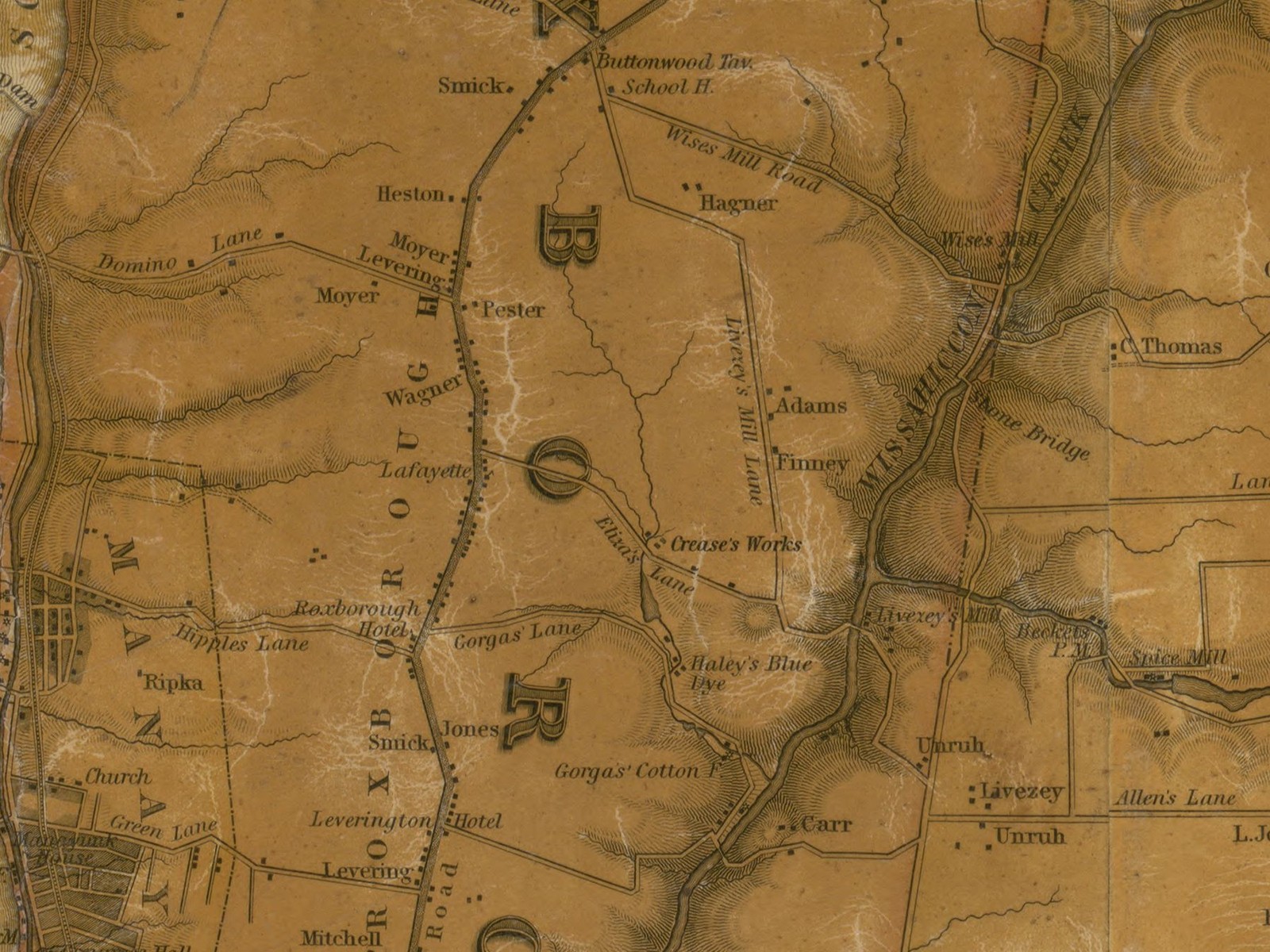
But the attempt fails, and it fails on the record. Nothing read puts the print works at the lane’s creek end, proves it ran on water power, or ties its Rees to the miller of 1781. A grandson, a namesake, a tenant’s successor — all are possible, and none can be proved from the online record. Thomas Rees’s seat stays unfixed. The print works stands as this group’s one lead: the only later Rees works in the township in anything read.
Pannebecker and Umstad: no thread to pull
For the other two men, not even an attempt is available. The Pannebecker name belongs famously to Skippack — Hendrick Pannebecker, the surveyor — but nothing read ties the Roxborough Henry to that family, and he is not merged with them. For Umstad, the family’s Roxborough land is the only thread, and it runs through deed books that exist on paper only.
The end
All of these mills are gone. No closing, fire, taking, or demolition record was found for any of them. If any stood inside the ground the Fairmount Park Commission began acquiring in 1868, the general pattern of those years is the context: taken buildings “torn down or became derelict and decayed,” with the WPA finishing the work in the 1930s. That pattern is printed here as context only — not as any one mill’s fate.
The standard accounts of the valley give these men nothing at all: no map, no list of seats, no later history names them. The tax lists alone prove that in 1781 three of Roxborough’s largest mills were turning under names no one can now put on the ground. Whether the list of 1779 hides them under other men’s names, or the creek held more mills than the famous list counts, is a genuine open question — and it stays open here.
Timeline
| Year | Event | Source |
|---|---|---|
| 1774 | Henry Pannebecker, printed “Pennypacker,” is taxed with a grist mill; Adam Prutzman is taxed with a grist mill | Pennsylvania tax lists, via the project’s tax-list sweep (SWEEP-26) |
| 1779 | Jones’s list sets down eleven Roxborough mills in creek order; none of the three is named. Evan Rees and John Umstatt stand in the year’s tax list | Jones, The Levering Family (1858), p. 187; SWEEP-26 |
| 1781 | Thomas Rees, “miller,” £989; Richard Umstad, “miller,” £964; Henry Pannebecker, “miller,” £723; Sebastian Fisher, “miller” | SWEEP-26 |
| 1783 | Thomas Rees is taxed with a grist mill | SWEEP-26 |
| 1843 | Ellet’s map index names “Rees’ Print Works: Eliza’s Lane (Roxborough)” | Free Library index, item 11764 |
| 1862 | Crease’s Chemical Works stands on Eliza’s Lane above Ridge Avenue | Atlas of the City of Philadelphia, 1862, Section 20 index |