Joseph Hill and his son Milton F. Hill ran the lower Bechtel mill on Cresheim Creek, in Germantown, for about twenty-five years in the middle of the 1800s. Cresheim Creek is a tributary of the Wissahickon. Their mill stood on its south bank, about a quarter of a mile above the creek's mouth. It was the downstream seat of the two Bechtel paper mills, on the same water as Joseph Carr's mill above it and David Hey's mill.
What the Hills made in their mill is a harder question than it should be. The records give three answers, and they do not agree. A Germantown history says Joseph ran the mill as a woolen spinning mill, tore down the old mill, and built a new one, which Milton then ran as a cotton spinning mill. The city directories and an 1862 atlas call the place a carpet factory, year after year. The family's first census calls Joseph a cotton manufacturer, and its last one calls both father and son carpet manufacturers. The records also disagree about the exact ground the mill stood on and about the year Joseph was born. Those disagreements are left as they stand.
The mill and the succession
The account of the mill itself comes from Samuel Fitch Hotchkin's history of Germantown, published in 1889, which took its facts from David Hinkle of Germantown, a man who had known the creek in the Hills' time. As Hotchkin tells it, the lower of Peter Bechtel's two paper mills passed to Joseph Hill, who worked it as a woolen spinning mill. Joseph tore down the old mill and built a new one in its place. His son Milton ran the new mill as a cotton spinning mill. By 1889 the mill "has since been unoccupied. It is owned by H. H. Houston" — Henry Howard Houston, the railroad man who had bought the Bechtel lands in 1882.
The ground under the mill was the Bechtel home tract, fifty-three acres that Peter Bechtel Jr. had bought from his father's executors in 1839 and that stayed in Bechtel hands until Houston's purchase. On what terms the Hills held their seat — lease, purchase, or employment — no record read says. Joseph Hill was no mere tenant in Germantown, though. The deed index shows him taking land by deed again and again between 1854 and 1872, eleven deeds in all. Two of them came from men named Patterson, and one from a man named Wild. What those deeds carried, and whether any of them was the mill seat itself, is not known. The three that matter most cannot be read. The books that hold them were never filmed, as the sections below explain.
An English cotton man, and the man in his house
Joseph Hill was born in England. The records do not agree on the year. The censuses and his death return put his birth anywhere from about 1817 to about 1821. A family listing made after his death gives April 15, 1818, but that comes from a volunteer's posting, not a record, and it is carried here as a lead only.
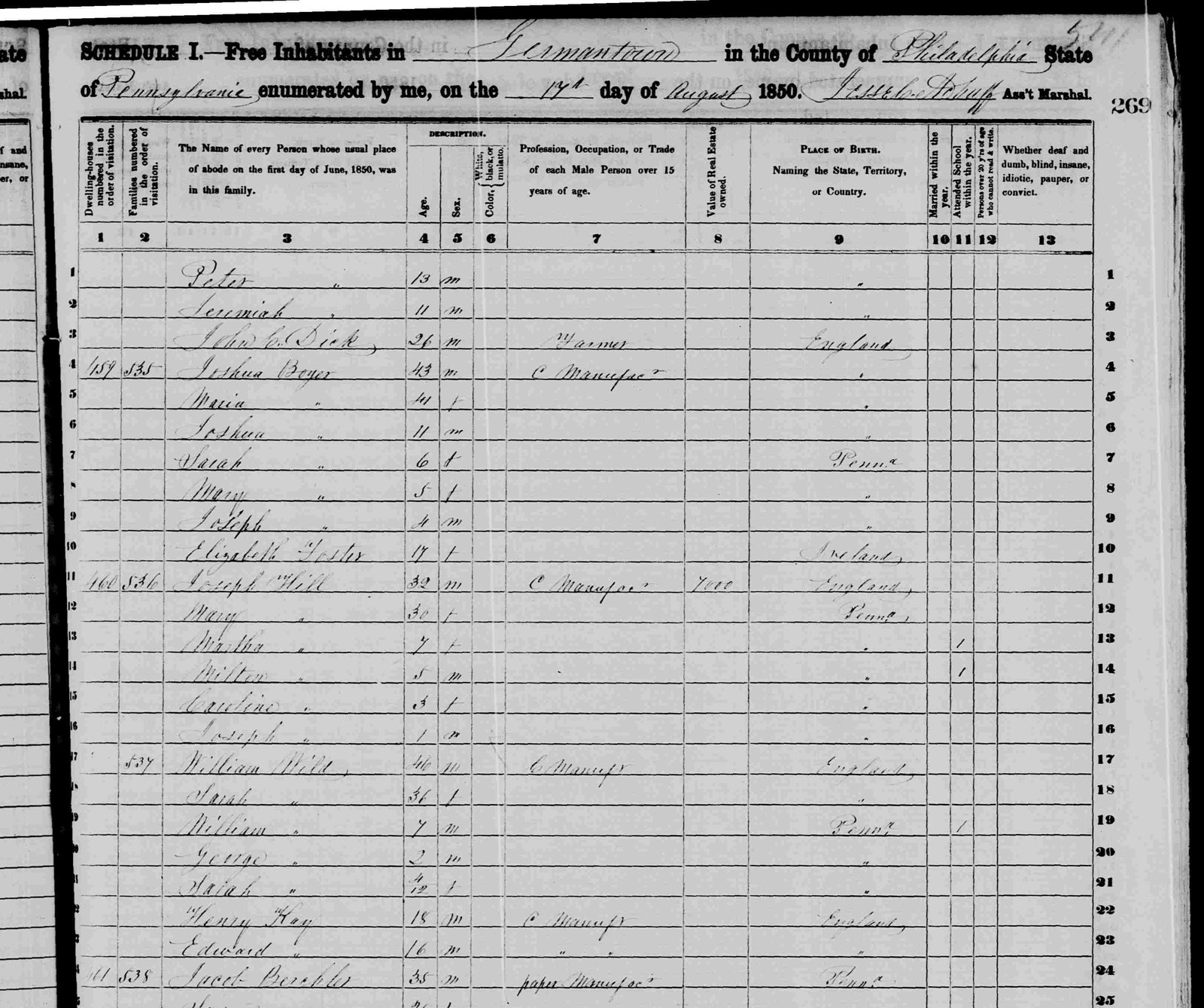
The 1850 census, the first that finds him, shows a Germantown Township household headed by Joseph Hill, 32, a cotton manufacturer — the census writes it "C Manufact" — with real estate worth $7,000. His wife was Mary, 30, born in Pennsylvania. Their children on that page are Martha, 7; Milton, 5; Caroline, 3; and Joseph, 1. More children came. The 1860 census lists Joseph, Oliver, Laura, and a baby Mary beside Martha and Milton, and by 1870 the household held eight children in all. Caroline, the three-year-old of 1850, is not in the 1860 household, and no record read says why.
The same 1850 page holds the entry's most suggestive find. The census gives Joseph's household one dwelling number and then lists, in the same dwelling, a second family: William Wild, 46, born in England, also a cotton manufacturer; his wife Sarah; their three small children; and two young men, Henry Kay, 18, a cotton manufacturer born in England, and Edward Kay, 16. The next dwelling on the page is Jacob Bechtel, a paper manufacturer.
William Wild matters because five years later, the 1855 map of the county by R. P. Barnes names the Hills' seat "Hill & Wild's Factory," on Cresheim Creek above Allen's Lane, and because in the same years the deed index shows a W. Wild conveying land to Joseph Hill. An English cotton manufacturer named William Wild, living under Joseph Hill's roof in 1850, fits the partner's place exactly. No record read calls them partners, though, or says the two men were in business together. The fit is strong. It is not proof. William Wild has not been found again in the records read for this entry. No census, directory, or probate entry in the Germantown and 22nd Ward records of 1850 to 1885 belongs to him. The deed from W. Wild to Joseph Hill is the one paper that might have spoken to their arrangement. The deed book that holds it was never filmed, like the books that hold the Patterson deeds below, so the deed stands in the index and nowhere else — its date, its parties, and nothing of its contents.
The working years
The city directories take Joseph Hill up in 1859: "Hill Joseph, manuf. Cresheim (C Hill)," a manufacturer on the Cresheim. In 1860 the same directory calls him "carpets," on Cresheim Creek near Mount Airy. In 1863 it lists him twice in two lines, once as a manufacturer on Cresheim Lane and once as a manufacturer on the Wissahickon — one man entered twice, or two men of the same name. The book does not say. The tax census of 1863, the Septennial, carries him in the 22nd Ward in three words: "Hill — Jos — Manuf."
The 1862 atlas, Smedley's survey of the county, prints "Hill's Carpet Factory" on Cresheim Creek below Paper Mill Lane — and, separately, a "Cresheim Cotton Factory" at Paper Mill Lane, without saying whose it was. Joseph Carr's cotton factory stood at the upper seat. Barnes's index puts Hill & Wild above Allen's Lane. The 1868–69 directory puts Joseph at "Cresheim creek n Allen's la." Four directory years after that put him at "Cresheim creek n Cresheim rd." The map drawings that might settle the seat have not been read, only their index entries. Allen's Lane, Paper Mill Lane, and Cresheim Road all stand in the records, and the mill stood near the meeting of those lanes, on the creek.
The goods conflict can be laid out the same way, record by record. For carpet: the 1860 directory ("carpets"), the 1862 atlas ("Hill's Carpet Factory"), five straight years of directories from 1869 to 1873 ("carpets," at the creek seat), and the 1870 census, which calls Joseph a carpet manufacturer and Milton one too. For cotton: the 1850 census ("C Manufact"), the 1868–69 directory ("cotton mfr," with Joseph listed among the city's cotton and woollen goods manufacturers) — the one directory year that breaks the carpet run, in a year whose own carpet list carries no Hill — and Hotchkin's Milton, spinning cotton in the new mill. For wool: Hotchkin alone, with Joseph spinning wool in the old mill. A mill that changed its goods over twenty years would explain the whole sequence, and the dates even fall in a tempting order. No record says the mill changed its goods.
One more name stands in the 1868–69 directory at the seat: "Hill Joseph E., overseer, h Cresheim creek, Allen's la." An overseer named Joseph E. Hill, living at the mill. Who he was, no record read says. He was not the school-teacher Joseph E. Hill whose 1892 will names a mother Louisa and a brother Andrew F. Hill and says nothing of Cresheim, a mill, or this family. That man was born about 1855, so he was about thirteen in 1868. The overseer stays as he stands in the directory: a name at the seat, unplaced.
Patterson's flour mill, and Colonel Kester
Hotchkin adds a second purchase. Joseph Hill, he says, bought Patterson's flour mill, just above his own mill, "for his work" — and the flour mill's next owner after Joseph was a man Hotchkin names only as "Colonal Kester."
The deed index bears the purchase out in shape. In the late 1850s Joseph Hill took two deeds from Pattersons — one from a D. Patterson, one from an R. Patterson. Those are the right names, the right years, and the right man taking title. The deed books that hold those two deeds were never filmed for the national archive that carries the rest of the county's deed records. The filmed run jumps over both volumes. So the deeds themselves have not been read, and what land they carried, at what price, with what mill or water rights, is not known. The purchase rests on the deed index and Hotchkin's account together.
Kester is thinner still. He has a title and a surname, and nothing else that any record read gives him. He is not in the city directories of 1840 to 1874 under any spelling tried — Kester, Kister, Kaster, Koester, Keester. He is not in the 1840 census index for Germantown, nor in the 1860 census index for the 22nd Ward, though the city held Kesters enough that year in other wards. He is not in the Philadelphia probate indexes of 1850 to 1885. He is not in the 1860 manufactures schedule for the ward's first division, the one part of it that could be read page by page. The record classes read for this entry have been searched for him. The grantor deed indexes, military records, the censuses of 1850 and 1870 outside Germantown, and the Germantown Telegraph have not. The flour men who do crowd these records are named Kern, not Kester. Kester stands here as Hotchkin printed him: a colonel named Kester who held a flour mill above the Hills' seat for a time, and no more than that.
The manufactures schedules deserve their own word, because they are the records that would have priced the mill: its capital, its hands, its yearly product. For 1850, the Germantown Township pages of the schedule were read in full, and no Hill mill is on them. For 1860, the pages for the first division of the 22nd Ward were read in full, and no Hill mill is on them either — though a firm called Hill & Fisher appears there, and it is not this firm. A second division of the ward, if the schedule kept one, was not found. For 1870, the ward's pages could not be picked out of the schedule rolls, and the one roll that holds Philadelphia by itself is closed to online reading. For 1880, the ward's district was not identified. So the schedules give two clean negatives, for 1850 and 1860, and no figures at all.
The end of Joseph's run
The directories tell the end plainly. In 1874 Joseph's line changes: no occupation, no carpets, no creek address — only a house, "h Green n Cresheim la, Mt Airy," a home on Green Lane in Mount Airy. The 1875 directory repeats the house line, and Milton appears in it too, at the same house, with no occupation given. After 1875, neither man is in the directories again.
Joseph Hill died on May 14, 1875. His death return, in the city's Board of Health registers, gives him at 56, white, married, a manufacturer, born in England, living at "Green Near Allens Lane" in the 22nd Ward — the Green Lane house of the last directory lines. The cause of death is written "Inflam. of Stomach." The physician was J. C. Gibson of Chestnut Hill. He was buried on May 17, 1875, at Ivy Hill Cemetery, and the undertaker was Kirk & Nice of Germantown. No will of his was found in the probate indexes searched, and no administration either. The indexes were read for the years around his death and his name is not in them. Parts of those indexes and the estate files themselves remain unread, so this says only that no estate paper was indexed in the spans read.
Milton was 28 or 29 when his father died. The mill's story after 1875 is told below. Milton's own is longer, and the records follow him for forty more years.
Milton's long afterlife
In the 1880 census Milton F. Hill is 32, single, living in his widowed mother's house at 5785 Main Street in Germantown, and working — "Manf. of Cotton Yarn," a manufacturer of cotton yarn, his father's England noted beside him. His brothers and sisters fill the house: Mattie, Oliver, Laura, Russell, Mary, and Frank. In June 1882, the deed index shows a Milton Hill taking a deed from a James Allen — the same year Henry Howard Houston bought the Bechtel tract — but what land that deed carried has not been read, and it is not tied here to the mill.
The censuses find him twice more, both times in other people's words and spellings. In 1900 he heads a house at 140 Upsal Street — the index calls him "Milton G" — a broker, single, born in December 1846 by that census, with his brother Oliver, his sister Mattie, another sister, and two servants. In 1910 the index calls him "Nullen," a brother in his sister Marion's household on Upsal Street, a salesman, his industry given as cotton goods.
Milton F. Hill died on March 28, 1916, at 140 West Upsal Street, aged 70. His death certificate gives his birth as December 17, 1845. The 1900 census said December 1846, and the two stand together, unchosen. He never married. His father is named on the certificate as Joseph Hill, born in England; his mother as Mary, born in Pennsylvania, her maiden name written in a hand read as Denfer, or perhaps Danfer. The modern index reads it as Singer, which the writing does not support, and the doubt stands with the name. The cause of death was endocarditis, an inflammation of the heart's lining, with sciatica of three years standing as a contributing cause. The undertaker was Kirk & Nice of Germantown Avenue — the same firm that had buried his father forty-one years before. His certificate says he was to be cremated, to Ivy Hill Cemetery. His obituary, if the papers carried one, has not been read.
The mill after the Hills
A later account of Chestnut Hill gives "Hill's Mill" as "a cotton factory from c. 1850 to 1879," standing beneath the McCallum Street bridge — the bridge that crosses the Cresheim near its mouth, over the Hills' seat. The court that heard the Bechtel land case in 1929 put the end of milling at the creek-mouth seat at forty or fifty years before, which is to say about 1879 to 1889, with the Hills and those who followed them as its working tenants. Hotchkin, in 1889, found the new mill Joseph built standing unoccupied, in Houston's hands. Between them the records let the seat work on a few years past Joseph's death in 1875 — under Milton, or under hands the records do not name — and then go quiet. No closing, sale, fire, or demolition of the Hills' mill appears in any record read. The newspapers that survive in searchable form carry no word of the family at the mill at all: no letting, no sale notice, no accident, no estate sale. The Germantown paper that would most likely have carried such news, the Germantown Telegraph, survives on microfilm and has not been read. That is the largest gap left in this entry.
The records prove the family's work on Cresheim Creek across twenty-five years. They do not prove what the mill made in any given year, or exactly where along the lanes it stood, or who the colonel was who took the flour mill above it.
Timeline
| Year | Event | Source |
|---|---|---|
| About 1817–1821 | Joseph Hill is born in England (the records spread his birth across those years, and none is chosen) | Censuses of 1850–1870; death return |
| December 17, 1845 | Milton F. Hill is born in Pennsylvania (the 1900 census gives December 1846) | Milton's death certificate; census of 1900 |
| 1850 | The census finds Joseph a cotton manufacturer in Germantown Township, William Wild's family in the same house, and Jacob Bechtel next door | U.S. census, 1850 |
| 1854–1872 | Joseph takes eleven deeds in Germantown, among them deeds from a W. Wild and from two men named Patterson | Philadelphia deed indexes |
| 1855 | Barnes's county map names the seat "Hill & Wild's Factory," on Cresheim Creek above Allen's Lane | Barnes map index |
| 1859 | The city directory lists Joseph as a manufacturer on Cresheim Creek — his first directory line | McElroy's directory, 1859, p. 320 |
| 1862 | Smedley's atlas prints "Hill's Carpet Factory," on Cresheim Creek below Paper Mill Lane | Smedley atlas, Section 20, index |
| 1863 | The Septennial tax census lists "Hill — Jos — Manuf." in the 22nd Ward | Septennial census, 1863 |
| 1868–69 | The directory calls Joseph a cotton manufacturer at the seat; Milton F. Hill appears as a clerk living at the seat, and a Joseph E. Hill as its overseer | Gopsill's directory, 1868–69 |
| 1869–1873 | The directories list Joseph as "carpets" at the creek seat, five years running | Gopsill's directories, 1869–1873 |
| 1870 | The census calls Joseph and Milton carpet manufacturers | U.S. census, 1870 |
| May 14, 1875 | Joseph Hill dies at his Green Lane house, of inflammation of the stomach; he is buried at Ivy Hill on May 17 | Philadelphia death return |
| 1880 | Milton is a manufacturer of cotton yarn, living at 5785 Main Street, Germantown, in his widowed mother's house | U.S. census, 1880 |
| June 2, 1882 | Milton takes a deed from a James Allen — the year H. H. Houston buys the Bechtel tract | Philadelphia deed index |
| March 28, 1916 | Milton F. Hill dies at 140 West Upsal Street; his certificate directs cremation, to Ivy Hill Cemetery | Pennsylvania death certificate |